
Earlier this year I published the PEER technique for brainstorming interviewees: “four categories to help journalists generate more names on any given story — and think more creatively about whose voices might add something to that story.”
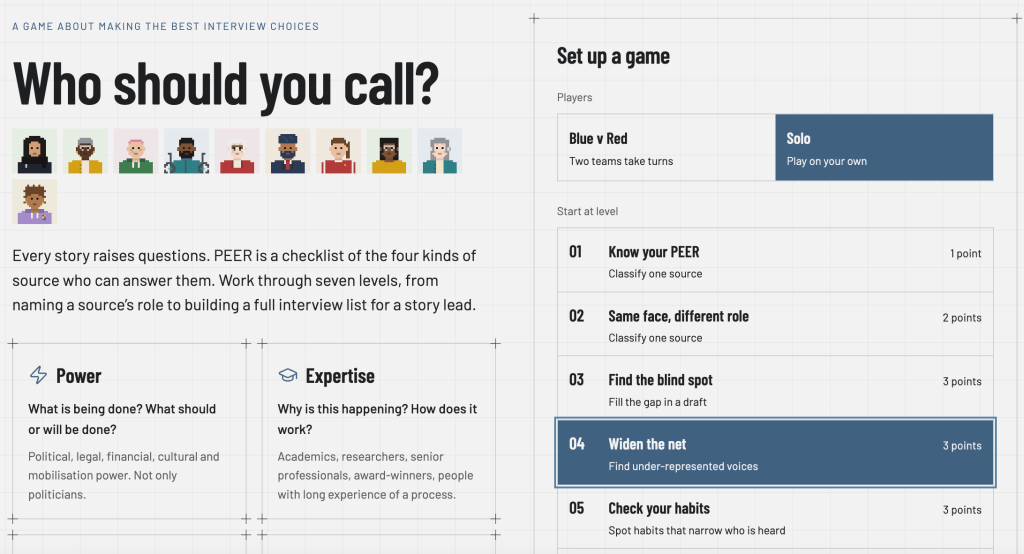
Now I’ve built a game to put that technique into practice — and improve your sourcing.
It’s much more fun.
Who should you call? has seven levels that move from identifying the type of source, to identifying who is missing from a story, to finding under-represented voices and picking a full interview list.
Teams mode for class activities and training
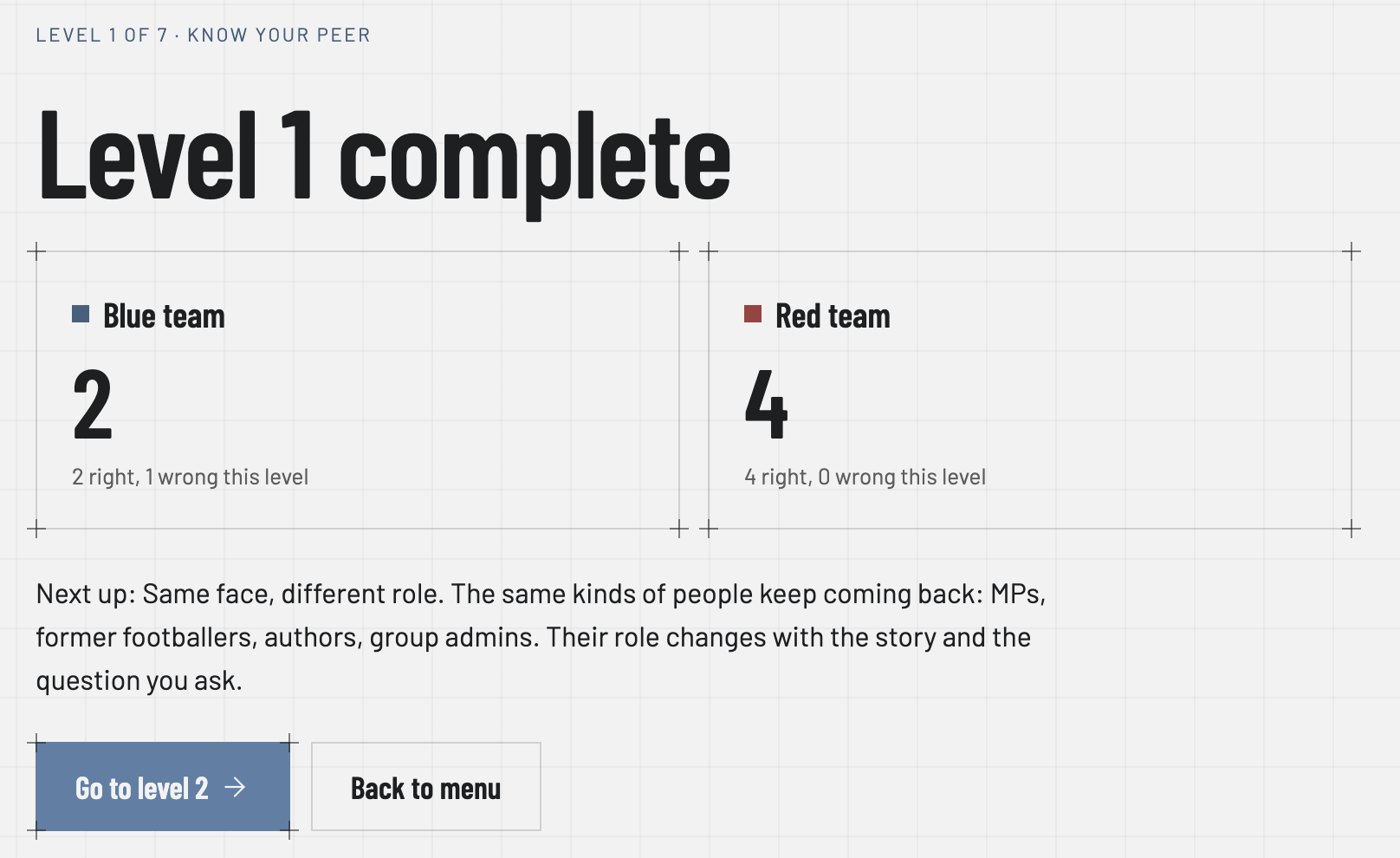
I included a ‘Blue vs Red’ teams mode for using the game in a class or training session. This allows you to introduce a competitive element by splitting a class into two teams. The lecturer can host a whole-class game on a big screen or let students play it themselves in smaller teams.
Play switches from one team to another when a team gets a question wrong. But play also switches if a team gets three answers correct in a row, to avoid the other team getting bored.
The game keeps track of each team’s scores and gives a running total at the end of each round.
The Solo version of the game allows students to play it on their own. This could be done in class — comparing scores and decisions at the end — or as an independent task or resource.
However you use it, students can continue to play the game and move through different levels outside of class.
Skip to the level you want to explore
The seven levels of the game don’t have to be played in order. If you want to focus on diversity, for example, you can select Level 4: Widen the net (“Find under-represented voices”) or Level 5: Check your habits (“Spot habits that narrow who is heard”) and click Start game under the list of levels.
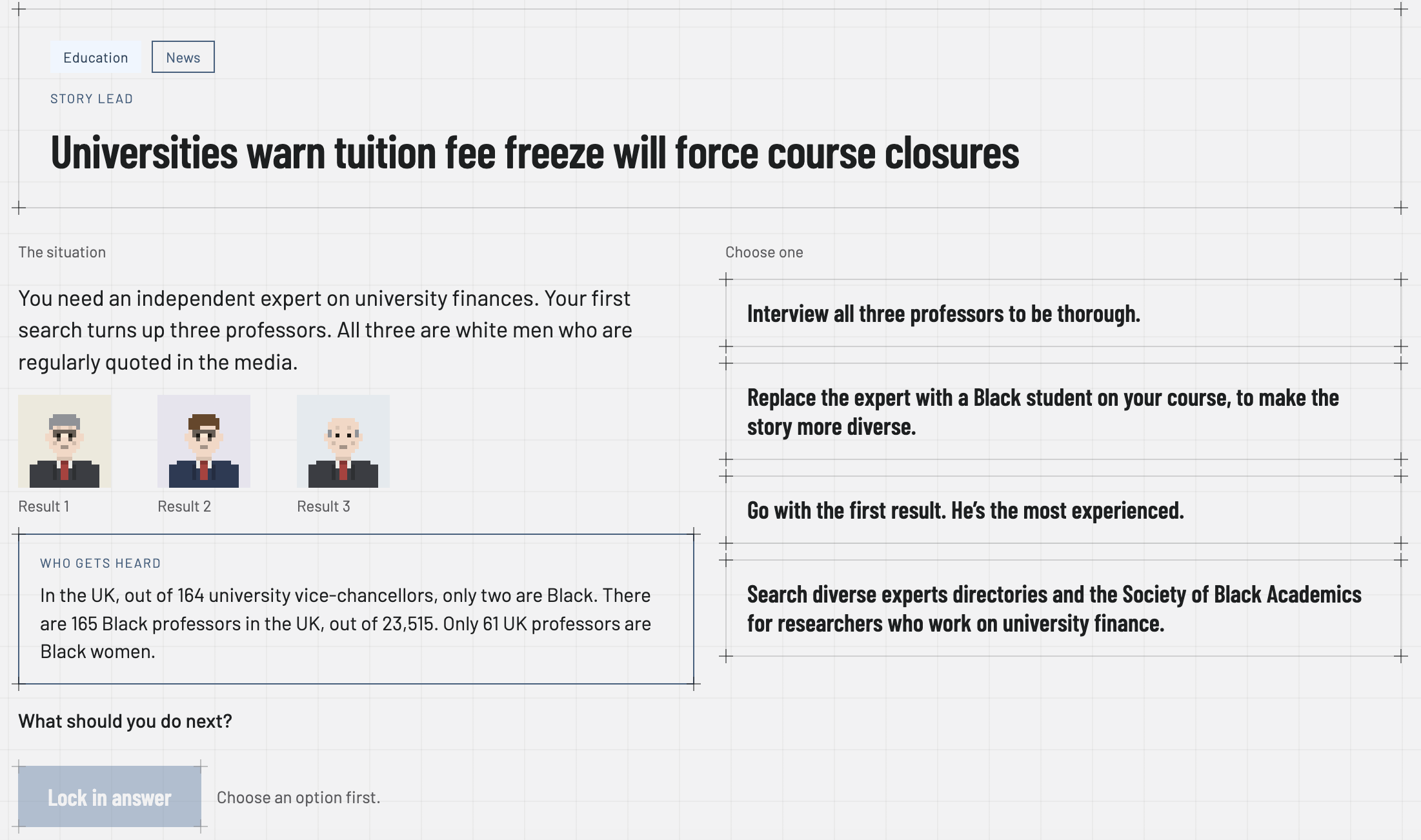
If you want to develop editing skills around identifying what voices are missing from a story, click on Level 3: Find the blind spot.
If you want to go straight to building a list of interviewees for a series of story scenarios you can play Level 7: Build the interview list.
At the end of each level you get a score, so you can choose to stop there or continue on to the next level.
Yes, of course it was vibe-coded
I didn’t write a line of code for this game. I generated the code using Claude’s Artifacts tool: my only coding contribution was to edit a link to a style sheet which broke when I hosted the game on GitHub.
I’ll write separately about how I approached the process and what I learned, but if you want to see the prompts and documents used to create the game I have published a transcript in a GitHub repo here.
The bulk of the work for the game was from the posts Here’s a framework to help fill the ‘human gap’ in your story and PEER: a technique for brainstorming interviewees and story sources. These were included in the initial prompt as the basis for the game (basically I was reversioning the posts as a game).
During the design process I also added some secondary research into diversity and sourcing I have collected over the years.
It’s not the only game I’ve vibe-coded for teaching. I have previously created much simpler Family Fortunes-style games to inject some interaction into some introductory classes covering news values and challenges facing the industry. One game invited students to guess the results of a survey of industry leaders; the other to remember the most common news values in a piece of research they were given to read. But with this game I took things up a notch to incorporate levels, visuals, wider research and more detailed iteration.
Try it and let me know how it works
Have a play with the game (here’s the Claude-hosted version) and let me know in the comments below or on LinkedIn whether you find it useful — or if there’s anything that could be improved or added.
I’ll keep updating the game in response to feedback and add details of changes to the bottom of this post.

