Author Archives: Paul Bradshaw

The 3 forces changing journalism education part 3: the relationship between education and industry

In the first part of this series, I talked about how changes in the news industry were reflected in changing journalism education. In the second I looked at how education itself is reacting to changes in information. The third change is a result of the first two:

Part 3: The relationship between the news industry and education is changing

In the UK the relationship between journalism schools and news organisations has largely been a supply chain of newsroom-ready graduates. As universities and training bodies like the NCTJ, BJTC, PTC and Skillset expanded, news organisations scaled back on their own training budgets.

But the changes in the industry outlined above threw a spanner into that supply chain, in two key ways.

Firstly, the chain was based on an assumption that the news industry – and specifically senior figures within it – was best placed to know what skills it was going to need in the future – but it quickly became apparent that they didn’t.

Accreditation documents that barely mentioned online skills – or that reduced it to web design or broadcast-style video – didn’t help.

Cultural battles that dragged on for years – over the validity of blogging, citizen journalism, SEO, and innumerable other innovations – didn’t help.

And the fact that the industry itself didn’t appear to have the skills to solve its problems – or know what skills would – didn’t help.

Universities faced an uncomfortable truth. It was increasingly clear that to serve their students properly they needed to teach skillsets that were in demand in the growing online media industries. But those industries were not the ones formally shaping their curricula – nor the ones that students even knew existed when they applied for the course.

Should they continue to teach the courses that sold – knowing that there was a good chance that graduates would be less employable in a few years’ time?

Supplier of cheap labour – or incubator?

Alongside the issue of curricula was another development. Student work experience, when scaled up to the numbers at which journalism courses were now operating, had become a significant part of the way the media industry worked.

As the workforce thinned there was the potential for that contribution to reduce the number of jobs available to graduates of the same courses.

In other words, while work experience may be useful for the individual student, it would also reduce the opportunities open to the same student in the jobs market.

The whole concept of work experience was also based on the same supply chain logic. It wasn’t designed to adapt to a situation where graduates were ‘expected to teach the news industry’ (which isn’t to imply that the exchange is only in that direction either).

It was designed largely on the basis that students would either perform an existing role while the occupant was on leave, or fill the gaps in another role – either of which may be redundant in a year.

Was this the best way to serve both journalism students and the news industry? Again, it may have been when the numbers were lower and the industry better defined.

But could that student workforce be used in a way that would better benefit both the student and the news industry?

What benefits both student and industry most?

In my own course I tackled this by designing the ‘work experience’ element as a consultancy, tackling a specific problem for a client (media organisation, or other organisation with a media element) through the research and practical skills that a student develops in higher education.

This helps the organisation explore possible new streams of revenue or content which could help create new jobs.

It helps the student develop unique knowledge and skills that can help them stand apart from others, in partnership with experienced journalists and publishers who can provide valuable insights too.

This process could be scaled up to see groups of students exploring industry problems.

There are other possibilities. At UCLAN Francois Nel has been developing the MADE project to help develop media and digital enterprise. At the Oxford Institute they are working on a range of industry problems (although it’s not clear how involved journalism students are). At Birmingham City University the university provides facilities to students launching their own enterprise. At City University London and at CUNY students pitch entrepreneurial ideas to potential investors.

Could universities – with their access to funding, infrastructure and business networks – do a lot more in this regard? Might it be one of the new areas where they can claim a gatekeeping role (although Kickstarter and other fundraising platforms still offer alternatives)?

In the final part of this series I will try to list some of the ways that journalism training is trying to change – can you add any?

The 3 forces changing journalism education part 2: the education business

Yesterday, in the first part of this series, I talked about how changes in the news industry were reflected in changing journalism education. In this second part I want to look at an area which is discussed much less: how education itself is reacting to changes in information – and how educators, like journalists, are no longer gatekeepers any more.

Data, information, knowledge, wisdom - pyramid

Part 2: Education and the information environment

The internet did not play any role in my time as an undergraduate. That meant that lecturers performed a ‘gatekeeping’ role very similar to journalists: acting as the main source of feedback on work, and the people who determined what books and journals were stocked by the library.

Information on the journalist’s craft was limited to a few mass market books; a couple dozen textbooks equally limited by their potential markets; what students picked up on their own work experience; and their tutors.

Just like journalism, the information environment in which education takes place has changed utterly.

Students can read a hundred blogs by journalists in an enormous variety of roles and industries that would never catch the eye of a book editor. They can contact journalists much more easily – and read the results of other students’ contacts with journalists.

They can gain feedback on their work not only from general news reporters, but specialist correspondents, from experts in the field they are covering, community members, and anyone else with an opinion.

They don’t need to book out a camera or visit a darkroom (as it was then) to take photographs; a camcorder to film; a marantz to record audio; a studio to broadcast.

As educators we are no longer the gatekeepers to information, the gatekeepers to people in the industry, or gatekeepers to the means of production and distribution. We can provide all of these things and make all the arguments we want about the quality of that access – but, like the news industry as a whole, are no longer the only ones.

The only thing we are gatekeepers to, in fact, is accreditation of individuals’ learning.

And yet journalism education – and training too – is still framed within that gatekeeper’s offering.

More importantly, many journalism students come into higher education with the same expectation, instilled during earlier schooling: that education consists largely of having gates opened for you by experts, and clearing the hurdles to walk on through.

From gatekeepers to gatewatchers

When higher education – and information – was limited to a small part of society, that may have been a valid expectation. But as first higher education access was widened, and then information access, this has become unsustainable.

We are operating in an information-rich environment. And so, like the news industry, we need to reformulate what role we play in that: moving from gatekeeping and transmission models to one involving aggregating and curating, challenging and verifying, and providing platforms for connection and investigation.

Like the news industry, our role becomes less that of transmitting information and more one of saving time, improving accuracy and guaranteeing quality. What Axel Bruns called gatewatching.

The first step in that process involves debunking the transmission myth that students arrive with. There’s a reason why I’ve used ‘information’ throughout above, because ‘knowledge’ and ‘understanding’ are things that higher education can act as a gatekeeper to – if you have good educators. But they are also things that the student has to play an active role in. It is not just a transmission; it is an exchange.

Multiple platforms

There’s a further change emerging that also mirrors developments in the news industry: just as journalists are having to operate across multiple platforms where once they only needed one, so educators are having to operate beyond chalk and talk and the classroom as a platform for learning.

If I look back at how my own teaching has changed over a decade I see this playing out year by year: email has become more widely used, of course, and universities have formally added VLEs (virtual learning environments) like Moodle and Blackboard. But over the years I have also started ‘delivering’ learning across an increasing number of informal platforms: student blogs; team content management systems; my own blogs; wikis; Facebook groups and pages; podcasts; and, of course, Twitter – which works particularly well as a classroom feedback system (where appropriate) as well as a way of coordinating students out in the field.

When I started running a course through distance learning it was like dropping a print edition: the week-by-week rhythm that traditional teaching (and room booking) dictates was not necessary. Structure was still needed – but it was particularly liberating to be able to advise different students to study different areas in different orders, based on the projects they were working on. It was particularly interesting to hear Howard Finberg, at the EJC anniversary, refer to research that suggested such a hybrid approach “works”.

In fact, the experience has informed my room-based teaching too: now I use each platform for what it’s best suited for – including classrooms (which are best for practice and questions, not transmission).

In the next post I tackle a final change resulting from the changes in both industries: the relationship between industry and academia. Comments welcome on how these changes are playing out where you are.

The 3 forces changing journalism education – and why we’re ignoring 2 of them (part 1)

On Monday I spoke about the future of journalism education at the EJC’s 20th anniversary event. It strikes me that while most of the discussion around journalism education centres on changes in the ‘news industry’, there are other significant forces which are too often overlooked.

In a series of posts this week I want to try to map out three areas where journalism education is facing changes and how they’re being tackled – or, in most cases, not.

Continue reading

Now available by distance learning: my MA in Online Journalism

The MA in Online Journalism which I established at Birmingham City University in 2009 is now available via distance learning.

The MA in Online Journalism by distance learning is primarily aimed at people who are already working in a content- or technology-related role.

Students can use their current work as part of their studies, or use their studies to explore ideas and skills that they have been unable to explore as part of their role.

The course requires self-discipline and motivation, and I look for evidence of that in the application process. You will be communicating regularly both with myself and other students on both the distance learning and ‘with attendance’ versions of the course, so there will be plenty of support, but like any Masters level course you will be expected to learn independently with guidance to develop your own areas of expertise.

I’ve actually been teaching the distance learning version of the course since last September, but hadn’t publicised the fact (I wanted to ‘soft-launch’ the first year with a small group first, and use agile principles to continue to develop it).

But now the secret’s out: The Guardian reported on the course last month, and student Robyn Bateman has written about her experience of studying via distance learning in Wannabe Hacks this week.

I’ll be blogging further about how the distance learning course has changed how I teach the MA as a whole, and changes in education more generally, but that’s for another post. In the meantime, I’m particularly welcoming applications from individuals with good experience as a working journalist, or as a web developer, or who are running or considering launching their own journalism enterprise.

Online journalism jobs – from the changing subeditor to the growth of data roles

The Guardian’s Open Door column today describes the changes to the subeditor’s role in a multiplatform age in some detail:

“A subeditor preparing an article for our website will, among other things, be expected to write headlines that are optimised for search engines so the article can be easily seen online, add keywords to make sure it appears in the right places on the website, create packages to direct readers to related articles, embed links, attach pictures, add videos and think about how the article will look when it is accessed on mobile phones and other digital platforms. Continue reading

F1 Championship Points as a d3.js Powered Sankey Diagram

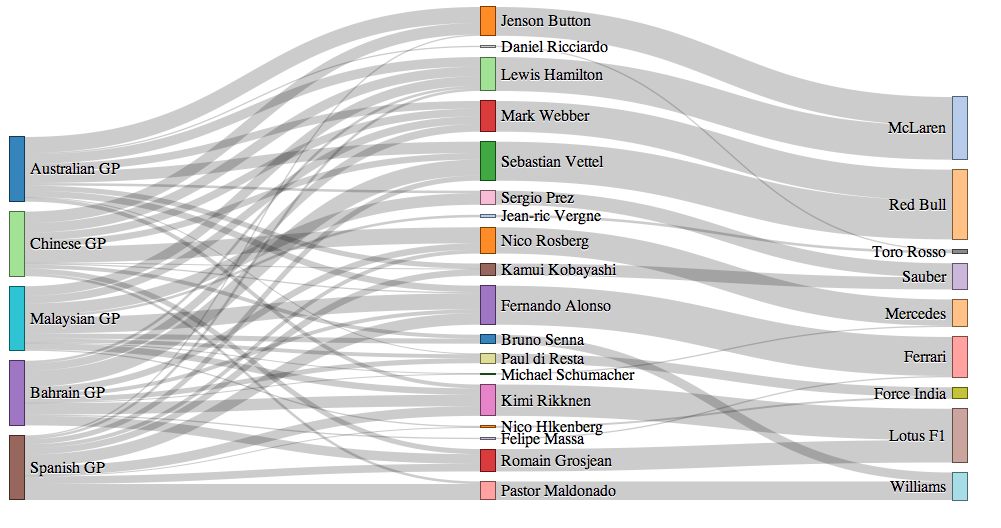
d3.js crossed my path a couple of times yesterday: firstly, in the form of an enquiry about whether I’d be interested in writing a book on d3.js (I’m not sure I’m qualified: as I responded, I’m more of a script kiddie who sees things I can reuse, rather than have any understanding at all about how d3.js does what it does…); secondly, via a link to d3.js creator Mike Bostock’s new demo of Sankey diagrams built using d3.js:

Hmm… Sankey diagrams are good for visualising flow, so to get to grips myself with seeing if I could plug-and-play with the component, I needed an appropriate data set. F1 related data is usually my first thought as far as testbed data goes (no confidences to break, the STEM/innovation outreach/tech transfer context, etc etc) so what things flow in F1? What quantities are conserved whilst being passed between different classes of entity? How about points… points are awarded on a per race basis to drivers who are members of teams. It’s also a championship sport, run over several races. The individual Driver Championship is a competition between drivers to accumulate the most points over the course of the season, and the Constructor Chanmpionship is a battle between teams. Which suggests to me that a Sankey plot of points from races to drivers and then constructors might work?

So what do we need to do? First up, look at the source code for the demo using View Source. Here’s the relevant bit:

Data is being pulled in from a relatively addressed file, energy.json. Let’s see what it looks like:

Okay – a node list and an edge list. From previous experience, I know that there is a d3.js JSON exporter built into the Python networkx library, so maybe we can generate the data file from a network representation of the data in networkx?

Here we are: node_link_data(G) “[r]eturn data in node-link format that is suitable for JSON serialization and use in Javascript documents.”

Next step – getting the data. I’ve already done a demo of visualising F1 championship points sourced from the Ergast motor racing API as a treemap (but not blogged it? Hmmm…. must fix that) that draws on a JSON data feed constructed from data extracted from the Ergast API so I can clone that code and use it as the basis for constructing a directed graph that represents points allocations: race nodes are linked to driver nodes with edges weighted by points scored in that race, and driver nodes are connected to teams by edges weighted according to the total number of points the driver has earned so far. (Hmm, that gives me an idea for a better way of coding the weight for that edge…)

I don’t have time to blog the how to of the code right now – train and boat to catch – but will do so later. If you want to look at the code, it’s here: Ergast Championship nodelist. And here’s the result – F1 Chanpionship 2012 Points as a Sankey Diagram:

See what I mean about being a cut and paste script kiddie?!;-)

Inter-Council Payments and the Google Fusion Tables Network Graph

One of the great things about aggregating local spending data from different councils in the same place – such as on OpenlyLocal – is that you can start to explore structural relations in the way different public bodies of a similar type spend money with each other.

On the local spend with corporates scraper on Scraperwiki, which I set up to scrape how different councils spent money with particular suppliers, I realised I could also use the scraper to search for how councils spent money with other councils, by searching for suppliers containing phrases such as “district council” or “town council”. (We could also generate views to to see how councils wre spending money with different police authorities, for example.)

(The OpenlyLocal API doesn’t seem to work with the search, so I scraped the search results HTML pages instead. Results are paged, with 30 results per page, and what seems like a maximum of 1500 (50 pages) of results possible.)

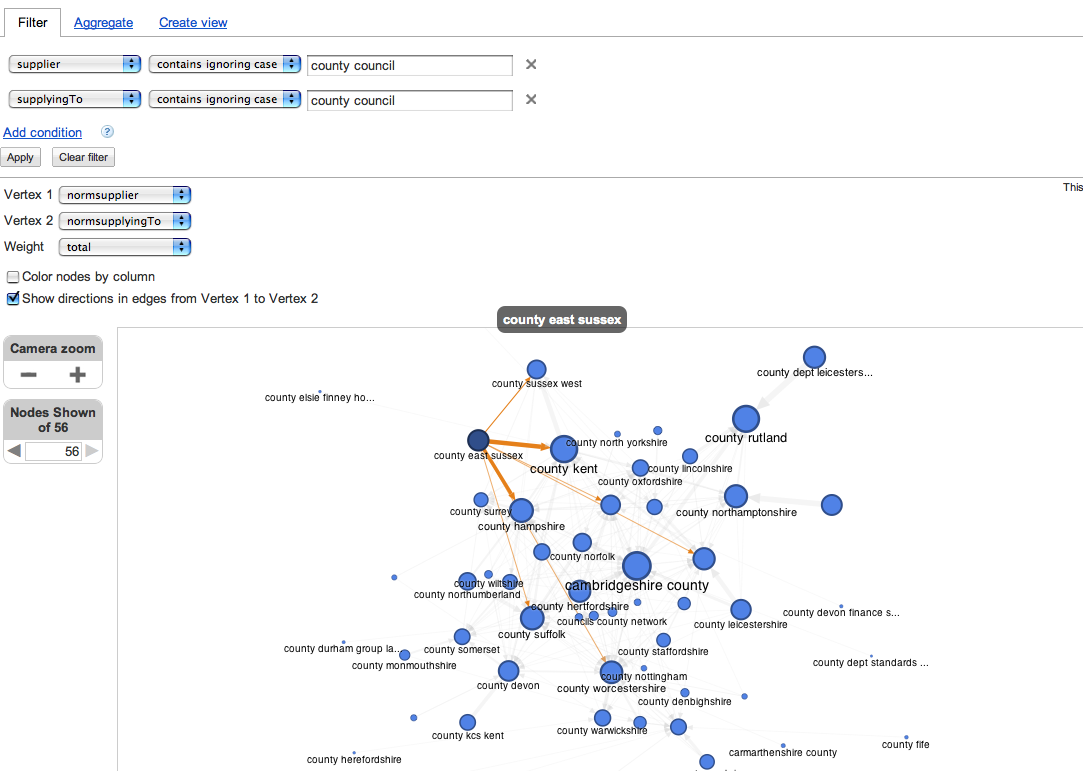
The publicmesh table on the scraper captures spend going to a range of councils (not parish councils) from other councils. I also uploaded the data to Google Fusion tables (public mesh spending data), and then started to explore it using the new network graph view (via the Experiment menu). So for example, we can get a quick view over how the various county councils make payments to each other:

Hovering over a node highlights the other nodes its connected to (though it would be good if the text labels from the connected nodes were highlighted and labels for unconnected nodes were greyed out?)

(I think a Graphviz visualisation would actually be better, eg using Canviz, because it can clearly show edges from A to B as well as B to A…)

As with many exploratory visualisations, this view helps us identify some more specific questions we might want to ask of the data, rather than presenting a “finished product”.

As well as the experimental network graph view, I also noticed there’s a new Experimental View for Google Fusion Tables. As well as the normal tabular view, we also get a record view, and (where geo data is identified?) a map view:

What I’d quite like to see is a merging of map and network graph views…

One thing I noticed whilst playing with Google Fusion Tables is that getting different aggregate views is rather clunky and relies on column order in the table. So for example, here’s an aggregated view of how different county councils supply other councils:

In order to aggregate by supplied council, we need to reorder the columns (the aggregate view aggregates columns as thet appear from left to right in the table view). From the Edit column, Modify Table:

(In my browser, I then had to reload the page for the updated schema to be reflected in the view). Then we can get the count aggregation:

It would be so much easier if the aggregation view allowed you to order the columns there…

PS no time to blog this properly right now, but there are a couple of new javascript libraries that are worth mentioning in the datawrangling context.

In part coming out of the Guardian stable, Misoproject is “an open source toolkit designed to expedite the creation of high-quality interactive storytelling and data visualisation content”. The initial dataset library provides a set of routines for: loading data into the browser from a variety of sources (CSV, Google spreadsheets, JSON), including regular polling; creating and managing data tables and views of those tables within the browser, including column operations such as grouping, statistical operations (min, max, mean, moving average etc); playing nicely with a variety of client side graphics libraries (eg d3.js, Highcharts, Rickshaw and other JQuery graphics plugins).

Recline.js is a library from Max Ogden and the Open Knowledge Foundation that if its name is anything to go by is positioning itself as an alternative (or complement?) to Google Refine. To my mind though, it’s more akin to a Google Fusion Tables style user interface (“classic” version) wherever you need it, via a Javascript library. The data explorer allows you to import and preview CSV, Excel, Google Spreadsheet and ElasticSearch data from a URL, as well as via file upload (so for example, you can try it with the public spend mesh data CSV from Scraperwiki). Data can be sorted, filtered and viewed by facet, and there’s a set of integrated graphical tools for previewing and displaying data too. Refine.js views can also be shared and embedded, which makes this an ideal tool for data publishers to embed in their sites as a way of facilitating engagement with data on-site, as I expect we’ll see on the Data Hub before too long.

More reviews of these two libraries later…

PPS These are also worth a look in respect of generating visualisations based on data stored in Google spreadsheets: DataWrapper and Freedive (like my old Guardian Datastore explorer, but done properly… Wizard led UI that helps you create your own searchable and embeddable database view direct from a Google Spreadsheet).

Journalism Reloaded – What journalists need for the future

In a guest post Alexandra StarkSwiss journalist and Head of Studies at MAZ – the Swiss School of Journalismargues that it’s time for journalists to take action on business models for supporting journalism. Stark proposes a broadened set of skills and a new structure to enable greater involvement from journalists, while also fostering further teaching of such skills.

Ask a journalist if his or her job will remain important in the future: “Of course,” he or she will answer while privately thinking, “What a stupid question!” Try changing this stupid question just a bit, asking: “How will it be possible that you’ll still be able to do a good job in the future?” It’s likely you won’t receive an answer at all. Continue reading

German social TV project “Rundshow”: merging internet and television

In a guest post for OJB, cross-posted from her blog, Franzi Baehrle reviews a new German TV show which operates across broadcast, web and mobile.

There’s a big experiment going on in German television. And I have to admit that I was slightly surprised that the rather conservative “Bayerischer Rundfunk” (BR, a public service broadcaster in Bavaria), would be the one to start it.

Blogger and journalist Richard Gutjahr was approached by BR to develop a format merging internet and TV. On Monday night the “Rundshow” was aired for the first time at 11pm German time, and will be running Mondays-Thursdays for the next four weeks. Continue reading

Dispatches’ Watching the Detectives: why journalists should be worried about the Communications Data Bill

Consider these two unrelated events:

  1. A bill is proposed to record every contact (and possibly search) made by every UK citizen, to be available to law enforcement agencies and stored by communication service providers
  2. An inquiry into press standards and a leaked Home Office report both uncover the ease with which private investigators can access personal records through law enforcement and other agencies

I’m worried about 1. because of 2. And tonight’s Dispatches: Watching the Detectives does a particularly good job of illustrating why. It is “the ease and extent to which the unregulated private investigation industry is willing to acquire personal data for a price” – not just from the police services, but the health services, benefits system, and other bodies, including commercial ones such as communications service providers (for an illustration of the data security of private companies, witness the Information Commissioner’s Office targeting them after a series of data protection breaches).

If you’re a journalist, student journalist or blogger with any interest in protecting your sources, you should be watching the Communications Data Bill closely and understanding how it affects your job.

In the meantime, it’s also worth developing some good habits to protect your stories and your sources against unwanted snooping. More on my Delicious bookmarks under ‘security’.