Author Archives: Paul Bradshaw

FAQ: Blogging inspirations, tools and trends

As part of the ongoing series of questions answered in public, here are another bunch:

1) What inspired you to become a blogger? Have you ever found it difficult to keep up regular posts/ stay dedicated to the same topic area?

As someone teaching online journalism, I felt I should be exploring the medium myself. What inspired me to continue, however, was the community I found along the way.

Yes, I sometimes find it difficult to post, but the great thing about blogging is that you have no deadlines to hit or boss to please, so if I can’t post for a while, I don’t – but as long as I have something to share, I can. Continue reading

‘Chunking’ online content? Don’t assume we start at the same point

Online multimedia production has for a few years now come with the guidance to ‘chunk’ content: instead of producing linear content, as you would for a space in a linear broadcast schedule, you split your content into specific chunks of material that each tackles a different aspect of the issue or story being covered. Interfaces like these show the idea in practice best:

Being a Black Man interactive

The concept is particularly well explained by Mindy McAdams (on text), and Andy Dickinson (on video, below): Continue reading

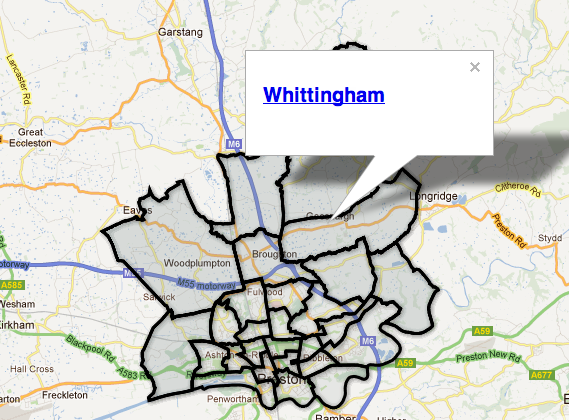
Create a council ward map with Scraperwiki

Mapping council wards

With local elections looming this is a great 20-30 minute project for any journalist wanting to create an interactive Google map of council ward boundaries.

For this you will need:

Finding images and multimedia for your news project (without breaking copyright laws)

For copyright reasons image is not available (badge)

Whether you need an image for your blog post, a soundtrack to your video or that YouTube clip for your documentary, if you’re dealing with multimedia it’s likely you’ll end up using – or wanting to use – someone else’s work as part of your own.

Here are some basic tips on finding and using multimedia across the web in a way that won’t (hopefully) land you in hot water.

The public domain myth

One of the mistakes that has repeatedly landed journalists and their employers in trouble is confusion over the term “public domain“.

Public domain has two possible meanings. In copyright terms, public domain refers to work whose copyright has expired, meaning that anyone can use it without having to ask the copyright holder. Disney – a fierce lobbyist itself for extending copyright – has used ‘public domain’ material as the basis for most of its cartoons, from the work of the Grimm Brothers to a host of other fairy tales, myths and legends.

But sometimes you will hear journalists talk about something being “in the public domain“, in other words ‘public’. For instance, when the Irish Daily Mail published photos of an air traffic controller from her website, they defended the decision on the grounds that the image was “in the public domain”.

But this is not the same.

For example, pretty much every piece of media, almost by definition, is “in the public domain”. Newspapers and magazines sit on the newsstands; television and radio reports are broadcast on huge city centre screens and speakers.

But if you take that content and reproduce it in its entirety without permission, you are breaking copyright law.

The $7,500 copyright scam

If you need any persuading about this, read this post about a copyright scam whereby images are pushed to the top of Google Images search results pages, and then bloggers sued for using them without permission.

It seems odd that media organisations so used to protecting their own, very public, content, should think that another person’s photo, or video, or report, should be fair game because it is “in the public domain”. But they do.

If you want public domain (in the sense of ‘copyright expired’) content, there are some useful sources. The Public Domain Review, for example, publishes a range of public domain work and has this guide to finding them. And Angela Grant writes here about finding public domain video, among other things (note that Angela refers to US law, not that of other countries).

But never assume something is public domain because it is “in public”.

One point to make: while an image, story, or composition may be out of copyright, its performance, re-design or re-telling may not.

Just ask Disney.

Creative Commons – making UGC copyright explicit

If you’re dealing with content that’s been published on a platform like Flickr or YouTube, you may be able to find out the copyright status of that content relatively easily.

Both allow users to easily establish copyright through the Creative Commons licence. You can either look for that licence in the relevant part of the page hosting the content.

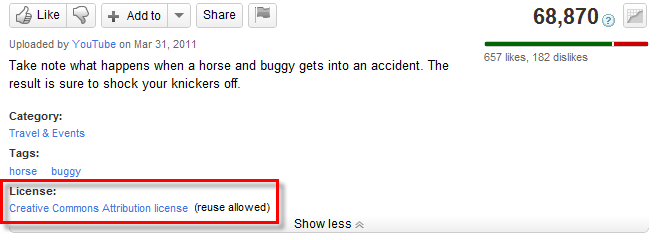
On YouTube it is under the video:

Where to find a YouTube video's licensing information - image from YouTube. Click to see original in context.

Where to find a YouTube video’s licensing information – image from YouTube.

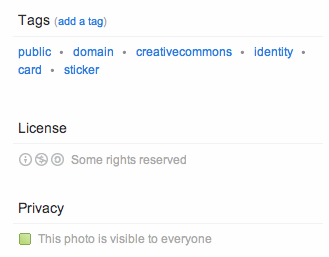
On Flickr this is on the right hand side under License:

Look for an image’s licensing information on Flickr on the right hand column. Make sure you click on that licence to find out what terms it requires.

Look for an image’s licensing information on Flickr on the right hand column.

Make sure you click on that licence to find out what terms it requires.

Creative Commons, for example, has a number of elements:

  • Whether the material can be used only in noncommercial contexts, or for commercial use as well
  • Whether the material can be adapted and changed, or must be left unchanged
  • Whether you must use the same CC licence if you use this material (e.g. you cannot use a noncommercial licence but then allow your work to be used commercially)
  • Whether you must attribute the work (this is where many people breach the licence)

If you’re unsure of where your work fits against those criteria (for example, whether it’s considered as “commercial”), then approach the copyright holder for clarity. Remember that the CC licence is only a default position, and can be negotiated. Also, if you cannot get any response and decide to publish anyway, your attempts to contact the copyright holder will be important if there are any legal proceedings.

If you want others to publish their content under a CC licence, it helps if you publish at least some of your own work under a CC licence too. Indeed, if it contains other CC material, their licences may require you to.

Flickr and YouTube aren’t the only sites that use Creative Commons licences, of course. To search for media under a CC licence (including on those sites), use the search facility on the Creative Commons site and select the engine you want to search through.

If you’re running a hyperlocal site, or any site that needs images of places, check out Geograph, which hosts Creative Commons-licensed images of locations around the UK.

There are also specialist sites for sharing music under CC, such as Freesound.

Even if the media you are interested in using does not use a CC licence, of course, you can still approach the copyright holder for permission to use it.

Attribution does not cover you for copyright

Another mistake that some people make is to believe that simply linking to the source, or naming the photographer/source, is enough to avoid copyright issues.

This is only the case if the licence for the material says so.

Copyright has two elements: moral rights, and economic rights.

The moral right is the right to be identified as the author of a piece of work. This is the attribution which is in pretty much every copyright licence, Creative Commons or otherwise.

But it’s not the right that most people sue over.

The economic right is the right to right to “allow or prevent the copying of their work or the performance of their work in public” (IPO). This translates into the ability to earn money from a piece of work. And this is what people largely sue over.

Attributing a photo only covers the moral right. It does not mean you won’t be sued.

If, then, you have used an image, video or audio without the permission of the rights holder (granted through a Creative Commons licence or directly to you through correspondence) then you are still probably breaking copyright law.

Embedding versus re-broadcasting

If the media is hosted on a platform like YouTube, you may be able to embed it on a webpage without seeking permission at all: if the creator* has enabled embedding then they would have little argument in suing for breach of copyright because:

  • By enabling embedding they have given an ‘implied’ right; and
  • They could stop you publishing it instantly by disabling embedding.
  • Also, your embedding of their media would not lead to any loss of revenue (as advertising can be embedded too), so it is unlikely that there would be any damages to sue for.

*note: this does not apply to video created by other people and uploaded by someone other than the copyright holder.

UPDATE: Interestingly on this note, in March 2014 Getty Images made it possible to embed 35 million of its images for non-commercial use:

“In essence, anyone will be able to visit Getty Images’ library of content, select an image and copy an embed HTML code to use that image on their own websites. Getty Images will serve the image in a embedded player – very much like YouTube currently does with its videos – which will include the full copyright information and a link back to the image’s dedicated licensing page on the Getty Images website.”

Reality bites

Of course, it’s one thing to talk about the strict legal position, and another to talk about what actually happens. Journalists regularly publish content that breaks the law – but make a judgement about the likelihood of ending up in court over that. For example, I can say that the Queen is corrupt (a defamatory statement) and be almost certain that the Queen is not going to sue me (because she has a history of not doing so).

Media lawyers are not just there to advise publishers on their strict legal position, but on the balance of risk involved, and how to reduce those risks. While you cannot always avoid risks, you can avoid them in simple ways:

  • Always try to establish the copyright situation regarding any media you use: who holds the copyright (there may be more than one copyright owner: for example, performer and composer), and what are the terms of the licence?
  • Try to contact the copyright holder if you’re in any doubt – even if you can’t contact them your efforts to do so will help you if you do end up in court.
  • Always attribute authorship and link to the source (this can be done in title credits, captions and/or links on the host webpage). Copyright claims normally revolve around loss of earnings: anything that may have contributed to that (i.e. not linking to the source) will likely add to damages.

Minimal cost and royalty free

‘Royalty free’ is a vague term which is often confused with, simply, ‘free’. It most often refers to media which is paid for once and can then be used multiple times in different contexts.

For example, you might pay for a CD of ‘royalty free’ music or sound effects which can be used across multiple video projects – saving you the hassle of acquiring permissions every time for different music.

Or you might buy a CD of royalty free images (clip art, for example) that you can use across various design projects.

If you’re studying in a school of media, or working in a large media organisation, they will probably have some royalty free media for students or employees to use – so ask around to find out what’s available.

But don’t use it for the sake of it: the quality can vary. In addition, many other media projects may have relied on the same libraries, so you can lose distinctiveness.

You should also be aware that the licences of even so-called ‘royalty free’ material can be restrictive: the Wikipedia entry on royalty free music notes that “the royalty-free music license at SmartSound states “You must obtain a “mechanical” license for replication of quantities in excess of 10,000 units.” (Read the licence here)

Thankfully for those who want more diversity, the internet has made new types of royalty free media – and new pricing – possible, as a wider range of photographers and other media creators can now sell their work through online marketplaces.

Pond5 has sound effects, photos, video, illustrations, music and even After Effects projects from $2 up – as well as occasional free materialiStockphoto covers most of those, and adds Flash files too – again at often very cheap prices. Quality, however, does cost more.

Stock.XCHNG deserves special mention, boasting that it is the world’s “leading free stock photo site” and hosting thousands of royalty free images. Even if the image is ‘free’, however, it’s only free under the terms of the licence – so always check them.

You can find many more sources by searching for articles like this on the ‘best places to get free images’.

On the audio front, there are sites like Audiosocket, which allow you to browse and licence independent music for your film (if you use Vimeo you can also add this through their music store).

If you know of other sources or issues to consider in finding material for multimedia, I’d love to know.

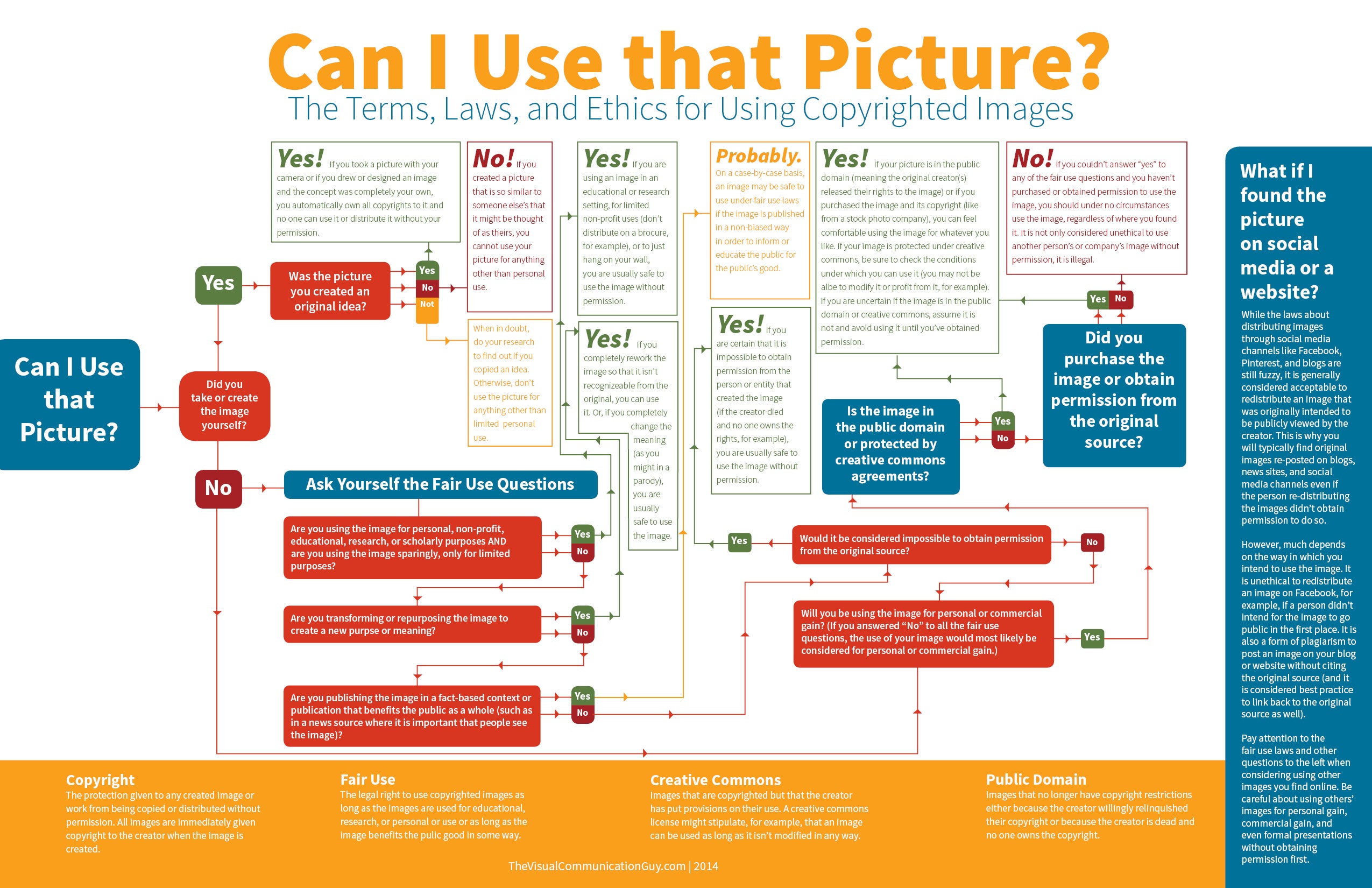
UPDATE: Here’s a useful flow chart on copyright via Mau Gris – although note that this is based on US law, which is more forgiving on images used for satirical purposes.

Can I Use that Picture? by The Visual Communication Guy via Visually

Can I Use that Picture? by The Visual Communication Guy via Visually & Lifehacker – click for full size

For more on these issues, and for related tools and links, see my bookmarks at http://delicious.com/paulb/creativecommons

Finding images and multimedia for your news project (without breaking copyright laws)

For copyright reasons image is not available (badge)

Image by gaelx

Whether you need an image for your blog post, a soundtrack to your video or that YouTube clip for your documentary, if you’re dealing with multimedia it’s likely you’ll end up using – or wanting to use – someone else’s work as part of your own.

Here are some basic tips on finding and using multimedia across the web in a way that won’t (hopefully) land you in hot water. Continue reading

Working With Excel Spreadsheet Files Without Using Excel…

One of the most frequently encountered ways of sharing small datasets is in the form of Excel spreadsheet (.xls) files, notwithstanding all that can be said In Praise of CSV😉 The natural application for opening these files is Microsoft Excel, but what if you don’t have a copy of Excel available?

There are other desktop office suites that can open spreadsheet files, of course, such as Open Office. As long as they’re not too big, spreadsheet files can also be uploaded to and then opened using a variety of online services, such as Google Spreadsheets, Google Fusion Tables or Zoho Sheet. But spreadsheet applications aren’t the only data wrangling tools that can be used to open xls files… Here are a couple more that should be part of every data wrangler’s toolbox…

(If you want to play along, the file I’m going to play with is a spreadsheet containing the names and locations of GP practices in England. The file can be found on the NHS Indicators portal – here’s the actual spreadsheet.)

Firstly, Google Refine. Google Refine is a cross-platform, browser based tool that helps with many of the chores relating to getting a dataset tidied up so that you can use it elsewhere, as well as helping out with data reconcilation or augmenting rows with annotations provided by separate online services. You can also use it as a quick-and-dirty tool for opening an xls spreadsheet from a URL, knocking the data into shape, and dumping it to a CSV file that you can use elsewhere. To start with, choose the option to create a project by importing a file from a web address (the XLS spreadsheet URL):

Once loaded, you get a preview view..

You can tidy up the data that you are going to use in your project via the preview panel. In this case, I’m going to ignore the leading lines and just generate a dataset that I can export directly as a CSV file once I’ve got the data into my project.

If I then create a project around this dataset, I can trivially export it again using a format of my own preference:

So that’s one way of using Google Refine as a simple file converter service that allows you to preview and to a certain extent shape the data in XLS spreadsheet, as well as converting it to other file types.

The second approach I want to mention is to use a really handy Python software library (xlrd – Excel Reader) in Scraperwiki. The Scraperwiki tutorial on Excel scraping gives a great example of how to get started, which I cribbed wholesale to produce the following snippet.

import scraperwiki
import xlrd

#cribbing https://scraperwiki.com/docs/python/python_excel_guide/
def cellval(cell):
    if cell.ctype == xlrd.XL_CELL_EMPTY:    return None
    return cell.value

def dropper(table):
    if table!='':
        try: scraperwiki.sqlite.execute('drop table "'+table+'"')
        except: pass

def reGrabber():
    #dropper('GPpracticeLookup')
    url = 'https://indicators.ic.nhs.uk/download/GP%20Practice%20data/summaries/demography/Practice%20Addresses%20Final.xls'
    xlbin = scraperwiki.scrape(url)
    book = xlrd.open_workbook(file_contents=xlbin)

    sheet = book.sheet_by_index(0)        

    keys = sheet.row_values(8)           
    keys[1] = keys[1].replace('.', '')
    print keys

    for rownumber in range(9, sheet.nrows):           
        # create dictionary of the row values
        values = [ cellval(c) for c in sheet.row(rownumber) ]
        data = dict(zip(keys, values))
        #print data
        scraperwiki.sqlite.save(table_name='GPpracticeLookup',unique_keys=['Practice Code'], data=data)

#Uncomment the next line if you want to regrab the data from the original spreadsheet
reGrabber()

You can find my scraper here: UK NHS GP Practices Lookup. What’s handy about this approach is that having scraped the spreadsheet data into a Scraperwiki database, I can now query it as database data via the Scraperwiki API.

(Note that the Google Visualisation API query language would also let me treat the spreadsheet data as a database if I uploaded it to Google Spreadsheets.)

So, if you find yourself with an Excel spreadsheet, but no Microsoft Office to hand, fear not… There are plenty of other tools other there you can appropriate to help you get the data out of the file and into a form you can work with:-)

PS R is capable of importing Excel files, I think, but the libraries I found don’t seem to compile onto Max OS/X?

PPS ***DATA HEALTH WARNING*** I haven’t done much testing of either of these approaches using spreadsheets containing multiple workbooks, complex linked formulae or macros. They may or may not be appropriate in such cases… but for simple spreadsheets, they’re fine…

Exploring GP Practice Level Prescribing Data

Some posts I get a little bit twitchy about writing. Accessing and Visualising Sentencing Data for Local Courts was one, and this is another: exploring practice level prescription data (get the data).

One of the reasons it feels “dangerous” is that the rationale behind the post is to demonstrate some of the mechanics of engaging with the data at a context free level, devoid of any real consideration about what the data represents, whilst using a data set that does have meaning, the interpretation of which can be used as the basis of making judgements about various geographical areas, for example.

The datasets that are the focus of this post relate to GP practice level prescription data. One datafile lists GP practices (I’ve uploaded this to Google Fusion tables), and includes practice name, identifier, and address. I geocoded the Google Fusion tables version of the data according to practice postcode, so we can see on a map how the practices are distributed:

(There are a few errors in the geocoding that could probably be fixed by editing the correspond data rows, and adding something like “, UK” to the postcode. (I’ve often thought it would be handy if you could force Google Fusion Table’s geocoder to only return points within a particular territory…))

The prescription data includes data at the level of item counts by drug name or prescription item per month for each practice. Trivially, we might do something like take the count of methadone prescriptions for each practice, and plot a map sizing points at the location of each practice by the number of methadone prescriptions by that practice. All well and good if we bear in mind the fact the the data hasn’t been normalised by the size of the practice, doesn’t take into account the area over which the patients are distributed, doesn’t take into account the demographics of the practices constituency (or recognise that a particular practice may host a special clinic, or the sample month may have included an event that drew in a large transient population with a particular condition, or whatever). A good example to illustrate this taken from another context might be “murder density” in London. It wouldn’t surprise me if somewhere like Russell Square came out as a hot spot – not because there are lots of murders there, but because a bomb went off on a single occasion killing multiple people… Another example of “crime hot spots” might well be courts or police stations, places that end up being used as default/placeholder locations if the actual location of crime isn’t known. And so on.

The analyst responsible for creating quick and dirty sketch maps will hopefully be mindful of the factors that haven’t been addressed in the construction of a sketch, and will consequently treat with suspicion any result unless they’ve satisfied themselves that various factors have been taken into account, or discount particular results that are not the current focus of the question they are asking themselves of the data in a particular way.

So when it comes to producing a post like this looking at demonstrating some practical skills, care needs to be taken not to produce charts or maps that appear to say one thing when indeed they say nothing… So bear that in mind: this post isn’t about how to generate statistically meaningful charts and tables; it’s about mechanics of getting rows of data out of big files and into a form we can start to try to make sense of them

Another reason I’m a little twitchy about this post relates to describing certain skills in an open and searchable/publicly discoverable forum. (This is one reason why folk often demonstrate core skills on “safe” datasets or randomly generated data files.) In the post Googling Nasties and Oopses on University and Public Sector Websites, a commenter asked: “is it really ethical to post that information?” in the context of an example showing how to search for confidential spreadsheet information using a web search engine. I could imagine a similar charge being leveled at a post that describes certain sorts of data wrangling skills. Maybe some areas of knowledge should be limited to the priesthood..?

To mitigate against any risks of revealing things best left undiscovered, I could draw on the NHS Information Centre’s Evaluation and impact assessment – proposal to publish practice-level prescribing data[PDF] as well as the risks acknowledged by the recent National Audit Office report on Implementing transparency (risks to privacy, of fraud, and other possible unintended consequences). But I won’t, for now…. (dangerrrrrroussssssssss…;-)

(Academically speaking, it might be interesting to go through the NHS Info Centre’s risk assessment and see just how far we can go in making those risks real using the released data set as a “white hat data hacker”, for example! I will go through the risk assessment properly in another post.)

So… let the journey into the data begin, and the reason why I felt the need to have a play with this data set:

Note: Due to the large file size (over 500MB) standard spreadsheet applications will not be able to handle the volumes of data contained in the monthly datasets. Data users will need to analyse the information using specialist data-handling software.

Hmmm… that’s not very accessible is it?!

However, if you’ve read my previous posts on Playing With Large (ish) CSV Files or Postcards from a Text Processing Excursion, or maybe even the aforementioned local sentencing data post, you may have some ideas about how to actually work with this file…

So fear not – if you fancy playing along, you should already be set up tooling wise if you’re on a Mac or a Linux computer. (If you’re on a Windows machine, I cant really help – you’ll probably need to install something like gnuwin or Cygwin – if any Windows users could add support in the comments, please do:-)

Download the data (all 500MB+ of it – it’s published unzipped/uncompressed (a zipped version comes in at a bit less than 100MB)) and launch a terminal.

>

I downloaded the December 2011 files as nhsPracticesDec2011.csv and nhsPrescribingDataDec2011.CSV so those are the filenames I’ll be using.

To look at the first few lines of each file we can use the head command:

head nhsPrescribingDataDec2011.CSV
head nhsPracticesDec2011.csv

Inspection of the practices data suggests that counties for each practice are specified, so I can generate a subset of the practices file listing just practices on the ISLE OF WIGHT by issuing a grep (search) command and sending (>) the result to a new file:

grep WIGHT nhsPracticesDec2011.CSV > wightPracDec2011.csv

The file wightPracDec2011.csv should now contain details of practices (one per row) based on the Isle of Wight. We can inspect the first few lines of the file using the head command, or use more to scroll through the data one page at a time (hit space bar to move on a page, ESCape to exit).

head wightPracDec2011.csv
more wightPracDec2011.csv

Hmmm.. there’s a rogue practice in there from the Wirral – let’s refine the grep a little:

grep 'OF WIGHT' nhsPracticesDec2011.CSV > wightPracDec2011.csv
more wightPracDec2011.csv

From looking at the data file itslef, along with the prescribing data release notes/glossary, we can see that each practice has a unique identifier. From previewing the head of the prescription data itself, as well as from the documentation, we know that the large prescription data file contains identifiers for each practice too. So based on the previous steps, can you figure out how to pull out the rows from the prescriptions file that relate to drugs issued by the Ventnor medical centre, which has code J84003? Like this, maybe?

grep J84003 nhsPrescribingDataDec2011.CSV > wightPrescDec2011_J84003.csv
head wightPrescDec2011_J84003.csv

(It may take a minute or two, so be patient…)

We can check how many rows there actually are as follows:

wc -l wightPrescDec2011_J84003.csv

I was thinking it would be nice to be able to get prescription data from all the Isle of Wight practices, so how might we go about that. From reviewing my previous text mining posts, I noticed that I could pull out data from a file by column:

cut -f 2 -d ',' wightPracDec2011.csv

This lists column two of the file wightPracDec2011.csv where columns are comma delimited.

We can send this list of codes to the grep command to pull out records from the large prescriptions file for each of the codes we grabbed using the cut command (I asked on Twitter for how to do this, and got a reply back that seemed to do the trick pretty much by return of tweet from @smelendez):

cut -d ',' -f 2 wightPracDec2011.csv | grep nhsPrescribingDataDec2011.CSV -f - > iwPrescDec2011.csv
more iwPrescDec2011.csv

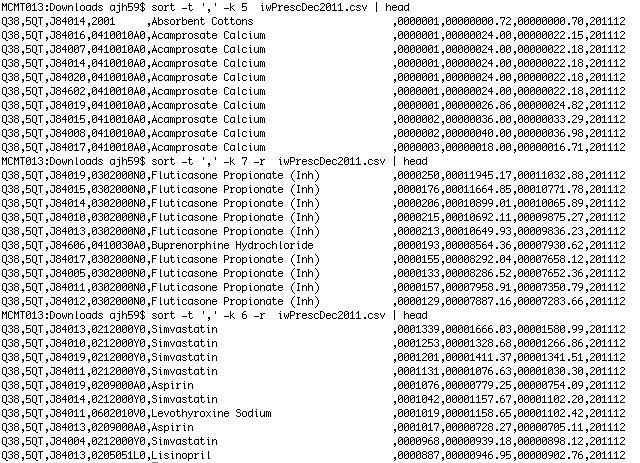
We can sort the result by column – for example, in alphabetic order by column 5 (-k 5), the drugs column:

sort -t ',' -k 5 iwPrescDec2011.csv | head

Or we can sort by decreasing (-r) total ingredient cost:

sort -t ',' -k 7 -r iwPrescDec2011.csv | head

Or in decreasing order of the largest number of items:

sort -t ',' -k 6 -r iwPrescDec2011.csv | head

One problem with looking at those results is that we can’t obviously recognise the practice. (That might be a good thing, especially if we looked at item counts in increasing order… Whilst we don’t know how many patients were in receipt of one or more items of drug x if 500 or so items were prescribed in the reporting period across several practices, if there is only one item of a particular drug prescribed for one practice, then we’re down to one patient in receipt of that item across the island, which may be enough to identify them…) I leave it as an exercise for the reader to work out how you might reconcile the practice codes with practice names (Merging Datasets with Common Columns in Google Refine might be one way? Merging Two Different Datasets Containing a Common Column With R and R-Studio another..?).

Using the iwPrescDec2011.csv file, we can now search to see how many items of a particular drug are prescribed across island practices using searches of the form:

grep Aspirin iwPrescDec2011.csv
grep 'Peppermint Oil' iwPrescDec2011.csv

And this is where we now start to need taking a little care… Scanning through that data by eye, a bit of quick mental arithmetic (divide column 7 by column 6) suggests that the unit price for peppermint oil is different across practices. So is there a good reason for this? I would guess that the practices may well be describing different volumes of peppermint oil as single prescription items, which makes a quick item cost calculation largely meaningless? I guess we need to check the data glossary/documentation to confirm (or deny) this?

Okay – enough for now… maybe I’ll see how we can do a little more digging around this data in another post…

PS Just been doing a bit of doing around other GP practice level datasets – you can find a range of them on the NHS Indicator Portal. As well as administrative links up to PCT and Stategic Health Authority names, you can get data such as the size and demographic make up of each practice’s registration list, data relating to deprivation measures, models for incidence of various health conditions, practice address and phone number, the number of nursing home patients, the number of GPs per practice, the uptake of various IT initiatives(?!), patient experience data, impact on NHS services data… (Apparently a lot of this ata is available in a ‘user friendly’ format on NHS Choices website, but I couldn’t find it offhand… as part of the GP comparison service. Are there any third party sites around built on top of this data also?)

Telling wannabe journos “Don’t work for free” doesn’t help

“Don’t work for free,” they were saying at the So You Want To Be A Journalist conference yesterday. “It’s fear, not freedom, that drives creators to succumb,” argued Jonathan Tasini in the Guardian.

The advice is understandable. But it’s also easy to say when you’re not an aspiring journalist competing against hundreds of others for entry level jobs.

The fact is that people do work for free to get a foot in the door, or experience, or both – and that many employers exploit that.

The fact is that this leads to a media industry which does not represent the diversity of its readers, viewers and users.

When opportunities are limited to those who can support themselves for months without a wage in an expensive city, to those who can fund degrees and postgraduate courses to boot, we end up with a journalism which may aspire to be for the people — but is not by any metric of the people.

But telling people not to work for free won’t change that unless it offers an alternative opportunity. Continue reading

Aggregated Local Government Verticals Based on LocalGov Service IDs

(Punchy title, eh?!) If you’re a researcher interested in local government initiatives or service provision across the UK on a particular theme, such as air quality, or you’re looking to start pulling together an aggregator of local council consultation exercises, where would you start?

Really – where would you start? (Please post a comment saying how you’d make a start on this before reading the rest of this post… then we can compare notes;-)

My first thought would be to use a web search engine and search for the topic term using a site:gov.uk search limit, maybe along with intitle:council, or at least council. This would generate a list of pages on (hopefully) local gov websites relating to the topic or service I was interested in. That approach is a bit hit or miss though, so next up I’d probably go to DirectGov, or the new gov.uk site, to see if they had a single page on the corresponding resource area that linked to appropriate pages on the various local council websites. (The gov.uk site takes a different approach to the old DirectGov site, I think, trying to find a single page for a particular council given your location rather than providing a link for each council to a corresponding service page?) If I was still stuck, OpenlyLocal, the site set up several years ago by Chris Taggart/@countculture to provide a single point of reference for looking up common adminsitrivia details relating to local councils, would be the next thing that came to mind. For a data related query, I would probably have a trawl around data.gov.uk, the centralised (but far form complete) UK index of open public datasets.

How much more convenient it would be if there was a “vertical” search or resource site relating to just the topic or service you were interested in, that aggregated relevant content from across the UK’s local council websites in a single place.

(Erm… or maybe it wouldn’t?!)

Anyway, here are a few notes for how we might go about constructing just such a thing out of two key ingredients. The first ingredient is the rather wonderful Local directgov services list:

This dataset is held on the Local Directgov platform which provides the deep links into Local council websites for a number of services in Directgov. The Local Authority Service details holds the local council URLS for over 240 services where the customer can directly transfer to the appropriate service page on any council in England.

The date on the dataset post is 16/09/2011, although I’m not sure if the data file itself is more current (which is one of the issues with data.gov.uk, you could argue…). Presumably, gov.uk runs off a current version of the index? (Share…. 😉 Each item in the local directgov services list carries with it a service identifier code that describes the local government service or provision associated with the corresponding web page. That it, each URL has associated with it a piece of metadata identifying a service or provision type.

Which leads to the second ingredient: the esd standards Local Government Service List. This list maps service codes onto a short key phrase description of the corresponding service. So for example, Council – consultation and community engagement is has service identifier 366, and Pollution control – air quality is 413. (See the standards page for the actual code/vocabulary list in a variety of formats…)

As a starter for ten, I’ve pulled the Directgov local gov URL listing and local gov service list into scraperwiki (Local Gov Web Pages). Using the corresponding scraper API, we can easily run a query looking up service codes relating to pollution, for example:

select * from `serviceDesc` where ToName like '%pollution%'

From this, we can pick up what service code we need to use to look up pages related to that service (413 in the case of air pollution):

select * from `localgovpages` where LGSL=413

We can also get a link to an HTML table (or JSON representation, etc) of the data via a hackable URI:

https://api.scraperwiki.com/api/1.0/datastore/sqlite?format=htmltable&name=local_gov_web_pages&query=select%20*%20from%20%60localgovpages%60%20where%20LGSL%20%3D413

(Hackable in the sense we can easily change the service code to generate the table for the service with that code.)

So that’s the starter for 10. The next step that comes to my mind is to generate a dynamic Google custom search engine configuration file that defines a search engine that will search over just those URLs (or maybe those URLs plus the pages they link to). This would then provide the ability to generate custom search engines on the fly that searched over particular service pages from across localgov in a single, dynamically generated vertical.

A second thought is to grab those page, index them myself, crawl them/scrape them to find the pages they link to, and index those pages also (using something like tf-idf within each local council site to identify and remove common template elements from the index). (Hmmm… that could be an interesting complement to scraperwiki… SolrWiki, a site for compiling lists of links, indexing them, crawling them to depth N, and then configuring search ranking algorithms over the top of them… Hmmm… It’s a slightly different approach to generating custom search engines as a subset of a monolithic index, which is how the Google CSE and (previously) the Yahoo BOSS engines worked… Not scaleable, of course, but probably okay for small index engines and low thousands of search engines?)