Author Archives: Paul Bradshaw

Lessons in crowdsourcing: Claire Wardle on using Ushahidi for the Tube strike

The following is cross-posted from Claire Wardle’s blog:

Late on Monday night, I wrote a short post in anticipation of the crowdmap I’d just set up for BBC London, which I hoped would provide a useful service the following day for the London tubestrike, 7th September 2010.

It’s now Wednesday morning, and I can write, while still feeling slightly shell-shocked from the experience, that all in all, I’m very pleased with how it went.

I want to use this post to reflect on some of the things that worked, some of the things that didn’t work as well, and some things I will do differently if the next scheduled tube strike goes ahead.

Bottom line was that lots of people saw it: 18,860 unque visitors, and 39,306 page views from 55 countries. 13,808 were from the UK, 3863 from the US, and I can’t get over the fact that we had 2 people form Bermuda, 1 person from Uruguay, and 9 from Kenya, the home of the Ushahidi platform. The power of social media never ceases to amaze me.

We posted 202 reports yesterday. About 50 were sent directly to the map from the audience, either via the web form or the specific SMS channel we set up. The rest of the reports we took from twitter, either tweets in the #tubestrike stream or replies to the @BBCTravelalert account. Continue reading

Charities data opened up – journalists: say thanks.

Having made significant inroads in opening up council and local election data, Chris Taggart has now opened up charities data from the less-than-open Charity Commission website. The result: a new website – Open Charities.

The man deserves a round of applause. Charity data is enormously important in all sorts of ways – and is likely to become more so as the government leans on the third sector to take on a bigger role in providing public services. Making it easier to join the dots between charitable organisations, the private and public sector, contracts and individuals – which is what Open Charities does – will help journalists and bloggers enormously.

A blog post by Chris explains the site and its background in more depth. In it he explains that:

“For now, it’s just a the simplest of things, a web application with a unique URL for every charity based on its charity number, and with the basic information for each charity available as data (XML, JSON and RDF). It’s also searchable, and sortable by most recent income and spending, and for linked data people there are dereferenceable Resource URIs.

“The entire database is available to download and reuse (under an open, share-alike attribution licence). It’s a compressed CSV file, weighing in at just under 20MB for the compressed version, and should probably only attempted by those familiar with manipulating large datasets (don’t try opening it up in your spreadsheet, for example). I’m also in the process of importing it into Google Fusion Tables (it’s still churning away in the background) and will post a link when it’s done.”

Chris promises to add more features “if there’s any interest”.

Well, go on…

Of online audiences and modes of address

One of the mistakes that people new to blogging often make is to write as if they’re addressing a crowd. “Hey everyone!” they shout. “Can any of you help with this?”

Speak to people who teach radio journalism, and you’ll find similar experiences.

Radio and online journalism have this in common: they are typically consumed alone. We listen to the radio in the car, or while we’re painting. We may listen to it in the workplace – but unless it is something seminal, not crowded around the set. We read online news at our work terminal, or on our mobile phone or laptop. It’s not a group activity. Television news is the only type we consume in groups, socially.

Or at least, that’s what I thought until recently.

Because it occurs to me that there are some examples in online media when we are addressing a crowd.

Social media is the most obvious example: if you ask a question on Twitter, should you say “Do you know the answer to this question?” or “Does anyone know the answer to this question?”

Although each user is sat at their computer or phone individually, they are also occupying a virtual social space, in which they are a group.

But isn’t a blog comments thread a similar virtual social space? No.

The key to the issue is synchronicity: if people are occupying that space at the same time, then they can be addressed as a crowd. If it is asynchronous – people occupy the space at different times, and return to check communications – then that mode of address doesn’t work.

Asynchronous communication is the dominant form of communication online: email, blogs, forums are all asynchronous. Live chat, some IM and some social media like Twitter tend to be more synchronous.

In those contexts then, is it okay to address people as a group? I think it is.

FROM THE COMMENTS: @Dubber’s further insights from radio are worth incorporating:

“Most online writing seems to fall naturally into the same mode as radio writing: personal, direct, individual – and, most importantly, conversational. If I was writing a style guide for online communication (including journalism), I’d pretty much make those four elements the fundamental rules.”

The foreign minister of Argentina on Twitter

Argentinian politicians of all parties are now fervent Twitter users, as I stated in my previous OJB post, and they don’t hesitate in arguing shamelessly about all national matters in 140 characters.

The new foreign minister, Hector Timerman (@hectortimerman), is maybe the most enthusiastic Twitter user of all the government officials. Every day you can read him discussing with national journalists – and regular Twitter citizens – the administration’s performance.

So, generally, journalists that don’t agree with Kirchner’s  marriage policies bear the brunt of his anger through Twitter. That’s why Reynaldo Sietecase (one of the top national journalists) asked Timerman in his radio show about the risk of communicating things by Twitter “without any filter”.

The foreign minister of Argentina replied with irony: ¿Dont you think that now, while I’m talking on the radio with you, I’m also doing it without any filter?

The journalist pushed on and asked if Twitter didn’t make him waste time. Of course, Timerman raised the bet: “Actually, I waste much more time talking with you than on Twitter”.

Review: Funding Journalism in the Digital Age

For the past few weeks I’ve been casually enjoying Funding Journalism in the Digital Age, a book that surveys the business models underpinning the industry – and those that are being explored for its future. And it’s rather good.

The book has four broad parts: the initial 3 chapters provide the current context: a history of news publishing as a business; and an overview of current business models and commercial tactics, from paywalls and hyperlocal projects to SEO and dayparting.

The bulk of the book then looks in detail at particular types of business models: micropayments and microfunding; sponsorship and philanthropy; family ownership and trusts; niche content; e-paper, and e-commerce.

Alongside this, a number of chapters look at organisational innovation, from pro-am collaboration to institutional partnerships. And finally, two key chapters look at the principles of microeconomic concepts for the industry, and the importance of innovation.

Rather than sit back and paint a neutral picture of things, the book states quite firmly why now is not the time to stick with old models (the economics of both publishing and advertising have changed), while also not pretending to know the answer to the industry’s problems.

Instead, over the course of the book, readers get a good overview of how media organisations are attempting to adapt to the new environment, as well as a sample of the different models being experimented with by innovative startups – the successes, failures, but mostly the wait-and-sees. The result is a valuable insight into the increasingly varied nature of the industry side of ‘the industry’.

The chapters are littered with examples from both mainstream and lesser-known publishing projects, and it’s refreshingly global in its perspective: the usual US and UK stories are complemented with online and print examples from France, Singapore, Norway, Australia and elsewhere. Sadly, like most journalism textbooks, magazines and, to a lesser extent, broadcast, are a little neglected.

Although this is an entry-level book the subject is broad enough – and the industry itself so varied – for most people to find something new here.

For students, this is a book to join the list of must-reads. Too few books address the current commercial realities that students face upon entering the media. It would be nice to see some more.

The New Online Journalists #10: Deborah Bonello

mexico reporter logo

As part of an ongoing series, Deborah Bonello talks about a career that has taken her from business journalism in London to video journalism in South America, and a current role producing video at the FT.

What education and professional experience led to your current job?

After I graduated from Bristol University in 1998 (I wrote for my student newspaper Epigram for most of my time there), I moved up to London and started working for Newsline, an online news service run as part of the media database product Mediatel.

A year later I was taken on by New Media Age as a reporter, where I got to watch the dot com boom become the dot com crash and work with the then-editor, Mike Butcher, now the editor of TechCrunch Europe.

From there I moved to Campaign to edit their Campaign-i section, and when that got cut because of budgets after a year I spent the next few years freelancing on media business magazines (Campaign, Media Week, NMA, FT Creative Business) and watching how the traditional publishing industry took on the internet.

By then, I was fed up of London and business journalism, so I headed off to Latin America. After a year in Argentina as a print only journo, I moved to Mexico to launch NewCorrespondent.com, an experiment in digital journalism, with help from Mike Butcher. Continue reading

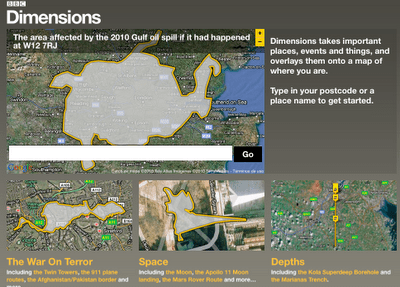
Mapping global events in a local way: BBC Dimensions

BBC Dimensions

This is one of the best BBC projects I’ve seen in a while: Dimensions maps key events, places and things such as the Pakistan floods, the Gulf oil spill and the Afghanistan-Pakistan border – over your postcode.

It’s a simple idea, but hugely effective.

The prototype comes not from the corporation’s News arm – it was commissioned by History. Commissioning Executive for the Multi-Platform Team Max Gadney writes:

“Our challenge was to make it relevant to audiences.

“This is a common desire. Commissioning editors often want stuff ‘made relevant’ – TV producers might translate this as putting a celebrity in it – one we can relate to (Who Do You Think You Are does this very well). How does digital media make something relevant?”

Currently this is a prototype, so feedback is welcomed. I hope that News will be rubbing their hands at the potential applications and making their own suggestions for improvements on those lines.

For once we may be able to stop comparing things to the size of Wales. Unless, of course, you have a Welsh postcode.

Internet use in the UK – implications from Ofcom's research for publishers

Apart from photo sharing and social networking, most internet users have little interest in UGC

UPDATE: The Office for National Statistics has also released some data on internet access which paints a more positive picture. Their data puts the numbers who haven’t been online at 18%. And 45% had accessed the web on the move .

I’ve just been scanning through the internet section of Ofcom’s latest report on The Communications Market 2010. As always, it’s an essential read and this year the body have done a beautiful job in publishing it online with unique URLs for each passage of the document, and downloadable CSV and PDF files for each piece of data.

Here are what I think are the key points for those specifically interested in online journalism and publishing: Continue reading

Online journalism and the promises of new technology PART 5: Multimedia

In this fifth and second to last part of this series I’ll review the research on how and to what degree multimedia is utilized in online journalism.

Previous parts of this series have focused on the revolution that never happened (part 1); how to define the three main assets of new technology to online journalism — interactivity, hypertext and multimedia (part 2); the research on the use of hypertext in online journalism (part 3); and the research on online journalism and interactivity (part4).

Content analysis studies

As with hypertext and interactivity, most studies of multimedia in online journalism rely on content analysis of websites. Tanjev Schultz (1999) found that only 16 percent of online newspapers in the US had multimedia applications in the late 1990s. Two more qualitative oriented content analysis studies revealed similar lack of multimedia (In the US, Canada and the Netherlands: Nicholas W. Jankowski and Martine van Selm (2000); In the US: Wendy Dibean and Bruce Garrison (2001) (only excerpt available for free)).

Jankowski and van Selm concluded that of all supposed added value facilities of online journalism multimedia “is perhaps the most underdeveloped” (2000, p. 7). However, online news sites affiliated with TV stations were more prone to utilize multimedia according to the same study. Yet, in a more extensive investigation of TV broadcasters’ online news sites in the US (pdf available), Mary Jackson Pitts (2003, p. 5)  lamented: “[t]he majority of stations provide text-only stories, thus failing to use the multimedia capabilities of the web”.

In their extensive investigation of European online journalism, Richard van der Wurff and Lauf (Eds) (2005) found that print newspapers were as much about multimedia as online newspapers (this study is not available online). Thorsten Quandt (2008) (only abstract available for free)  found that 84.5 percent of the 1600 stories he analyzed in 10 online news sites in the US, the UK, Germany, France and Russia were strictly text-based.

In Scandinavia, Martin Engebretsen (2006) (pdf available) found that online newspapers used a bit more multimedia, but still not more than found in previous studies in the US. Daniela V. Dimitrova and Matt Neznanski’s (2006) study of the coverage of the Iraq war in 2003 in 17 online newspapers from the US and elsewhere showed no increase in the use of video and audio in the US newspapers compared to Tanjev Schultz’s study published seven years earlier. Furthermore, they found minimal difference between the international and the US online newspapers (slightly more use of multimedia in the US online newspapers). However, Jennifer D. Greer & Donica Mensing (2006) (book chapter partly available through Google books) found a significant increase in multimedia use during the same period (1997-2003) in their longitudinal study of online newspapers in the US.

Interviews and surveys

Studies relying on interviews and surveys with online journalists and editors reveal some of the possible reasons for the lack of multimedia in online journalism found in the content analysis studies. According to Michele Jackson and Nora Paul (1998) (the US) and Christoph Neuberger et al. (1998) (Germany) online journalists and editors had a positive attitude towards utilizing multimedia technology, but problems related to lack of staff, inadequate transmission capacity and other technical issues obstructed the materialization of multimedia content.

Later studies indicate that online journalists and editors downscale the value of multimedia content: Thorsten Quandt et al. (2006) (only abstract available for free) found that multimedia was considered to be the least important feature of web technology for online journalism. John O’Sullivan (2005) found similar results in his qualitative interviews with Irish online journalists (only abstract available for free). Niel Thurman and Ben Lupton interviewed 10 senior editors and managers affiliated with British online news providers and found that the general sentiment was that “text was still core” (2008, p. 15). However, in his PhD dissertation (which is not available online)  Arne H. Krumsvik, in interviews with CNN and NRK (Norwegian public broadcaster) executives, found a much more positive attitude towards multimedia than towards interactivity and hypertext (2009, p. 145). And in a recent case study of multimedia content on the BBC online (only abstract available for free),  Einar Thorsen concludes that video content has increased tremendously (Thorsen, 2010).

User studies

There are not many studies that investigate the users’ attitudes towards multimedia news online.  In an experimental study (pdf), S. Shyam Sundar (2000) found that those who read text-only versions of a story gained more insight into the topic of the story than those who read/viewed multimedia versions of the same story. Hans Beyers (2005) (pdf) found that only 26.4 of the Flemish online newspaper readers in his survey thought the added value of multimedia was an important reason to read online newspapers.

Multimedia summarized

To summarize the findings of the research on multimedia in online journalism deriving from the techno-approach, it seems that multimedia remains the least developed of the assets offered to journalism by Internet technology. Online journalism is mostly about producing, distributing and consuming written text in various forms, even though some recent studies describe an increase in the use of especially video. This falls in line with the general increase in online video watching described in a recent Pew Internet report. However, it seems that online news sites are struggling to cope with multimedia.

In the last part of this series I will conclude on what we might learn from the research on the utilization of hypertext, interactivity and multimedia in online journalism. Might their be other ways of understanding the development of online journalism then through the lens of technological innovation?

Are Android phones the best option for journalism students?

[youtube:http://www.youtube.com/watch?v=8ADwPLSFeY8%5D

A few months ago I was asked what sort of mobile phone I would recommend for a journalism student. Knowing how tight student budgets are, and that any choice should have as much of an eye on the future as on the present, I recommended getting an Android phone.

The reasoning went like this: iPhones are great at certain things, and currently benefit from a wider range of applications than other mobile phones. But the contracts are expensive, the battery life poor, and Apple’s closed system problematic, for reasons I’ll expand on in a moment. Continue reading