Category Archives: user generated content

Guardian makes its comments accessible, SEO friendly and mobile friendly all in one go!

The Guardian has changed its user-generated comment system – moving from a client-side system to a server-side one. (This story was first published here, where you can read a bit more of the background.)

With the old system, once you loaded a story, some javascript would go off and look up readers’ comments and display them. This wasn’t terribly accessibleif you couldn’t or didn’t run javascript, you couldn’t see the comments.

It was also bad for SEO, as search engines couldn’t run the javascript (so couldn’t see the comments). And if your mobile didn’t run javascript (like mine), you couldn’t read the comments either.

With the new system, the comments are just part of the web page, like all the rest of the text.

This is a great change by the Guardian, and not before time. Google has already started to index the text of comments, as this search for some text I left as a comment once shows.

If you notice any problems, they’ve asked you to point them out.

Covert online campaigns: a primer

Following last week’s Question Time, the BBC’s Have Your Say forum was red hot with sympathy for old Nick.

This led to some soul searching in the media, and across the social sphere. To what extent can we say that this mass-protest; much of which condemned the ‘bullying’ of a panellist rather than openly endorsing his party’s policies, fairly reflects public opinion? Are we looking at an orchestrated online campaign?

Without access to HYS log data, it is very hard to say. And even with an extensive list of IP addresses, and a breakdown of traffic by source, the free availability of anonymous proxies and easy-to-set-up email and social network accounts will always leave breathing space for a well-regimented astroturfing campaign.

So how can we shed light on covert political campaigns online? Any group who have been infiltrated in the past will be ultra security-conscious – so events last week may be untraceable to outsiders. Other groups may not be as well organised – so here are some pointers.

 Language

Spreading an effective mass-campaign across a forum or social network requires speed. People who work quickly don’t have time to spell-check, or type accurately. But hunting out spelling errors won’t help you unearth a conspiracy here.

Typos are a different matter – if you spot regularly occurring mis-types, this could suggest a common origin.

Punctuation and the use of capital letters can also slow the process of rapid posting. Conversely, evidence of the sporadic and distinctive use of upper-case shouting (within ordinary text), can also be indicative of a single personality expressed across multiple accounts.

Phrase searching” excerpts from suspicious sentences can provide a simple way of tracking down duplicate content across the web. This can be useful where people are trolling across different forums (which might, in this case, include a perceived spike in support on the Sky News forums). But testing an adequate number of sentences can be time consuming.

Alternatively, there are a few freely available services out there intended to detect plagiarism, which can be used to track duplicate posting across parts of the web.

However, it is likely that well organised and long-term campaigns will already have organised participants into cells who are responsible for trolling particular domains, thus lending uniqueness and authenticity to their posting. Such decisions will most likely take place offline, or at least via encrypted communications – which some groups are known to use.

Getting back to the analysis of output, it is possible to mine large volumes of text (i.e. a large number of posts in one domain), via software such as Analysts Notebook. This could certainly help establish grammatical trends, and those phrases which are hard for the human eye to spot systematically. But this software is far too expensive for most media organisations.

Linking

In the unlikely event that a covert campaign to influence public opinion is discussed openly on the web, there are a number of places to check for mobilisation, and linking.

A search of Omgili (covering keywords, or URLs) will highlight any attempts on public discussion boards to mobilise on a given subject and/or target (though this is of little use for private boards).

Alternatively, Yahoo’s site explorer can be used to eke out all the inbound links to any page across the web. This source gives an insight into just how skewed political opinion on the web can be. If you search for Ron Paul’s Campaign for Liberty you will find it has over 600,000 inbound links, by comparison with the Republican National Committee which has just over 220,000. You might wonder which party’s representative came runner up at the last presidential election on this analysis.

For the social web, bit.ly’s search option allows you either to search for linking by keyword or by URL. When the results come back, check Info for a particular entry, then select View all from the Conversations option to track the development of conversation around the page in question, and tease out other associated links and trends.

Lost in hyperspace

Sometimes the most obvious indication that something’s going on is when that thing’s not going on somewhere you’d expect it to. The relative inactivity on Thursday night from those who publicise their affiliations (a bio: search in Tweepz will help here) is noteworthy.

On the eve of the greatest public exposure in the party’s history, some might question where were the pro- trending topics – there were no shortage of anti- topics that night. A cynic might suggest that mobilising on Twitter, where real identities often crowd out fakes, is not the ideal medium for pushing an unpopular agenda.

Dummy accounts represent a different challenge. Forum owners can easily keep track on accounts which spark unerringly to life when a particular issue comes along which fits with a particular agenda. But the surfer can replicate this too – IceRocket’s Twitter search tab allows you to browse vital statistics – including tweet count – which can be indicative of a dummy account (as can long periods of inactivity between non-specific tweeting, and proactive tweets).

A trawl through the names posted on forums may highlight a number of plausible but bogus identities (see 192.com for domestic names, or Infobel for international ones), which should arouse suspicion. The age-range option in 192 can be especially useful in analysing Facebook accounts. Where you see a profile picture of someone in their twenties, if everyone by that name on the electoral roll is over 40, something is surely up.

Likewise one or two people finders, such as 123people or Yasni, when used in conjunction with 192, can highlight anomalies between real and online identities.

When browsing through the real names posted on a forum, if you can’t find names who elsewhere publicly declare their affiliations, especially in relation to a contentious issue, then alarm bells may start ringing.

But then, where a campaign groups’ leadership encourage members to hide their true identity in public, it’s little wonder conspiracy abounds. Such advice accommodates a reactive approach to online campaigning, away from the direct expression of party support, and towards (for example) outrage at a perceived injustice. Yet the absence of significant online connections between a party and its activists would indicate that this type of strategy is working perhaps a little too well.

Linking and transparency in online politics

Groups who seek to hide their true colours online can come embarrassingly undone if they aren’t careful. The link can cut a swathe through façade – it can bring transparency to our politics, as well as to our journalism.

For this reason the Identify Firefox extension can bring insight. This plugin reads links on social network and blog profiles tagged rel=”me” (more information on the plugin can be found on Read Write Web). Use the keyword combination Ctr+i on any public profile to bring back other social networks and blogs which also link to these web sources.

Try it out on a couple of prominent public profiles – you may be surprised (or possibly appalled) at what you find.

Investigative journalism – accept no substitute

While conventional online research techniques offer options in terms of digging out evidence, there remains no substitute for good old fashioned investigative journalism.

With this in mind, a first port of call for guidance on approaching online groups for any investigator should be the internet research clinic.

When the lack of comments damages your news brand

If you want to skip the background, go to the next subheading

Last week the BBC Education website published a piece about a report into the use of technology by schoolchildren: “Tech addiction ‘harms learning'”:

“Technology addiction among young people is having a disruptive effect on their learning, researchers have warned,” the intro led, before describing the results of the study. No one other than the study authors was quoted.

But GP and Clinial Lecturer AnneMarie Cunningham, hearing of the report on Twitter, felt the headline and content of the article didn’t match up: “The headline suggests a causal relationship which a cross-sectional study could not establish, but the body of the text doesn’t really support any relationship between addiction and learning”, she wrote, and she started digging:

“It … was clear that none of the authors had an education background. The 2 main authors, Nadia and Andrew Kakabadse, have a blog showcasing their many interests but education doesn’t feature amongst them. They descibe themselves as “experts in top team and board consulting, training and development”.”

AnneMarie bought the report for $24.99 – the only way to read it – and started reading. This is what she found: Continue reading

UK newspapers add 213,892 Twitter followers in a month

National UK newspapers had 1,471,936 Twitter followers at the start of September – up 213,892 or 17% on August 1 (when they had 1,258,044 followers).

You can see the September figures (orignally posted here) below or here.

I have more Twitter statistics here.

Taking cues from Citizen Science

One rap against citizen journalism is that there is always a possibility that it isn’t accurate or credible. Unmonitored, unmoderated blogs can get it wrong. Well, so can traditional journalists, but with blogs, it’s harder to hold someone accountable, and erroneous information is that much trickier to retract.

Would it help then, to look for ideas in a field where inaccuracy is barely tolerated, if at all? The media should be able to tap into crowd wisdom for credible content if, as Dan Schultz notes, “members of the scientific community, a professional group that arguably maintains higher standards for verification than journalism, are trying to harness the crowd in the same way that we are.”

Citizen science has been effectively used in one main way – collection of data, which is then used by scientists for contextualization, analysis and consolidation with experiments and previous scientific literature.

Be it recording the dates of Spring’s first lilac blossoms, or counting the number of eggs in bird nests, citizens are contributing in meaningful ways, so scientists can then then use this for more specialized tasks, like assessing the information thus obtained to study the impact of global warming or the influence of human activity on wildlife.

Perhaps, the closest counterpart to this use in journalism is something akin to WNYC’s crowdsourced project to track price gouging in New York City or the Shropshire Star’s map of fuel prices. In both these exercises, citizens were not expected to do much more than report their daily observations.

Since scientific research usually requires a high level of education and training, the tasks get divided neatly between professionals and dabblers. As Schultz points out, in the case of science, “professionals have bigger and better things to do; it doesn’t make sense for a PhD to use a million-dollar telescope to look at something that a hobbyist could view using a thousand-dollar one, especially when there is so much of the universe left to unlock.”

This is not to say that such a clear definition would not work for journalism. In fact, citizen journalism pioneer Jay Rosen has often said that division of labor is essential for crowdsourced journalism projects. In WNYC’s case, citizens were responsible for collecting information that was put together in a story. In more complex investigative projects, the public is given the task of perusing documents, as is happening with The Guardian’s investigation of the MP’s expenses scandal.

Another idea would be to outsource so-called “fluff” journalism to the public (self plug warning). Many sites are already implementing this, by allowing citizens to post blogs and articles on lifestyle and recreational topics. Schulz suggests hyperlocal content as one such department where citizens can often do a good, if not better, job than reporters.

One of the main problems is that unlike scientists, journalists–irrationally or not–are in constant fear of being replaced by amateurs. Hence, they seem more hesitant to solicit citizen help. The fact that journalists are losing jobs, however, has more to do with the lack of revenue-generating mechanisms on the Internet than it has to do with bloggers posting content online. In fact, by recruiting audiences to act as eyes and ears for news organizations, the latter would actually save costs and be able to divert resources toward more specialized reporting.

Secondly, in the case of scientific crowdsourcing or citizen science, there is a distinct classification of contributors and their scope of contribution–as identified by what professionals, amateurs and citizens can do. This leads to a clear division of labor, which is not quite possible in journalism, at least in the way it is being practiced right now. While there is no doubt that journalism needs a special set of skills and training, it’s not rocket science, quite literally.

Amateurs contribute toward citizen science in significant ways by performing unspecialized tasks. In the case of bloggers, on the other hand, short of traveling to a war zone (with some exceptions) they are pretty much doing–or attempting to do–what professional journalists routinely do.

The solution is not to curb bloggers and independent journalists, however. It is to produce the sort of in-depth, high-quality journalism that makes newsroom journalism “special.” In order to have clear-cut division of labor, professionals merely have to offer a product that makes use of the creativity and resources that are available to them. And in the process, they can implement projects that involve the lay public so the latter can do what they do best.

Guardian the most bookmarked newspaper on delicious

The Guardian has more URLs bookmarked on Delicious than any other UK newspaper, as I first revealed here (with the original video here)

There are 10,914 Guardian URLs bookmarked, with the Times coming 2nd (3,944) and the Independent in 3rd place (3,196).

Newspaper
website
Bookmarks on Delicious
Guardian 10,914
Times Online 3,944
The Independent 3,196
Telegraph 2,258
The Sun 1,409
FT 1,303
Daily Mail 785
Mirror 624
Express 197

Quarkbase must be using the Delicious API but it doesn’t say where it gets the number. Click the papers’ name to see the Quarkbase figures (and more).

The Revenge of Lilliput: Former-SPCK Bookshop Campaign blog passes 150k visitors

20090824-spckssg-news-blog-past-150k-pageviews-screenshotThis morning the SPCK SSG News, Notes and Information campaign blog passed a total of 150,000 page views since it was established in June-July 2008.

This is a story which is an excellent example of both investigation by a network of people, and campaigning blogging. It shows how a coalition of individuals can make a significant difference. You can read a brief outline on the blog’s introductory page.

The blog is about the mismanagement and destruction of a chain of 25 Anglican bookshops, which have been around since the first half of the 20th Century, by two brothers based in the USA, J Mark – who is a lawyer – and Philip Brewer. They took over control of the Bookshops from the SPCK charity with the promise of maintaining and improving the business back in 2006. They used a charity called the “Society of Saint Stephen the Great” (SSG) as their vehicle.

Since then there has been a saga of “shenanigans”, including sackings by email, bullying of staff, “Cease and Desist” attempts to suppress straight reporting, creation of half-a-dozen business entities to confuse everyone, a fake attempt in the US at putting the core charity into bankruptcy (declaring only liabilities not assets) where the court has no jurisdiction anyway, and much much more, which I will be describing in some detail in a series of podcasts.

I (along with many others) helped promote the new campaign site in summer 2008 when Dave Walker the blogger doing the existing reporting (75 posts in about 18 months was one of several threatened legally by Mark Brewer; here is an example of the style of letter used – this one was published by Sam Norton. An instant archive of these deleted posts was of course established within days on the blog Open Debates not Libel Threats .

20080827-philip-brewer-of-spck-aircraft-for-sale-1-small1There have also been some lighter moments, such as the lawyer running a chain of religious bookshops being instructed by the Court to take remedial education in bankruptcy law and legal ethics, and the discovery that his brother possesses a private “hobby” aircraft painted in “Trotter Trading” yellow, which was maintained at charitable expense . However, the core objective is to make sure that the mismanagement of the chain is scrutinised, and the miscreants brought to book.
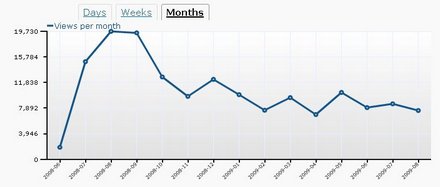
The campaign blog now has nearly 250 articles, and has received 2500 comments. Here are the visitor statistics from the WordPress stats module. You can see the initial surge, and how interest has been maintained at around 10k page views each month.

20090824-spckssg-news-blog-past-150k-pageviews

Though very respectable, this is not a huge amount of traffic, but a successful niche campaign does not need a huge amount of traffic – and it could even be a distraction to receive many more comments than we do already.

Continue reading

What’s good for TwitPic may be bad for photojournalists

Yesterday Mashable ran an interesting story about how iPhone will soon become the top camera for images uploaded onto Flickr. Previously that spot belonged to the Canon EOS Digital Rebel XT, which is basically the DSL-R for beginners.

With each production cycle, mobile phone cameras are getting more sophisticated. Meanwhile it’s incredibly easy to upload a just-taken photo from your sophisticated camera phone onto the web. I recently upgraded my BlackBerry to the 8900, which has a 3.2MP auto-focus camera. Not a lot of megapixels, but the autofocus is what makes it a great camera phone. Taking a photo and uploading it to TwitPic takes less than a minute. The quality of the photos are pretty good, too.

The proliferation of iPhones, BlackBerrys and other camera phone brands has meant more people are photographing the things they do and putting them up on the web. For small and mid-size papers, getting art for a story could be as easy as doing a TwitPic search by keyword and see what pops up. If a user-taken photo of an event pops up, you could contact the author, ask for permission and post it. At worst, they’d ask for a small fee, which when paid would still be a money saver compared to sending a photojournalist to an event.

The same could be said for videos. If a video of an event is uploaded to YouTube or any of the other video hosting sites, a news organisation could contact the person who shot it and ask permission to use it.

As the line between reporter and reader becomes further blurred, technological advances and the will of the people may mean that photojournalists are primarily employed by news organisations who feel they can both print the photos and sell the originals for a nice profit.

If the public is providing printable photos either for free or at a fraction of the cost of employing a photojournalist, that won’t be a terribly difficult decision for any executive editor to make.

Opportunities for local news blogs: Trends in Blogging

In the last year or so there have been a number of new blog / news sites developing which provide commentary for a geographically identified area, covering politics but also giving a more rounded view of life in the area.

The site which has drawn my attention recently is The Lichfield Blog, which I mention on the Wardman Wire or on Twitter (follow me to keep up to date) from time to time. There are examples of sites with a similar ethos established for some time, including some personal blogs, and I’d mention Londonist and Dave Hill’s Clapton Pond Blog (Hackney), but also sites such as Created in Birmingham (Birmingham Arts, mainly) and Curley’s Corner Shop (South Tyneside).

Some areas have a range of local blogs. The tiny Isle of Thanet, for example, has Bignews Margate, Thanet Life and Thanet Online, in addition to the more idiosyncratic Thanet Coast Life, Eastcliff Richard and even Naked in Thanet. It’s worth noting that – once again – this set of blogs are all edited by men.

And if you think that Thanet is small to have all those local blogs, try the Plight of Pleasley Hill, an ultra-local blog specifically created to foster community in an area of 3 or 4 streets in the Nottinghamshire village of Pleasley Hill, near Mansfield. I did a podcast interview with Mark Jones, who has triggered the project, for the Politalks podcast. One interesting point is how the creation of a website has helped “institutionalise” a small group internally, but also how it can help externally in the process of persuading large bureaucracies (e.g., the local council) to engage with the group.

Some of those sites have political stances, and some don’t. The common factor is that they provide coverage of local life and grounded politics, and don’t pay unnecessary attention to the Westminster Punch and Judy show.

Occasionally “ultra-local” has been used to refer to areas the size of a London Borough, or a provincial city. I’d suggest that we need to think in *much* smaller areas. I wonder if the one-horse-town newspaper of settlers’ America, but written by local people for themselves, is where we are going to end up, and then with sites covering larger communities, areas and specialist themes which are able to draw an audience.

I’d suggest that there is also a new opportunity opening up for these independent commentary and reporting sites due to a pair of current trends:

  • The drive by national media sites to find new ways of persuading their readers to pay for parts of their web content – pay-walls, charges for special services and anything else they can dream up. As the editor of an independent “politics and life” commentary site with a number of excellent contributors, I can’t wait for the age of “Pay 4 Polly” to arrive.
  • The continuing liquidation of our local newspapers and regional media.

Locally focused blogs with a more rounded coverage may provide an answer to consistent criticisms made of “the political blogosphere”:

  • Political bloggers only do partisan politics (which is wrong, but it can sometimes look as if it is true).
  • There is too much coverage of the Westminster Village (which is right, but someone has to do it, and it is the place where many decisions are made).

I think group blogs with varied teams of contributors may be best placed to provide a decent level of coverage and draw a good readership, while competing effectively with other media outlets. That is a trend we have seen in the political blog niche over several years – the sites which have established themselves and maintain a position as key sites have developed progressively larger teams of editors, and provided a wider range of commentary and services.

A team of contributors allows a site to benefit from the presence of real enthusiasts in each area of reporting, from the minutiae of the Council Meetings to Arts Events at the local galleries.

I’m developing a list of sites aiming to rounded provide coverage of a defined local area, town, or community. If you run a good one, or know of one, please could you drop me a line via the Contact Form on the Wardman Wire. Alternatively, use the form below:

Loading…

(Note: if you want to know more about local news blogs in general rather than what I think can be done with them, the go-to place is Talk About Local.)

Gatewatching for local news

Among the many good things about Internet news consumption is the fact that audiences can seek any sort of information to suit their interests and inclinations. No longer stifled by editorial, corporate or advertiser monopoly, readers browse everything from obscure blogs to mainstream news sites to get the information they want.

Ever since Internet media started going mainstream, however, many have raised the question of whether this vast and tolerant space is causing people to replace news that informs and educates with that which merely entertains. One has only to look at the slew of sensational Internet videos that go viral, or the latest online reiteration of Jessica Simpson’s gaffe to accept that this is a legitimate concern. In addition, people have more options than ever before to confine themselves to fragmented communities and echo chambers to get the news they want in lieu of what they need.

As Charlie Beckett points out in Supermedia, while the diversity provided by the Internet with regard to information dissemination is important, it also tends to further the divide between those looking for real, relevant information and those who merely want instant gratification through the latest celebrity gossip.

Of course, blaming new media for its endless possibilities would be sort of like blaming that decadent chocolate cake for existing. Just because it is there, doesn’t mean you need to seek it.

This has been a more major concern with regard to local news. Citizens might tend to focus on the latest iPhone application released by Apple at the expense of important news happening at home – information that would be vital to them as contributors to a democracy.

But while lack of reader interest is a problem, it is often spurred on by scarcity of engaging content from news organizations – if all a local paper can provide is a string of wire service accounts and press releases, how do they expect to keep readers motivated? This was hard enough to accept in an age where the newspaper or the evening news broadcast was the only source of information. It is simply untenable in the Web 2.0 world, where readers can get actual, eyewitness accounts from their Twitter followers and view firsthand pictures through Flickr groups. In other words, in this age of social media and online networks, local journalists seem almost out of touch with the community they live in.

The question then is, can residents of a community do well as their own gatewatchers?

The New York-based site NYC.is, which functions as a “Digg” for the city and its surrounding areas is trying to do just that. “Our goal is to connect bloggers, independent reporters and activists in different parts of the five boroughs, rewarding the best work by sending it traffic and increasing potential for impact,” reads the mission statement.

I got a chance to talk to Susannah Vila, a graduate student at Columbia University, who launched the site. “The inspiration behind the concept is [it provides] ways of democratizing the Web.  This was part of what excited me about making the site,” she says.

Readers themselves direct attention to local news that they deem important, while also channeling traffic to independent bloggers, regional Web sites and mainstream sites. Anything from New York City mayor Michael Bloomberg’s job approval ratings to rising prices of a pizza slice in Brooklyn can turn up on the front page.  “The point is, it is not just one type of story that gets popular. There is a lot of range,” says Vila. The common thread is relevance to people of the community. In true Digg fashion, the top contributors get a mention on the home page, as do the most popular stories.

Can this go one step further, and actually motivate people to do original reporting or garner data for a new story? “Once I get more of a community on the site with more engaged readers there is definitely a possibility to prompt them to investigate certain things or to [urge them] to go to community board meetings,” Vila says. ““It would also be cool to let people vote on ideas for stories.”

A gatewatching site at a local community level may not be sufficient to provide all the information residents need, but it certainly allows a comprehensive look at what readers are looking for, and what is important to them as residents, and as citizens: it can sometimes be an aspiring young band, or the New York Mets’ dismal season, but more often than not, it is about hard issues, such as the annual decline in household incomes, grassroots candidates for City Council, and governmental oversight of local schools.