Category Archives: mobile

Something for the Weekend #8: the easiest blogging platform in the world: Posterous

Assuming you want them to, how do you get people to blog? It’s a challenge facing most community editors, particularly as they seek to encourage a conversation with readers for whom WordPress or Blogger are still too fiddly.

Enter Posterous, a fantastically intuitive, quick and easy blogging platform. Scrapping the need for registration, or even the need to go onto the web, this has the potential to be a mass blogging tool – as well as a great tool for blogging on the move. Continue reading

Live coverage on Twitter – useful or just plain annoying?

My live coverage of the Investigative Journalism Goes Global conference seemed to polarise opinion among the Twitterati. The Guardian’s Neil McIntosh and Charles Arthur, the BBC’s Bill Thompson, and Pete Ashton all unsubscribed from my updates – and those were just the ones I know about. Continue reading

Geotagging and news – the mobile future is here

I’ve written before on just how important geotagging will be in preparing for a mobile future – well, now that mobile future is here:

“Apple’s newly unveiled second-generation iPhone includes a news service from the Associated Press which provides stories tailored to an individual user’s location.

“The application uses the phone’s in-built GPS (global positioning system) and serves stories based on the user’s immediate area.”

Now, what’s your excuse?

Zemanta Pixie

Q: “What is the point of Twitter?” A: …

Someone recently posted on my Facebook wall: “Paul, I don’t understand, and fear I may be too old for all this already… but… what exactly is the point of twitter?”

I can come up with at least nine answers. I’m sure you can come up with more:

  1. It’s a great way to publish to mobile devices;
  2. it’s a social networking tool to make contacts and carry on conversations;
  3. it’s a way of discovering new information (through tips and leads);
  4. it’s a great way to follow what’s happening through your mobile (set Twitter up to send you mobile updates)
  5. It’s a way of organising people
  6. It’s a great way of reporting from a live event or other occasions when you only have your phone
  7. You can aggregate a number of twitter feeds to one collective feed of what a group of people are doing
  8. You can push an RSS feed into twitter, creating a mobile/social network update
  9. For bloggers, it’s a good place to put thoughts and ideas that are so brief you wouldn’t normally blog them

Any more for any more?

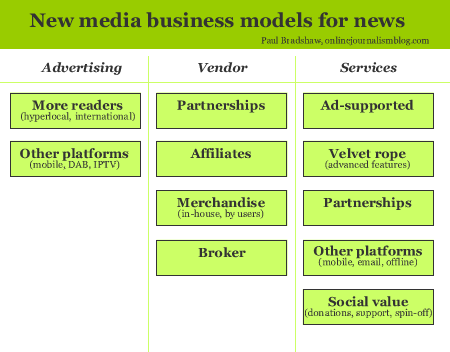
Making money from journalism: new media business models (A model for the 21st century newsroom pt5)

In the final part of the Model for the 21st Century Newsroom I look at how new media has compounded problems in news organisations’ core business models – and the new business models which it could begin to explore.

Let’s start by looking at the traditional newspaper business model. This has rested on selling, in a broad simplification, three things:

  • Advertising. Put more explicitly: selling readers to advertisers.
  • Selling content to readers, and, twinned with that:
  • Selling the delivery platform to readers – i.e. the paper

Developments in the past few decades have eaten into each of those areas as follows: Continue reading

Five Ws and a H that should come after every story – update

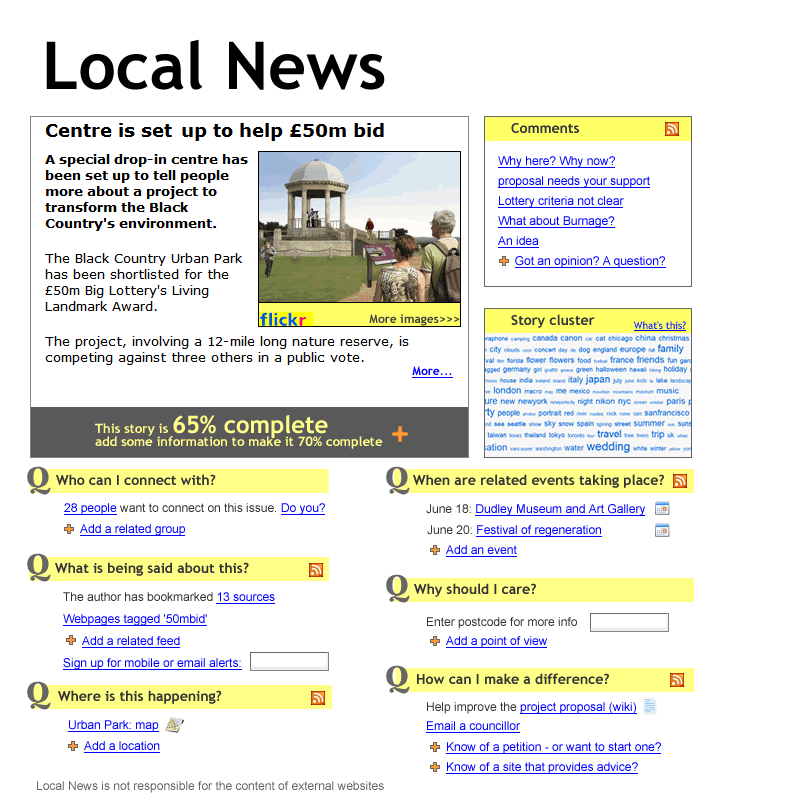
Since I wrote the Five W’s and a H that should come *after* every story post I’ve been responding to the hugely helpful posts and leads, and developing the idea further. As the deadline for Round 2 of the Knight News Challenge looms on Friday I thought I would post the latest on how the idea is shaping up, including a mockup (click for full size):

Conversation Toolkit mockup

So here’s what’s happened since that first post: Continue reading

Help make ‘5Ws+H’ happen

I felt so strongly about the Five W’s and a H that should come *after* every story that I pitched an idea based on it to the Knight Foundation. It’s called the ‘Conversation Toolkit’, and it’s through to the second round of the Knight News Challenge. Think it sounds like a good idea? Have any improvements? Want to help make it happen, or test it out? Then log on to the idea wiki at http://bidideas.pbwiki.com/conversationtoolkit (password: idea) and add what you can, or contact me directly.

Here’s the text so far: Continue reading

Five W’s and a H that should come *after* every story (A model for the 21st century newsroom: pt3)

So far this model has looked at sourcing stories in the new media age, and reporting a news story in the new media age. In this third part I look at what should happen after a news story has been reported, using a familiar framework: the 5 Ws and a H – who, what, where, why, when and how.

Five W’s and a H that should come *after* every story

A web page – unlike a newspaper, magazine or broadcast – is never finished – or at least, can always be updated. Its permanence is central to its power, and relates directly to its connectivity (and therefore visibility).

Once out there it can be linked to, commented on, discussed, dissected, tagged, bookmarked and sent to a friend. That can take place on the original news site, but it probably doesn’t. The story is no longer yours. So once the news site has added comments, a message board, ’email to a friend’ boxes and ‘bookmark this’ buttons, what more can it do? Continue reading