Category Archives: newspapers

Newspapers: turn off your RSS feeds

Update, 2 days later: Paul lets me guest post here (ie I wrote this, not him). It was going fairly well until I wrote this post … You can read my climbdown here

The latest subscriber figures (see table below, and first published in my blog’s newspapers category) show that, apart from a couple of exceptions, it’s time for newspapers to turn off their RSS feeds – and hand over the server space, technical support and webpage real estate to an alternative, such as their Twitter accounts.

(You can read some of the defences of RSS here and here)

The table below shows that only 3 of the 9 national newspapers have an RSS feed with more than 10,000 subscribers in Google Reader.

And most newspaper RSS feeds have readerships in the 00s, if that.

melanie-phillips-rssDaily Mail columnist Melanie Phillips has just 11 subscribers to her RSS feed (maybe there’s hope for the UK population yet …).

Despite having virtually no users, the Mail churns out 160 RSS feeds and the Mirror 280. All so a couple of thousand people can look at them in total.

The other papers are just as bad. And while the Guardian has a couple of RSS readers with decent numbers (partly because Google recommends it in its news bundle), it has more feeds than there are people in the UK … Continue reading

St Petersburg Times: cautiously embracing the web, assiduously reporting Scientology

Scientology has long been a tricky subject for journalists to cover; the corporate-structured religious movement has a reputation for litigation, against government agencies, news organisations and individuals.

Given this it is all the more interesting to consider the recent series of articles about Scientology in Florida’s St Petersburg Times, which focus on the behaviour of its leader David Miscavige and offer a counterpoint to the Church’s own line that “since the founding of the first Church of Scientology in 1954, Scientology has become the fastest-growing religion in the world.”

The Times presented the series as three large articles (totalling nearly 15,000 words, with the first article alone stacking up 6,618) published across print and web over three consecutive days, starting on Sunday 21st June. In addition the paper ran ancillary features which fleshed out elements of the main story, provided historical context, and also laid out some of the raw material which helped to underpin the series. Continue reading

Daily express website relaunching

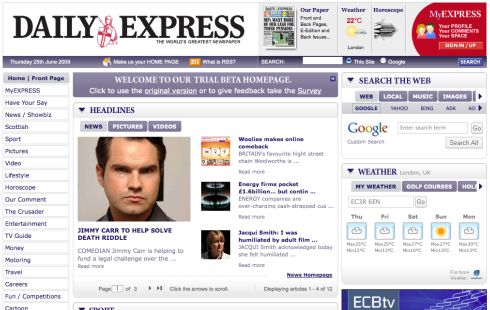
Express.co.uk is about to undergo a redesign (and there’s a good review of the new look, still currently in beta, at econsultancy).

To me, the new site isn’t that impressive (screenshot below, or you can compare the old front page or new front page) – it looks like a poor mashup of the BBC and Yahoo in the existing colour scheme.

Even worse, it’s not very accessible as there is literally no content on the new home page with javascript turned off.

The agency behind it is Netro42 who say here about the old version that “Netro42 working in partnership with Northern and Shell quickly established that the key to success was in wholly utilising the digital space.”

Personally, I like to partially use the analogue space when working on websites, but I may be old fashioned.

New Express homepage

New Express homepage

I wonder if the new design means they’ll update their site on a sunday? Or get some better suggested search terms?

ABCe: please sort out your terrible website (again)

In March, I appealed to the Audit Bureau of Circulations to sort out its terrible ABCe website. It’s had a redesign. Here’s a list of its latest problems (originally published here).

If at any point the ABC wants to pay me a consultancy fee, for all this free advice, just leave me a comment to tell me how to receive my money …

All the URLs have changed but there are no redirects

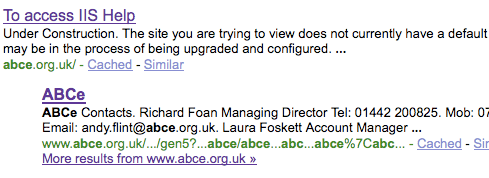
New ABCe homepage in Google

New ABCe homepage in Google

They’ve had a redesign, but they haven’t redirected the old URLs to new ones. So, for instance, if you click the second link shown in Google for a search on ABCe, you get page not found.

Lesson When relaunching a website, always 301 redirect your old pages to new ones (even if they’re all just to your new home page). That way, external links still work and you keep the SEO benefit of any links.

They haven’t sorted www vs non www

The more observant will have noticed that the title of the first result in that screenshot says ‘To access IIS Help’. The ABC hasn’t realised that abce.org.uk is not the same URL as http://www.abce.org.uk. And if you go to the ABC URLs without www, you get page not found or server errors.

Compare these pages:

and these ones:

Lesson When you set up your website, redirect yourdomain.co.uk/whatever to http://www.yourdomain.co.uk/whatever. And log in to your google webmaster account to set your preferred domain (www or non-www).

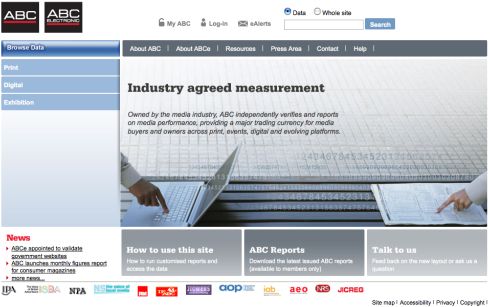
They’re running two absolutely identical websites

ABCs new homepage. No, it's ABCe's. No, it's aaaaggghhh

ABCs new homepage. No, it's ABCe's. No, it's aaaaggghhh

You can access the entire website at www.abc.org.uk – or you can see an identical website at www.abce.org.uk. Continue reading

The complicated case of the (now not) anonymous police blogger, The Times, and ‘public interest’

Widely lauded anonymous police blogger NightJack has had his identity revealed after The Times took the affair to court.

It’s a cloudy affair. The Times’ angle is that media correspondent Patrick Foster wanted to ‘out’ someone he felt “was revealing confidential details about cases, some involving sex offences against children, that could be traced back to genuine prosecutions” as well as offering “advice to people who found themselves the subject of a police investigation.”

NightJack’s case for preventing the publication of his name was that he would be (and indeed has already been) punished by his superiors.

Mr Justice Eady didn’t buy that, saying: “I do not accept that it is part of the court’s function to protect police officers who are, or think they may be, acting in breach of police discipline regulations from coming to the attention of their superiors.”

The Times also reports him as saying “that even if the blogger could have claimed he had a right to anonymity, the judge would have ruled against him on public interest grounds.”

Hugh Tomlinson, QC, for the blogger, had argued that “thousands of regular bloggers who communicate nowadays via the internet under a cloak of anonymity would be horrified to think that the law would do nothing to protect their anonymity of someone carried out the necessary detective work and sought to unmask them”.

The judge said … the blogger needed to show that he had a legally enforceable right to maintain anonymity in the absence of a genuine breach of confidence, by suppressing the fruits of detective work such as that carried out by Mr Foster.

But Mr Justice Eady said that the mere fact that the blogger wanted to remain anonymous did not mean that he had a “reasonable expectation” of doing so; or that The Times was under an enforceable obligation to him to maintain that anonymity.

There are so many elements to this case it’s difficult to pick them apart.

  • On the one hand we have a blog which is potentially, in some circumstances, in contempt of court, written by a policeman who is, strictly speaking, breaking his obligations under the “statutory code governing police behaviour and general public law duty”. That’s The Times’ ‘public interest’, or at least the case that they made (The Times have history here – it would have been interesting to have seen the public interest argument for publishing the name of Girl With A One Track Mind).
  • On the other we have someone’s privacy.
  • But the 3rd point – and it’s interesting that this doesn’t seem to have been used as a defence – is that this is a ruling that has enormous implications for whistleblowers and people blogging ‘on the ground’. That’s someone else’s ‘public interest’.

And that last element is the saddest for me.

With the disappearance of NightJack (his blog has already been deleted*), we lose one more ‘voice on the ground’. While The Times focused on the letter of the law that was being broken, the broader public interest of letting public servants voice their…

frustrations with … attempts at the reform of policing which, he says, has turned officers from “approachable neighbourhood figures into neon-clad stormtroopers.””

…has been ignored.

It is difficult enough to get soldiers to blog, for people to get a genuine feel for the experiences of NHS workers, civil servants and teachers.

And it just got harder.

UPDATE: Curiously, The Times appear to have prevented their reporter from speaking about the issue on Radio 5.

UPDATE 2: A couple of Times journalists have gone on the record with their feelings about the affair.

UPDATE 3: NightJack himself has written a piece in The Times on the story behind the case. Anonymong describes it as “reminiscent of a communist show trial where the accused is allowed to publicly confess their sins and misdemeanors.” But the comments tell a very different story of support.

UPDATE 4: I’ve written a guide to anonymity for bloggers.

UPDATE 5: Via Anonymong:  “as noted by Anna Raccoon there is now some precedent for investigating and publishing identifying material relating to a serving police office as prohibited by the counter terrorism act 2008.”

UPDATE 6: As you’d expect, someone has dug into Patrick Foster’s past and come up with some dirt of their own.

UPDATE 7: Fellow public service blogger and ambulance driver Tom Reynolds gives his views on the case. Chicken Yoghurt gives his on the media’s use of anonymous sources. David MacLean responds: “Of course journalists rely on anonymous sources, but if a rival national newspaper found out who was tipping off a competitor, they’d more than likely expose them if the resulting story would be of interest to the public.”. Emily Bell highlights the raft of furious comments on The Times’ Crime Central blog. Gary Andrews gives his take. And Journalism.co.uk round up some more besides.

UPDATE 8 [Jan 24 2012] It seems that Nightjack’s email was hacked in order to get that story.

(h/t Girlonetrack) *Thanks to Martin in the comments: if you type “site:nightjack.wordpress.com” into Google, the pages appear to be cached. Don’t know how long that will last though.


In defence of paywalls (a thought experiment)

It may be received wisdom that paywalls don’t work, but that seems to me a great reason to challenge that wisdom.

Here’s the thing: the media landscape as we know it is now unsustainable.

It doesn’t matter if all newspapers stopped publishing online overnight, or blocked Google, or anything else. The problem lies offline: the business model no longer supports the debts. The advertising has left the building.

Now news organisations are looking to online to save them.

And hence we come to paywalls.

Turning around a tanker

If you work in a news organisation this is the institutional position: your whole structure is built around selling and distributing 2 things: advertising; and platforms filled with content (newspapers).

Now, when the first (and main) revenue stream goes, what do you do? Do you take a long-view gamble on something that requires you to restructure the culture of your organisation? Or do you go with route of trying, somehow, to get people to pay for content alone?

Seen alone, that may look like a flawed strategy. Your product is perishable, the customers have already paid for the platform, and you don’t control the distribution.

But the people you have to convince in your organisation believe their work is worth paying for. Do you lose time and money convincing them otherwise, or do you move fast because time isn’t something you have to spend?

Do you come up with an idea that requires investment and change – which also takes time – or do you come up with one which adjusts the existing model cheaply – and quickly – and is more likely to bring in some money, even if not at the levels which might secure the long-term future of the organisation?

Do you come up with an idea that looks to protect what revenues you have?

When you’re driving a tanker and you see a big rock ahead – do you ask everyone on the ship to rebuild it as an aeroplane? Or do you start steering away in the hope that your part of the tanker will somehow avoid the worst?

Sometimes we need to make mistakes twice. Sometimes things change enough to make it work second time round. Sometimes it’s in the execution and not the concept. And sometimes things need to get worse before they get better.

What happens next

I can see a number of things happening as a result of news organisations charging for content:

  • First, it will put organisations like the BBC, NPR, ProPublica and (to a lesser extent) Guardian in a strong position to claim they are providing a public service and appeal for, retain, or increase, public and donor funding. Among all of the mercenary rhetoric it’s worth remembering that news has a civic and democratic value as well as a commercial one.
  • Second, it will strengthen the ability of any organisation that has free content to attract larger visitor numbers and therefore higher advertising revenue. In effect, the paywalled news organisations will be giving up on at least part of their advertising, which will actually make it easier for other news organisations to make advertising viable.
    (And yes, paywalls may well be the final nail in the coffin for some companies – it’s fair to say that advertising revenue is now so thinly spread that it will not support the number of media outlets it once did. Let’s not extend that misery. Some news organisations have already lost.)
  • Third, it should put pressure on paywalled news organisations to create unique, valuable content that people are willing to pay for. That’s a very different dynamic to filling column inches with a roundup of what’s happened in the past 24 hours. And it’s a very different commercial context to the one that led to only 12% of stories in the quality press being generated by reporters.
  • Fourth, it will most likely force news organisations to look beyond content alone and towards providing services like those that have given some creative news organisations profit margins of nearly 30 percent.
  • Fifth, for that reason we might discover some models that actually work. And we’ll discover which ones don’t. It’s never as simple as ‘Paywalls don’t work’. History may suggest it’s not a gamble that’s likely to pay off, but there may still be a black swan out there.
  • And finally, it will clear the way for independent media companies and startups to do more with their own content and services, and more agile business models. They will have the luxury of starting from scratch, without debts to service, stakeholders to satisfy, or cultures to rebuild.

So when the alternative is a slow, passive agonising death, let’s stop fussing about hypotheticals and let the Great Paywall Experiment begin.

Telegraph drops to 5th place in Google results for MPs expenses

Google has dropped the Telegraph to 5th place when you search for MPs expenses for some reason, as revealed here.

Last week Google had pages from the BBC 1st and the Telegraph 2nd – even though the Telegraph is the primary source of all this material.

Today the search results are even worse:

  1. In first place, we have the BBC, with one page from yesterday and from October 2004 – is this what seachers want?
  2. Then comes the Guardian, with its MPs’-expenses landing page followed by a story from Saturday. That might be fair enough for 2nd place.
  3. Then theyworkforyou.com – tangentially interesting I suppose, but the page is dated 2004.
  4. Then the Daily Record from Saturday. I’ve nothing against Scottish newspapers. But really – ahead of the Telegraph?
  5. And finally, the Telegraph with one page from Sunday and its MPs’-expenses landing page.

The Telegraph is benefiting from the 3 news stories above the normal results. And Google is probably having trouble identifying the original source because no mainstream news organisations link back to the Telegraph. But for a topical news story, this set of web search results is really bad.

Search results for MPs expenses at Google

Search results for MPs expenses at Google

8% of Telegraph.co.uk traffic from social sites

Telegraph.co.uk gets an amazing 8% of its visitors from social sites like Digg, Delicious, Reddit and Stumbleupon, Julian Sambles, Head of Audience Development, has revealed.

The figure explains how the Telegraph is now the most popular UK newspaper site.

75,000 visitors a day

The Telegraph had about 28 million unique visitors in March, which means social sites are sending it almost 75,000 unique visitors a day.

Search engines are responsible for about a third of the Telegraph’s traffic Julian also revealed – or about 300,000 unique visitors a day.

This means the Telegraph gets 1 social visitor for every 4 search ones – an astonishingly high ratio.

You can read more of what Julian said about the Telegraph’s social media strategy here. The statistics were originally given for an article on social sites on FUMSI.

Which news sites do and don’t get a ‘last updated’ time in Google

Some news sites get a last updated time stamp in Google – and some don’t. It’s a bit of information next to the URL that says XX minutes ago and shows when the most recent story was published.

Not all news sites get it – although I can’t see any rhyme or reason (originally posted here).

Sites that do have it

The sites that do have it are: Times, Telegraph, BBC News, Express, ITN, Guardian. (Click the picture for a bigger version).

News sites with a time stamp

News sites with a time stamp

The Express could probably live without it, as I recently showed that they don’t update their site after 8am on a Sunday. Continue reading

Newspaper websites need to improve their readability

Most newspaper websites are doing a bad design job in making their stories readable. Too many are using:

  • small fonts,
  • long off-putting paragraphs,
  • no subheadings,
  • no in-content boxes or pictures, and
  • no in-content links.

To explain more, I’ve written a companion post on online readability (design, not writing – and this post was first published here). And here’s an example each of their news stories so you can see the issue: Daily Mail, Express, FT, Guardian, Independent, Mirror, Sun, Telegraph, Times.

Main readability design mistakes

This table summarises the main ways they are going wrong.

Tiny fonts

They are all using font sizes that are too small for comfortable reading on copy-heavy pages. Only the Guardian, Independent, Mirror and Telegraph offer obvious controls for resizing text.

But most of the sites use 12 or 13px fonts for body copy. I think this is too small to be the default – 16px is a much more readable size. Only the Guardian comes anywhere near this. Continue reading