Category Archives: social media

Has investigative journalism found its feet online? (part 2)

The first part of this serialised chapter for the forthcoming book Investigative Journalism: Dead or Alive? looked at new business models surrounding investigative journalism. This second part looks at how new ways of gathering, producing and distributing investigative journalism are emerging online.

Online investigative journalism as a genre

Over many decades print and broadcast investigative journalism have developed their own languages: the spectacular scoop; the damning document; the reporter-goes-undercover; the doorstep confrontation, and so on. Does online investigative journalism have such a language? Not quite. Like online journalism as a whole, it is still finding its own voice. But this does not mean that it lacks its own voice.

For some the internet appears too fleeting for serious journalism. How can you do justice to a complex issue in 140 characters? How can you penetrate the fog of comment thread flame wars, or the “echo chambers” of users talking to themselves? For others, the internet offers something new: unlimited space for expansion beyond the 1,000 word article or 30-minute broadcast; a place where you might take some knowledge, at least, for granted, instead of having to start from a base of zero. A more cooperative and engaged medium where you can answer questions directly, where your former audience is now also your distributor, your sub-editor, your source.

The difference in perception is largely a result of people mistaking parts for the whole. The internet is not Twitter, or comment threads, or blogs. It is a collection of linked objects and people – in other words: all of the above, operating together, each used, ideally, to their strengths, and also, often in relationship to offline media. Continue reading

When will we stop saying “Pictures from Twitter” and “Video from YouTube”?

Image from YouTube

Image from YouTube

Over the weekend the BBC had to deal with the embarrassing ignorance of someone in their complaints department who appeared to believe that images shared on Twitter were “public domain” and “therefore … not subject to the same copyright laws” as material outside social networks.

A blog post, from online communities adviser Andy Mabbett, gathered thousands of pageviews in a matter of hours before the BBC’s Social Media Editor Chris Hamilton quickly responded:

“We make every effort to contact people, as copyright holders, who’ve taken photos we want to use in our coverage.

“In exceptional situations, ie a major news story, where there is a strong public interest in making a photo available to a wide audience, we may seek clearance after we’ve first used it.”

(Chris also published a blog post yesterday expanding on some of the issues, the comments on which are also worth reading)

The copyright issue – and the existence of a member of BBC staff who hadn’t read the Corporation’s own guidelines on the matter – was a distraction. What really rumbled through the 170+ comments – and indeed Andy’s original complaint – was the issue of attribution.

Continue reading

A quick note to Louise Mensch: sunlight is the best disinfectant

Plenty of others have given their own opinion on MP Louise Mensch’s suggestion that authorities should be able to shut down social media during civil unrest, so I just want to add a couple of experiences:

Here’s the first: when rumours spread about children being kidnapped in supermarket toilets, they first spread by text message (not social media). When they spread via the semi-public Facebook, it was easier for others to raise questions or debunk them. On Twitter – a much more public medium – it seems even harder for rumour to get a foothold.

I’ve written before about similar rumours and how journalists can and do play a role in debunking them.

I’ve also written about the potential for automated debunking. The less ‘social’ a medium, the harder it is to create these automated services, and the harder it is to distribute facts.

Finally, I’ve written about how journalists can use the qualities of social media itself to more easily separate rumour from fact.

Gossip and rumour don’t need social media to spread. Removing social media – in my experience (and that of the police, apparently) – just makes it harder to spot, and debunk.

Q: Who owns a journalist’s Twitter account? A: The users

Screengrab of Laura Kuenssberg's Twitter settings renamed to ITV

image from Tom Callow's Wall blog

When Laura Kuenssberg announced she was leaving the BBC for ITV, much was made of what might happen to her Twitter account. Was @BBCLauraK owned by her employer? (After all, it was branded as such, promoted on TV, and tweets were ‘processed’ by BBC producers). Or should Laura be able to take it with her? (After all, it was Laura that people were following, rather than a generic BBC political news feed).

The implications for the ‘journalist as brand‘ meme were well explored too, while newly empowered journalists may have been concerned to read that companies are inserting social media clauses into contracts:

“To keep hold of the good will created by a brand personality. Recruiters, for example, are often required to hand over their LinkedIn accounts upon leaving, so their contacts remain with the employer.”

Amidst all the speculation, Tom Callow stood out in offering some hard facts:

“When she had earlier tweeted the details of a new separate ITV account to her then 59,000 followers, only around 1,000 of them started following the new account.”

This sounds compelling until you remember that tweets are only seen for a relatively brief period of time by those followers who happen to be watching at that moment, and that a significant proportion of followers of celebrity/high profile accounts are likely to be idle or spam.

Still, it also highlights the fundamental weakness in all the debates about who ‘owns’ a Twitter account. One very important party is not being represented: the users.

Much of the commentary on Laura Kuenssberg’s move treated her 60,000 followers as an “audience”. But of course, they are not: they are users.

Some will be personal acquaintances; some will be fans of the BBC’s political coverage; and yes, some will be spam accounts or accounts set up by curious BBC viewers who forgot their password the next day. Some will follow her to ITV, some will follow her replacement at the BBC, and some never worked out how to click ‘unfollow’. (Kuenssberg’s successor – @BBCNormanS – had 5,824 followers after she tweeted a link, according to Paul Gregory, which means that only around 10% of her followers read either of those tweets and acted on them.)

Whether an employer claims ownership of a social media account or not, they cannot ‘own’ the relationship between users and that account. And there will be as many relationships as users. Some passive; some collaborative; some neglected; some exploitative.

It is those relationships that we should be concerned with developing, not the small print of an employee’s contract.

Learning about community strategies: 10 lessons

Back in February I blogged about the process of teaching journalism students to think about working with communities. The results have been positive: even where the strategy itself wasn’t successful, the individuals have learned from its execution, its research, or both. And so, for those who were part of this process – and anyone else who’s interested – I thought I would summarise 10 key themes that came through the resulting work.

1. A community strategy isn’t something you can execute effectively in one month

Perhaps the number one lesson that people drew from the experience was that they should have started early, and done little, often, rather than a lot all at once. There was a tendency to underestimate the needs of community management and a need for better time management.

Communities needed time to “grow organically”, wrote one; it wasn’t a top down approach. Members might also have felt they were being “manipulated” when weeks of inactivity were followed by a flood of posts, links and questions.

Continue reading

FAQ: How can broadcasters benefit from online communities?

Here’s another set of questions I’m answering in public in case anyone wants to ask the same:

How can broadcasters benefit from online communities?

Online communities contain many individuals who will be able to contribute different kinds of value to news production. Most obviously, expertise, opinion, and eyewitness testimony. In addition, they will be able to more effectively distribute parts of a story to ensure that it reaches the right experts, opinion-formers and eyewitnesses. The difference from an audience is that a community tends to be specialised, and connected to each other.

If you rephrase the question as ‘How can broadcasters benefit from people?’ it may be clearer.

How does a broadcaster begin to develop an engaged online community, any tips?

Over time. Rather than asking about how you develop an online community ask yourself instead: how do you begin to develop relationships? Waiting until a major news event happens is a bad strategy: it’s like waiting until someone has won the lottery to decide that you’re suddenly their friend.

Journalists who do this well do a little bit every so often – following people in their field, replying to questions on social networks, contributing to forums and commenting on blogs, and publishing blog posts which are helpful to members of that community rather than simply being about ‘the story’ (for instance, ‘Why’ and ‘How’ questions behind the news).

In case you are aware of networks in the middle east, do you think they are tapping into online communities and social media adequately?

I don’t know the networks well enough to comment – but I do think it’s hard for corporations to tap into communities; it works much better at an individual reporter level.

Can you mention any models whether it is news channels or entertainment television which have developed successful online communities, why do they work?

The most successful examples tend to be newspapers: I think Paul Lewis at The Guardian has done this extremely successfully, and I think Simon Rogers’ Data Blog has also developed a healthy community around data and visualisation. Both of these are probably due in part to the work of Meg Pickard there around community in general.

The BBC’s UGC unit is a good example from broadcasting – although that is less about developing a community as about providing platforms for others to contribute, and a way for journalists to quickly find expertise in those communities. More specifically, Robert Peston and Rory Cellan-Jones use their blogs and Twitter accounts well to connect with people in their fields.

Then of course there’s Andy Carvin at NPR, who is an exemplar of how to do it in radio. There’s so much written about what he does that I won’t repeat it here.

What are the reasons that certain broadcasters cannot connect successfully with online communities?

I expect a significant factor is regulation which requires objectivity from broadcasters but not from newspapers. If you can’t express an opinion then it is difficult to build relationships, and if you are more firmly regulated (which broadcasting is) then you take fewer risks.

Also, there are more intermediaries in broadcasting and fewer reporters who are public-facing, which for some journalists in broadcasting makes the prospect of speaking directly to the former audience that much more intimidating.

Can we go beyond ‘Share on Facebook’?

ProPublica have created a rather wonderful news app around education data. As Nieman reports:

“The app invites both macro and micro analysis, with an implicit focus on personal relevance: You can parse the data by state, or you can drill down to individual schools and districts — the high school you went to, or the one that’s in your neighborhood. And then, even more intriguingly, you can compare schools according to geographical proximity and/or the relative wealth and poverty of their student bodies.”

This is exactly what data journalism is great at.

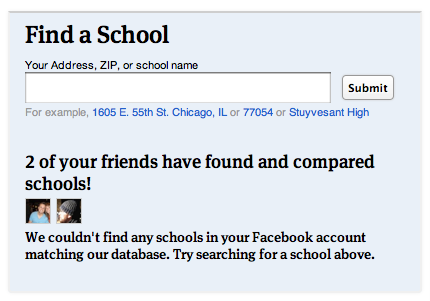
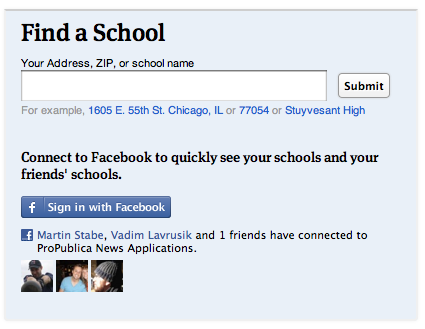
What’s more, the Nieman article talks breathlessly about ProPublica aiming to make data “more social”. What they describe is basically an embedded ‘Share this’ text box (admittedly nicely seamless) and a hashtag. But the news app page actually has a lot more to it: for example, once you’ve given it permission to access your Facebook account, it tells you how many friends have used the app, and appears to try to connect you to schools in your profile. This is how that’s presented on the homepage:

This came as a refreshing relief, because the ‘share this’ strategy reminds me of organisations who say their social media strategy is to ‘get everyone on Twitter’.

Still, it made me think of the range of challenges that Facebook and other social media platforms present. For example, if you land on one of the comparison pages, the offering isn’t so compelling: the reason to install the Facebook app is just “Share this”.

As I’ve written before, technology is a tool, not a strategy, so here are some other opportunities that might be explored:

  1. Publish your school’s scores to Facebook graphically, not just the generic link. Images work particularly well in news feeds, and would be much better than the dry list of names that is generated by the ‘Share this’ button.
  2. Turn conventional news values on their head: be positive. This is a curious one: positive headlines seem to get shared more on social media, so could users celebrate their school’s ratings as much as bemoan them? Could they generate a virtual report card with a ‘Try harder!’ line? Imagine a Facebook editor who asks “Where can we put the exclamation mark?” Yes, I know, it makes me feel uncomfortable too – but I also hear Yoda’s voice saying “You must unlearn what you have learned…”
  3. Build on where they’ve come from: if a friend has used the app to send them to a comparison page, can you build on that in the way you invite the user to connect through Facebook? Could they add something to what the friend has done, and correspond back and forth?
  4. A Facebook-based quiz which sees how well you guess where your school rates on different scales. Perhaps you could compete against your current or former classmates…
  5. A campaigning tool that would allow people to use data on their local school to petition for more support –
  6. Or a collaboration tool to help parents and students raise money, or organise provision.

Competition, fun, campaigning, conversation, collaborating – those are genuinely social applications of technology. It would be interesting to start a discussion about what else might suit a news app’s integration with Facebook. Any ideas?

Crowdfunding in Spanish journalism: 5×55 Terrassa

Cross-posted by Silvia Cobo from her blog.

Eduard Martín-Borregón is a freelance journalist based in Terrassa, a town 30km from Barcelona. The media landscape in this city is quite small: a local newspaper without a website, some local public radio, one local TV station and couple of websites. In contrast, the city have a lively amount of bloggers.

During the last election campaign Eduard wanted to show that was possible to make an informative project connecting politics and citizens, even without big resources: “8 years ago it would have been unthinkable that a single person could do this.”

And so he launched 5x55terrassa.org.

5×55

The idea of the project is simple: 5 questions to 55 people from Terrassa. 55 video interviews with different people about the present and future of Terrassa divided on 12 different areas.

The local elections took place on the 21th May. He published the interviews on 5x55terrassa.org daily between March 7 and May 20, using publishing platforms including Tumblr and Vimeo, and social media platforms such as Twitter and Facebook to promote the project.

The result is a mosaic of people’s lives, a picture of those who, in many different ways, make up the city.

But Eduard wanted to go a step further. He had many hours of good quality video interviews with different people from the city. What to do? He decided to transform all this video in a documentary, to be premiered – he hoped – at one of the city’s cinemas. Would people pay to have this document on DVD?

Crowdfunding the DVD

And that’s where the online crowdfunding platform Verkami comes in.

The aim was to cover the cost of publishing the story on DVD. Eduard needed 500 euros and asked for this money on Verkami, offering different ways to sponsor the project, purchasing the DVD and getting a ticket for the cinema release in Terrassa.

He collected the money in 40 days, with 32 people participating.

Eduard is now preparing the script. He says the experience has given him more knowledge about social platforms and the boundaries and narratives that work best online. He admits that the project has also given him greater visibility as a journalist online and in the city of Terrassa.

What I learned from the Facebook Page experiment – and what happens next

Paul Bradshaw Facebook page

Cross-posted from the BBC College of Journalism blog:

Last week my experiment in running a blog entirely through a Facebook Page quietly came to the end of its allotted four weeks. It’s been a useful exercise, and I’m going to adapt the experiment slightly. Here’s what I’ve learned:

It suits emotive material

The most popular posts during that month were simple links that dealt with controversy – Isle of Wight council talking about withdrawing accreditation if a blogger refused to pre-moderate comments; and the wider issue of being denied access to public documents or meetings on the basis of blogging.

This isn’t a shock – research into Facebook tends to draw similar conclusions about the value of ‘social’ content.

That said, it’s hard to draw firm conclusions because the Insights data only gives numbers on posts after June 9 (when I posted a book chapter as a series of Notes), and the network effects will have changed as the page accumulated Likes.

UPDATE: Scrolling down the page each update does have impressions and interaction data on it in light grey – I’m not sure why these are not included in the Insights data (perhaps that service only kicks in after a certain number of Likes). But they do confirm that links get much higher traffic than Notes.

It requires more effort than most blogs

With most blogging it’s quite easy to ‘just do it’ and then figure out the bells and whistles later. With a Facebook Page I think a bit of preparation goes a long way – especially to avoid problems later on.

Firstly, there’s the choice whether to start one from scratch or convert an existing Facebook account into a Page.

Secondly, there’s the page name itself: at first you can edit this, but after 100 Likes you can’t. That leaves my ‘Paul Bradshaw’s Online Journalism Blog on FB for 1 month‘ looking a bit silly 5 weeks later. (It would be nice if Facebook warned you that this was happening)

Thirdly, if you want write more than 420 characters, you’ll need to use Notes (ideally, when logged on as the Page itself, which will result in the Note being auto-posted to the wall). And if you want to link phrases without leaving littering the note with ugly URLs, you’ll need to use HTML code.

Next, there’s integration with other online presences. Here are the apps I used:

  1. RSS Graffiti (for auto-posting RSS feeds from elsewhere)
  2. Slideshare (adds a new tab for your presentations on that site)
  3. Cueler YouTube (pulls new updates from your YouTube account)
  4. Tweets to Pages (pulls from your Twitter account into a new tab)

There’s also Smart Twitter for Pages which publishes page updates to Twitter; or you can use Facebook’s own Twitter page to link pages to Twitter.

Finally, I was thankful that I had used a Feedburner account for the Online Journalism Blog RSS feed. That allowed me to change the settings so that subscribers to the blog would still receive updates from the Facebook page (which also has an RSS feed) – and change it back afterwards.

It’s not suited for anything you might intend to find later

Although Vadim Lavrusik pointed out that you can find the Facebook page through Google or Facebook’s own search, individual posts are rather more difficult to track down.

The lack of tags and categories also make it difficult to retrieve updates and notes – and highlight the problems for search engine optimisation.

This created a curious tension: on the one hand, short term traffic to individual posts was probably higher than I would normally get on the blog outside Facebook. On the other, there was little opportunity for long term traffic: there was no footprint of inbound links for Google to follow.

This may not be a problem for local, hard news organisations which have a rapid turnover of content, no need to rank in Google News, and little value in the archives.

But there are too many drawbacks for most to move (as Rockville Central’s blog recently did) completely to Facebook. It simply leaves you too isolated, too ephemeral, and too vulnerable to changes in Facebook’s policies.

Part of a network strategy

So in short, while it’s great for short term traffic, it’s bad for traffic long-term. It’s better for ongoing work and linking than more finished articles. It shouldn’t be viewed in isolation from the rest of the web, but rather as one more prong in a distributed strategy: just as I tweet some things, Tumblelog others, and just share or bookmark others, Facebook Pages fit in somewhere amidst all of that.

Now I just need to keep on working out exactly how.