Following Malcolm Coles’ piece on how the Guardian, Times and FT are winning on Twitter, Sothisischristmas graphed the results:
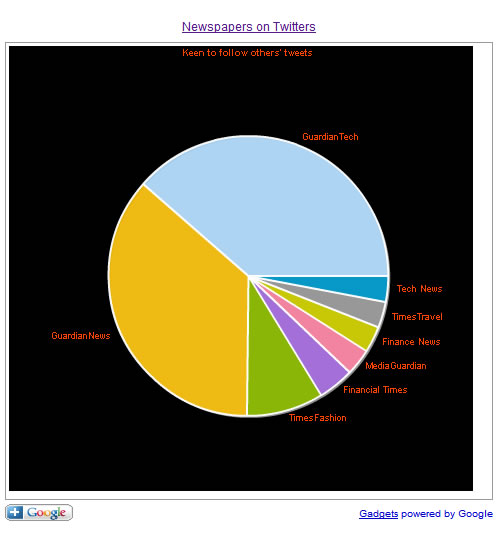

Following Malcolm Coles’ piece on how the Guardian, Times and FT are winning on Twitter, Sothisischristmas graphed the results:
Other people have tweeted (or retweeted) the Guardian’s URLs 328,288 times over the last 4 months – way more than any other UK newspaper, according to my full analysis here.
The FT and Times have more followers on Twitter than the Telegraph and Mail – but they’re not tweeted about as often. The Telegraph is in second place: 120,731 tweets by other people (ie excluding the Telegraph’s own accounts) have included a link to one if its URLs. The Daily Mail is 3rd with 95,851.
National newspapers have a total of 1,068,898 followers across their 120 official Twitter accounts – with the Guardian, Times and FT the only three papers in the top 10. That’s according to a massive count of newspaper’s twitter accounts I’ve done (there’s a table of all 120 at that link).
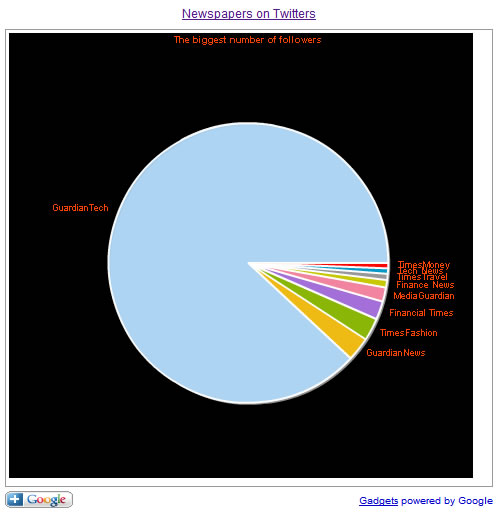
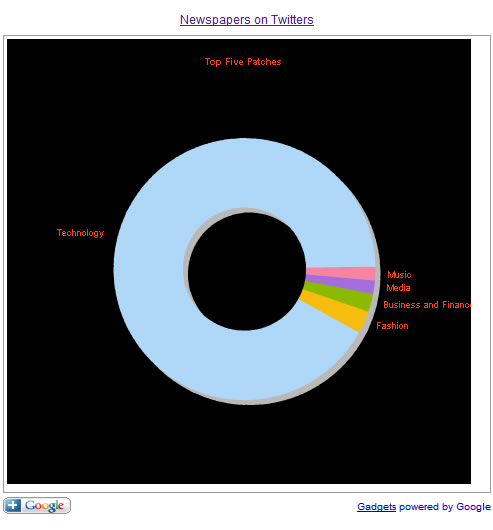
The Guardian’s the clear winner, as its place on the Twitter Suggested User List means that its @GuardianTech account has 831,935 followers – 78% of the total …
@GuardianNews is 2nd with 25,992 followers, @TimesFashion is 3rd with 24,762 and @FinancialTimes 4th with 19,923.

Screenshot of the data
The full spreadsheet of data is here (and I’ll keep it up to date with any accounts the papers forgot to mention on their own sites)… It’s based on official Twitter accounts – not individual journalists’. I’ve rounded up some other Twitter statistics if you’re interested.
I follow the BBC World, the Guardian and the New York Times through my Twitter account, among other news services, but I get more news and information from the friends I follow on the microblogging service. My friends just happen to read stories from a wide variety of sources and pass along the kind of information they are interested in, and that by extension, I am interested in. In other words, they act as my personal filters for news. And I can safely say that I return the favor for several of my friends as well.
This concept is not exclusive to the new media world. Since the 1940s, media scholars such as Paul Lazarsfeld have spoken about the two-step flow of communication where “opinion leaders” play a huge part in transmitting information from the media to its audience. These mediators help the process by disseminating news in a more concise, intelligible way, but also often infuse their personal agendas and perspectives. Opinion leaders have always existed; who they might be and how you obtain your information from them has changed over time. Continue reading
On the day that Parliament released MPs’ expenses in their ‘official’ form, I was hawking around on Twitter trying to find a good way to crowdsource analysis of the documents (this was before The Guardian’s crowdsourcing tool went live).
Central to the problem was that the expenses were presented in search-unfriendly PDFs. So I was looking for a place people could upload those PDFs and post comments, tag and annotate them.
Scribd was the obvious option: you can comment and tag – but not annotate. After a number of responses on Twitter (in particular Jen Michaels’ suggestions and Marcelo Soares, who had converted Brazilian parliamentary salaries from PDF to Excel with Able2Extract), I had one from Fred Howell of A.nnotate.
A.nnotate was indeed an ideal candidate – however, the website charges for use, which made it redundant for crowdsourcing purposes. But I was feeling cheeky…
“Perhaps you could let users do #mpexpenses for free as a great bit of PR?” I asked.
Fred saw the potential. Within a couple of hours he had twittered back:
“Put a list of all #mpexpenses pdfs for free shared online annotation at : http://a.nnotate.com/beta/mpexpenses/”
So credit to Fred – and the power of Twitter. Had The Guardian not created their tool, we had hacked together our own platform within hours – and there lies lesson #1: the power of the web to enable people to mobilise very quickly. It also brought to mind something I said to a group of people at an event the same day: don’t obsess with the tools – the networks are more important: because through the networks you should be able to find someone who knows the tools, or how to use them.
The Guardian meant Fred’s efforts were – this week – to no avail. But in the longer term, I know who to turn to if I need a bunch of PDFs annotated – as will anyone else who saw those tweets. And anyone reading this blog post will know about A.nnotate too. So there is lesson #2: it wasn’t the PR of ‘delivering a message’ but simply ‘doing a good turn’, which in social media is the best PR there is.
But I still wish there was a free online PDF upload service that did annotation.
It’s often said that Twitter’s big advantage over Google is its ability to allow you to conduct ‘real time search’ – if an event is happening right now, you don’t search Google, you search Twitter.
But today Google has announced a series of features that, while still not offering real time search, take it just that bit closer. For me it is the most significant change to Google’s core service in years.
Here’s the video:
This week, while talking to my students about the ability to search by date in Google, the computer assisted reporting blogger Murray Dick mentioned how unreliable the feature was, so I wouldn’t get too excited.
What is new, however, is the ‘recent search’ facility, which brings up results from the past hour or two. Continue reading
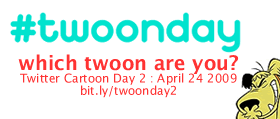
Today is Twitter Cartoon Day 2 – or, for brevity’s sake: Twoonday.
The idea is simple: cheer up the Twittersphere by changing your avatar (picture) to a cartoon character.
Last year was fun, but this year there are more of us on Twitter, and more things we can do.
There’s a Flickr group where you can submit your screengrabs, and @AlexGamela is creating a Google Map of Twooning Twitterers. I’ll also be creating a tagcloud of the words most used with the #twoonday tag (thanks to @psychemedia for help with that).
The image above is designed to fit neatly on Twitter wallpaper. A larger version is available on Flickr.
Tag your tweets #twoonday to join the fun. Follow the tag here.
After all, it’s Friday!
Following on from the previous Something for the Weekend, Twickie, which allows you to collect responses to a question posted on Twitter, this tool allows you to present a conversation – with impressive control.
QuoteURL allows you to drag and drop (or copy and paste) Twitter tweet URLs to reconstruct a conversation. Continue reading
3 weeks ago my class of online journalism students were introduced to the website they were going to be working on: BirminghamRecycled.co.uk – environmental news for Birmingham and the West Midlands.
The site has been built by final year journalism degree student Kasper Sorensen, who studied the online journalism module last year.
In building and running the service Kasper has done a number of clever, networked things I thought I should highlight. They include:
The site itself is clever too.
Kasper wanted to explicitly follow a Mashable-style model rather than a traditional news service: he felt an overly formal appearance would undermine his attempts to build a community around the site.
And community is key. When unveiling the site to the journalists Kasper made the following presentation – a wonderful distillation of how journalists need to approach news in a networked world:

Guardian community moderator Todd Nash* makes an interesting suggestion on his blog about the difficulties journalists face in wading through comments on their stories:
“there is potential for news stories to come out of user activity on newspaper websites. Yet, as far as I know, it is not a particularly well-utlised area. Time is clearly an issue here. How many journalists have time to scroll through all of their comments to search for something that could well resemble a needle in a haystack? It was commented that, ironically, freelancers may make better use of this resource as their need for that next story is greater than their staff member counterparts.
“The moderation team at guardian.co.uk now has a Twitter feed @GuardianVoices which highlights good individual comments and interesting debate. Could they be used as a tool to collect potential leads? After all, moderators will already be reading the majority of content of the publication they work for. However, it would require a rather different mindset to look out for story leads compared to the more usual role of finding and removing offensive content.”
It’s an idea worth considering – although, as Todd himself concludes:
“Increased interactivity with users builds trust, which in turn produces a higher class of debate and, with it, more opportunities for follow-up articles. Perhaps it is now time for the journalists to take inspiration from their communities as well.”
That aside, could this work? Could moderators work to identify leads?
*Disclosure: he’s also a former student of mine
 Online Journalism Blog