Category Archives: twitter

How “organised” was the Jan Moir campaign?

Was the campaign against Jan Moir that crashed the PCC website “heavily orchestrated”? Jan Moir herself thinks so. Was it “organised”? The deputy editor of the Telegraph said it was.

If this was the case, who was organising this? “The big gay who runs the internet“? Stephen Fry?

And what do they mean by organised?

Let’s start with 3 definitions:

  1. Functioning within a formal structure, as in the coordination and direction of activities.
  2. Affiliated in an organization, especially a union.
  3. Efficient and methodical.

Of the 3 descriptions, the only one that might apply in this case is the third, and here’s the rub. Imagine the Jan Moir fuss in a world without Twitter: here’s how it unfolded:

  1. Some people read the Jan Moir article and are offended; they forward it to their friends to express disgust.
  2. People complain to the PCC. They also complain to advertisers.
  3. After a while the expressions of disgust reach a celebrity, and a columnist.
  4. The celebrity mentions the article during a public appearance; the columnist writes a column about it. The columnist mentions the parts of the Press Complaints Commission code that the article breaks. Politicians pick it up too.
  5. More people complain. They also complain to advertisers.
  6. The ‘offence’ over the article now becomes a story in itself; the celebrity angle is key to selling the story.
  7. More people complain. They also complain to advertisers.

In a world without Twitter the above might unfold over a series of days. The difference in a world with Twitter is that the above process is accelerated beyond the ability of many people to see, and they think Step 4 is where it begins.

But why does it matter if it’s organised?

But of course this isn’t about definitions, but about the discourse of what ‘organised’ means in this context. It means ‘not spontaneous’; it means ‘not genuine’; it means ‘not valid’.

Although different people may have different (oppositional, negotiated) readings I would argue this is the dominant one, where the discourse of ‘organised’ is being used to marginalise the protests. I will make a bet here that the PCC use that discourse in how they deal with the record numbers of complaints.

Stef Lewandowski hit the nail on the head when he said that it sounded “like the argument from design applied to social media”.

Help me investigate this

But what would be really interesting here is to test the hypotheses against some evidence: I want to see just how organised the ‘campaign’ was. How important were the celebrities and the formal organisations?

I’m using Help Me Investigate to see if we can work out what level of organisation there was in the campaign. So far, thanks to Kevin Sablan we have a key part of the evidence: all the #janmoir tweets since October 14. And some suggestions on how to analyse that from Ethan Zuckerman (who’s been here before): “grab all #janmoir tweets, do word freq. analysis esp on RTs, look to see if it’s grassroots or one instigator, amplified…”

If you need an invite, let me know.

And if you have any ideas how you can measure the organisation of a campaign like this, I’d welcome them.
Notes on #janmoir – don’t ‘blame’ Fry

I’ve seen a few media reports now on yesterday’s unprecedented new media revolt against the Daily Mail.

Of all of them the Huffington Post’s takes the biscuit for ‘worst take’. They reckon it’s about a fight between the Daily Mail and The Guardian. Seriously. I suspect a showbizzy intern selected their quote heavy, googled contribution.

A meme in practically all the reports is the role of Stephen Fry. This has now culminated in a Telegraph piece titled ‘Don’t laugh – Stephen Fry is giving the orders now.’

Those, like Fry, who are “deeply dippy about all things digital”, argue that the internet is the ultimate tool of democracy. But it could just be that historians – if they are so permitted – might look back on this period as the moment when the techno-savvy few seized control of the minds of the many.

The blogger Guido Fawkes seems effectively to run British politics. Ashton Kutcher – actor and tweeter with over three million followers: “life isn’t tied with a bow, but it’s still a gift” – is our spiritual leader. And Fry? Well, he’s bigger than both of them.

Where to start? Iain Dale has a lot more blog traffic than Guido. Not sure what Kutcher’s in there for save to keep the ‘celeb’s rule’ idea going (and his Twitter following like that of other Hollywood celebs doesn’t seem to translate to followers automatically watching their shows). And as for Fry?

I was actually dipping in-and-out of the #janmoir Twitter stream yesterday and very, very few of the tweets were Fry Retweets. Sure, his numbers are huge but the ‘Twitosphere’ is far, far, far huger. Presumably far too huge for most journalist’s to get their minds around.

By 2010, 26 Million (1 in 7) U.S. Adults Will Use Twitter Monthly.

Edited to add: Thanks to to commentator Ian Hopkinson for pointing to some evidence.

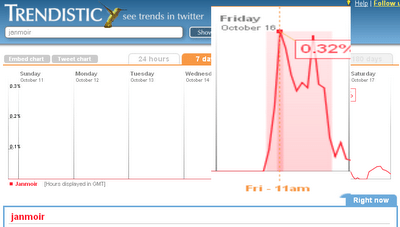
Here’s the trendastic tracking of #janmoir

Showing it peaking at 11am – @stephenfry first tweet on #janmoir was at 12:27pm.

What the ubiquitous Fry mentions in their reports are about is a journalistic laziness and the ever-present need for a celeb mention. A real piece of good work would be to actually track #janmoir all the way from where the first rock was thrown out to the furthest reach of the ripples.

Such as the excellent American analyst Evgeny Morozov‘s tweet:

notes on the new public sphere: Twitter has shrunk the Atlantic and purely local UK scandals are now global news

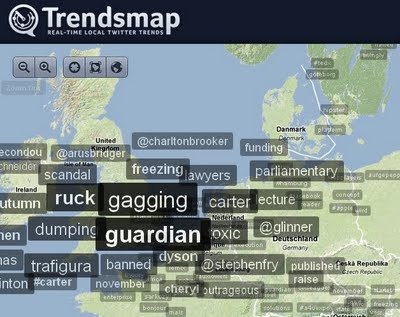
That’s why HuffPost bothered putting Gately on the front page – #janmoir was number one or two trending topic when they woke up, and it had that celeb angle they love. 

It’s notable that they’ve ignored what it by far the most game-changing event on Twitter this week, #trafigura – something which Gill Hornby in the Telegraph thinks is also down to Mr Fry.

From his palm-top device .. he struck a major blow for press freedom – when the Dutch company Trafigura won an order preventing the press from discussing the impact of its pollutants on the African coast, Fry tweeted the details to his vast audience and the gag was lifted.

Sigh.

How to spot a hoax Twitter account – a case study

Fake Jan Moir tweets on Twitter

The fake Jan Moir lays some too-good-to-be-true bait on Twitter

If you were following the Jan Moir-Stephen Gateley story that was all over Twitter today you may have come across a Twitter account claiming to be Jan Moir herself – @janmoir_uk. It wasn’t her – but it was a convincing attempt, and I thought it might be worth picking out how I and other Twitter users tried to work out the account’s legitimacy.

The too-good-to-be-true test

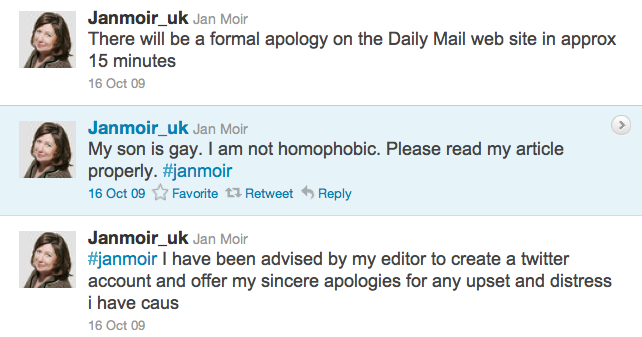
The first test in these cases is the too-good-to-be-true test, and this works on a number of levels. Jan Moir tweeting in itself was a great story – but not completely unbelievable. Her second tweet said “I have been advised by my editor to create a twitter account and offer my sincere apologies for any upset and distress i have caus” [sic] – a superficially plausible story. Would you buy it?

But there were some other too-good-to-be-true claims in her tweets. One said “My son is gay. I am not homophobic. Please read my article properly.” Does Jan Moir have a son? Is he gay? Would she announce it on Twitter? Continue reading

Jan Moir is a heterosexist

Now anyone whose reads me knows I like video .. So watch this …

N’kay. All done?

Jan Moir is a Daily Mail columnist whose printed words have today caused her to reach for her boss’ PR agency (because of an Internet revolt that Twitter was at the heart of that blew up the Press Complaints Commission’s website) in order to say she’s not what you think she is.

That is significant. Today was significant. Social media made this happen – apparently the Mail doesn’t usually respond within hours to outrage at its contents.

But listen to what Richard Yates, from black experience, is telling you – focus on what they said, not who you think they are.

And this is very relevant to this situation. The Mail, and others, publish Moir’s sort of rant all the time. In the official ‘process’ it will be judged on what she said, not who she is accused of being.

If what we want is what she (and others) write banished from the mainstream, not to silence but to place them firmly on the fringes, then how is that achieved?

How do we define her words? I ask, is what she wrote heterosexist or is it homophobic?

Cue Wikipedia:

Heterosexism is a term that applies to negative attitudes, bias, and discrimination in favor of opposite-sex sexuality and relationships. It can include the presumption that everyone is heterosexual or that opposite-sex attractions and relationships are the norm and therefore superior.

Homophobia (from Greek homós: one and the same; phóbos: fear, phobia) is defined as an “irrational fear of, aversion to, or discrimination against homosexuality or homosexuals”, or individuals perceived to be homosexual; it is also defined as “unreasoning fear of or antipathy toward homosexuals and homosexuality”, “fear of or contempt for lesbians and gay men”, as well as “behavior based on such a feeling”.

I don’t think Jan Moir is about fear, she’s about superiority. I think this because that’s what she wrote.

Yates is laying out for us how, exactly, we undermine the sort of power which a Moir (there’s a type) wields, especially including their power in claims of ‘victim’ or ‘silencing’. Here’s a template, from other minorities, which should be grasped in order to define her as ‘fringe’, ‘extreme’, someone who says she’s superior.

Drop ‘Moir is homophobic’ for ‘Moir is heterosexist’.

That’s my contribution to the aftermath of today: Learn from others and be precise in attacking power.

Make them go look ‘heterosexist’ up and in the process completely change the coming debate over ‘silencing free speech’, the ‘power of the mob’ and the ubiquitous raising of that cop-out phrase ‘PC’.

Mugging the lawyers

If the famous media gaggers, the libel law firm Carter-Ruck, scourge of Private Eye, thought they’d scored another famous victory suppressing news (these guys are big on bragging) they hadn’t reckoned with social media.

#trafigura is as I type the #1 trending topic on Twitter (that’s in the whole world). The Spectator has already broken the wall between what the blogs will say and what the print media thinks it can get away with … and many, many more people are now aware of the very story a very rich set of people running a polluting company is paying them – presumably – many millions to kill.

In a few hours American bloggers will start picking up on the story enmasse. What’s Carter-Ruck going to do then? As @ElrikMerlin just pointed out to me ‘this is Streisand Effect in action’ – something which I have blogged about before.

When Uzbek billionaire Alisher Usmanov tried the same trick, and created the same effect, it generated this quote from Boris Johnson (one of those inadvertently whacked by Usmanov’s ‘take-down’ action):

We live in a world where internet communication is increasingly vital, and this is a serious erosion of free speech.

This is what Carter-Ruck did: Continue reading

@Guardiantech accounts for 78% of the growth in national newspaper Twitter accounts

National UK newspapers had 1,665,202 followers of their Twitter accounts at the start of October – an increase of 193,266 on September 1st (when they had 1,471,936).

The rate of growth has slowed, however. This is a monthly increase of 13.1%, compared with 17% from August 1 to September 1, and also from July 1 to August 1.

What’s more, 151,555 of the increase (or 78% of the total) is down to just one account – that of @guardiantech (which owes its popularity to its place on the Twitter Suggested User List). Indeed, of the 131 accounts I’m tracking, 51 have fewer followers than me (@malcolmcoles)!

You can see the full table here, or below (although the iframe isn’t behaving properly, so you’re better off clicking here).
Continue reading

Search and filter tweets using Friendfeed advanced search

I’ve never been fond of the search engine on Twitter, not the one on search.twitter.com anyway. I have found the ones build on it’s API much friendlier and more intuitive, such as Twitterfall and the integration in Tweetdeck. But none of them work for finding old tweets. Google is not much help either, unless you know how to create your own search engine.

Friendfeed aggregates and stores all the activity that is fed into the system. Most FF users bring in their Twitter feed, in effect storing all their tweets. It works a little bit like Google Reader, once it’s there, it will always be there, even if the original is deleted.

The advanced search features of Friendfeed makes it a pretty good twitter search alternative. It even supports real-time, so you can make your own twitter news monitors.

Searching old tweets

Twitter only keeps tweets in it’s search database for a few weeks, after that they disappear. They’re still available on the web, just not searchable from Twitter (or any thrid party app). That’s great if you just want the real-time view, but not practical when looking for an exact tweet a few weeks old.

I needed to find this tweet from Paul Bradshaw for a presentation, but it was long gone from the internal database. I knew that Paul is using Friendfeed, not actively but he’s sharing his tweets there, so I did this search (Bingo, no. 2 from the top). Here’s the equivalent twitter search which is no help.

From any Friendfeed page, you simple select advanced search at the top, fill in the blanks and you got it. Here’s how mine was filled in.

Real-time “noise” filtering

Some hashtags can get ugly, real quick. There’s no way to filter out the high quality tweets either. People can favorite tweets, but you can’t search them, so no way to filter. When news breaks, there will be a few quality tweets in the beginning, people will retweet the most important. But people quickly starts talking about the event which brings no real value to the table, other than twitter-chatter. Eyewitness accounts and other useful information is lost in the stream because people have no way of marking important tweets for later retrieval (search).

On Friendfeed, people have the option of liking entries, and the advanced search let’s you filter items based on likes or comments. You can now rely on the FF community to mark the important stuff and cut through all (some of) the noise.

Friendfeed advanced search

Here’s an example of a search that filters all tweets with the #iranelection hashtag, and shows only tweets that has 3 or more likes.

Other uses

There are many other ways to search Friendfeed and you can filter for all services like facebook, blogs etc. You can save searches and use them as filters. I have several live searches saved in Friendfeed. Here’s an example of a search that gives me all twitter entries from my friends with one or more comments.

Friendfeed suffers from the fact that it’s userbase is not as big as Twitter’s, but the ‘real’ real-time search more than makes up for that in my opinion. What I mean by real, is that items are published automatically from all services. If you bring in your Flickr, comments and blog activity to Friendfeed, they will publish automatically. Twitter doesn’t do that, you have to actively share the link after you have uploaded to Flickr, made a comment somewhere or updated your blog.

What kind of Twitterer are you?

Here’s a bit of fun for a Friday. Here are 9 types of Twitter user that I reckon exist – you might be able to think of more. I’ve not included spammers and bots because, not existing, they won’t be reading this. So… which one are you?

The Conversationalist

You follow a couple dozen people who mostly follow you back. Most of your tweets start with @. Twitter is the new Facebook to you.

The Polymath

You follow a few thousand people. Twitter is just one big pool of potentially interesting stuff to you, and you’re followed largely by people who feel the same way. Most of your tweets start with RT. Twitter is the new Google Reader to you.

The Networker

You follow a few hundred people, most of whom work in your industry or you know professionally. You try to keep track of most of what they’re saying and your tweets are a mix of replies, retweets and remarks. Twitter is the new LinkedIn for you.

The Broadcaster

You follow half a dozen people who either work with you, or are actually you on another Twitter account. Most of your tweets come from Twitterfeed and end with three dots and a URL. The @ sign never appears in your Twitter stream. Twitter is the new blog for you. With comments disabled.

The Fan

You follow a couple dozen people, mostly DJs and TV personalities, who all ignore your @ messages. You found out about Twitter on the radio and although you talk to your friends about it, you don’t talk to your friends on it. Twitter is the new gossip magazine for you.

The Experimenter

You probably plugged your plant into Twitter or something. It sounded like a good idea at the time.

The Marketer

You follow a few thousand people but never read anything that they say. Your biography includes WORDS IN CAPITALS and reads like you vomited up a pile of business cards. A few hundred people have followed you back by mistake. To you, Twitter is the new email newsletter.

The Misanthrope

Your updates are protected. You never let anyone see your updates. Actually, you never post any updates but no one knows that. Your Twitter account exists purely to annoy people – to you, it’s the new ‘Do Not Disturb’ sign.

The Dabbler

You heard about Twitter on TV, signed up to the site, posted one tweet and wondered why nothing happened. You’ve since forgotten all about it but in 9 months time one of your friends will start following you and it will all make sense. Twitter is the new Friends Reunited to you.

What kind of Twitterer are you?(online surveys)

What’s good for TwitPic may be bad for photojournalists

Yesterday Mashable ran an interesting story about how iPhone will soon become the top camera for images uploaded onto Flickr. Previously that spot belonged to the Canon EOS Digital Rebel XT, which is basically the DSL-R for beginners.

With each production cycle, mobile phone cameras are getting more sophisticated. Meanwhile it’s incredibly easy to upload a just-taken photo from your sophisticated camera phone onto the web. I recently upgraded my BlackBerry to the 8900, which has a 3.2MP auto-focus camera. Not a lot of megapixels, but the autofocus is what makes it a great camera phone. Taking a photo and uploading it to TwitPic takes less than a minute. The quality of the photos are pretty good, too.

The proliferation of iPhones, BlackBerrys and other camera phone brands has meant more people are photographing the things they do and putting them up on the web. For small and mid-size papers, getting art for a story could be as easy as doing a TwitPic search by keyword and see what pops up. If a user-taken photo of an event pops up, you could contact the author, ask for permission and post it. At worst, they’d ask for a small fee, which when paid would still be a money saver compared to sending a photojournalist to an event.

The same could be said for videos. If a video of an event is uploaded to YouTube or any of the other video hosting sites, a news organisation could contact the person who shot it and ask permission to use it.

As the line between reporter and reader becomes further blurred, technological advances and the will of the people may mean that photojournalists are primarily employed by news organisations who feel they can both print the photos and sell the originals for a nice profit.

If the public is providing printable photos either for free or at a fraction of the cost of employing a photojournalist, that won’t be a terribly difficult decision for any executive editor to make.

What happened when Sky News took images from Twitter

Holy crap police man shot at Southwark tube station! on Twitpic

When Sky News needed a picture to illustrate a shooting at Waterloo Station, they found what they needed on Twitter: a photo of the crime scene taken by Joe Neale and posted to Twitter using Twitpic (used above, with permission).

Just one problem: they didn’t bother to tell Joe. Continue reading