Category Archives: user generated content

Trinity Mirror to revamp local websites

Liverpool Echo April 19 07According to Holdthefrontpage.co.uk Trinity Mirror is to upgrade its sites with “breaking news, video, audio, blogs and user-generated content.”

This includes a training programme with “a series of week-long video journalism courses and a series of one-day multimedia workshops, which will be attended by more than 70 journalists in the North West region before being rolled out across the division.”

BBC, UGC and online video

Some insights into the workings of the BBC, UGC and online video from Shane Richmond’s latest post:

“At a time when most newspapers, including this one, are trying to encourage user participation and comments on their sites, the BBC is questioning the need to host those conversations.

“Instead they’re linking their content out to the likes of YouTube, Flickr, Technorati and del.icio.us. Encourage the conversation but let it happen elsewhere.

“The burden of moderation is simply too great. Like us, the BBC moderates comments received from readers, mostly for legal reasons, but as Tom pointed out: “What we call moderation, readers call censorship.”

“The more successful you are at attracting reader responses, he explained, the bigger the problem gets.”

Also:

“One week in November last year, the BBC news site published around 500 pieces of video.

“Analysing the traffic for those clips later, they found that just 30 of them accounted for about half the traffic. They have learned some lessons about what type of video clips work online but mostly they learned to focus on doing less better.”

Defining and conceptualising interactivity

A conversation with a radio colleague yesterday about a new course that I’m involved in – a Masters in Television and Interactive Content – threw up the question of how people define interactivity.

“What you mean by interactivity is probably not what I think of,” he said.

“I see interactivity as giving the user control,” I replied.

“Well OK then, we both think of interactivity in the same way. But to most people interactivity is video on the web and flashy things, which couldn’t be less interactive.”

I began thinking about this idea of how you define interactivity. “Giving the user control” is a nice summary, but what does that mean? How do you conceptualise it to make the process easier? Rolling it over in my head I’ve come up with two dimensions along which interactivity operates. Firstly:

  • Time: where broadcast required the user to be present at a particular time, and print to wait for the next edition, technologies such as Sky+, podcasts, mobile phones and websites allow the audience to consume at a time convenient to them. The PDF newspaper is an interesting development that also allows readers to avoid the dependence on print cycles.
  • Space: where television required the user to be physically present in front of a static set, mobile phones, mp3 players and portable mpeg players and wifi laptops allow the audience to consume in a space convenient to them. Portable radio and portable newspapers have always had this advantage.

Both these seem to be about hardware, and miniaturisation. The second level of interactivity is more about software:

  • Control over output: With linear media like TV, radio and print, the consumer relies on the ability of the producer, editor, etc. to structure how content is presented, or output. New media allows the audience to take some of that control.
    • At a basic level, for instance, hyperlinks allow the reader to dictate their experience of ‘content’.
    • With online video and audio, the user can pause, fast-forward, etc. – and if it has been split into ‘chunks’, the user can choose which bit of a longer video or audio piece they experience.
    • RSS, meanwhile, allows users to create their own media product, combining feeds from newspapers, broadcasters, bloggers, and even del.icio.us tags or Google News search terms.
    • Database-driven content allows the user to shape output based on their input – e.g. by entering their postcode they can read content specific to their area. At a general level search engines would be another example.
    • And Flash interactives allow the user to influence output in a range of ways. This may be as simple as selecting from a range of audio, video, text and still image options. It may be playing a game or quiz, where their interaction (e.g. what answers they get right, how they perform) shapes the output they experience.
  • Control over input: Again, the old media model was one that relied on the producer, editor, etc. to decide on the editorial agenda, and create the products. The audience may have had certain avenues of communication – the letter to the editor; the radio phone-in; the ‘Points of View‘. The new media model, as Dan Gillmor points out, is one that moves from a lecture to a conversation. So:
    • Blogs, podcasts, vlogs, YouTube, MySpace, etc. allow the audience to publish their own media
    • Forums, message boards, chatrooms and comments on mainstream media blogs allow the audience to discuss and influence the content of mainstream media, as well as engaging with each other, bypassing the media
    • Live chats with interviewees and media staff do the same.
    • User generated content/citizen journalism sees mainstream publishers actively seeking out input from consumers, from emails to mobile phone images, video and audio.
    • Wikis allow the audience to create their own collaborative content, which may be facilitated by mainstream media
    • Social recommendation software like del.icio.us, Digg, etc. allow users to influence the ‘headline’ webpages through bookmarking and tags.
    • A similar but separate example is how page view statistics can be used by publishers to rank content by popularity (often displayed side by side with the editorial view of what are the ‘top stories’)
    • I hesitate to add the last example but I will anyway: email. Although we could always, in theory, contact producers and editors by telephone, they didn’t publish their numbers on the ten o’clock news. Email addresses, however, are printed at the end of articles; displayed on screen alongside news reports; read out on radio; and of course displayed online.

I’m sure I’ve missed examples, or entire other dimensions. If you have an input to make, comment away.

MySpace News? Everyone else is doing it…

Terry Heaton’s PoMo Blog is saying that MySpace has a news offering planned in the next few months “according to inside sources and the company’s own sales materials”:

  • “MySpace News takes News to a whole new level by dynamically aggregating real-time news and blogs from top sites around the Web
  • “Creates focused, topical news pages that users can interact and engage with throughout their day
  • “MySpace is making the news social, allowing users to:
    Rate and comment on every news item that comes through the system
    Submit stories they think are cool and even author pieces from their MySpace blog
  • “MySpace users previously had to leave the site to find comprehensive news, gossip, sporting news, etc. With MySpace News, we bring the news to them!

It will be interesting to see what MySpace can bring to the idea – it’s already been tried by The Sun (MySun) and, more recently, USAToday (as Heaton explains in his post), but it’s one thing for a news organisation to try social networking; quite another for a social networking company to try news. I’m hoping for intelligent agents that suggest RSS feeds, or automatically subscribe you to your friends’ blog feeds (I’ve never used the MySpace blog but that might persuade me otherwise), or their RSS feeds, in an Amazon ‘people who liked this also like this’ kind of way.

Given the critical mass of MySpace, could this be the tipping point (I hate that phrase) to bring RSS to the mainstream?

UPDATE: Matthew Ingram has posted his take on the announcement, with some interesting questions:

  • It “could give News Corp. lots of ideas about pushing its news content into such an aggregator, giving it priority of some kind, etc.”
  • “Will News Corp. use its MySpace News as a kind of jungle drum, to pick up stories that might be under the radar?” (my view: sadly, I don’t think so, as this assumes that News Corp. sees journalism as a priority, rather than making money)
  • “News Corp. is also trying to get other video content owners to bring their stuff to MySpace.”

USATODAY.com relaunches

USA TOday April 19 07USATODAY.com has relaunched with, reportedly, more prominent user generated content:

MediaPost reports: “The revamped site, which went live Saturday, enables reader comments on each story and solicits users’ input in the form of photos and movie reviews. USA Today also is aping Digg, the new Netscape and other social news sites that allow readers to determine which stories are most important.”

Editor & Publisher explains: The site has incorporated technology developed by Pluck Corporation to “create a community around the news,” according to a release. Using the new features, users can see other news sources directly on the USA Today site; see others readers’ reactions to stories; recommend content and comments to each other; interact using comments and in public forums, upload digital photographs to the site; write arts and culture reviews of their own; and interact more with the newspaper’s staff.”

There certainly is a lot of UGC there – but the front page would benefit from being slimmed down from the whacking great five pages you have to scroll down (usability expert Jakob Nielsen says three Page Downs should be the maximum) – the best stuff takes two Page Downs to get to – photo galleries, video, blogs, and interactive graphics.

You can also read USA Today’s own blog post on the relaunch.

UPDATE (Apr 16 2007): The relaunch has been quite a success, as IIN reports “a dramatic 380% increase in registrations. Readers are also spending more time per visit on the site.”

Magazines: Web Sites will be about UGC & video

It’s all about user-driven content and video says MediaWeek of the Magazine Publishers of America conference:

“Marthastewart.com, the umbrella Web site of Martha Stewart Living Omnimedia, this summer will introduce new ways for audience members to share information with each other, said Susan Lyne, president and CEO, MSLO. And as MSLO looks for growth avenues, it’s looking at community sites, among other acquisitions.

“Dennis Publishing also is embracing user-driven content, though in a different way. Stephen Colvin, president and CEO, who joined Lyne on the panel, said Dennis’ Maxim magazine has in the works MyMaxim.com. Launching in three to four weeks, the new site will let visitors customize the text, images and video they see when they go there

“Executives noted that the Web has become a strong source of new subscriptions and in so doing, helped magazines lower their direct mail costs.

“Case in point is Blueprint, the lifestyle/shopping magazine MSLO launched with a test issue in May 2006, and which will publish bimonthly this year. The magazine derived two-thirds of its subscriptions for its first two issues from the Internet, Lyne said.

DMNews also reports that “155 magazine digital initiatives have been activated” at the conference:

“MPA members who announced digital initiatives included BusinessWeek, which will offer exclusive online content, a mobile edition for PDAs and cell phones, online business school rankings and multiplatform distribution of rich media and video content.

“Conde Nast, who this year will produce an online film festival, user-generated content on Web sites, interactive dating blogs, an online video series, an online radio station, bridal sites with virtual fitting rooms and PDA-enabled editions with mobile sites and text shopping/buying from cell phones. ”

“A section of Magazine Digital Initiatives has been created on the MPA’s Web site at www.magazine.org. It offers complete, detailed lists of new products and platforms for consumer magazines.

“The lists will be updated weekly and feature information with links to press releases and articles where available.”

I love MEN (for purely journalistic reasons)

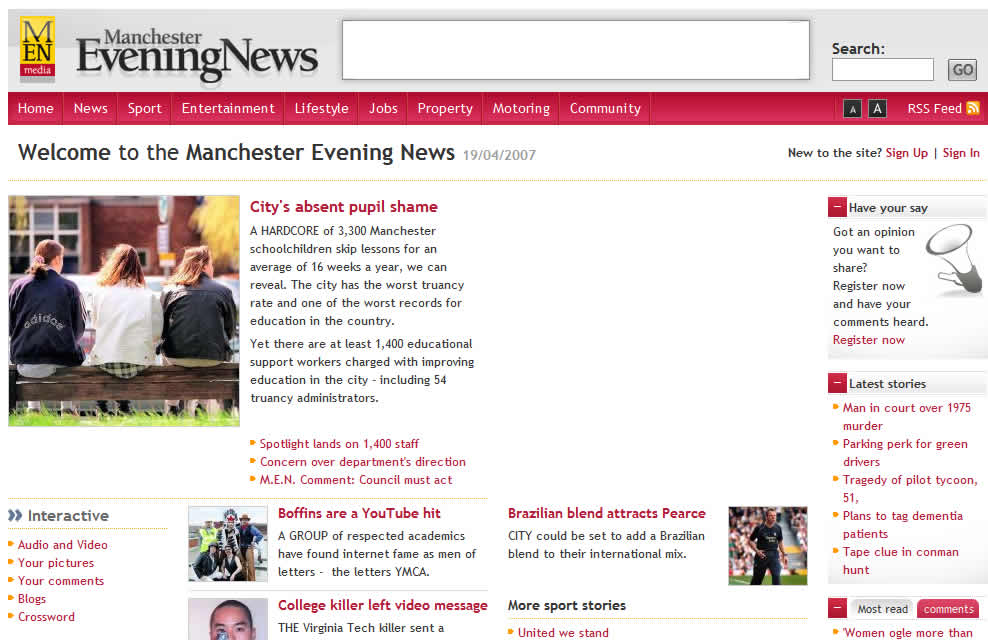
MEN April 19 07Sorry, I couldn’t resist that headline. The Manchester Evening News (MEN) has been relaunched and – forgive me for not knowing which bits are new and which are not, but this really does look very good. Aside from the lovely clean navigation there’s clearly some attention been paid to the strengths of the web:

  • Have Your Say is one of the top boxes
  • There’s a ‘most read/commented’ box as well;
  • ‘your pictures’ and ‘your comments’ are prominent links,
  • there’s a raft of blogs.
  • There’s a ‘community’ section,
  • and audio and video (yes, they’re under ‘interactivity’ which isn’t really that true, but where else would they put it?). At the moment this is still ‘journalist reads headlines over still images’ but at least they’re plugging the forums (not that I could find them). The audio shows promise – an interview with Michael Ball includes a link to the full 12 minute audio.

MediaWeek reports the site has also dumped pop-ups:

“As part of the revamp, which has been a year in development, the site will also introduce more user- generated content and simplify its navigation after complaints it was too cluttered.
“The MEN’s head of online editorial, Sarah Hartley, said the dumping of pop-up and pop-under ads was a big move for the site.”

Citizen journalism discussion

There’s a fairly lengthy discussion about citizen journalism available over at the BBC’s Digital Planet. It’s entry-level stuff – if you’ve heard the phrases “filtering role” and “democratisation” you’ve heard most of it before, although Bill Thomson’s distinction between user generated content (UGC) and citizen journalism (CJ) is interesting: UGC has no commercial value; CJ does.

MSNBC.com shows how to do the citizen journalism thing

FirstPerson, an MSNBC.com project, looks like one of the best mainstream CJ projects I’ve ever seen, combining a number of imaginative requests for user generated content and backing them up with editorial support and filtering, user votes to “engender a sense of ownership and loyalty”, and exposure on TV, as MediaPost reports:

“In recent weeks, FirstPerson tied in with NBC Nightly News’ feature “Trading Places,” a series of reports on adult children caring for their aging parents. Viewers submitted more than 6,000 videos, stories, and photos to FirstPerson editors about dealing with the issue. “

And by the way:

“MSNBC.com isn’t the only news organization introducing reader-generated multimedia content.

“Last week, The New York Times initiated a similar feature for its “Weddings and Celebrations” page by inviting readers to submit videos on the newspaper’s Web site. The video of newly engaged couples will become part of the “How We Met” series, marking the first time the site has published user-generated video.

“Times staffers screen all video submissions. And like MSNBC.com, the paper also has a site that invites auto enthusiasts to post photos and personal stories about their collectible cars. Readers can rate each other’s autos and post comments at collectiblecars.nytimes.com.

“CNN.com has “I Report,” in which consumers can send their stories and video reports to the news organization. The Feb. 26 series of reports delivered weather-related video reports from regular folks around the country.”