Blogging journalists pt 5: Post-publication: “You’ve got to be ready for that conversation”

The 5th part of the results of my survey of blogging journalists looks at how blogging has affected what happens after news is ‘published/broadcast’.

In the post-publication or post-broadcast phase of journalism, blogging has introduced a more iterative and ongoing format. Some phrase this in terms of old media paradigms – the items have “more legs” – while others identify how the previous process of “moving on” to the next big story and forgetting about the old one no longer applies so strongly: Continue reading

Real life tips for changing newsrooms

Here’s my contribution to this weekend’s Carnival of Journalism, on the theme of practical tips for changing newsrooms for a new media age:

1. Set up your systems so that journalists get emails when someone comments on their stories. Nothing kills a conversation like someone who doesn’t listen.

2. Make an effort to meet social media users in your community/beat in person at least once a month (it helps if you set up a meeting or join one that exists). Failing that, have a video conversation. Both strengthen community more than just text. Jo Geary does this brilliantly in Birmingham.

3. Make 30 minutes every week to think about how you do your job, identify problems or frustrations, and blog about it, inviting suggestions on how you can do it better, or asking if others can help.

4. Try a new toy every fortnight – online services like Seesmic, Twitter, blogging, Ning, social bookmarking, Dipity, Yahoo Pipes, Shozu; hardware like the Zoom H2, Flip camcorder, and N95. IF you don’t have any ideas check out TechCrunch.

5. Regularly distribute information internally to all reporters and editors about what is happening on the website – popular stories, most commented on, bookmarked, old stories getting new interest, most visited on mobile, what times most accessed, where traffic is coming from, what search terms are most popular, what stories are getting a ‘long tail’ of small but consistent traffic.

6.If the online side of things seems like ‘extra work’ find out ways to make it less onerous and more automatic – explore Firefox extensions, bookmarking buttons, shortcuts; using ‘downtime’ to update via text or mobile web; and how to syndicate an RSS feed from one place to another (e.g. Twitter’s feed or Delicious feed to your blog).

7. If you are lucky enough to spend most of your time away from a desk and computer, work to keep it that way. A good mobile phone and Shozu may come in useful.

I’d welcome your ideas and reactions.

(Posted from my mobile, so apologies for no links)

Permalink

| Leave a comment  »

Blogging journalists pt 4: Blogs and news production: “I think in hyperlinks, even when working in print”

The 4th part of the results of my survey of blogging journalists looks at how blogs have affected how news production is affected by blogging.

The area where respondents most often identified a change in news production was in the rise of a looser, more personal, and less formal writing style, echoing the findings of Wall (2005). Respondents talked of finding their “voice”, being more informal and “creative”. For some this fed back into the mainstream news vehicles, particularly for broadcast journalists whose work previously involved less writing. Continue reading

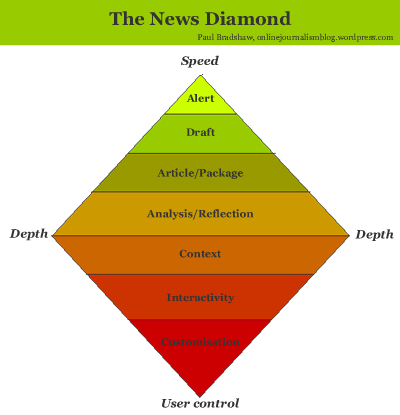
Are you teaching (or being taught) the News Diamond?

A couple of recent emails have brought home to me just how many people are being taught the ‘News Diamond’ model I first proposed as part of my Model for a 21st Century Newsroom series.

So I’d love to know – are you teaching this? What has the reaction been like? Or are you a student learning about it? What do you think?

When I first blogged it I was disappointed by the lack of critical reaction. Come on people, add to it, pick it apart, remix it! Comments please.

Blogging journalists: pt.3: Blogs and story research: “We swapped info”

The third part of the results of my survey of blogging journalists looks at how blogging has affected how stories are researched.

As journalists move onto gathering information for a story, the scope of easily accessible sources is made broader by journalists’ involvement in blogs. Continue reading

Blog Action Day – what are you doing?

It’s Blog Action Day .Here are 88 ways to do something about poverty now.

And if you’re in the Midlands, here’s an 89th: go to the Birmingham Social Media Surgery, to support voluntary and community groups in the city. Credit to Nick Booth for getting things going; credit to the Birmingham blog community for demonstrating once again what a fantastic bunch of people they are.

If you know a language other than English and would like to help Blog Action Day translation work, please email Easton at easton@blogactionday.org.

I’d love to know what you’re doing, blogger or not.

Blogging journalists: pt.2: Blogs and news ideas: “The canary in the mine”

The second part of the results of my survey of blogging journalists looks at how blogs have affected how journalists generate story ideas and leads.

Blogs and news ideas: “The canary in the mine”

Blogging's effect on story ideas by industry

For blogging journalists, blogs have disrupted the traditional processes of journalism in a number of ways.

Respondents spoke of a clearer perception of audience needs and interests as a result of comments and visitor statistics, which in turn fed into the choice of topics and angles to cover. Continue reading

Blogging journalists: survey results pt.1: context and methodology

Back in June I distributed an online survey to find out how journalists with blogs felt their work had been affected by the technology. 200 blogging journalists responded in total, from 30 different countries.

The responses paint an interesting picture: in generating ideas and leads, in gathering information, in news production and post-publication, and most of all in the relationship with the audience, the networked, iterative and conversational nature of the blog format is changing how many journalists work in a number of ways. Continue reading