When social media meets art and creates a new business model

Twit2art is one of those wonderful ideas that captures the age we’re living in – and heading towards. A project by Belgian artist Jan Leenders, it works like this: you send a tweet @twit2art and he’ll make an artwork with it.

So far, so good. But this is where it gets interesting:

“If you’re fast, it’s cheap. The first twit (thus the first painting) costs € 1. The second € 2, the third € 3 and so on. The price includes everything. Material, packaging, shipping, taxes. Everything. Continue reading

Image of the day: celebrities beat politicians hands down

Here’s a little graph using Google Trends to compare how many people have been searching for the terms ‘celebrity’, ‘politician’ and ‘footballer’ in the past few years – more interestingly, along the bottom is how often those terms are mentioned in news articles. Even since 2004 the gap between ‘politician’ and ‘celebrity’ has noticeably widened – particularly since 2007 (narrowing this year, presumably due to the US candidate elections). Continue reading

Another Week in Online Journalism

Virtual intern Natalie Chillington rounds up last week’s online journalism-related news

Google

  • Lots of debate over whether Google is making us stupid

WordPress

  • Puffbox.com announces it will be sponsoring WordCamp UK in July,bringing together around 100 devotees of WordPress in Birmingham for aweekend of code and conversation. Continue reading

Could the BBC – or Channel 4 – be funded by a tax on web and mobile?

Could the BBC be funded by a tax on web and mobile? In France President Sarkozy has just announced that, from next year,

“prime-time advertising on public television will be phased out, with the lost revenues to be replaced by taxes collected from internet, mobile phone and commercial broadcasting companies Continue reading

Semantic Journalism: Ideas

Semantic journalism is a vision for the future of journalism. As the writer works on her article, her computer would gather data on the matter, from pictures to other articles to assessing global opinion trends. It would read through the Wikipedia pages of a given theme and summarize key concepts. A semantic algorithm would bring a selection of the most authoritative people on a subject.

The journalist is left with what she does best: checking and analyzing the data.

That means avoiding the pitfalls of redundant news content. That means escaping the trap of writing about topics without having a clue of what’s at stake. That means interviewing people who do things rather than those who talk about it.

This article is the first of a 4-part series. We’ll explore semantic hacks for newsgathering, writing and publishing in the coming weeks. Continue reading

What online skills should broadcast journalists learn?

A couple months ago I was leafing through the Broadcast Journalism Training Council guidelines. Drawn up a few years ago (well, 2005), they look worryingly similar to those ‘web journalism’ courses that simply consist of teaching journalists to design webpages. In their guidelines [PDF – page 21] they say students should produce: Continue reading

Interview: Charlie Beckett on SuperMedia

“This book is my manifesto for the media as a journalist but also as a citizen of the world. As a journalist you are constantly being told that the news media have enormous power to shape society and events, to change lives and history. So why are we so careless as a society about the future of journalism itself ?” [1]
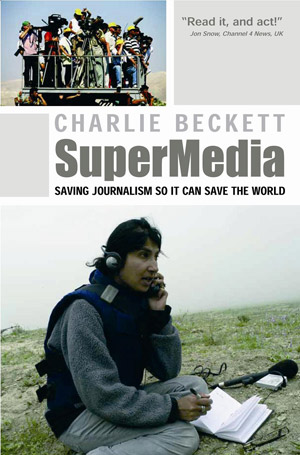
Saving JournalismThis is how Charlie Beckett presents his book “SuperMedia: Saving Journalism So It Can Save The World” (Wiley-Blackwell, 2008), in which he tackles the main challenges to journalistic practice in our days, and its influence to maintain free and democratic societies .

Charlie Beckett is a journalist with a 20 yearscareer at the BBC and ITN, and he is also the founding Director of POLIS, a think tank about journalism and society at the London School of Economics. “SuperMedia” is a work that gathers and structures several streams of thought about the future of Journalism as a essential service to contemporary societies, and how the changes in the news industry, beyond inevitable, are necessary.

Alex Gamela posed a few questions to Charlie Beckett about his book (Portuguese version available here). Continue reading

Live coverage on Twitter – useful or just plain annoying?

My live coverage of the Investigative Journalism Goes Global conference seemed to polarise opinion among the Twitterati. The Guardian’s Neil McIntosh and Charles Arthur, the BBC’s Bill Thompson, and Pete Ashton all unsubscribed from my updates – and those were just the ones I know about. Continue reading

Sky launches Young Journalist Awards for 14-19-year-olds

I’ve had an email about The Sky Young Journalist Awards which “aims to find and celebrate the very best journalist talent across online, television, radio and print.” Its aimed at encouraging 14-19-year-olds to report on local, national or international news stories that matter to them.

It sounds pretty worthy, so here’s the rest of the fluff: Continue reading

Four ways journalists can use Facebook (and other social networks)

The following are answers to a question posed by Greg Manset (via Facebook, naturally):How can journalists use Facebook?

  1. As a great way to find contacts. For example: say you cover the health industry and you add 20 of your contacts to Facebook – by looking at their friends you may be able to find other contacts you wouldn’t otherwise have met. Now, you obviously have to be careful you don’t add whistleblowers or anonymous sources and risk their anonymity, but for most day to day work this can be really useful. I should add that LinkedIn and Twitter can be used in the same way. Continue reading