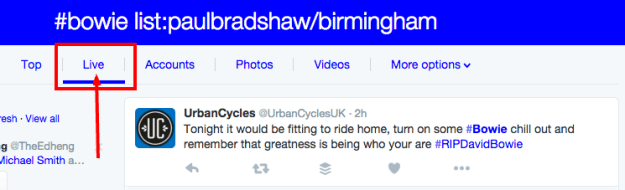
When a national news story breaks and you need local reaction, how do you exclude the national-level updates that dominate all the other coverage? On Twitter there’s a simple answer: search within lists.
Here’s how you do it. Continue reading

When a national news story breaks and you need local reaction, how do you exclude the national-level updates that dominate all the other coverage? On Twitter there’s a simple answer: search within lists.
Here’s how you do it. Continue reading

Peach includes a feature called the ‘looping photobooth’
Will Peach be to 2016 what Meerkat was to 2015? This app fascinates me, but I have very mixed emotions.
Why? Well, this is a new social network which cherry-picks bits of functionality from Twitter, Snapchat, Tumblr and Slack, then adds some Storify-esque built-in media search tools and a bit of text-as-images functionality and its own ‘looping photobooth’.
But it’s the sensor-driven elements which fascinate me. Continue reading
The media’s reaction to David Bowie‘s death from cancer early this morning demonstrates just how widely curation has become in journalism practice – and specifically, how it has become the web native version of the obituary. Below I’ve done a bit of curation of my own: 8 13 16 ways that different publications used curation to mark the death of a legend. If you have seen others, please let me know.
The Telegraph’s live reporting of Bowie’s death is an example of curation itself, incorporating just some of the following elements:

Snapchat’s breaking news coverage was one of the most significant developments of 2015
It’s that time again: Nic Newman‘s email has dropped asking various people to do some highly suspect future-gazing (at least I got WhatsApp and the election right last time). Here are my answers to his questions, delivered with suitable scepticism…
What surprised me most in 2015 is the enormous surge in ‘civic tech‘ around the election compared to 2010: coders collaborating to make apps and websites to help people make an informed decision on their vote. Continue reading
Google organised a free workshop on 14 December 2015 in Birmingham focused on how journalists can use technology to improve and complement their stories.
In this post Carla Pedret summarises some tips Google News Lab’s Matt Cooke gave during the event. You can read more about the event using the hashtag #DNRoadShow.
As journalists we sometimes use words that we think are commonly used by our audience but actually are not.
In addition, one of the biggest difficulties is how to approach a story in a fresh way or a way that is attractive for our readers. Google Trends can give us some clues. Continue reading

How has Mexico moved from 2 cartels in the 1970s to 9 cartels today? That is the question the Mexican website Animal Político wanted to answer when in January 2015 they started to work on NarcoData, a data journalism project that shows the evolution of 40 years of drug dealing in Mexico, home to the most violent cartels in the world. Carla Pedret reports.
The origin of the project was a document Animal Político journalist Tania Montalvo obtained in October 2014 from the country’s Attorney General’s Office, after a request under the Mexican Freedom of Information law. Continue reading
The latest post in the FAQ series (where someone has sent me questions and I republish it here) had 22 questions. This one just has two, and they’re all about writing online:
Absolutely, but I don’t think that’s to do with the medium so much as the institutional framework surrounding that. Continue reading

For the last few months I have been working on an investigation into football agents with the rather wonderful Nigerian journalists Yemisi Akinbobola and Ogechi Ekeanyawu. You can now read the resulting story on both IQ4News and Nigeria’s Premium Times. Continue reading
Google’s Digital News Roadshow comes to Birmingham on Monday December 14. It’s open to journalists, hyperlocal bloggers and journalism students, as well as pretty much “anyone with a strong interest in journalism.”
Here’s the blurb:
“Google News Lab and Trinity Mirror Group invite you to attend this free workshop session where short, bite size presentations; will give you a clear overview of some of the tools, tips and tech that journalists are using around the world to complement their stories. Speakers will provide examples and case studies that could help inspire and engage your audiences.
It’s free, and drinks and “light refreshments” are included. Register here.

It’s not unusual for news organisations to publish full transcripts of political speeches – but The Mirror have done something simple with Hilary Benn’s speech on a vote on air strikes in Syria which seems like such a no-brainer you wonder why everyone doesn’t do it.
It is simply this: they have added links.
In doing so they transform a linear, text-only experience which assumes certain knowledge on the part of the reader (actually, listener) into something journalistic: reporting that adds context and illustration.

The links added to the Hilary Benn speech help provide context and drive traffic
Here are some of the roles that those links perform:
This last point bears some elaboration: too often journalists assume that their online readers are as familiar with the publication as print readers used to be.
But online readers are more diverse and read much more widely than a typical print readership: there is no guarantee that a typical user landing on a page on your site has ever read anything else on it; and it’s even less likely that they read everything.
This particular article is a good example: from an SEO perspective it is targeted at people Googling for ‘Hilary Benn speech‘ or ‘Hilary Benn speech transcript’.
Can we assume they read The Mirror’s coverage of the Paris attacks? No. It is much more likely that they heard about the Paris attacks through social media and broadcast bulletins.
Online, it’s more likely they checked the BBC site than the Mirror.
There’s also a point to make about international audiences: what may have dominated the news in Europe for days may have been missed by readers elsewhere in the world. Never assume your audience knows what you do.
The ‘Carnage in Paris’ link isn’t just about driving internal traffic: it is also about SEO. Internal linking helps Google to find and understand content better.
For the same reason the word ‘Daesh‘ is linked not once but every time it is mentioned: the Mirror is trying to strengthen the link (in Google’s terms, the relevance) between that word and their post explaining what Daesh is and why the term is being used instead of ISIS or Isil.
Unfortunately, this also means that other opportunities to serve the reader through links can be missed.
The speech, for example, mentions a United Nations resolution, but there is no link to that. It mentions debate about the ‘70,000 troops’ figure, but does not link to any factchecking on that figure. Both of these might involve linking outside the site, and sadly this isn’t a priority.
This is something that needs to change in news organisations. In some cases, external linking is discouraged in the mistaken belief that it will ‘drive traffic elsewhere’. In fact, there is evidence that it leads people to return to your site (it’s even been linked to evidence of digital progress). This is like a TV producer arguing that they should not film on location in case people decide to go there instead of watching TV.
There is even evidence that suggests it makes a small impact on your SEO; and no evidence that it is a negative factor.
Links are as fundamental to online journalism as pictures are to TV, and yet we are not there yet: still you will find articles published online with no links at all.
The Mirror’s approach is a great example of this. To see why, you only have to imagine if television had no footage of Benn speaking (as would have been the case 30 years ago). In that situation TV would not simply run audio on a black screen: they would add pictures to illustrate what we were hearing. Likewise, if radio only had a transcript they would find aural ways of bringing that to life and adding context.
Links, of course, can do both. And embedding – essentially a form of linking – can do. In fact, that’s the approach the Express adopt on their transcript, alongside images and a gallery. And it’s also useful to note that the Mirror still embed the video of the speech at the top of their piece, even though they have devoted a separate post to the video alone.
Because: why not?