
A conversation with a radio colleague yesterday about a new course that I’m involved in – a Masters in Television and Interactive Content – threw up the question of how people define interactivity.
“What you mean by interactivity is probably not what I think of,” he said.
“I see interactivity as giving the user control,” I replied.
“Well OK then, we both think of interactivity in the same way. But to most people interactivity is video on the web and flashy things, which couldn’t be less interactive.”
I began thinking about this idea of how you define interactivity. “Giving the user control” is a nice summary, but what does that mean? How do you conceptualise it to make the process easier? Rolling it over in my head I’ve come up with two dimensions along which interactivity operates. Firstly:
- Time: where broadcast required the user to be present at a particular time, and print to wait for the next edition, technologies such as Sky+, podcasts, mobile phones and websites allow the audience to consume at a time convenient to them. The PDF newspaper is an interesting development that also allows readers to avoid the dependence on print cycles.
- Space: where television required the user to be physically present in front of a static set, mobile phones, mp3 players and portable mpeg players and wifi laptops allow the audience to consume in a space convenient to them. Portable radio and portable newspapers have always had this advantage.
Both these seem to be about hardware, and miniaturisation. The second level of interactivity is more about software:
- Control over output: With linear media like TV, radio and print, the consumer relies on the ability of the producer, editor, etc. to structure how content is presented, or output. New media allows the audience to take some of that control.
- At a basic level, for instance, hyperlinks allow the reader to dictate their experience of ‘content’.
- With online video and audio, the user can pause, fast-forward, etc. – and if it has been split into ‘chunks’, the user can choose which bit of a longer video or audio piece they experience.
- RSS, meanwhile, allows users to create their own media product, combining feeds from newspapers, broadcasters, bloggers, and even del.icio.us tags or Google News search terms.
- Database-driven content allows the user to shape output based on their input – e.g. by entering their postcode they can read content specific to their area. At a general level search engines would be another example.
- And Flash interactives allow the user to influence output in a range of ways. This may be as simple as selecting from a range of audio, video, text and still image options. It may be playing a game or quiz, where their interaction (e.g. what answers they get right, how they perform) shapes the output they experience.
- Control over input: Again, the old media model was one that relied on the producer, editor, etc. to decide on the editorial agenda, and create the products. The audience may have had certain avenues of communication – the letter to the editor; the radio phone-in; the ‘Points of View‘. The new media model, as Dan Gillmor points out, is one that moves from a lecture to a conversation. So:
- Blogs, podcasts, vlogs, YouTube, MySpace, etc. allow the audience to publish their own media
- Forums, message boards, chatrooms and comments on mainstream media blogs allow the audience to discuss and influence the content of mainstream media, as well as engaging with each other, bypassing the media
- Live chats with interviewees and media staff do the same.
- User generated content/citizen journalism sees mainstream publishers actively seeking out input from consumers, from emails to mobile phone images, video and audio.
- Wikis allow the audience to create their own collaborative content, which may be facilitated by mainstream media
- Social recommendation software like del.icio.us, Digg, etc. allow users to influence the ‘headline’ webpages through bookmarking and tags.
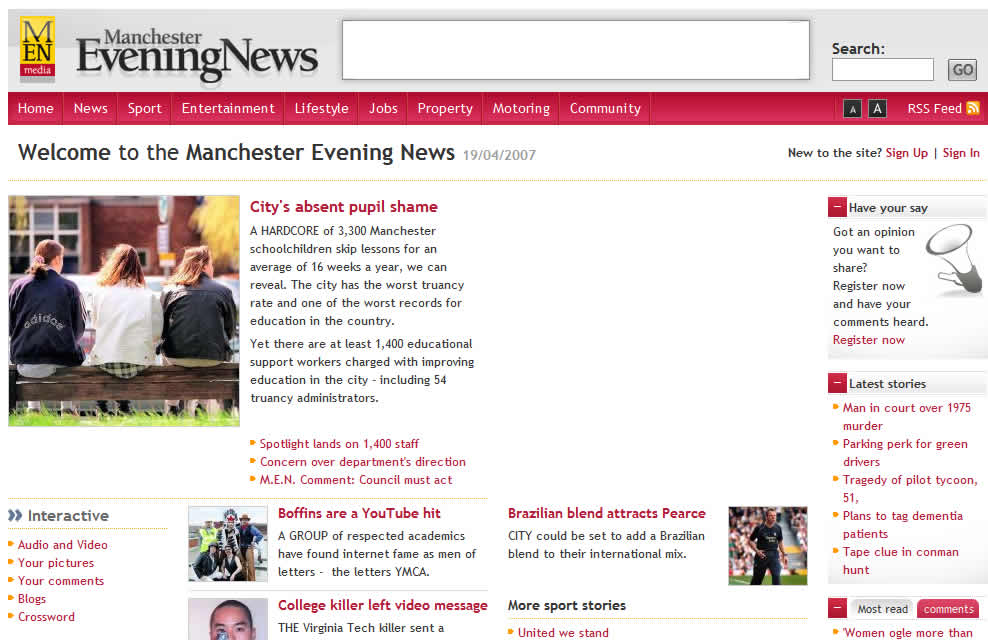
- A similar but separate example is how page view statistics can be used by publishers to rank content by popularity (often displayed side by side with the editorial view of what are the ‘top stories’)
- I hesitate to add the last example but I will anyway: email. Although we could always, in theory, contact producers and editors by telephone, they didn’t publish their numbers on the ten o’clock news. Email addresses, however, are printed at the end of articles; displayed on screen alongside news reports; read out on radio; and of course displayed online.
I’m sure I’ve missed examples, or entire other dimensions. If you have an input to make, comment away.

 Online Journalism Blog