Tag Archives: daily mail

Newspaper websites need to improve their readability

Most newspaper websites are doing a bad design job in making their stories readable. Too many are using:

  • small fonts,
  • long off-putting paragraphs,
  • no subheadings,
  • no in-content boxes or pictures, and
  • no in-content links.

To explain more, I’ve written a companion post on online readability (design, not writing – and this post was first published here). And here’s an example each of their news stories so you can see the issue: Daily Mail, Express, FT, Guardian, Independent, Mirror, Sun, Telegraph, Times.

Main readability design mistakes

This table summarises the main ways they are going wrong.

Tiny fonts

They are all using font sizes that are too small for comfortable reading on copy-heavy pages. Only the Guardian, Independent, Mirror and Telegraph offer obvious controls for resizing text.

But most of the sites use 12 or 13px fonts for body copy. I think this is too small to be the default – 16px is a much more readable size. Only the Guardian comes anywhere near this. Continue reading
Newspaper sites start to scrap ‘no inbound links’ policies

The Daily Mail and Daily Mirror have joined the Daily Telegraph in scrapping their bans on other websites linking to them without prior written consent.

Ian Douglas, head of digital production at telegraph.co.uk, says they dropped the clause as soon as they read about it on Twitter.

David Black, Group Director of Digital Publishing at Trinity Mirror, says it’s ‘being fixed’ for mirror.co.uk.

And James Bromley, Managing Director at Mail Digital, says ‘We also will be allowing people to actually link to our website shortly’. Continue reading

Newspaper sites: do not link to us

How will other newspapers react now The Guardian is giving access to a million articles to developers for free as part of its Open Platform initiative

If their site T&Cs are anything to go by, they have a long way to go to embrace the internet.

It’s fairly standard to forbid people from copying your material. But some papers have gone so far with their site T&Cs that you’re not allowed to link to – or even read – their pages. The quotes below are all from the sites’ T&Cs (and all seem to conflict with the ‘share’ buttons, such as the one enabling the Times to top the StumbleUpon league). Continue reading

It’s the Sun wot won it at Fark

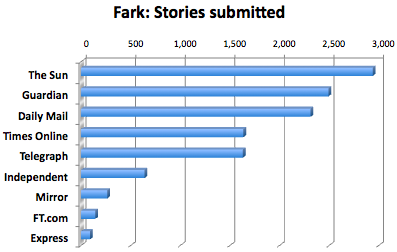
The Sun has had more stories submitted to Fark, the social news site for stranger news stories, than any other UK newspaper. That may be no surprise, but it’s the Guardian wot’s runner up.

The news follows the discovery that the Guardian is top at Reddit, the Times at StumbleUpon, and the Telegraph at Digg.

The graph is based on an analysis of the total submissions for each newspaper site to Fark. It shows that, just as with those other social news sites, the FT, Mirror and Express are trailling in last.

Sun winning at Fark, Guardian second

Sun winning at Fark, Guardian second

Guardian tops Reddit submissions list

The Guardian has had more stories submitted to Reddit.com than any other major newspaper site.

The news follows the Telegraph topping the Digg list and the Times topping the StumbleUpon list.

The graph shows how many pages have been submitted to Reddit for each site. It’s based on an analysis of newspapers’ Reddit submissions that also suggests the Telegraph is catching up with the Guardian – they tied for the number of stories submitted over the last week.

Submissions to Reddit: Guardian wins

Submissions to Reddit: Guardian wins

Telegraph.co.uk top of Digg league

The Daily Telegraph has more stories submitted to Digg, the social news website, than any other daily newspaper site.

Times Online may be winning at StumbleUpon, but the Telegraph has:

  • had more stories submitted to Digg,
  • more stories on the front pages of Digg,
  • and its most-Digged story has more Diggs than any other newspaper site’s top story.

The graph shows how many pages have been submitted for each site that made the Digg ‘front pages’ (ie proved sufficiently popular).

It’s based on an analysis of newspaper site pages submitted to Digg (which also suggests that the reason for the success of the Telegraph and Mail is that their users are more likely to Digg than those of other newspaper sites).

Newspaper site Diggs

Newspaper site Diggs

Times Online tops newspaper Stumble list

All self-respecting newspaper sites have share and social-bookmarking functionality, such as links to Digg, Reddit, Fark etc.

But if the results of StumbleUpon are typical then:

  1. Times Online is miles ahead of its rivals when it comes to users sharing / bookmarking its pages.
  2. The FT has a lot of work to do.
  3. Adding icons for an individual service makes no difference to how often users submit a given page.

Continue reading

Reasons not to ignore comments #2: The Daily Mail and Julie Moult

UPDATE: A response from the Daily Mail’s Martin Clarke: “comments on the article in question were not published, because the story was already a few days old … If you want to complain about a story some days after it’s published you have to take a more traditional view of things and write to the editor”

I’ve blogged before about the problem with ignoring comments. But recently “marketing man gone native” blog Bloggerheads has been providing a rather stronger case.

Julie Moult is a journalist who wrote a particularly poorly informed non-story for the Daily Mail about UK MP Hazel Blears being Googlebombed (in short, Blears wasn’t Googlebombed at all: the top result for her name just happened to be a humorous image). Continue reading

Cartoons online – what are news organisations doing? (guest post)

In a guest post for the OJB, The Professional Cartoonists’ Organisation give an overview of how news organisations are treating cartoons online.

Cartoons have long been an essential part of British newspapers, so why do so many of those publications fail to do justice to drawn content on their websites?

The digital display of the web is a visual medium and cartoons and illustrations thrive on it. Yet many newsprint employers have not been quick to develop the advantages that drawn imagery offers as a digital communication tool and as existing sticky content for their sites and products. Continue reading

A week in online journalism: roundup

Allison White has written this wonderful roundup of last week’s news for the OJB. But now she’s got a job. Persuade her to do this again in the comments…

Google

-Announced no desire to create content and will respect copyright.

It added face-blur technology to its Street View mapping serivce to protect privacy. Also speculation from Groves Media on whether this technology is more of a threat to civil liberties than CCTV.

Microsoft

-Looking to limit the kinds of computers that can use their low-cost OS, making them poor computers even if they could be better and still be as cheap. Continue reading