Tag Archives: ethics

Serene Branson: The Sun changes its story – but not the URL

Serene Branson Grammys Stroke story 3am

It appears last week’s guidance from the PCC on correcting URLs as well as the contents of stories has not reached The Sun. Serene Branson’s on-air slurring was initially mocked by the tabloid with the headline “Grammy’s reporter goes gaga”. When it emerged that the presenter may have* suffered from a stroke the article was rewritten – but not the URL:

sun_SereneBranson_URL

The Daily Record, meanwhile, have changed their URL as well as the headline (or their content management system has done it for them). 3am haven’t changed anything (see image at top).

A further issue occurs here too: comments posted on the original Sun story remain, but now – under a now more sober report – these appear insensitive.

More recent commenters can be seen criticising these older comments, and without any notice on the article that it has been updated, those commenting under their real names could argue that their reputations are being damaged as a result.

Certainly there’s an ethical issue here: if you change a story so substantially that original comments now no longer apply, should you remove them?

Via Dave Lee, whose post ‘Serene Branson: The disturbing viral that shames us all‘ should also be read.

*UPDATE: The station website says she was examined by paramedics but not hospitalized. “Her vital signs were normal” and “she says that she is feeling fine this morning”.

Sources fight back: fabrication, complaints, and the Daily Mail

Juliet Shaw writes in a guest post on No Sleep ‘Til Brooklands about her experience of fighting The Daily Mail through the courts after they published an apparently fabricated article (her dissection of the article and its fictions is both painstaking and painful).

There is no happy ending, but there are almost 100 comments. And once again you are struck by the power of sources to tell their side of the story. For Juliet Shaw you could just as well read Melanie Schregardus, or the Dunblane Facebook Group.

Among the comments is Mail reader Elaine, who says

“I have always taken their stance and opinions with a large doze of salt. It will be even larger now. Thank goodness for the internet – as a balance to the Mail I can access the Guardian and the Independent to see their take on a particular world/UK event.”

But also in the comments are others who say they have suffered from being the subject of fabricated articles in the Mail – first Catherine Hughes:

“The article was so damaging to my freelance career that editors I was working with now no longer answer my emails. ‘Heartbroken, devastated and gutted’ doesn’t even come close to how I feel. It happened in September and I am still distraught.”

Then Pomona:

“[I have] been a victim of the Daily Fail’s “journalism” on two occasions: once when my first marriage broke up and they printed a lurid and utterly innaccurate story about me (I’m no celeb, just Jo Public), and more recently when one of their journalists lifted and printed a Facebook reply to their request for information (leaving out the bit where I told them I did not permit them to use or reprint any part of my post)”

And Anonymous:

“The Daily Mail said they were looking for a real life example of a similar case of teachers exploiting trust to complement a news story. They promised to protect my anonymity, use only a very small picture and as one of a number of case studies. A week later a double page spread – taken up mostly with a picture of me – bore the headline ‘Dear Sir, I think I Love you’. The quotes bore no resemblance to what I said and made it sound like I liked the teacher?! Instead of what really happened – a drunken shuffle in the back of a car and a feeling of abuse of trust and sadness the next day.”

Jon Morgan:

“When the article was published, my role as welfare officer was never mentioned, the average overdraft had become *my* overdraft, and I was apparently on the verge of jacking in my studies in despair.”

Anonymous:

“I applied as a case study, the photoshoot, the invasive questions. Took months to get my expenses after dozens of ignored emails. Thankfully the article never went to print. At the time I was annoyed but now I am thankful. I also work in PR and would feel extremely uncomfortable offering anyone as a case study for a client. No matter how large the exposure.”

Dirtypj:

“I complained to the editor. He insisted that all journalists identify themselves as such every time. And that his employee had done no wrong. In short, he was calling ME a liar. And as all interviews are recorded he could prove it. I said, Okay, listen to the recording then! He replied, No, I don’t need to. I stand by my writers.”

Other comments mention similar experiences, some with other newspapers. It’s a small point, driven home over and over again: power has shifted.

On publishing – and deleting – allegations online

TechCrunch’s Paul Carr has a thoughtful piece on “cyber-vigilantism” where citizens witness or experience a crime and go online to chase it down, name the alleged perpetrators, or pressure the authorities out of complacency:

“[W]hen that naming happens, the case is over before it’s begun: no matter whether the accused is guilty or innocent, they are handed a life sentence. Until the day they die, whenever a potential employer or a new friend Googles their name – up will come the allegation. And, prison terms notwithstanding, that allegation carries the same punishment as guilt – a lifetime as an unemployable, unfriendable, outcast. There’s a reason why the Internet is a great way to ruin someone with false allegations – and it’s the same reason why falsely accused people are just as likely to harm themselves as guilty people.”

The post was written after TechCrunch decided to delete a story about an alleged sexual assault and is a useful read in provoking us as journalists in any medium to reflect on how we treat stories of this type.

There are no hard rules of course, and associated legal issues vary from country to country.

In the Judith Griggs case, for example, was I right to post on the story? My decision was based on a few factors: firstly, I was reporting on the actions of those on her magazine’s Facebook page, rather than the ‘crime’ itself (which was hardly the first time a publisher has lifted). Secondly, I waited to see if Griggs responded to the allegations before publishing. Thirdly, I evaluated the evidence myself to see the weight of the allegations. Still, I’d be interested in your thoughts.

Kay Burley. Discuss.

Some say that journalism students should simply be taught how to ‘do’ journalism rather than spending time analysing or reflecting on it. On Saturday Sky’s Kay Burley showed why it’s not that simple – when she berated someone demonstrating in favour of electoral reform (skip to around 2 mins in):

[youtube:http://www.youtube.com/watch?v=ELJh2bTK1ew%5D

This, and the copious other clips from a career history of walking a fine line (many say crossing it), are a goldmine for lecturers and journalism students – particularly when it comes to discussing broadcast journalism technique, ethics, and regulation.

It helps students to look at their own journalistic practice and ask: in trying to please my bosses or meet an idea of what makes ‘good television’, am I crossing a line? How do the likes of Jeremy Paxman manage to dig behind a story without losing impartiality, or becoming the story themselves (do they manage it?) What, indeed, is the purpose of journalism, and how does that carry through into my practice?

Journalism is easy. You don’t need to study it for 3 years to do it. You don’t need a piece of paper to practise it.

But professional journalism is also the exercise of power – “Power without responsibility,” as the quote has it (which continues: “the prerogative of the harlot throughout the ages”). We expect to scrutinise politicians and hold them to certain ethical standards yet cry foul when the same scrutiny is applied to us. Studying journalism – while doing it – should be about accepting that responsibility and thinking about what it entails. And then doing it better.

So: Kay Burley. Discuss.

Another newspaper that ignores copyright law – and ethics

http://podcasting.ie/docs/mos.pdf

The Irish Mail on Sunday has finally responded to complaints about a story it published this week based on the words of a blogging female air traffic controller: “The male chauvinist pigs of air traffic control” (PDF)

“Melanie Schregardus,” the article says, “claims she was forced to endure a torrent of sexist abuse when she and a handful of colleagues first broke into [the] profession”, and the rest of the article continues in the same vein.

The publication of the article understandably caused Melanie some distress. She wrote:

“In the middle of an incredibly trying time for my colleagues, an article has appeared in a Sunday Newspaper that says I feel abused by the people I work with. It gives me opinions that I do not have, and uses words I have never said. It does so to attack my profession, impugn my employers, and portray me as a victim of my friends.

“I feel sick. Any future employer could fairly read what Luke Byrne has written about me and conclude that I am a disloyal, untrustworthy person. The people I work with today could, and probably have, read it and decided that I am not on their side, and that I think that they are sexist, nasty, bullies. None of this is true.

In fact, she deleted her blog, before realising that, without it, there would be no record of her actual words. So she then started a new blog, with the post quoted above. Apart from her complaints about misrepresentation, and that she was never contacted about the story, she also wonders how the newspaper was able to publish a photograph of her without permission (see comments for more on this aspect). And she has complained to the ombudsman. This is where the Irish Mail’s response comes in.

The Irish Mail responds: ‘She was asking for it, mate’

Now at this point The Irish Mail could have protected its brand and claimed this was just one rogue journalist without a sub editor to keep them in check.

Instead, they have decided to dig themselves in deeper, saying:

“The photograph of Mrs Schregardus which we published to accompany this article came from Page 36 of this online magazine http://issuu.com/connors-bevalot/docs/publication1_-destress

“Like Mrs Schregardus’s blog, it had been put into the public domain by Mrs Schregardus herself.”

Of course, being in the public domain has no relevance to copyright. A published newspaper is ‘in the public domain’, but that doesn’t mean anyone is free to copy images from it without paying or crediting the copyright holder. You’d think newspapers would know this.

As for not contacting Mrs Schregardus, they provide an insight into the rigorous journalism practised in their newsroom:

“On Thursday, January 21, Luke Byrne [the reporter] attempted to contact Mrs Schregardus by Twitter (the only contact details he had) and asked her for an interview. On Friday, January 22, Mrs Schregardus replied. She informed Mr Byrne that she had sought permission from her trade union to speak to us. He awaited further contact from her, but he did not hear from Mrs Schregardus again. Either she chose not to speak to him or her union refused her permission to do so.”

So here we have the relentless reporter who will leave no stone unturned in his search for… hold on. “Oh, she didn’t tweet back. Well, I guess I’ve done all I could then.”

Luke Byrne's tweets to Melanie Schregardus

And finally, the misrepresentation. Incredibly, the newspaper claims

“The Irish Mail on Sunday did not attribute to Mrs Schregardus the view that her colleagues were sexist”

So that line saying that she “claims she was forced to endure a torrent of sexist abuse”?

Or the one that reveals “She went on to say that the representation of women didn’t seem to have changed much”?

Or that “She revealed that she endured one of the most pervasive forms of workplace sexism”.

Silly words. They do have an awful habit of arranging themselves in the most unusual sentences.

Same old story, different context

Of course it’s nothing new for a Sunday newspaper to take quotes out of context. Normally that someone is a public figure, and the journalist can argue that it comes with the territory. In The Irish Mail on Sunday’s response you can detect the same theme: she “published on an internet blog that was open to millions of people around the world to read,” they say.

That’s true, and some will say Mrs Schregardus should have been more cautious. I think that’s expecting a level of cynicism that we wouldn’t like to see in the average air traffic controller, but that’s a conversation for another blog post. In the meantime, it’s worth pointing out (aside from the, you know, ruining-a-person’s-life-for-a-story aspect) the long-term effects of an event like this.

Firstly, there’s the effect on the newspaper brand and journalism as a whole. Schregardus outlines how her own opinion (and now, you would expect, those of her readers) has changed as a result:

“I’m sure this happens to other people all the time. Probably people who are far more famous than me. I’ve probably read and formed opinions of other people based on things that are just not true. I’ve probably talked about other people’s lives based on things I’ve read that were hurtful to them.”

Secondly, there’s the effect on workblogging more broadly. We’ve already seen the prize-winning writings of police blogger Nightjack deleted after he was unmasked by The Times, and it’s fair to say that it’s going to be more helpful to journalists to encourage workblogging than to shop their authors – or misrepresent them – to their employers.

Because when the workblogs have gone what will you do? Pick up the phone? Luke Byrne may struggle with that.

Facebook, Dunblane and a 2 page apology from the Express – a lesson in online journalism ethics


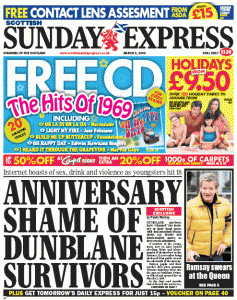
2 weeks ago the Scottish Sunday Express led with this cover story (PDF) on how the survivors of the Dunblane massacre were turning 18 and – shock, horror – drinking and making rude gestures. Reporter Paula Murray, it seemed, had “managed to inveigle her way into a Facebook friendship with teenagers from the town and write a salacious piece about their “antics”, based on information culled from their profiles.” You can read it in full here (text) and also here (PDF). The original was quickly taken down.

So far, so middle market. But what happened next was an abject lesson for the Express – and Paula – in how things have changed for journalists who will do anything for a ‘story’. Continue reading

Ten ways journalism has changed in the last ten years (Blogger’s Cut)

A few weeks ago I wrote an 800-word piece for UK Press Gazette on how journalism has changed in the past decade. My original draft was almost 1200 words – here then is the original ‘Blogger’s Cut’ for your delectation…

The past decade has seen more change in the craft of journalism than perhaps any other. Some of the changes have erupted into the mainstream; others have nibbled at the edges. Paul Bradshaw counts the ways…

From a lecture to a conversation

Perhaps the biggest and most widely publicised change in journalism has been the increasing involvement of – and expectation of involvement by – the readers/audience. Yes, readers had always written letters, and occasionally phoned in tips, but the last ten years have seen the relationship between publisher and reader turn into something else entirely.

You could say it started with the accessibility of email, coupled with the less passive nature of the internet in general, as readers, listeners and watchers became “users”. But the change really gained momentum with… Continue reading

Some conflicting lessons on journalism ethics re: forums, social networks, mailing lists and blogs

A recent discussion on the NUJ New Media mailing list prompted me to jot down some thoughts on the current private-public confusion thrown up by online communication channels. I think some education is required here on both sides.

Lesson 1: It’s public. Whatever you may think about codes of conducts, etc. etc. if you say something on a forum you should be aware that it may be quoted, that it may be indexed by search engines, databases, etc and potentially findable. You cannot rely on people’s good manners. So be careful what you say, or be prepared to stand by what you say.

Lesson 2: It’s private. Journalists got a lot of flak for wandering into blogs and forums after Virginia Tech because they saw it as being ‘in the public domain’ and therefore ethical (Tony Harcup had this view when I spoke to him at the time). But people using those platforms have a different view of what is ‘public domain’. So be courteous and sensitive.

An addendum: legal issues are still to be resolved around much of this. Employers and lecturers who look at people’s social networking profiles could be breaking the law; Facebook ads might be doing the same.

This post is part of a ‘blog carnival’. Read more at CarnivalOfJournalism.com.

Blogs and Investigative Journalism: conclusion

The concluding part of this draft book chapter sums up some of the key points and looks at the future paths of investigative journalism in a new media age. I would welcome any corrections, extra information or comments.

Conclusion

Blogs and new media have undoubtedly changed the landscape of investigative journalism. In terms of its form, journalism as a whole has become more conversational, and iterative, as readers seek to contribute to the story, and journalists open more of their processes to public view. The time and space offered by the internet has provided opportunities for these conversations to take place, and for journalists to make raw material available to fuel them. And the networked nature of the Web has facilitated coordination of contributors across borders and industries, along with a now global distribution of material. Continue reading

Blogs and investigative journalism: publishing

Part four of this draft book chapter looks at how blogs have changed the publishing of journalism through its possibilities for transparency, potential permanence over time, limitless space, and digital distribution systems (part one is here; part two here; part three here) . I would welcome any corrections, extra information or comments.

Publishing

Traditionally, news has always been subject to the pressures of time and space. Today’s news is tomorrow’s proverbial ‘fish and chip paper’ – news is required to be ‘new’; stories “have a 24 hour audition on the news stage, and if they don’t catch fire in that 24 hours, there’s no second chance” (Rosen, 2004). At the same time, part of the craft of journalism in the 20th century has been the ability to distil a complex story into a particular word count or time slot, while a talent of editors is their judgement in allocating space based on the pressures of the day’s competing stories.

In the 21st century, however, new media technologies have begun to challenge the limitations of time and space that defined the news media in the 20th. Continue reading