Tag Archives: online video

NUJ ADM: Digital Convergence: How should we respond?

Probably the most interesting part of the weekend’s NUJ annual conference was a fringe meeting on digital convergence. Speakers included Cardiff University’s Dr Andy Williams on his research into Trinity Mirror’s online strategy, The Guardian’s Len Mulholland, BBC News Online journalist Paula Dear, NUJ NEC member Adam Christie, and NUJ General Secretary Jeremy Dear.

Below are video clips from the event, but here are the bullet points:

  • Trinity Mirror makes more money, spends less, employs fewer, circulation drops
  • The Guardian invests in its website and training, but the web staff are often marginalised when decisions are made – for instance, when the political print team went ‘web-first’ for a conference the web journalists (who had already been web-first) were not consulted as to how they might adapt as a result.
  • There is also concern about short-term contracts for those on more ‘experimental’ projects such as vodcasts.
  • The main issue for journalists on the BBC’s website is 24/7 working patterns and the rota that goes with that.
  • News management admit they don’t have a clue what they’re doing. The NUJ is seeking to set up a commission on convergence to help establish best practice and lead the process of convergence (more on this in later posts).

Introduction (chair: Jemima Kiss)

Dr Andy Williams

Len Mulholland, Guardian

Paula Dear, BBC

Finally, go to this page to download audio of Jeremy Dear.

Piltdown Man joins the new media fold

I’m currently in the middle of a 3-week break from computers – in the meantime, here’s an article I wrote for Press Gazette the week before last, about the past year’s raft of newspaper website relaunches:

The last Luddite has left the building. With almost every national newspaper having revamped its website in the past twelve months, Richard Desmond has finally joined the club and relaunched Express.co.uk – and the Daily Star site is set to follow later in the year.

In an industry of technophobes, Desmond was the Piltdown Man of news. Before last week Express Newspapers’ only attempt to tackle the threat of the internet was to offer an ‘e-Edition’ of the Express and Star which amounted to little more than a PDF with animated pages.

But as his competitors launched MySpace-inspired sections and video-heavy offerings – and even resorted to lime green in their attempts to appear up-to-date – something had to give.

Still, it’s something of a watershed moment that sees Express journalists moving to a 24-hour reporting cycle, plans being made for online video and podcasts, and even web 2.0 elements such as blogging and social networking.

In reality, the new site looks like it was created by someone who has had a website described to him, but never actually seen one. The ‘blogs’ are actually opinion columns with nary a link to be seen, video is being outsourced, and online journalists will work separately from print hacks.

But it’s the move into social networking with ‘MYExpress’ that represents a quantum leap for this most reluctant of online newspapers. The service, which allows readers to create a personalised homepage, blog, and communicate with other users, has the potential to create a community of Disgusteds from Tunbridge Wells that may well represent the group’s cash cow.

So how did Richard Desmond – the man who sold the Express websites for £1 in November 2000 – come to join the rush online? And why the recent rush by national newspapers generally to give their sites a makeover?

Desmond can blame his rival Rupert Murdoch. It was he who, in 2005, warned the American Society of Newspaper Editors that unless his industry woke up to the changes brought about by new media they would be “relegated to the status of also-rans.”

Murdoch had sneezed, and the whole news industry began to catch a web fever.

The Times and Telegraph websites, which weren’t even in the top ten online news destinations, have since been overhauled and are making significant ground on leader The Guardian. Tabloids began to see that there was more to the web than monetising page 3 girls. And the middle market just worried about internet chatrooms.

Murdoch wasted no time in buying up promising web properties including, most spectacularly, MySpace, a property which was then cloned on The Sun’s ‘MYSun’ feature.

The Sun’s transformation has been most surprising of all – the reactionary paper has proved technologically progressive as the paper embraced video and virals, slideshows and podcasts, created blogs that actually understood the medium, and built a ‘Lite’ version of the paper for time-starved visitors. Perhaps most tellingly, the paper realised the web presented a window into the regional classifieds market. Oh, and we mustn’t forget the legendary video version of Dear Deirdre.

The Mirror, once again, has been left playing catch up. Its February redesign was ripped apart by many observers for a range of misjudged decisions ranging from buying in video content from the US (coverage of American Idol, anyone?) to the use of capital letters on the home page. The site has five sections – news, sport, showbiz, blogs, and… ‘more’ – a vagueness which perhaps gives some indication of a lack of direction behind the scenes.

Video has been a recurring theme throughout all newspaper website relaunches as ad sales departments realised they could tap into the television advertising market. The Mail has been no exception with its ‘showbiz video’ section, while a number of newspapers have bought in content from the likes of ITN and Reuters. And the ability to encroach on broadcasters’ territory without that pesky Ofcom to worry about has proved particularly useful for tabloid exclusives such as The Sun’s ‘friendly fire’ video and a range of NOTW stings.

The three major broadsheet websites have led the way in the use of blogs and podcasts, video and galleries. The Telegraph’s relaunch focused on the systems behind the site, building a multimedia ‘hub’ and training journalists to work across print and online, video and audio. But The Times’ makeover resulted in an all-singing site that belied its staid reputation and currently looks the most modern of national newspaper sites. The Independent plans a low-key revamp this year but for the most part has sat and watched from the sidelines like a kid waiting to be asked to join in the football game.

So where do the sites go from here? Last year The Guardian’s commentisfree raised the bar for newspaper blogs, while its Flash interactives remain a unique demonstration of the possibilities of new media. But a wholesale revamp is likely to be part of editor Alan Rusbridger’s planned £15m investment, while the move into television production with Guardian Films demonstrates that the group have ambitions beyond getting reporters to read out the day’s headlines: it has already brought dividends with a series of slots on prime time ITV News.

The Sun continues to innovate in the tabloid market, and the launch of a mobile edition suggests they understand the next big challenge for newspapers: if Desmond thought his work was done with new media, he’d better think again: the battleground is moving on.

Guardian wants online video and audio staff – and Emap invests in web projects

The Guardian is to recruit online video and audio staff, reports the paper:

“Guardian Unlimited, the title’s online operation, is looking to hire five staff for its internet video unit to work on footage of breaking news, as well as “developing mini documentaries and video elements within larger, cross media projects”.”As well as the five online video staff, GU is looking to recruit a head of audio and two audio producers as it expands its year-old podcast operation.”

And in the same edition, Emap is reported to be “ramping up its digital strategy by launching new media “incubator” projects for Motorcycle News, Today’s Golfer and Empire magazines and appointing three new digital directors”:

“Mr Mistry said he has interviewed nearly 50 digital media specialists, including people from search firms and entrepreneurs with up to 10 years’ experience in launching digital brands.”

But here’s a stat to bore your print journalism friends with:

“rock magazine Kerrang!, for example, now makes less than 25% of its revenue through the original print product. Kerrang! has music TV, digital radio, mobile and live event offerings.”

Rocketboom may charge for shows

Advertisers aren’t interested in 200,000 users, reports MarketWatch:

“So, how does Rocketboom keep the lights on? Baron says the video blog has become kind of a loss leader and a promotional device for the real money. Like a blog, he says he has established the Rocketboom team as experts in using video on the Web. “We get consulting opportunities, conferences give honorariums. For us, there are many off-shoots.””

Express relaunches online, Star to follow

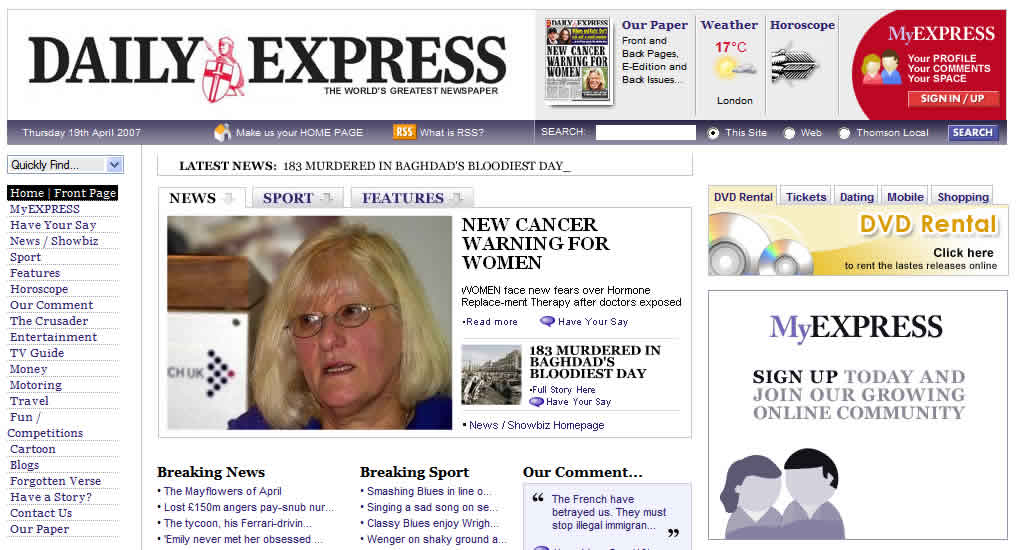
Express website 19 April 07Journalism.co.uk reports on the relaunch of the Express, with the Daily Star to follow, including:

  • “unique content and an archive which allows readers to search past stories and the community areas of the site.
  • “a string of blogs from its Sunday and Daily journalists.
  • “MYExpress facility that enables users to have their own space on the site. This area can be to personalised by filtering some content, such as weather and horoscopes, and uploading pictures. It will also be possible for users to browse through other users’ profiles.”
  • And “a deal had been done with a video supplier and that video and podcasts would be added to the mix in the coming weeks once the initial launch was completed.”

Sounds pretty good for a Desmond-owned publication (not difficult, admittedly), although in reality it’s a website that looks like it was created by someone who was once told what this web 2.0 thing is all about, but wasn’t really listening. Or, in other words, new media through an old media hack’s eyes.

The blogs are basically opinion columns (no links), I can’t find the “community areas”, and of course there’s no video yet. MYExpress is the most impressive – I can imagine Express readers too dazzled by MySpace social networking away with other Disgusteds, although there’s not much to it apart from a blogging service, personalised homepage and ability to search other profiles. Oh, and the online journalists are ghettoised in a separate team.

Anyway, welcome to the 21st century, Express.

Students revel in video

Last week I had the tall task of introducing students to online video in barely three hours. Thankfully they were thoroughly engaged in the subject – particularly enjoying the examples I showed (most of them in my previous post on four types of video journalism.

In order to get them using the editing software (rather than Avid I picked something free that anyone can download – Windows Movie Maker) I sent them out to record video diaries for their blogs, with the emphasis on movement, personality, and mise en scene.

The draft results indicated they’d got the idea. I’m waiting to see the finished versions but below is Felicity’s reflections on being Communities Correspondent (Polish & Jewish), which is nice and breezy for 20 mins’ work and shows good use of movement (if not great audio at the start):

Herald-Tribune shows the way for Flash and database journalism

I’m still scooping my jaw from the floor after looking at the Herald-Tribune’s Flash interactive on how complaints about teachers are handled. Not only does this use Flash cleverly – particularly to illustrate the complex process through which complaints go (now try doing that in print), along with audio clips – but it’s integrated with a database so you can search by district and school, keyword, or even map, a great example of database-driven journalism. From Journalistopia:

“It took the Herald-Tribune 14 months and repeated threats of legal action to obtain the database under Florida’s public records law.

“Even then, some information turned out to be so inaccurate that the Herald-Tribune decided to create its own version, reviewing 30,000 pages of administrative documents to build a database […]”

Inspirational.

Steve Smith: Mobile Video – Didn’t We Do This Already?

Steve Smith, writing about mobile video in general (registration required), makes a very informed point about the attempts to ‘crack’ the medium, with some historical anecdotes. Here’s his summary:

“Much of the technical and aesthetic experimentation in mobile entertainment may already have taken place in a Webisodic format that never took hold on the medium for which it was intended. To go back to history, a lot of time and money gets spent trying to squeeze the last medium’s successful formats into successes on the new medium. But it is just as likely that we should look to the failures of the previous medium when planning the next.”

What he’s talking about is this:

“Back in the day of TheDen, TheSpot, PseudoTV or even the early AtomFilms, for that matter, the fledgling Internet was all about birthing a new art form. “Webisodic” fiction, online reality shows and soap operas, the renaissance of the short subject, and the new venue for animators — all this and more were promised by the new Web.”

BBC, UGC and online video

Some insights into the workings of the BBC, UGC and online video from Shane Richmond’s latest post:

“At a time when most newspapers, including this one, are trying to encourage user participation and comments on their sites, the BBC is questioning the need to host those conversations.

“Instead they’re linking their content out to the likes of YouTube, Flickr, Technorati and del.icio.us. Encourage the conversation but let it happen elsewhere.

“The burden of moderation is simply too great. Like us, the BBC moderates comments received from readers, mostly for legal reasons, but as Tom pointed out: “What we call moderation, readers call censorship.”

“The more successful you are at attracting reader responses, he explained, the bigger the problem gets.”

Also:

“One week in November last year, the BBC news site published around 500 pieces of video.

“Analysing the traffic for those clips later, they found that just 30 of them accounted for about half the traffic. They have learned some lessons about what type of video clips work online but mostly they learned to focus on doing less better.”