Tag Archives: Times

7 ways to blog anonymously {updated}

Following today’s landmark judgement on one blogger’s right (or not) to anonymity, I thought it might be useful to post the following tips on maintaining anonymity online.

1. Use an anonymous email account to register your blog. Hushmail is one free service that provides encrypted accounts; RiseUp is aimed at activists; MintEmail gives you a 3 hour temporary email address and FilzMail gives you one that expires after 24 hours. You could also use these to post to your blog via email. Posterous is a great blogging service that allows you to do this.

2. Make sure your IP address isn’t logged when you register or post to the blog. You could use something like Anonymizer or Tor or Psiphon. Other services that mask your IP are listed on this forum.

3. Or you could use an anonymous blogging platform. Invisiblog was one but no longer exists. BlogACause claims to be “anonymous” but I’m trying to find out exactly how UPDATE: here’s how, apparently. In the meantime, this post recommends WordPress and something like Tor.

4. Use a pseudonym that you don’t use anywhere else. If you use a pseudonym, don’t use it on other services as well, as this will make it easier to trace you. If you’re struggling, this Random Name Generator will create one for you.

5. If you’re going to register a domain name do so anonymously with a service like The Online Policy Group.

6. Be careful what information you include. Although police blogger NightJack changed or did not include names in cases he was involved in, the details were specific enough for a journalist to track him down.

7. Don’t win awards. Or book deals. It’s safe to say that a major newspaper would not have been interested in the identities of NightJack or Girl With A One Track Mind if both had remained cult underground heroes. So just pretend you’re sub-literate, OK?

For more information, the following guides go into much more detail:

More links and tips welcome. My Delicious bookmarks on anonymity are at http://delicious.com/paulb/anonymity

The complicated case of the (now not) anonymous police blogger, The Times, and ‘public interest’

Widely lauded anonymous police blogger NightJack has had his identity revealed after The Times took the affair to court.

It’s a cloudy affair. The Times’ angle is that media correspondent Patrick Foster wanted to ‘out’ someone he felt “was revealing confidential details about cases, some involving sex offences against children, that could be traced back to genuine prosecutions” as well as offering “advice to people who found themselves the subject of a police investigation.”

NightJack’s case for preventing the publication of his name was that he would be (and indeed has already been) punished by his superiors.

Mr Justice Eady didn’t buy that, saying: “I do not accept that it is part of the court’s function to protect police officers who are, or think they may be, acting in breach of police discipline regulations from coming to the attention of their superiors.”

The Times also reports him as saying “that even if the blogger could have claimed he had a right to anonymity, the judge would have ruled against him on public interest grounds.”

Hugh Tomlinson, QC, for the blogger, had argued that “thousands of regular bloggers who communicate nowadays via the internet under a cloak of anonymity would be horrified to think that the law would do nothing to protect their anonymity of someone carried out the necessary detective work and sought to unmask them”.

The judge said … the blogger needed to show that he had a legally enforceable right to maintain anonymity in the absence of a genuine breach of confidence, by suppressing the fruits of detective work such as that carried out by Mr Foster.

But Mr Justice Eady said that the mere fact that the blogger wanted to remain anonymous did not mean that he had a “reasonable expectation” of doing so; or that The Times was under an enforceable obligation to him to maintain that anonymity.

There are so many elements to this case it’s difficult to pick them apart.

  • On the one hand we have a blog which is potentially, in some circumstances, in contempt of court, written by a policeman who is, strictly speaking, breaking his obligations under the “statutory code governing police behaviour and general public law duty”. That’s The Times’ ‘public interest’, or at least the case that they made (The Times have history here – it would have been interesting to have seen the public interest argument for publishing the name of Girl With A One Track Mind).
  • On the other we have someone’s privacy.
  • But the 3rd point – and it’s interesting that this doesn’t seem to have been used as a defence – is that this is a ruling that has enormous implications for whistleblowers and people blogging ‘on the ground’. That’s someone else’s ‘public interest’.

And that last element is the saddest for me.

With the disappearance of NightJack (his blog has already been deleted*), we lose one more ‘voice on the ground’. While The Times focused on the letter of the law that was being broken, the broader public interest of letting public servants voice their…

frustrations with … attempts at the reform of policing which, he says, has turned officers from “approachable neighbourhood figures into neon-clad stormtroopers.””

…has been ignored.

It is difficult enough to get soldiers to blog, for people to get a genuine feel for the experiences of NHS workers, civil servants and teachers.

And it just got harder.

UPDATE: Curiously, The Times appear to have prevented their reporter from speaking about the issue on Radio 5.

UPDATE 2: A couple of Times journalists have gone on the record with their feelings about the affair.

UPDATE 3: NightJack himself has written a piece in The Times on the story behind the case. Anonymong describes it as “reminiscent of a communist show trial where the accused is allowed to publicly confess their sins and misdemeanors.” But the comments tell a very different story of support.

UPDATE 4: I’ve written a guide to anonymity for bloggers.

UPDATE 5: Via Anonymong:  “as noted by Anna Raccoon there is now some precedent for investigating and publishing identifying material relating to a serving police office as prohibited by the counter terrorism act 2008.”

UPDATE 6: As you’d expect, someone has dug into Patrick Foster’s past and come up with some dirt of their own.

UPDATE 7: Fellow public service blogger and ambulance driver Tom Reynolds gives his views on the case. Chicken Yoghurt gives his on the media’s use of anonymous sources. David MacLean responds: “Of course journalists rely on anonymous sources, but if a rival national newspaper found out who was tipping off a competitor, they’d more than likely expose them if the resulting story would be of interest to the public.”. Emily Bell highlights the raft of furious comments on The Times’ Crime Central blog. Gary Andrews gives his take. And Journalism.co.uk round up some more besides.

UPDATE 8 [Jan 24 2012] It seems that Nightjack’s email was hacked in order to get that story.

(h/t Girlonetrack) *Thanks to Martin in the comments: if you type “site:nightjack.wordpress.com” into Google, the pages appear to be cached. Don’t know how long that will last though.

Which news sites do and don’t get a ‘last updated’ time in Google

Some news sites get a last updated time stamp in Google – and some don’t. It’s a bit of information next to the URL that says XX minutes ago and shows when the most recent story was published.

Not all news sites get it – although I can’t see any rhyme or reason (originally posted here).

Sites that do have it

The sites that do have it are: Times, Telegraph, BBC News, Express, ITN, Guardian. (Click the picture for a bigger version).

News sites with a time stamp

News sites with a time stamp

The Express could probably live without it, as I recently showed that they don’t update their site after 8am on a Sunday. Continue reading

Newspaper websites need to improve their readability

Most newspaper websites are doing a bad design job in making their stories readable. Too many are using:

  • small fonts,
  • long off-putting paragraphs,
  • no subheadings,
  • no in-content boxes or pictures, and
  • no in-content links.

To explain more, I’ve written a companion post on online readability (design, not writing – and this post was first published here). And here’s an example each of their news stories so you can see the issue: Daily Mail, Express, FT, Guardian, Independent, Mirror, Sun, Telegraph, Times.

Main readability design mistakes

This table summarises the main ways they are going wrong.

Tiny fonts

They are all using font sizes that are too small for comfortable reading on copy-heavy pages. Only the Guardian, Independent, Mirror and Telegraph offer obvious controls for resizing text.

But most of the sites use 12 or 13px fonts for body copy. I think this is too small to be the default – 16px is a much more readable size. Only the Guardian comes anywhere near this. Continue reading

Newspaper sites: do not link to us

How will other newspapers react now The Guardian is giving access to a million articles to developers for free as part of its Open Platform initiative

If their site T&Cs are anything to go by, they have a long way to go to embrace the internet.

It’s fairly standard to forbid people from copying your material. But some papers have gone so far with their site T&Cs that you’re not allowed to link to – or even read – their pages. The quotes below are all from the sites’ T&Cs (and all seem to conflict with the ‘share’ buttons, such as the one enabling the Times to top the StumbleUpon league). Continue reading

It’s the Sun wot won it at Fark

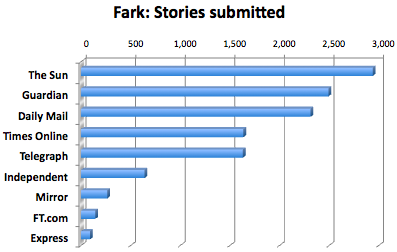
The Sun has had more stories submitted to Fark, the social news site for stranger news stories, than any other UK newspaper. That may be no surprise, but it’s the Guardian wot’s runner up.

The news follows the discovery that the Guardian is top at Reddit, the Times at StumbleUpon, and the Telegraph at Digg.

The graph is based on an analysis of the total submissions for each newspaper site to Fark. It shows that, just as with those other social news sites, the FT, Mirror and Express are trailling in last.

Sun winning at Fark, Guardian second

Sun winning at Fark, Guardian second

Guardian tops Reddit submissions list

The Guardian has had more stories submitted to Reddit.com than any other major newspaper site.

The news follows the Telegraph topping the Digg list and the Times topping the StumbleUpon list.

The graph shows how many pages have been submitted to Reddit for each site. It’s based on an analysis of newspapers’ Reddit submissions that also suggests the Telegraph is catching up with the Guardian – they tied for the number of stories submitted over the last week.

Submissions to Reddit: Guardian wins

Submissions to Reddit: Guardian wins

Telegraph.co.uk top of Digg league

The Daily Telegraph has more stories submitted to Digg, the social news website, than any other daily newspaper site.

Times Online may be winning at StumbleUpon, but the Telegraph has:

  • had more stories submitted to Digg,
  • more stories on the front pages of Digg,
  • and its most-Digged story has more Diggs than any other newspaper site’s top story.

The graph shows how many pages have been submitted for each site that made the Digg ‘front pages’ (ie proved sufficiently popular).

It’s based on an analysis of newspaper site pages submitted to Digg (which also suggests that the reason for the success of the Telegraph and Mail is that their users are more likely to Digg than those of other newspaper sites).

Newspaper site Diggs

Newspaper site Diggs

Times Online tops newspaper Stumble list

All self-respecting newspaper sites have share and social-bookmarking functionality, such as links to Digg, Reddit, Fark etc.

But if the results of StumbleUpon are typical then:

  1. Times Online is miles ahead of its rivals when it comes to users sharing / bookmarking its pages.
  2. The FT has a lot of work to do.
  3. Adding icons for an individual service makes no difference to how often users submit a given page.

Continue reading

Lessons in community from community editors #4: Tom Whitwell

I’ve been speaking to news organisations’ community editors on the lessons they’ve learned from their time in the job. Today, The Times’s Tom Whitwell:

1. Trust the readers

Self-policing often works. I had a case where a sports writer was annoyed by a commenter who said he’d got his facts wrong. He wanted us to take the comment down, but by the time we got to the page, there were 3-4 other commenters backing up the writer. On the whole, we have very intelligent readers who leave great comments.

2. Interaction is incredibly subtle and variable

Similar articles with similar traffic can get very different responses – something in the wording of one will inspire hundreds of comments, but not the other.

Some people are hesitant about leaving a comment, but they might be very willing to vote in a poll, or fill in a survey. There are an infinite number of ways that websites can get readers more engaged.