Tag Archives: twitter

Twitter-reviewing – some reflections

Last Friday I tried a little experiment with Twitter: I used it to live-review the Clay Shirky book Here Comes Everybody: The Power of Organizing Without Organizations (Amazon US).

Why did I do it?

It wasn’t a preview copy, so there was no ‘scoop’ here.

It wasn’t a live event, either. As Dave Lee pointed out, “A book is a book. It’s not changing. Read it all and then tell me whether it’s any good or not.”

I did it, well, because I could. Because I wanted to give myself a reason to read the book without distraction. Because I wanted to see how viral it would go. Because I wanted to see how social you could make that most anti-social of activities: reading a book.

The thing is, Dave was mistaking Twitter for a pure publishing platform. What I discovered was this: it was about a conversation, not a publication: Continue reading
How interactive are UK business news websites?

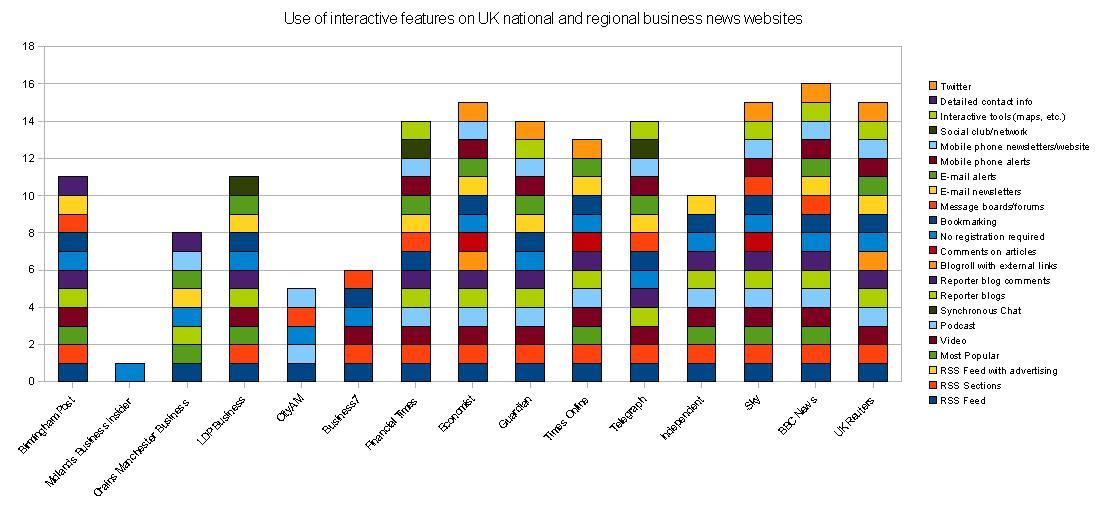
That’s the question Birmingham Post reporter Joanna Geary has been asking herself, and has come up with the following rather lovely graphic:

Clickon the image for a larger, more readable version – you’ll see she’s looking for availability of email contacts, use of things like maps, blogs, bookmarking, video (is that interactive? Or multimedia?), email newsletters, mobile alerts, RSS, podcasts, chats, forums – and Twitter: “I know it’s not yet a mass communication device but I think it’s a good indicator of those who are thinking about the development of the market” Continue reading

Live-reviewing a book on Twitter: Here Comes Everybody by Clay Shirky

From 10am UK time today I will be reading Clay Shirky’s new book Here Comes Everybody: The Power of Organizing Without Organizations (Amazon US) – and reviewing it on Twitter as I go.

And I won’t be alone. Joining me will be Antonio Gould, Dave Briggs, Jon Bounds, Paul Inman and Brendadada.

All six twitterers – plus a Tweetscan search for ‘Here Comes Everybody’ – will be aggregated at http://xfruits.com/paulbradshaw/?id=38799 so you can follow them all, or join in yourself.

Twitter – what are you doing in your newsroom? What would you like to do?

OK, so everyone is on Twitter. Let’s take stock. I’d like to know what you’re doing with the tool as a journalist and in your newsroom – or what you’d like to do. Oh, and what good examples of its use have you seen? Comment away – let’s see if we can’t compile a useful collection of examples, experiences and ideas.

UK Government signs up to Twitter

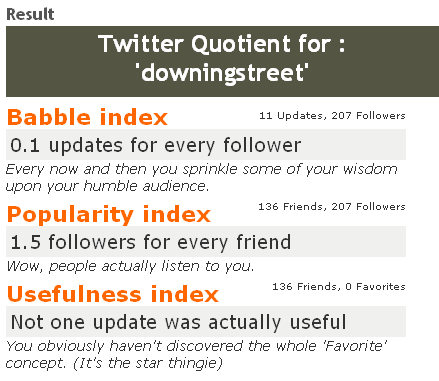
I’m not the only one to have noticed an unusual surge of people signing up to Twitter recently. But today, Downing Street started using it. And when the UK government signs up to Twitter, you know it’s hit the mainstream.

Oh, and where did I hear this? On Twitter.

Anyway, turns out it’s just Twitter shovelware using Twitterfeed, though that’s not bad in itself, and actually shows a higher level of tech savviness than simply twittering.

Meanwhile, those who want mobile updates on government matters now have it, which is pretty good. Marshall Manson suggests Brown may be the first head of state to use the tool, while Luke Pollard adds “to be fair both Obama and Clinton are well progressed and twittering a plenty in their fight for the democratic nomination – here and here – and arguably have a better Twitter pedigree”. Continue reading

Q: “What is the point of Twitter?” A: …

Someone recently posted on my Facebook wall: “Paul, I don’t understand, and fear I may be too old for all this already… but… what exactly is the point of twitter?”

I can come up with at least nine answers. I’m sure you can come up with more:

  1. It’s a great way to publish to mobile devices;
  2. it’s a social networking tool to make contacts and carry on conversations;
  3. it’s a way of discovering new information (through tips and leads);
  4. it’s a great way to follow what’s happening through your mobile (set Twitter up to send you mobile updates)
  5. It’s a way of organising people
  6. It’s a great way of reporting from a live event or other occasions when you only have your phone
  7. You can aggregate a number of twitter feeds to one collective feed of what a group of people are doing
  8. You can push an RSS feed into twitter, creating a mobile/social network update
  9. For bloggers, it’s a good place to put thoughts and ideas that are so brief you wouldn’t normally blog them

Any more for any more?

JEEcamp – when the cottage news industry met mainstream media

What happens when you bring together local journalists, bloggers, web publishers, online journalism experts and new media startups – and get them talking?

That was the question that JEEcamp sought to answer: an ‘unconference’ around journalism enterprise and entrepreneurship that looked to tackle some of the big questions facing news in 2008: how do you make money from news when information is free? Where is the funding for news startups? How do you generate community? What models work for news online? Continue reading

Launching an environmental news website – four weeks in

As you have probably worked out, this year’s Online Journalism students have been building up towards launching an environmental news website. This week the site went public, and I thought I’d take the opportunity to reflect on the lessons learned so far…

The Background

The site is the final year project of two final year journalism degree students – Azeem Ahmad and Rachael Wilson. The decision was made to launch an environmental site because of the increase of investment in this area from a number of news organisations, and also because of a local connection – more of which later.

Azeem is responsible for the more technical side of the site, which he has built from scratch using the open source content management software Joomla.

Azeem has been blogging his progress with the software, including the frightening experience of having the site hacked into by the creator of a theme Azeem installed.

Rachael has the responsibility for editorial, which means writing for the site herself, but more importantly managing 14 second year students on the Online Journalism module as they try to build a news site on a subject most have never written about. She’s also been blogging her experiences.

Week One: Choosing a name, assigning beats, making connections

After some cheesy brainstorming, the very literal name ‘Environmental News Online‘ was chosen for the site for the simple reasons of search engine optimisation and domain name availability. The abbreviation ‘ENO’ lent it more character. Continue reading

Student journalists cover the UK earthquake

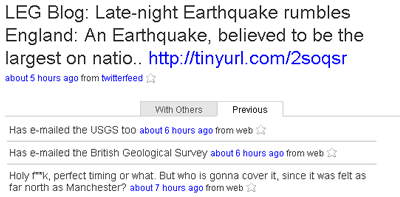
Kudos to two of my student journalists who had the nous to report on last night’s earthquake as soon as it happened, using Twitter, blogs and the website, and sourcing from forums, Twitter, blogs, and Flickr.

Quickest off the draw was Stephen Nunes, who posted a tweet complete with link to the U.S. Geological Survey (journalistic quandary: to twitter immediately without verification, or to get the facts?)

Meanwhile, Mitchell Jones was also twittering – about his scrambling for information about the earthquake.

Mitch’s Twitter feed

Once he’d gathered some facts, he blogged it. In addition to the official sources and other news outlets, Mitch had also gathered some original material from blogs and blog comments.

(And the Flickr-sourced image of a bleary-eyed housemate in dressing gown watching the news was an unusual one, but in the absence of the old lump-of-debris snap it kinda works for me as a representation of what was happening across the country – and he gets credit for thinking visually).

Cleverly, he’s obviously set up Twitterfeed to post blog updates to his Twitter account too.

Within two hours the story had gone live on the Environmental News Online website, complete with tags.

Congratulations, Mitchell, on a job well done.