Monthly Archives: April 2008

Comment call: which are the best non-English language blogs?

I’ve been painfully aware of my (and many people’s) ignorance of blogs written in languages other than English. I’m aware of some – Andre Deak in Brazil; Philip Couve in France; Alex Gamela in Portugal (who writes every post in English too); Nico Luchsinger in Switzerland; Beppe Grillo in Italy (also in English); and Adam Javurek in the Czech Republic – but really I could do better.

And I’ve started creating a Yahoo! Pipe which (clumsily) translates three of those blogs into English (sadly Adam tells me there is no online Czech to English translator)

So here’s a call for comments – what are the best non-English blogs, either about journalism specifically or social media generally?

Update your news article online? Not if Google News has anything to do with it.

The Google News Blog has posted on some truths and myths about its ranking systems (via Cowbite) – and this one caught my eye:

Updating an article after posting it will create problems with Google News TRUE
Currently, the Google News crawler only visits each article URL once. If you make updates to the article after we’ve crawled it, they won’t be reflected on our site. We hope that soon we’ll have the ability to re-crawl your articles to make sure we have the latest version displayed on our site, but for now this is not the case.”

In other words, the commercial pressure here is not to update a single article, but to instead create new ones with the new information (there is already an imperative here in that this increases your page count stats).

I’m not sure if this is a bad thing (errors go uncorrected?) or good (twitter-style newsrivers?). Continue reading

Flickr takes video – what does that mean?

Flickr has announced it will now be hosting video – with a maximum length of 90 seconds. The idea is that these are “long photos”, “capturing slices of life to share”

I’m not sure what the implications are for journalism or journalists (note the distinction). Could we see a July 7 moment, but with short video? Will it be easier for users to upload video to Flickr from their mobiles than it is to upload to YouTube? Can we expect better composed video on Flickr because it comes from a community of photographers? (If that matters to you)

I don’t know, which is why I’m calling for your comments and thoughts on this.

Read what the Twittersphere is saying about the change here

Read more OJB posts about Flickr

Dutch site reinvents what news looks like online

Recently my attention has been drawn to the Dutch news website www.en.nl. Wilbert Baan, interaction designer for the Dutch newspaper de Volkskrant, told me he wants to see “what we can do with news, social networks, wikis and more.

“I think you might like the experiment we are doing,” he wrote.

And bloody hell was he right. Continue reading

Twitter-reviewing – some reflections

Last Friday I tried a little experiment with Twitter: I used it to live-review the Clay Shirky book Here Comes Everybody: The Power of Organizing Without Organizations (Amazon US).

Why did I do it?

It wasn’t a preview copy, so there was no ‘scoop’ here.

It wasn’t a live event, either. As Dave Lee pointed out, “A book is a book. It’s not changing. Read it all and then tell me whether it’s any good or not.”

I did it, well, because I could. Because I wanted to give myself a reason to read the book without distraction. Because I wanted to see how viral it would go. Because I wanted to see how social you could make that most anti-social of activities: reading a book.

The thing is, Dave was mistaking Twitter for a pure publishing platform. What I discovered was this: it was about a conversation, not a publication: Continue reading

How interactive are UK business news websites?

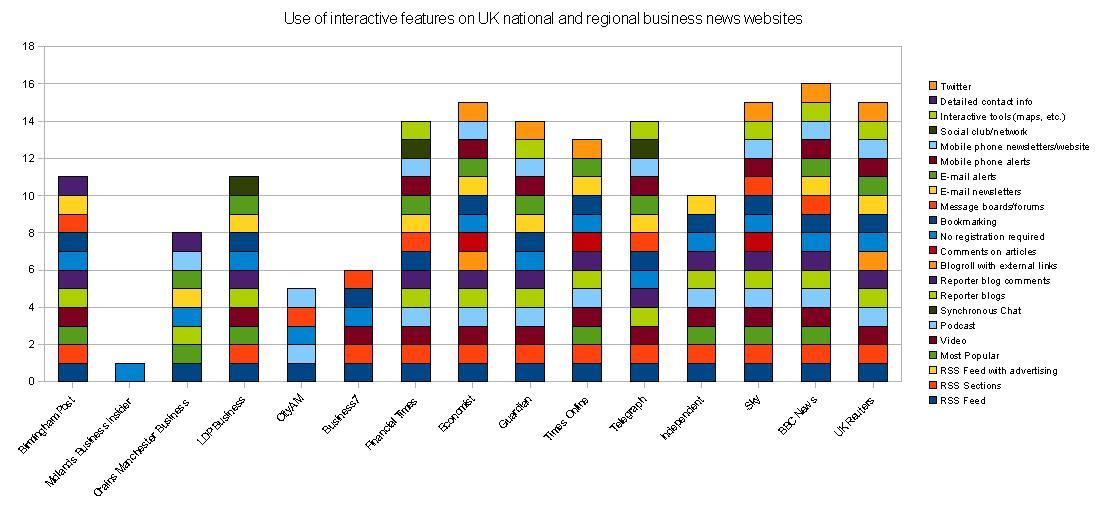
That’s the question Birmingham Post reporter Joanna Geary has been asking herself, and has come up with the following rather lovely graphic:

Clickon the image for a larger, more readable version – you’ll see she’s looking for availability of email contacts, use of things like maps, blogs, bookmarking, video (is that interactive? Or multimedia?), email newsletters, mobile alerts, RSS, podcasts, chats, forums – and Twitter: “I know it’s not yet a mass communication device but I think it’s a good indicator of those who are thinking about the development of the market” Continue reading

Something for the Weekend #5: Who needs to know Flash? Vuvox

Vuvox is to Flash what WordPress is to Dreamweaver. Vuvox is, effectively, a content management system for multimedia content – an easy way to create Flash interactives without having to know Flash.

I first explored it a few months ago, but still haven’t had the time to really see what it can do. But here’s some things:

Vuvox also works with RSS feeds, Flickr, Buzznet and Picasa, so you can create dynamically updated content.

One problem: the resulting movie is hosted by Vuvox  (although you can embed it). If you want to get the movie to host yourself you’ll have to use an .swf ripper, which is probably breaking the terms and conditions of Vuvox.

Anyway, over to you – what uses can you think of?

Live-reviewing a book on Twitter: Here Comes Everybody by Clay Shirky

From 10am UK time today I will be reading Clay Shirky’s new book Here Comes Everybody: The Power of Organizing Without Organizations (Amazon US) – and reviewing it on Twitter as I go.

And I won’t be alone. Joining me will be Antonio Gould, Dave Briggs, Jon Bounds, Paul Inman and Brendadada.

All six twitterers – plus a Tweetscan search for ‘Here Comes Everybody’ – will be aggregated at http://xfruits.com/paulbradshaw/?id=38799 so you can follow them all, or join in yourself.

Twitter – what are you doing in your newsroom? What would you like to do?

OK, so everyone is on Twitter. Let’s take stock. I’d like to know what you’re doing with the tool as a journalist and in your newsroom – or what you’d like to do. Oh, and what good examples of its use have you seen? Comment away – let’s see if we can’t compile a useful collection of examples, experiences and ideas.