Monthly Archives: October 2009

Mugging the lawyers

If the famous media gaggers, the libel law firm Carter-Ruck, scourge of Private Eye, thought they’d scored another famous victory suppressing news (these guys are big on bragging) they hadn’t reckoned with social media.

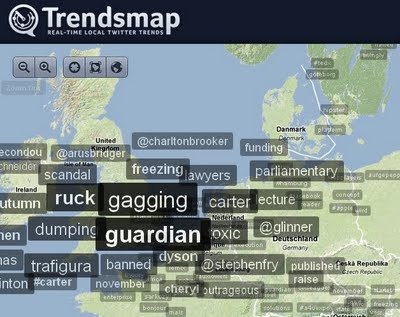
#trafigura is as I type the #1 trending topic on Twitter (that’s in the whole world). The Spectator has already broken the wall between what the blogs will say and what the print media thinks it can get away with … and many, many more people are now aware of the very story a very rich set of people running a polluting company is paying them – presumably – many millions to kill.

In a few hours American bloggers will start picking up on the story enmasse. What’s Carter-Ruck going to do then? As @ElrikMerlin just pointed out to me ‘this is Streisand Effect in action’ – something which I have blogged about before.

When Uzbek billionaire Alisher Usmanov tried the same trick, and created the same effect, it generated this quote from Boris Johnson (one of those inadvertently whacked by Usmanov’s ‘take-down’ action):

We live in a world where internet communication is increasingly vital, and this is a serious erosion of free speech.

This is what Carter-Ruck did: Continue reading

Text still rules

This is a really excellent reminder of a web basic, which is unfortunately often forgotten as websites add and add and add and in the process become bloated.

“Think of your Web audience as lazy, selfish and ruthless,” said Michael Gold, West Gold Editorial principal quoting usability guru Jakob Nielsen’s apt description of today’s impatient, task-oriented Web audience during his remarks at a recent ONA panel. “Web audiences are on a mission—they’re task-oriented.”

Text matters on the Web from Martin Ricard on Vimeo.

HT: ONA

@Guardiantech accounts for 78% of the growth in national newspaper Twitter accounts

National UK newspapers had 1,665,202 followers of their Twitter accounts at the start of October – an increase of 193,266 on September 1st (when they had 1,471,936).

The rate of growth has slowed, however. This is a monthly increase of 13.1%, compared with 17% from August 1 to September 1, and also from July 1 to August 1.

What’s more, 151,555 of the increase (or 78% of the total) is down to just one account – that of @guardiantech (which owes its popularity to its place on the Twitter Suggested User List). Indeed, of the 131 accounts I’m tracking, 51 have fewer followers than me (@malcolmcoles)!

You can see the full table here, or below (although the iframe isn’t behaving properly, so you’re better off clicking here).
Continue reading

Fast Flip: The coolest web news application I never use

google-fast-flip

Last month at TC:50, Google unveiled their latest Google News effort called Fast Flip. News began dripping onto Twitter and soon I was playing around with it. I loved it right away.

Soon more people started hearing about it and did their own trials. Opinion was mixed. I remained steadfast in my love for it. I saw it as the “next step” in web news consumption. I still think that.

Thing is, I never use it.

I have re-visited Fast Flip since that first night, but it’s only been to see if there were features I had missed. My favourite aspect of it is that it allows me to deep-dive web sites, leading me to discover stories I otherwise never would have found. It’s especially useful for sites with large archives and numerous sections, such as NYTimes.com.

Picture 3

I also realised that Fast Flip is not best utilised on a laptop. If ever there was an application built with direct manipulation touch screen devices in mind, Fast Flip is it. The elegance of “flipping” through pages is lost on clicking. Using a finger to flip like you would a book page would feel much more natural.

I can envisage using Fast Flip more if I wanted to find out what I’m not seeing on NYTimes.com when I visit the web site. But for regular consumption, it’s either a half-baked idea, or way ahead of its time. At this point it’s hard to say.

Ultralocal Blogging Roundup. Talk About Local ’09, Guardian, Wired Mag

There have been several events and reports worthy of note in the last week in the world of local blogs and websites .

Wired Magazine Intelligence Briefing

Recently I gave an interview about current directions in the world of local blogging, for one part of a Wired Intelligence Briefing, to @jamiedouglas.

The whole presentation identified “10 current trends in 20 minutes”, which characterise our environment:

  1. We the people – isolation of the political class.
  2. Abundance creates scarcity of attention.
  3. Serendipity and shared experiences – where discovery happens.
  4. Everybody is local – enrichment of neighbourhoods.
  5. Collaborate and listen.
  6. The media is unpoliceable.
  7. Watch out, sport.
  8. Social networks have a half-life.
  9. Google’s Achilles’ heel.
  10. An era of etiquette.

Talk About Local ’09

Also worth a look is a report in the Guardian about the Talk About Local ’09 Unconference, held on Saturday 3rd October in Stoke-on-Trent:

Almost 100 people left their bedrooms, home offices and local community halls for talkaboutlocal’s inaugural unconference this weekend. Some attendees in Stoke-on-Trent are professional journalists, starting out on their own against a backdrop of local and regional press lay-offs and closures, some have a political cause to fight while others quite simply want to give a voice to a community not well-served by a newspaper industry retracting and centralising.

Definitive numbers of these hyperlocal sites are hard to come by but the website www.nutshell.org.uk has already listed more than 50.

The event organiser, William Perrin, from TalkAboutLocal.org says: “People have always wanted to get involved to make things better and suddenly they can do it for themselves. The web 2.0 tools provide platforms that are incredibly easy to use, without any real cost.”

In the Guardian, the report author mentioned the practice of Stoke City Council to treat “Citizen Journalists” as being different from ‘real journalists’:

The town hall which PitsnPots set up to scrutinise has been less welcoming. Stoke Council’s head of PR and communications, Dan Barton, explained that bloggers would not be invited to briefings and are excluded from sitting at the press table in the council chamber.

“Opinion should be encouraged but we do draw a distinction between what is news otherwise we are in danger of de-valuing the role of journalists,” he said.

The National Association of Local Councils (NALC) is currently updating its guide to include the rise of social media networks but looks unlikely to change the definition of who gets treated as a journalist. A spokeswomen said: “We can say anecdotally that we would encourage councils to treat only accredited journalists as journalists. And treat citizen journalists as citizens. But that does not stop citizen journalists making enquiries in the normal way … And there is no reason why media releases cannot be available to everyone as they are public documents.”

Reflections

The comment from Dan Barton seems to imply that the content of newspapers is “news, not comment”, and that the content of blogs is “comment, not news”.

I’d suggest that this is a ludicrous position to take, bearing in mind the extent to which news and opinion are mixed in the local (and especially the national) media, and also the miraculous range of howlers and planted stories which appear regularly. To mention just two that I have covered in the the last 5 weeks, remember the non-fact-checked Mayor of Baltimore spoof, which appeared in half a dozen national media outlets, and the Alan Sugar on Terrorism Death List story, which was invented out of the air and swallowed by the Sun?

I’d assert the opposite position: that thoughtful and careful bloggers, whether our beat is “local”, “subject-based”, “professional”, “political”, “technical”, or anything else, have potential to increase significantly the range and quality of niche coverage, due our tighter focus and our freedom from a need to work tightly to deadlines and volume of output requirements.

There are two clusters of issues that we need to address:

  1. We need to make sure that we do work to a level of quality which is equivalent to, or better than, our colleagues whom Mr Barton is willing to name as “journalists”.
  2. We need to make sure that it is impossible for the councils we are scrutinising to refuse to accredit us for any reason.

I’ll cover these issues more in a future article, but I think it is time for local bloggers to go on the front-foot; the decline in local media has left the gate wide-open.

Two places to start are firstly to write for other outlets, such as your local newspaper and sites which are regarded as “media” not “blogs”, and to see if you can get a UK Press Card. There are a range of bodies which issue UK Press Cards, and some people may come within the rules who do not realise that they do so.

Matt Wardman is an online consultant, and edits the Wardman Wire group political blog and Nutshell directory of local blogs and websites.

Arriving at an ideal social-media policy for journalism, Part 1: Perspectives from journalists and news organizations

Much has been said about the Washington Post’s now-infamous incident with issuing restrictive social-media guidelines after Managing Editor Raju Narisetti expressed his not-so-subtle views on war spending and public-official term limits on his Twitter page. Narisetti’s own first reaction to the policy was another tweet: “For flagbearers of free speech, some newsroom execs have the weirdest double standards when it comes to censoring personal views.” He since retracted and shut down his Twitter page on account of “perception problems.”

The Post’s own media reporter Howard Kurtz poked fun at the incident with this tweet: “I will now hold forth only on the weather and dessert recipes.” He then gave a half-hearted, almost contrived endorsement to his organization’s policy, calling the furor surrounding the incident “much ado about nothing” while emphasizing that social media are important channels for communication with readers. The newspaper’s technology writer Rob Pegoraro was also quick to insist that journalistic interactions through social media are indispensable.

It is hard to deny the fact that opiners are neatly divided between journalists and news organizations–in other words—between those that use social media and those that want to regulate it.

The very essence of social media is that it offers readers a glimpse of the “person” behind the journalist. Citizen journalism pioneer Dan Gillmor looks at social networks as an opportunity for news organizations “to show readers that news is not a commodity produced by a faceless institution but a rich, collaborative process.”

For instance, Post political reporter Chris Cillizza, whose Twitter account, “The Fix” is named after his blog at the paper, entertains readers not only with snarky political comments but also by finding humor in life’s little trials, and his Twitter page has been surprisingly—and comfortingly—unhindered by all the drama. If his tweets were to trickle down to news article URLs in keeping with the Post’s new regulations, I wouldn’t follow him. It’s safe to say, neither would 14,540 others.

Despite these differences, even old-school news organizations agree that social media are important. But can managers, editors, reporters and readers agree on a social media policy? To that end, it would, perhaps, be helpful to analyze guidelines that have so far been proposed by different news organizations, and more importantly, how they have been received.

The policies

The Wall Street Journal laid down its own set of social-media regulations over the summer to much opposition.“Sharing your opinions,” the Journal said in an e-mail to staff members, “could open us to criticism that we have biases and could make a reporter ineligible to cover topics in the future for Dow Jones.” A tad more ridiculously, it continued, “Openly “friending” sources is akin to publicly publishing your Rolodex.”

Apart from confidential sources that any journalist would be expected to protect through sheer common sense, social media interactions with reporting contacts can only serve to enrich the exercise of newsgathering, and allow a more transparent process while at it.

Continuing in the same vein of going against the grain of journalistic transparency, the WSJ guidelines also insist that reporters not “detail how an article was reported, written or edited.” Social media guru Jeff Jarvis rightfully points out that these rules challenge the very idea of the collaborative nature of journalism that is promoted by online media.

The ability of a journalist to interact with his audience, be it by seeking story ideas, soliciting sources or sharing the newsgathering process is one of the main advantages of social media. Time’s James Poniewozik astutely calls blogs and social networks, the “DVD director’s cut with commentary.”

Perhaps, one of the most ridiculous of guidelines comes from the AP, which over the summer issued a set of rules, among them, asking employees to control not only what they said on social networks but also what their friends and acquaintances said: “It’s a good idea to monitor your profile page to make sure material posted by others doesn’t violate AP standards; any such material should be deleted.”

The AP’s rules came in the aftermath of one of its reporters posting a critical comment about the McClatchy newspaper chain on his Facebook profile. Mashable’s Ben Parr expressed rightful outrage at this, pointing to the ridiculousness of holding an employee accountable for another individual’s words.

Some guidelines, of course, are acceptable, though none seem to require much more than common sense and ethical awareness on the part of the reporter. For instance, the WSJ’s following rules:

  • “Don’t recruit friends or family to promote or defend your work,” or
  • “Don’t disparage the work of colleagues or competitors or aggressively promote your coverage.”

Also reasonable are rules curbing the sharing of confidential company information. “Posting material about the AP’s internal operations is prohibited on employees’ personal pages” is acceptable as a standard for all staff members at an organization, not exclusively for journalists.

This was one of the reasons why the NYT found itself in a tight corner earlier this summer, when its reporters tweeted about internal discussions at the paper. The Timessocial-media rules are actually more reasonable than most, merely asking reporters to avoid conflicts of interest, maintain political impartiality, and exercise good judgment.

But when a group of journalists decided to broadcast proceedings from an internal staff meeting, the Times decided to throw down the gauntlet. Craig Whitney, the standards editor, made a valid point: “When you’re in an internal meeting that is not public where you’re discussing policy, you would no more Twitter it than pick up the cell phone or call up one of your friends and say, ‘Hey you’ll never believe what (Executive Editor) Bill Keller just said!”

And while that is perfectly reasonable, Jennifer Lee, one of the tweeters from the meeting insisted that there is often something to be said for sharing internal information about your news organization with your audiences. For instance, her tweet about Times’ Pulitzer winners was not only acceptable, but also good for the paper, she said.

Are readers excited to learn these nuggets of information directly from journalists they follow? Sure, it’s certainly more personal than reading a press release. And when the news is about the organization itself, it is especially helpful to hear employees’ unfiltered opinions. If not for Twitter, I probably would have had no way of knowing what Howard Kurtz thought about the Post’s regulations.

Distinction between individual tweeters and institutional ones

Where the Times went a bit far in its regulation was Bill Keller’s insistence that tweeting policies should follow what was already being implemented with regard to what reporters say on television or speeches: anything said was representative of the entire institution. This seems reasonable till you consider that Twitter is a “personal-social” page. It is not like appearing on television to talk about your thoughts and viewpoints on an issue as a reporter from the NYT might be expected to on Meet the Press.

This sentence among the Post‘s guidelines, rings a similar tone: “Post journalists must recognize that any content associated with them in an online social network is, for practical purposes, the equivalent of what appears beneath their bylines in the newspaper or on our website.”

Along the same lines, Rob King, Editor in Chief of ESPN.com, called Twitter a “live microphone.” The site’s guidelines state that “editorial decision makers (such as reporters and writers) essentially represent ESPN in all social networks, and hence, should exercise appropriate judgment (this is as opposed to policies for the rest of ESPN’s staff who may extricate themselves from ESPN affiliation in personal blogs).

ESPN sparked its own controversy when it recently banned reporters from using Twitter for content not sanctioned by ESPN.com, and Mediaite actually questioned the use of the “live microphone” metaphor in an interview with ESPN spokesman Paul Melvin: “Does ESPN recognize the difference between a Twitter feed and a live microphone on television (which requires incredibly exclusive access as well as millions of dollars of broadcast infrastructure)?”

Melvin’s response: “The point here is that all of these media are public. Whether it is TV or radio or a blog, a column a tweet or any other publishing format, these are all public media. The words we use have impact, and we should be mindful of that.”

This is significant. What a journalist says in a tweet cannot be similar to what would appear under a byline or on live television or on radio. Social media don’t operate strictly within the sphere of the workplace. Social media are part of what journalists carry home with them; it is where they ought to be able to express views wholly unrestrained by the rigid rules of traditional journalism. It is also where they delight their readers with a goofy tale about their dog and the latest controversy unfolding on Capitol Hill with equal aplomb.

A distinction should be made (as is done in the business world) between “individual” tweeters, and tweeters who tweet “under the umbrella of an organization.” Corporate policies on social media separate the personal from the professional, and hence are less restrictive on an employee’s right to tweet or blog. By these standards, @washingtonpost would clearly cross the line by tweeting about enforcing a term limit on senators such as Mr. Byrd, but @rajunarisetti was entitled to his opinion. As individual tweeters, journalists should not “relinquish some of the personal privileges of private citizens,” as the Post guidelines require them to.

The BBC, perhaps comes closest to adopting this sort of hands-off approach to the use of “personal” social media by its reporters: “Many bloggers, particularly in technical areas, use their personal blogs to discuss their BBC work in ways that benefit the BBC, and add to the “industry conversation”.  This editorial guidance note is not intended to restrict this, as long as confidential information is not revealed.” In addition, it excludes “personal” blogs from the guidelines, as long as no affiliation to the BBC is mentioned, and even encourages employees to include a disclaimer.

Is unadulterated objectivity possible?

It does, however, specify that editorial staff “should not be seen to support any political party or cause.” It also warns employees to discuss “any potential conflicts of interest” with managers and editors. This is a common theme among regulations cited by all news organizations. Perhaps, if a reporter did not share on his social network opinions and viewpoints on subjects he was reporting on, that would be acceptable.

But then again, restricting specific types of content is a slippery slope. As Editor & Publisher editor Jennifer Saba questions,“Somebody could say, ‘Oh I really enjoy Mad Men,’ and if they cover TV, does that mean they are biased?”

Post ombudsman Andrew Alexander raises this very question in his piece: “Can a reporter who doesn’t cover sports tweet that a team’s owner is a tyrant? Should an editor in the Business section post a comment on her Facebook page that gun owners are paranoid?” I’m not sure if his question is rhetorical, but unfortunately for Saba, he fails to answer it. The New York Times, ever our reliable source for information, jumps in, however: “A City Hall reporter or a politics editor might be “friends” with several different City Council members as well as the Mayor, but not just with one of them. But a reporter or editor whose work has nothing to do with City Hall could be “friends” with people who work there with no conflict of interest.”

But then again, is unadulterated objectivity on a subject a journalist has studied closely, even possible? As James Poniewozik writes, “any person who immersed him or herself in a vital, contentious subject all day and formed no opinion about it whatsoever would be an idiot, and you do not want to get your news from idiots.” And if he does have an opinion, is it in keeping with journalism’s goals to shield it?

Not surprisingly, organizations that appear to be least restrictive of journalists’ use of social media are also the ones that have embraced social networks to effectively disseminate information, engage with the audience, and promote content, such as the BBC and the New York Times, and NPR, which is touted by many as the most effective user of social media, most notably, Mashable.

Alan Rusbridger, Editor-in-chief of the Guardian, another organization known for its utilization of social media tools for citizen journalism and crowdsourcing, has perhaps been most convincing in his ringing endorsement of journalists’ use of such networks to interact, engage and impart information. He has clearly stated on the site’s editorial pages that one of the advantages of Twitter is that it allows reporters to publish, unhindered by the confines of the newspaper and its Web site. This is also reinforced in the site’s social media statement, which promotes the idea of an open forum that promotes all forms of social networking interactions with readers.

Any set of reasonable rules for social media, then, are more common-sense parameters than anything else. And one would hope that journalists would be smart enough to not broadcast something on Twitter that would jeopardize their own credibility, alienate audiences, or embarrass their organizations.

As NYT’s David Carr writes “if you can’t trust the women and men who put out your newspaper to use their keyboards wisely regardless of platform, what are they doing working for you?”

[Part 2 will look at perspectives from history, such as the role of objectivity and the influence of technology on the changing rules of journalism]

Google actually makes something potentially useful for publishers

ReadWriteWeb reports on Google’s inclusion of “Real-Time Updates” in selected users’ Gmail messages. Google’s Help explanation says:

“If you’re subscribed to receive email from certain senders, the messages you receive from them will be enhanced with an interactive gadget that has up-to-date content from their website (you’ll also see an icon in your inbox identifying these messages).

“For example, if you receive a Pregnancy Bulletin newsletter from Babycenter, you’ll be able to view up-to-date content, including the baby name of the day, and browse though the current top 100 baby names within the message. Aside from the convenience of being able to interact with certain websites from inside Gmail, the branded content will help identify that your messages are legitimate and not spoofed (we’ll only show branded content when the sender authenticates their mail). We’re currently testing this with a small number of senders and will decide whether to make it widely available based on user and partner feedback.”

This has a two major implications for publishers: the first is the possibilities it opens to create genuinely lucrative email newsletters either for their own publications or – just as likely – for advertisers (think of it as the email equivalent of the corporate magazine). But will they have to get in bed with Google to benefit from them?

The second implication is this: advertisers are already beginning to spend their budgets on their own publishing operations – i.e. websites and viral marketing. This is another possible candidate for those budgets.

Walking us through Reuters’ multimedia time lines: Q&A with Jassim Ahmad

Reuters has been among the leading news organizations in its use of Internet technology, both in its forays into citizen participation in the developed and developing worlds, and in experimenting with audio visual tools to offer fine narrative journalism.

Following the success of its online documentary on the Iraq war last year, Bearing Witness, Reuters recently produced another interactive multimedia time line, this one elucidating on the impact of the current financial crisis.

In Bearing Witness, the agency brought together five years of reporting from 100 correspondents and photographers to give a comprehensive account of significant events that transpired during half a decade of the war, from reasons that led to the conflict, recounts of battles in various Iraqi cities from Baghdad to Fallujah, the army offensive led by the US and its allies, and political, economic, and social consequences. In addition to offering personal accounts from its reporters, the project illustrates numbers and statistics through elaborate infographics.

The Times of Crisis project offers a peak into the impact of the current financial disaster over the course of a year since it was first set off by the collapse of Lehman Brothers. It is a compelling narrative not only in terms of its rich multimedia interactivity, but also in what it brings in terms of the human face of the impact, providing anecdotes and stories from real people.

I recently got a chance to interview Jassim Ahmad, Head of Visual Projects at Reuters, over e-mail. Below is the exchange:

Q. What inspired Reuters to do this? What was your main motive behind the two projects?

We were first inspired to produce Bearing Witness to mark half a decade of war in Iraq – a story to which Reuters has dedicated a team of 100 correspondents, photographers, cameramen and editorial support staff. The conflict has been the most dangerous in history for the press. 139 journalists and 51 media support staff have been killed (latest figures from CPJ) including seven Reuters colleagues. Our ambition was to go much further than simply repackage our coverage. We sought to tell the wider story through reflection and behind the scenes perspectives of conflict reporting.

Bearing Witness received exceptionally positive feedback and picked up a string of awards in the US, UK, France and Italy. We chose the financial crisis for our next initiative – undoubtedly one of the biggest stories of our times and one which Reuters is able to tell with exceptional depth with its financial expertise. Whereas most news coverage has understandably focused on the local and regional effects of the crisis, ours would attempt to show its global significance.

Chronology is the natural backbone of a wire news agency. We wanted to re-imagine the classical news “time line” with a much more visual approach.

Q. As someone that coordinates such visual projects, I was wondering if you could shed some light on how a story is approached differently for multimedia vs. text. Is there a different philosophy when a journalist has to let pictures and videos tell a story without getting in the way of it?

There is no one multimedia model. We try to embark upon each project with fresh eyes. Each subject determines its own mix of special reporting, research and interactive design. Unlike automated feed and search-based approaches, we would manually curate the story for quality and cohesion. Through 15 streams of information spanning news, visuals and data, we carefully pieced together this puzzle into a single fluid narrative – putting the story in its total cross-media context in a way only multimedia can achieve.

Q. Do you feel that these sorts of multimedia projects afford people deep, contextual knowledge without them having to go through 20 odd pages of print to get the same breadth of detail? In other words, can this sort of journalism replace traditional reported pieces?

Photography in particular is unparalleled at conveying information with power and immediacy. We would weave together stories, pictures, video, graphics and data so that each piece of information advances the story within an immersive mixed-media experience. This accessible framework would deliver both immediate impact and greater depth for those that sought it.

There are different degrees of production and in-depth multimedia is not a replacement for existing forms of journalism. However, for the appropriate subject, it can deliver unequalled emotion, clarity and understanding.

Q. In countries and regions where high-speed Internet is still not very prevalent and where broadband is not accessible, could such stories pose limits on readership, as they tend to be time consuming and extensive? Is that a problem?

Lack of broadband connectivity is a barrier for many, but multimedia need not always equate to bandwidth-intensive video. Our interactive visual timeline is a case in point. I would argue that language and complete lack of connectivity for many are greater barriers. That said, rebranded editions of Times of Crisis were simultaneously launched on client web sites from Australia to France, Germany to the Gulf. Whereas Reuters content traditionally feeds into our clients’ products, this shows how we can be end-producers for our clients on stories with global resonance.

Q. Despite the effectiveness of such multimedia projects, why do you think more mainstream organizations are not doing these types of stories? Did Reuters encounter any resistance when you embarked on these initiatives?

Rich multimedia demands editorial time and creative resources, as does all special coverage. For those willing to invest in production, the reward is compelling, distinctive site-building content. Finding new ways to engage audiences has to be a key step towards securing new streams of revenue.

Reuters has the advantage of a truly global presence and teams working in every medium. We continue to use this basis to explore new approaches to information gathering, visualisation and interactivity to evolve storytelling.

The shaping of an online feature journalist

What happens when an online newspaper decides to implement web-only feature journalism? Will the role of the online feature journalist be different from that of a print feature journalist?

These questions form the topic of a recently published article in a special issue of the academic journal Journalism focusing on the changing conditions of work and labour in the global news industry (the introduction to this special issue can be downloaded here). In the article, I argue that academic research into online journalism has been biased towards exploring online journalism as breaking news journalism, thereby to some extent neglecting the magnitude of new styles and genres that emerges in online news sites (see David Domingo’s excelent Phd dissertation (pdf) for a thorough overview of the academic research into online journalism). An increasing number of online newspapers across the world
now for instance include sections like “special reports” (e.g this section on the St. Petersburg Times online edition), “multimedia features” (like The New York Times online multimedia/photo section), ‘travel’ (e.g The Guardian online’s travel section), etc., where breaking news and immediacy in reporting are not core activities.

Such sections signal a coming together of two apparently widely different practices of journalism: feature journalism and online journalism. Feature journalism is often associated with glossy magazines and newspaper weekend sections where readers are invited to spend time, relax and take pleasure in their reading. The dominant discourses of feature journalism therefore seem to contrast with the discourse of online communication as it so far has been portrayed in research on the practice of online journalism and the evolving role of the online journalist. (For a more thorough discussion of what feature journalism is, see the paper What is feature journalism? that I recently presented at the 19th Nordic Conference for Media and Communication Research in Karlstad, Sweden)

In the article in the special issue of Journalism I investigate how the implementation of feature journalism in an online newsroom influences the role of online journalists and how the role of an online feature journalist is thus shaped. The article is based on a longitudinal, ethnographic case study of the production of feature journalism in the Norwegian online newspaper dagbladet.no (which, as the first Scandinavian online newspaper, launched a section entirely devoted to feature stories in 2002). What is interesting with this online feature section is that most of the production is web exclusive – it is produced by especially assigned online feature journalists. Feature stories that emerge online elsewhere (e.g Soundslides- and Flash-productions) tend to be spin-off products of already published newspaper productions. The dagbladet.no-case therefore represents a unique opportunity to explore how (or if) an online newsroom establish a new, online-based understanding of what feature journalism is or should be when they are left to explore the genre without influence from old media editors and journalists.

The empirical material gathered from the case study (six weeks of observation in the newsroom of dagbladet.no in four different periods from 2005 to 2007), 28 interviews with newsroom staffers, and document analysis) reveals that – in this particular case – the online feature journalists became heavily influenced by the productions routines and role performance of their online colleagues. Hence immediacy became a virtue for them – they developed a production routine where frequent publishing of new stories became important. However, the online newsroom at large was influenced by what the feature journalists brought to the table: The other online journalists felt that the feature section ernhanced their status and gave them a competitive advantage over other Norwegian online newspapers.

The findings can further be summed up in these points:

  • In order to provide their role with status, the online feature journalists in dagbladet.no felt a need to distance them selves from how feature journalism is understood and practiced in conventional media in general and in the Dagbladet (print) feature journalism supplement “Magasinet” in particular. This lead to, amongst other things, a dismissal of the reportage as genre. The online feature journalists felt the readers provided the same kind of ‘human touch’ to their stories as the method of field reporting and face-to-face interviewing did for their print counterparts, as the readers were allowed to comment on and attach personal stories to the feature pieces. An interesting examples of this strategy can be found in this story on the troubles of gay people in rural areas in Norway, where the comments at the end of the article are dominated by personal experiences on the topic from gay readers (the story is in Norwegian).
  • Even though they became heavily influenced by the work routine of their online colleagues, the feature journalists of dagbladet.no felt a need to distance them selves from the standards of online journalism in general which they perceived to be too inaccurate and shallow. They therefore became intensely occupied with for instance backing up there stories with a sufficient amount of sources and hyperlinks. They perceived their role as being pioneers in the process of increasing the standards of online journalism. This was appreciated by the other online journalists in dagbladet.no as they felt the feature journalists enhanced the overall status of online journalism.
  • The online feature journalists of dagbladet.no developed a strategy implying that close relations with readers became more important than close relations with sources – the latter being a more common virtue in conventional feature journalism, where close encounters with people and milieus are common elements in the discourse. Even though they based their stories on many sources, the majority of the sources where second or third hand and largely assembled from other websites (reflecting a copy/paste practice common in online journalism at large). In stead of searching for first hand sources, the feature journalists devoted their attention to the audience. Readers were perceived as content providers both in the sense that the discussions the stories generated were regarded as valuable content and because the journalists ‘outsourced’ the human touch reporting to the audience. Thus, the readers to some extent became the sources.

The article concludes that the web exclusive feature journalism of dagbladet.no is a “multi-skilled practice of feature journalism entailing a devaluation of reportage as genre and emphasizing audience participation. This marks a shift from source-driven to audience-driven feature journalism, where debate and sharing of information and knowledge replace intimacy and adventure as dominant discourses.” (p. 715).

The case study is framed by an understanding of labour in general and media work in particular as undergoing substantial change and entailing a more individualized and random style of work. This development can be traced both in a historical axis of factors that have shaped the role of journalists throughout history, and a contemporary axis of the particulars of labour in modern society at large. Thus, the case study of how the role of an online feature journalist was negotiated within the online newsroom of dagbladet.no, serve as an example of these more general trends in media work.

Daily Show archive blocked for UK: Channel Four display several layers of stupid

UK fans of America’s leading satirical TV show got a shock today when they discovered they could no longer view the show on its website.

The website has forums where overseas fans of the show have been venting their rage at the block. Not just UK viewers but those from Ireland who can no longer watch the show on the UK licensee Channel Four’s website yet also remain blocked from watching it on the show’s website, apparently because C4 hasn’t bothered to tell the Daily Show’s channel, Comedy Central, that it’s blocked the Irish. People in the rest of Europe have no such problems.

There’s no statement from either Channel Four or the show about this out-of-the-blue block but it appears from past Daily Show statements on their forum that they only do the blocking on the request of a country’s license holder. Incidentally, I was able to leave a comment on their website and I see that the show’s producers do respond to comment. Channel Four offers no such option, there is no comment space offered for the show and they have no forum or similar space for viewers to talk back to them.

What is particularly sad/appalling about Channel Four’s actions is that all online video from the extensive Daily Show online archive is now being blocked for UK – yet Channel Four is only showing the past week’s shows online! Do they even have rights to episodes from before they started showing the Daily Show, because I can’t watch clips from 2000.

What is so stupid about this (and it has multiple layers of stupid) is that I have been posting clips on my blog which promotes the show Channel Four have rights to! Now none of those embedded clips work and so the show gets no (free) promotion from me or the many others who embed clips.

When the Daily Show’s sister program The Colbert Report was being shown on a UK cable channel you couldn’t watch clips on their website – but you could watch clips embedded on other websites. This makes complete sense as if you liked what you saw it promoted the cable channel’s show and made it far more likely that you’d bother to subscribe to it. It also makes it appear that C4’s block request included blocking embedded clips.

At the same time that one bit of C4 takes this completely stupid action another makes clips from C4 news freely available, even ad free!

Here’s another stupidity. I have watched clips from US shows which have served up country specific ads. On sites like HuffPost I get UK ads. So if you can recognise I’m from the UK you can monetise it to the benefit of the UK license holder. Hardly rocket science.

What C4 are doing is tragic for the Daily Show itself as it is going to lose a significant chunk of its UK audience. All – one would assume – in the name of driving viewers back to watching the show on More4 ON TV!

I hope that the show’s resident Brit, the hugely popular John Oliver, learns about it and tells Channel Four to stop behaving like idiots.

Of course people can watch Daily Show clips if they know how to get around the block by hiding their computer’s ip address. This means C4 lose out on any hope of ad revenue. I won’t even bother linking to how because a simple Google (or a look on the Daily Show’s forums where they allow comments explaining how) will tell you what to do. So not only are C4 idiots but they think the rest of us UK fans of the show are too.

Reblog this post [with Zemanta]