Author Archives: Paul Bradshaw

How much local council coverage is there in your local newspaper? – help crowdsource the answer

Are local newspapers really wimping out on council coverage? Sarah Hartley would like you to help her investigate council coverage in local newspapers:

“After responses to the debate about council “newspapers” prompted so many comments … about local papers dumbing down and failing to cover civic issues at the expense of celebrity trivia, I suggested on this blog carrying out some sort of a survey to see whether that was truly the case.

“This alleged withdrawal of bread-and-butter reporting hasn’t been my experience of working on regional papers in northern England and Scotland, but, maybe times have changed or other regions have different stories to tell?”

Sarah’s investigation began on her blog with the Darlington & Stockton Times (of 7 eligible pages, the equivalent of 2 are concerned with local council stories) before I suggested she use Help Me Investigate to crowdsource the research.

If you’d like to help and need an invite contact Sarah, leave a comment here, or request an invite on Help Me Investigate itself.

UK newspapers add 213,892 Twitter followers in a month

National UK newspapers had 1,471,936 Twitter followers at the start of September – up 213,892 or 17% on August 1 (when they had 1,258,044 followers).

You can see the September figures (orignally posted here) below or here.

I have more Twitter statistics here.

Taking cues from Citizen Science

One rap against citizen journalism is that there is always a possibility that it isn’t accurate or credible. Unmonitored, unmoderated blogs can get it wrong. Well, so can traditional journalists, but with blogs, it’s harder to hold someone accountable, and erroneous information is that much trickier to retract.

Would it help then, to look for ideas in a field where inaccuracy is barely tolerated, if at all? The media should be able to tap into crowd wisdom for credible content if, as Dan Schultz notes, “members of the scientific community, a professional group that arguably maintains higher standards for verification than journalism, are trying to harness the crowd in the same way that we are.”

Citizen science has been effectively used in one main way – collection of data, which is then used by scientists for contextualization, analysis and consolidation with experiments and previous scientific literature.

Be it recording the dates of Spring’s first lilac blossoms, or counting the number of eggs in bird nests, citizens are contributing in meaningful ways, so scientists can then then use this for more specialized tasks, like assessing the information thus obtained to study the impact of global warming or the influence of human activity on wildlife.

Perhaps, the closest counterpart to this use in journalism is something akin to WNYC’s crowdsourced project to track price gouging in New York City or the Shropshire Star’s map of fuel prices. In both these exercises, citizens were not expected to do much more than report their daily observations.

Since scientific research usually requires a high level of education and training, the tasks get divided neatly between professionals and dabblers. As Schultz points out, in the case of science, “professionals have bigger and better things to do; it doesn’t make sense for a PhD to use a million-dollar telescope to look at something that a hobbyist could view using a thousand-dollar one, especially when there is so much of the universe left to unlock.”

This is not to say that such a clear definition would not work for journalism. In fact, citizen journalism pioneer Jay Rosen has often said that division of labor is essential for crowdsourced journalism projects. In WNYC’s case, citizens were responsible for collecting information that was put together in a story. In more complex investigative projects, the public is given the task of perusing documents, as is happening with The Guardian’s investigation of the MP’s expenses scandal.

Another idea would be to outsource so-called “fluff” journalism to the public (self plug warning). Many sites are already implementing this, by allowing citizens to post blogs and articles on lifestyle and recreational topics. Schulz suggests hyperlocal content as one such department where citizens can often do a good, if not better, job than reporters.

One of the main problems is that unlike scientists, journalists–irrationally or not–are in constant fear of being replaced by amateurs. Hence, they seem more hesitant to solicit citizen help. The fact that journalists are losing jobs, however, has more to do with the lack of revenue-generating mechanisms on the Internet than it has to do with bloggers posting content online. In fact, by recruiting audiences to act as eyes and ears for news organizations, the latter would actually save costs and be able to divert resources toward more specialized reporting.

Secondly, in the case of scientific crowdsourcing or citizen science, there is a distinct classification of contributors and their scope of contribution–as identified by what professionals, amateurs and citizens can do. This leads to a clear division of labor, which is not quite possible in journalism, at least in the way it is being practiced right now. While there is no doubt that journalism needs a special set of skills and training, it’s not rocket science, quite literally.

Amateurs contribute toward citizen science in significant ways by performing unspecialized tasks. In the case of bloggers, on the other hand, short of traveling to a war zone (with some exceptions) they are pretty much doing–or attempting to do–what professional journalists routinely do.

The solution is not to curb bloggers and independent journalists, however. It is to produce the sort of in-depth, high-quality journalism that makes newsroom journalism “special.” In order to have clear-cut division of labor, professionals merely have to offer a product that makes use of the creativity and resources that are available to them. And in the process, they can implement projects that involve the lay public so the latter can do what they do best.

Maps on news websites – an overview

The following is part of a chapter for a forthcoming book on online journalism. Contributions welcome.

Maps have become a familiar part of the news language online due to a number of advantages:

  • They provide an easy way to grasp a story at a glance
  • They allow users to drill down to relevant information local to them very quickly
  • Maps can be created very easily, and added to relatively easily by non-journalists
  • Maps draw on structured data, making them a very useful way to present data such as schools tables, crime statistics or petrol prices
  • They can be automated, updating in response to real-time information

News organisations have used maps in a number of ways: Continue reading

The CollegeJourn global reporting project

“How does the healthcare on my University campus compare to the healthcare at other Universities?”

That is the focus of CollegeJourn‘s first collaborative data-gathering project, an idea that has rapidly gained momentum in just one week.

Some background on CollegeJourn: Founded by Ben Leis (@benleis) in January of this year, CollegeJourn started out as a Twitter hashtag chat for journalism students, educators and practitioners for the furtherance of ideas on remodelling journalism education to suit a rapidly changing industry.

With burgeoning popularity, the hashtag chat switched to a chatroom hosted on collegejourn.com, taking place at 8pm EDT every Sunday evening. I set up a parallel chat at a more amenable time of 8pm BST for European participants, also hosted at collegejourn.com, in March.

Last week, the idea of a global collaborative project for student reporters was floated. The first, a ‘hard-news’ data-gathering assignment, would go hand-in-hand with the second, a thematic feature piece exploring the history of a word or concept in the relevant location. You can find CollegeJourn transcripts to catch up on here.

For the first part, participants would gather data relevant to their location on a particular topic, collaborating with those investigating the same in other locations as they go. On or before the deadline, reporters would bring their findings together for use in one (or more, depending on findings) finished publication.

In the second-part of the assignment, contributors would file their feature pieces as a news-feature accompaniment, allowing for creative interpretation across the globe and likely producing some interesting interpretations. The accompaniment to the investigation above is “What does ‘health’ mean in your location?”.

Sarah Jackson (@sarahsodyssey), involved in the chat on the night, blogged about her dream of a ‘global collaborative journalism project’ here. Suzanne Yada (@suzanneyada), moderator of the US-based chat, later said, ‘we’re breaking out of the naval-gazing. Let’s stop talking about journalism and do some journalism’.

As a platform for the collaboration, we will use HelpMeInvestigate.com. Aside from the benefits of working alongside a highly-skilled virtual newsroom, HMI allows us to easily break the investigation down into digestible challenges and see the progress of others working on the same thing. UPDATE: Click here for Help Me Investigate group.

For group communication, we will be using the newly-acquired Publish2 network, Wired Journalists. Click here for the CollegeJourn group. Weekly catch-up chats will also be held on Sundays, 8pm BST (3pm EDT), at collegejourn.com. All welcome.

Even though the (very) new UK Student Publication Association is in it’s earliest stages, I would urge them to jump on board for this project. As an organisation that seeks to work to ‘support student publications and their contributors by offering guidance, knowledge sharing, links in to the industry’, this would seem to be the perfect opportunity to develop alongside similar networks.

Likewise, I would urge anyone who’s as excited about this as us to get involved. By the nature of the project, we’re wanting contributors from all corners of the globe to join in, so do get in touch.

Feel free to come along to our Sunday chats and join our Wired Journalists group. Presuming you’re on Twitter, send a message to @suzanneyada, me (@JoshHalliday), @sarahsodyssey or tag your tweet with #collegejourn to jump into the conversation. We’ll look forward to hearing from you!

What kind of Twitterer are you?

Here’s a bit of fun for a Friday. Here are 9 types of Twitter user that I reckon exist – you might be able to think of more. I’ve not included spammers and bots because, not existing, they won’t be reading this. So… which one are you?

The Conversationalist

You follow a couple dozen people who mostly follow you back. Most of your tweets start with @. Twitter is the new Facebook to you.

The Polymath

You follow a few thousand people. Twitter is just one big pool of potentially interesting stuff to you, and you’re followed largely by people who feel the same way. Most of your tweets start with RT. Twitter is the new Google Reader to you.

The Networker

You follow a few hundred people, most of whom work in your industry or you know professionally. You try to keep track of most of what they’re saying and your tweets are a mix of replies, retweets and remarks. Twitter is the new LinkedIn for you.

The Broadcaster

You follow half a dozen people who either work with you, or are actually you on another Twitter account. Most of your tweets come from Twitterfeed and end with three dots and a URL. The @ sign never appears in your Twitter stream. Twitter is the new blog for you. With comments disabled.

The Fan

You follow a couple dozen people, mostly DJs and TV personalities, who all ignore your @ messages. You found out about Twitter on the radio and although you talk to your friends about it, you don’t talk to your friends on it. Twitter is the new gossip magazine for you.

The Experimenter

You probably plugged your plant into Twitter or something. It sounded like a good idea at the time.

The Marketer

You follow a few thousand people but never read anything that they say. Your biography includes WORDS IN CAPITALS and reads like you vomited up a pile of business cards. A few hundred people have followed you back by mistake. To you, Twitter is the new email newsletter.

The Misanthrope

Your updates are protected. You never let anyone see your updates. Actually, you never post any updates but no one knows that. Your Twitter account exists purely to annoy people – to you, it’s the new ‘Do Not Disturb’ sign.

The Dabbler

You heard about Twitter on TV, signed up to the site, posted one tweet and wondered why nothing happened. You’ve since forgotten all about it but in 9 months time one of your friends will start following you and it will all make sense. Twitter is the new Friends Reunited to you.

What kind of Twitterer are you?(online surveys)

Guardian the most bookmarked newspaper on delicious

The Guardian has more URLs bookmarked on Delicious than any other UK newspaper, as I first revealed here (with the original video here)

There are 10,914 Guardian URLs bookmarked, with the Times coming 2nd (3,944) and the Independent in 3rd place (3,196).

Newspaper
website
Bookmarks on Delicious
Guardian 10,914
Times Online 3,944
The Independent 3,196
Telegraph 2,258
The Sun 1,409
FT 1,303
Daily Mail 785
Mirror 624
Express 197

Quarkbase must be using the Delicious API but it doesn’t say where it gets the number. Click the papers’ name to see the Quarkbase figures (and more).

The Revenge of Lilliput: Former-SPCK Bookshop Campaign blog passes 150k visitors

20090824-spckssg-news-blog-past-150k-pageviews-screenshotThis morning the SPCK SSG News, Notes and Information campaign blog passed a total of 150,000 page views since it was established in June-July 2008.

This is a story which is an excellent example of both investigation by a network of people, and campaigning blogging. It shows how a coalition of individuals can make a significant difference. You can read a brief outline on the blog’s introductory page.

The blog is about the mismanagement and destruction of a chain of 25 Anglican bookshops, which have been around since the first half of the 20th Century, by two brothers based in the USA, J Mark – who is a lawyer – and Philip Brewer. They took over control of the Bookshops from the SPCK charity with the promise of maintaining and improving the business back in 2006. They used a charity called the “Society of Saint Stephen the Great” (SSG) as their vehicle.

Since then there has been a saga of “shenanigans”, including sackings by email, bullying of staff, “Cease and Desist” attempts to suppress straight reporting, creation of half-a-dozen business entities to confuse everyone, a fake attempt in the US at putting the core charity into bankruptcy (declaring only liabilities not assets) where the court has no jurisdiction anyway, and much much more, which I will be describing in some detail in a series of podcasts.

I (along with many others) helped promote the new campaign site in summer 2008 when Dave Walker the blogger doing the existing reporting (75 posts in about 18 months was one of several threatened legally by Mark Brewer; here is an example of the style of letter used – this one was published by Sam Norton. An instant archive of these deleted posts was of course established within days on the blog Open Debates not Libel Threats .

20080827-philip-brewer-of-spck-aircraft-for-sale-1-small1There have also been some lighter moments, such as the lawyer running a chain of religious bookshops being instructed by the Court to take remedial education in bankruptcy law and legal ethics, and the discovery that his brother possesses a private “hobby” aircraft painted in “Trotter Trading” yellow, which was maintained at charitable expense . However, the core objective is to make sure that the mismanagement of the chain is scrutinised, and the miscreants brought to book.
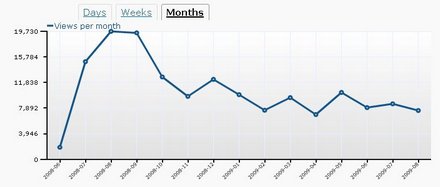
The campaign blog now has nearly 250 articles, and has received 2500 comments. Here are the visitor statistics from the WordPress stats module. You can see the initial surge, and how interest has been maintained at around 10k page views each month.

20090824-spckssg-news-blog-past-150k-pageviews

Though very respectable, this is not a huge amount of traffic, but a successful niche campaign does not need a huge amount of traffic – and it could even be a distraction to receive many more comments than we do already.

Continue reading

Wikipedia to require new biography edits to be approved first

The New York Times reports that edits by new users to biographical entries on Wikipedia will be held back from publication until a more experienced editor approves them.

This seems something of a no-brainer to me. When I talk to students about Wikipedia I always point out that the main risks come with biographies, because of the obvious personal element involved (I also point them to the discussion pages behind each entry, and the ability to look at the history of edits and who made them).

It’s more likely that someone will have a beef with a former editor of The Tennessean in Nashville than they will with the atmosphere of Jupiter.

Likewise, when someone dies, people know they can have fun with the media by inserting a little myth that they can guess will be repeated as fact by journalists under a deadline. (Recently Popbitch’s Camilla Wright, whose readers helped debunk inflated Michael Jackson sales figures, argued in a Press Gazette column that web journalists don’t seem to be as vulnerable to this as print journalists).

And it’s worth pointing out that the much-quoted study by Nature which compared Wikipedia’s accuracy with Britannica only looked at science articles.

So it’s a no-brainer on the accuracy front. But for Wikipedia it still raises that community issue: if a new contributor doesn’t see their edit go live immediately, how does that affect their involvement? How does creating a 2-tier system affect the community? Why not instead try adding a disclaimer to the top of all biographies urging caution because “this is about a person”?

It will be interesting to see what happens. In the meantime, I’m off to read about the atmosphere of Jupiter before someone hoaxes it.

Is poor SEO behind thelondonpaper’s failure?

thelondonpaper is closing – with a pre-tax loss of £12.9m last financial year on £14.1m turnover. Maybe if they’d sorted out their SEO strategy, they’d have got more website visitors and sold more adverts? (See this story in video form).

thelondonpaper's poor appearance in google's results

thelondonpaper's poor appearance in google's results

They have no meta descriptions on their pages. Although the meta description doesn’t influence your position in google‘s search results, it does affect users’ propensity to click on each result.

With no meta description, google has to guess what to show in its results – and the picture reveals what it shows for thelondonpaper’s home page.

Would this tempt YOU to click through?

UPDATE: from someone who worked with the website team at thelondonpaper: “The website relaunch included a number of changes to improve the search engine optimisation of the site. These had a pretty substantial positive impact. The issue you raise was a known one and would have been fixed in time. In general though, recent website performance had been good.”