Author Archives: Paul Bradshaw

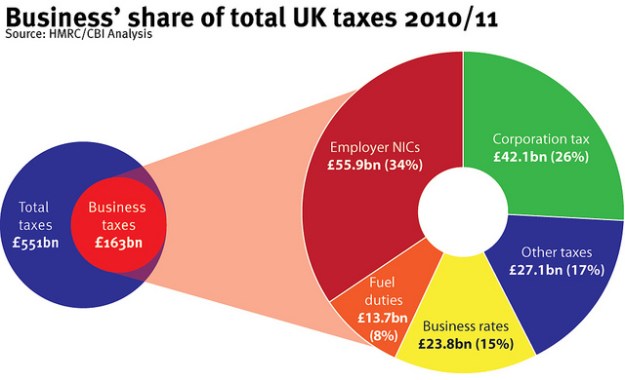
Too many FOI requests are “commercial”? You know that businesses pay tax too?

Every so often public officials who wish to curtail Freedom of Information rights will argue that money spent on fulfilling FOI requests might be better spent on healthcare, or fixing roads, or catching criminals.

This argument is superficially persuasive, but there are two significant counter-arguments:

  • Firstly, that as taxpayers we have already ‘paid’ for the collection of information held by public authorities and have the right to access that;
  • And secondly that FOI allows citizens to scrutinise how our money is being spent and highlight inefficiencies and abuse.

In other words, even if your argument is purely economic (rather than, say, about democratic accountability), Freedom of Information may save at least as much money as it costs: money which, well, might also be better spent on healthcare, or fixing roads or catching criminals.

A system in which public officials can spend money without scrutiny is a system more open to abuse and overspending. So curtailing Freedom of Information to ‘save money’ may be a false economy.

The latest weapon to be used in attacking FOI is to list how many requests are being made by businessesSt Albans Council‘s media offensive against the FOI Act, for example, mentions that:

“57 percent of the requests were from businesses, 15 percent from the national media and 13 percent from the Metropolitan Police.”

Continue reading

Why do you optimise content for search and social? 4 reasons and a mnemomic to boot

Content strategies are one of the many things that used to be the preserve of publishers and editors. We didn’t call it ‘content strategy’ then: we ‘chose angles’ or adopted an ‘editorial approach’.

Now of course every journalist is a publisher, an editor, and a distributor. We control our Twitter platform, Facebook page, perhaps a professional blog and other platforms to boot. We are expected to be web first in all sorts of ways.

That means new responsibilities. We have to make choices about style, medium, timing and platform that we never had to think about before. Why? Because we want people to engage with what we are reporting on.

Read these other posts on content strategy:

It’s as simple as that. That engagement is what defines us as journalists, and not just people who enjoy writing. What also defines us is the speed at which we have to do that. And to make editorial decisions quickly most journalists use content strategies.

For example, we choose this subject over another because it is more important to our audience. We choose this angle over another because it is more relevant to our audience. We choose this time because that’s when our audience is online. We choose this platform because that’s where the audience is at that time.

But I come back to ‘why’. Because it isn’t quite as simple as just getting people to read. Continue reading

Thinking of doing your student project online? Here are 5 mistakes to avoid

Journalism courses often expect students to spend a large part of their final year or semester producing an independent project. Here, for those about to embark on such a project online, or putting together a proposal for one, I list some common pitfalls to watch out for… Continue reading

16 reasons why this research will change how you look at news consumption

Most research on news consumption annoys me. Most research on news consumption – like Pew’s State of the News Mediarelies on surveys of people self-reporting how they consume news. But surveys can only answer the questions that they ask. And as any journalist with a decent bullshit detector should know: the problem is people misremember, people forget, and people lie.

The most interesting news consumption research uses ethnography: this involves watching people and measuring what they actually do – not what they say they do. To this end AP’s 2008 report A New Model for News is still one of the most insightful pieces of research into news consumption you’ll ever read – because it picks out details like the role that email and desktop widgets play, or the reasons why people check the news in the first place (they’re bored at work, for example).

Now six years on two Dutch researchers have published a paper summarising various pieces of ethnographic and interview-based consumption research (£) over the last decade – providing some genuine insights into just how varied news ‘consumption’ actually is.

Irene Costera Meijer and Tim Groot Kormelink‘s focus is not on what medium people use, or when they use it, but rather on how engaged people are with the news.

To do this they have identified 16 different news consumption practices which they give the following very specific names:

  1. Reading
  2. Watching
  3. Viewing
  4. Listening
  5. Checking
  6. Snacking
  7. Scanning
  8. Monitoring
  9. Searching
  10. Clicking
  11. Linking
  12. Sharing
  13. Liking
  14. Recommending
  15. Commenting
  16. Voting

Below is my attempt to summarise those activities, why they’re important for journalists and publishers, and the key issues they raise for the way that we publish. Continue reading

Audio: UK Conference of Science Journalists panel on tools for journalists

Back in June I took part in a panel at the UK Conference of Science Journalists conference, discussing tools for reporters alongside BBC Trending’s Mukul Devichand and Digital Science’s community manager Laura Wheeler.

The conference website has just published audio of the session, including chair Daniel Clery’s tips and recommendations. You can listen to the clip below.

The Great British Bake Off copyright grab: We can use your #ExtraSlice Twitter images but not give you credit

Images shared on the #ExtraSlice hashtag. I don't know who took these - they waived their moral rights

Images shared on the #ExtraSlice hashtag. I don’t know who took these* – they waived their moral rights

This year’s series of The Great British Bake Off has a social media-savvy spin-off: An Extra Slice.

It’s a mix of interviews, punditry and contributions from audience members and viewers. But the programme makers have a curious approach to copyright law which users of Twitter and Instagram may be ‘agreeing’ to without knowing about it. Continue reading

FAQ: Do you need new ethics for computational journalism?

This latest post in the FAQ series answers questions posed by a student in Belgium regarding ethics and data journalism.

Q: Do ethical issues in the practice of computational journalism differ from those of “traditional” journalism?

No, I don’t think they do particularly – any more than ethics in journalism differ from ethics in life in general. However, as in journalism versus life, there are areas which attract more attention because they are the places we find the most conflict between different ethical demands.

For example, the tension between public interest and an individual’s right to privacy is a general ethical issue in journalism but which has particular salience in data journalism, when you’re dealing with data which names individuals.

I wrote about this in a book chapter which I’ve published in parts on the blog. Continue reading

Transfer rumours, robot journalism and The Guardian: when it makes sense to put a poll BEFORE the article

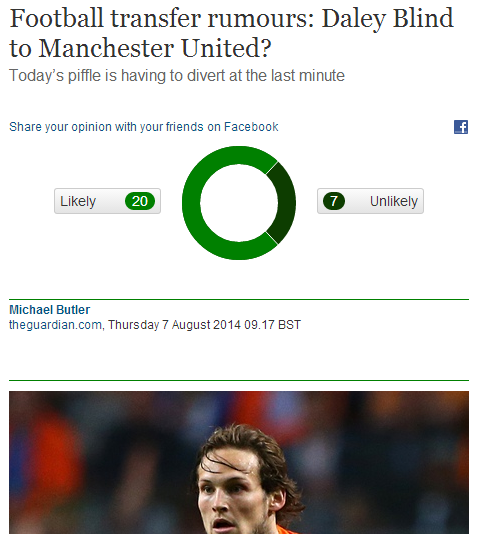
Football transfer rumours  Daley Blind to Manchester United    Football   theguardian.com

Nice work by The Guardian (above) in their online reporting on transfer rumours: readers of each report are presented with a vote on whether they think the rumour is likely to be true before they get to read the full article.

It’s a good example of putting interactivity – and distribution – front and centre when the headline has already done most of the editorial work. Continue reading

So Google scans email for dodgy images – should we be worried about scanning for sensitive documents?

Gmail logo

You could be forgiven for not having heard of John Henry Skillern. The 41 year old is facing charges of possession and promotion of child pornography after Google detected images of child abuse on his Gmail account.

Because of his case we now know that Google “proactively scours hundreds of millions of email accounts” for certain images. The technology has raised some privacy concerns which have been largely brushed aside because, well, it’s child pornography.

Sky’s technology correspondent Tom Cheshire, for example, doesn’t think it is an invasion of our privacy for “technical and moral reasons”. But should journalists be worried about the wider applications of the technology, and the precedent being set?

Continue reading