Category Archives: newspapers

It’s the Sun wot won it at Fark

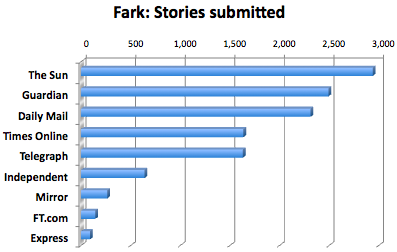
The Sun has had more stories submitted to Fark, the social news site for stranger news stories, than any other UK newspaper. That may be no surprise, but it’s the Guardian wot’s runner up.

The news follows the discovery that the Guardian is top at Reddit, the Times at StumbleUpon, and the Telegraph at Digg.

The graph is based on an analysis of the total submissions for each newspaper site to Fark. It shows that, just as with those other social news sites, the FT, Mirror and Express are trailling in last.

Sun winning at Fark, Guardian second

Sun winning at Fark, Guardian second

NewsCred founder Shafqat Islam about startups and the future of media

While everybody in journalism is wondering how the future of media looks like, entrepreneurs try to shape it. They develop new products and services that maybe could be the next big thing in journalism. OJB asks those entrepreneurs three simple questions in a series of interviews. First up: Shafqat Islam from NewsCred.

For everyone who has never heard of NewsCred: it’s an online platform that aggregates articles from lots of media – newspapers, magazines, blogs. NewsCred users can build a personalised online newspaper by selecting media and topics they want to read from and about. Continue reading

Guardian tops Reddit submissions list

The Guardian has had more stories submitted to Reddit.com than any other major newspaper site.

The news follows the Telegraph topping the Digg list and the Times topping the StumbleUpon list.

The graph shows how many pages have been submitted to Reddit for each site. It’s based on an analysis of newspapers’ Reddit submissions that also suggests the Telegraph is catching up with the Guardian – they tied for the number of stories submitted over the last week.

Submissions to Reddit: Guardian wins

Submissions to Reddit: Guardian wins

USA Today’s awesome jobs forecast interactive


USA Today interactive - click for larger image

USA Today interactive - click for larger image

Here’s a hugely rich interactive from USA Today which does a number of things very well.

Firstly, it’s an intelligent use of resources: the recession is likely to last for some time, and be the biggest ongoing story of our time. With everyone talking about it, you need something with that ‘wow’ factor, that will not only attract a great deal of attention now, but also a long tail of repeat visits.

Secondly, it’s personalised – not only can you get information on jobs growth in your state, but your particular industry in your state.

Thirdly, it’s dynamic – the graphic promises to be updated each month “with revised data from Moody’s Economy.com.”

There’s one major element missing – interaction. Find a way to capture users’ experiences (value) and you have an extra dimension that really capitalises on all the attention your interactive is getting.

Still, I’m not complaining…

Telegraph.co.uk top of Digg league

The Daily Telegraph has more stories submitted to Digg, the social news website, than any other daily newspaper site.

Times Online may be winning at StumbleUpon, but the Telegraph has:

  • had more stories submitted to Digg,
  • more stories on the front pages of Digg,
  • and its most-Digged story has more Diggs than any other newspaper site’s top story.

The graph shows how many pages have been submitted for each site that made the Digg ‘front pages’ (ie proved sufficiently popular).

It’s based on an analysis of newspaper site pages submitted to Digg (which also suggests that the reason for the success of the Telegraph and Mail is that their users are more likely to Digg than those of other newspaper sites).

Newspaper site Diggs

Newspaper site Diggs

Times Online tops newspaper Stumble list

All self-respecting newspaper sites have share and social-bookmarking functionality, such as links to Digg, Reddit, Fark etc.

But if the results of StumbleUpon are typical then:

  1. Times Online is miles ahead of its rivals when it comes to users sharing / bookmarking its pages.
  2. The FT has a lot of work to do.
  3. Adding icons for an individual service makes no difference to how often users submit a given page.

Continue reading

Try it, refine it – or throw it away

Try new stuff! If it doesn’t work, just stop doing it. Then move on and try something else.

That’s what Mackenzie Warren, director of content at Gannett Digital (that’s the digital division of what’s currently the USA’s largest media company), advised a group of Norwegian media executives at the Norwegian Institute of Journalism this week.

Now, let me first point out that Mackenzie Warren has been a journalist since the age of 14. He’s been a photographer, reporter, online editor, managing editor… just about anything you can be in a newsroom. Except that at Gannett, and at Fort Myers News-Press, where he worked before heading up the digital content section at Gannett, they no longer call it a newsroom.

“We’ve done away with the word “newsroom”. There’s no news in a newsroom (desk reporters are often the last to hear of a story). Plus, it’s not news we do – it’s aquiring, processing and distributing information”, he said.

Now, the Gannett publications have more of a control centre where section editors (sports, news etc., not print, online or TV) monitor the competition and also what the readers and viewers are responding to at any time. Continue reading

Sport and data – now it’s more than just ‘interactive’

I’ve written previously on the Online Journalism Blog about ‘Why fantasy football may hold the key to the future of news‘. Now it seems The Guardian has taken things up a notch with the wonderful Chalkboard feature: an interactive database-driven toolkit that allows you to create your own ‘chalkboards’ illustrating whatever point you may wish to make about a team or player’s performance. Here’s my first attempt below:

Cute, yes? But more than just cute. This is an idea that takes sports data and makes it more than just ‘interactive’. This makes it communicative

Because you are not just toying with data but creating it to make a point. Once you create a chalkboard it is published to everyone, with space for comments. You can send it, share it or embed it – as I have.

Clearly there are improvements that can be made – starting with searchability/findability from the chalkboard/team page and the odd bug (the description which I entered was not visible on the test I did above, and limiting it to the final 15 minutes does not seem to have worked – you still see all passes).

But really that would be picking holes in what is a beautifully thought-through piece of work – a piece of work that understands if you’re to make news work online it has to be as much a platform as a destination (a platform which in turn opens up plenty of opportunities for monetisation).

The site claims match stats will be available 15 minutes after the full time whistle. Suddenly the calls to local radio to bemoan the manager’s tactics seem one-dimensional. And spending 60 seconds reading the match report is nothing compared to the time that will be spent carefully constructing your argument as to why your star midfielder should not have been sold to that close relegation rival…

Thanks to Alex Lockwood for the tip-off.