Category Archives: newspapers

Telegraph launches powerful election database

The Telegraph have finally launched – in beta – the election database I’ve been waiting for since the expenses scandal broke. And it’s rather lovely.

Starting with the obvious part (skip to the next section for the really interesting bit): the database allows you to search by postcode, candidate or constituency, or to navigate by zooming, moving and clicking on a political map of the UK.

Searches take you to a page on an individual candidate or a constituency. For the former you get a biography, details on their profession and education (for instance, private or state, oxbridge, redbrick or neither), as well as email, website and Twitter page. Not only is there a link to their place in the Telegraph’s ‘Expenses Files’ – but also a link to their allowances page on Parliament.uk. Continue reading

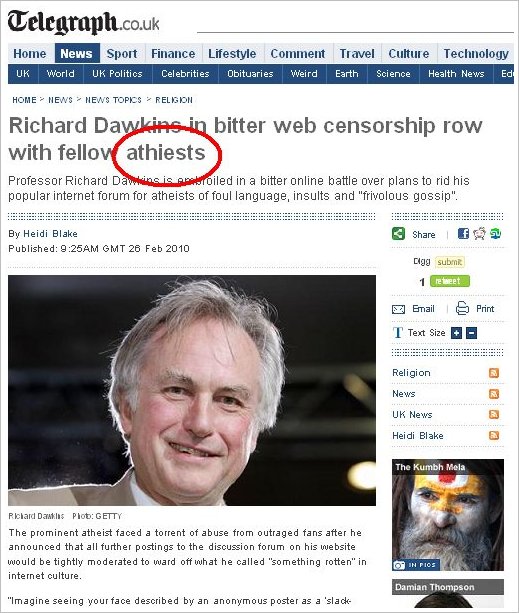
Telegraph invents comparative degrees of atheism. Dawkins = "athiest"

A wonderful headline malfunction at the Telegraph, in their story about the Dawkins Forum dustup, where the discussion forums at richarddawkins.net have been summarily suspended and made “read only” (*):

20100226-telegraph-dawkins-forums-headline-malfunction-1

So, what are you?

ath?

athier?

or athiest?

(*) My take is that the Telegraph is rushing to catch up with a “religion” story that the Times got hold of first when blogger Chris Wilkins tipped them off (and updated later). Ruth Gledhill already had an interview with Richard Dawkins done before it even appeared on the Telegraph website. The Telegraph piece reads slighty like a digested and regurgitated version of the previous one in the Times.

They all seem to have got the wrong end of the stick in several respects, including Richard Dawkins himself, and are playing the “nasty rotten horrible anonymous internet culture” tune. Further, newspapers seem to have invented an intra-atheist culture war where one doesn’t exist, albeit based partially on Richard Dawkins’ own misapprehensions.

The actual history is well summarised by blogposts by former moderators Pete Harrison, Jerome23 and Darkchilde. The problem is not that the forum has closed; it is of the way the process has been (mis)managed – particularly because RD has taken a very hands-off approach and backed his employed staff over his volunteer moderators, when it is the former who may well be in he wrong.

The vitriol is being generated because volunteer moderators who have invested hundreds of hours building an online community, and the members of that community, have had their community summarily yanked from beneath them, and had their means of communicating with each other turned off. RD’s “Outrage” response is a restatement of a line from his employed staff which does not match the facts.

What does John Terry’s case mean for superinjuntions?

The superinjunction obtained by England Captain John Terry was overturned on Friday – and the case raises some interesting issues (cross posted from John Terry: another nail in the superinjunction coffin):

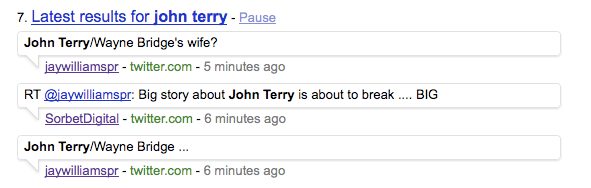
  • Ecen when the superinjunction was in force, you could find out about the story on Twitter and Google – both even promoted the fact of Terry’s affair – via the Twitter trends list and the real-time Google search box.
  • No one got the difference between an injunction and a superinjunction – the former banned reporting of Terry’s alleged affair, the latter banned revealing there was an injunction. They weren’t necessarily both overturned, but there was a widespread assumption you could say what you liked about Terry once the superinjunction was overturned. This wasn’t necessarily the case …
  • The Mail and Telegraph seemed to flout the superinjunction – as did the Press Gazette which decided if wasn’t bound as it hadn’t seen a copy. This seemed risky behaviour legally – which makes me wonder if the papers were looking for a weak case to try to discredit superinjunctions.
  • This superinjunction should never have been granted. What was the original judge thinking?

Google and Twitter ignored the superinjunction

Tweets from while the superinjunction was in force

Tweets from while the superinjunction was in force

The superinjunction was overturned at about 1pm or 2pm on Friday. Needless to say, the papers had a field day over the weekend. Continue reading

The Press Complaints Commission consultation: respond by January 25th

The Press Complaints commission, which is the industry body which attempts to regulate the printed media, and now the corresponding websites, is engaged in a “Governance Review” – and is wanting responses by January 25th 2010.

The commission last had the attention of bloggers when a proposal was made by the PCC Chairman Baroness Buscombe that they should be regulated by the PCC. Unity, at Liberal Conspiracy, organised a response which drew expressions of support from perhaps 300 bloggers over the following 3 days.

At that point I also commented on some problems with the PCC itself :

Baroness Buscombe, the Press Complaints Commission and the Internet: Hard Questions

Firstly, the Chairman of the Press Complaints Commission is a position which surely depends on political and commercial neutrality. (Baroness Buscombe takes the Tory Whip in the Lords)

Secondly, despite the Chairman of the PCC clearly needing to be a neutral figure, Baroness Buscombe used her speech to the Society of Editors to make party political points.

Thirdly, the PCC’s level of knowledge and understanding about the Internet is open to question; they appear not to understand News Headline Aggregators.

Fourthly, the PCC needs to defend vigorous investigative journalism. The Baroness – as current Chairman and a Peer herself – has suggested that the Lords should not be subjected to the same scrutiny as the Commons has been in the last 12 months.

Tim Ireland has been organising an excellent response , based around these five specific proposals:

SUGGESTION ONE: Like-for-like placement of retractions, corrections and apologies in print and online (as standard).

SUGGESTION TWO: Original or redirected URLs for retractions, corrections & apologies online (as standard).

SUGGESTION THREE: The current Code contains no reference to headlines, and this loophole should be closed immediately.

SUGGESTION FOUR: Sources to be credited unless they do not wish to be credited or require anonymity/protection.

SUGGESTION FIVE: A longer and more interactive consultation period for open discussion of more fundamental issues.

And he has done an excellent (and noisy) video involving space invaders, which you can see here .

The PCC has a special website set up, from where you can send your submission.

The closing date is January 25th 2010.

Wired stands by story after Guardian denies iPhone app paywall plans

If, like me, you’re a regular reader of The Guardian‘s media coverage, or you listen to their Media Talk podcast, you might have been surprised to have read the following in the February 2010 UK edition of Wired:

The Guardian… hopes users of it’s £2.39 (iPhone) app will pay extra for privileged access to in-demand columnists. (p.89)

This seems to fly in the face of what I know about The Guardian‘s digital strategy. The Guardian have always seemed to be staunch opponents of paywalls, and Emily Bell, Director of Digital Content at Guardian News & Media, always seems to me to take a particularly strong line that she doesn’t want to charge for online content. I asked her to comment on Wired‘s claim. “I’m not sure where the ‘columnists’ assumption comes from, not us, that’s for sure. Bit off beam” she told me on Twitter (incidentally the ‘columnists’ in question include David Rowan, Wired‘s Editor, who co-wrote the piece).

So, order is restored to my universe: The Guardian is still the bastion of free online content, creatively looking for another way to make digital pay. But wait, what’s this? Wired have weighed back in, with this tweet:

@jonhickman @emilybell Came from a senior Guardian exec who demonstrated the app in person, actually

So, are The Guardian really thinking about paywalls? Was this loose talk? Has there been a misunderstanding? Is someone fibbing?

I don’t know, but I think it matters. The Guardian‘s online brand seems to be about free: free data, free access, free comment. If there’s a grain of truth in Wired‘s claim, what does it tell us about the future of online access?

What I expect at news:rewired — and what I hope will happen

Screen shot 2010-01-06 at 11.23.20Next Thursday is the news:rewired event at City University London, which is being put on by the good people at journalism.co.uk. I’ll be on hand as a delegate.

All of the bases will be covered, it seems: Multimedia, social media, hyperlocal, crowdsourcing, datamashups, and news business models.

Continue reading

Portadista: the new editorial role of looking after the home page

When I translated the sixth part of the Model for the 21st Century Newsroom into Spanish, I learned some of the new roles for journalists in news organizations.

Now I have the chance to write about a new role for digital journalists thanks to my Argentinian colleague Alvaro Liuzzi, who recently visited Spain to interview some of the directors of national news websites for his documentary on Hispanic online newsrooms (Argentina, Peru and Spain).

The Editorial Director of 20minutos.es, Virginia Pérez Alonso, told him about a new position they created to permanently control the long home page of the site to make sure everything is correct (links, images, headlines) and to track the most popular stories in each column, using their own software that shows real time stats.

They call this new position the “Portadista” (Portada is Spanish for home page). This is how it works in the newsroom:

  • The “portadistas” are journalists [This may seem obvious but it is important to note that it’s necessary for the people in charge of this job to have journalistic skills].
  • There are three portadista shifts every day, and the first one arrives at 7 AM. They say it is a exhausting job so they change the people in charge every 15 days.
  • They receive all the information from the journalists via Google Docs and organize the home page according to that.
  • Then they proceed to review the hole home page, check the links, control that the verbal tenses are correct, the photos, etc.
  • They constantly monitor that the home page doesn’t exceed a maximum file size. If that happens they have to take out images, cut articles and reduce their size.

Google will give Murdoch what he wants if he renames the Sun as the Wapping News Journal

Has anyone pointed out the workings of Google Scholar to Rupert Murdoch? He’s going to have a fit when he finds out (first published here) …

Imagine if Google offered a deal like this to news publishers (as you’ll have guessed, this is exactly how Google Scholar works):

  • Where content is behind a paywall, Google will index it all and include it in its web results even if searchers who click through to the page are then told they can’t read the story without subscribing.
  • Google will work out which is the authoritative source of a story and show that – so newspapers breaking exclusives get priority over bloggers etc.
  • Google won’t differentiate these results in any way – searchers will think they’re going to see the content they can see in the Google results, but actually they’ll hit a paywall.

As I say, that’s exactly how Google Scholar works – but it’s not a deal that Google’s offering to newspapers Continue reading

Mistakes in the Big (and small) Media: Quality in Reporting

It is always fun when a hoaxed piece of research gets past all the filters and makes the newspapers, but what does it teach us? This is a video report from the Hungry Beast team in Australia, “proving” which part of Australia is the most gullible. The answer is, apparently, “the media”.

Link, in case the video doesn’t embed properly.

Here’s a different example from last week: Andrew Lansley’s insurance of a painting and medal on his Expenses as an MP.

All the papers quoted a value of 3500 ukp, except for the Independent which quoted a *premium* of 3500 ukp. Continue reading

National newspaper Twitter account growth gets ever slower …

UK national newspaper Twitter accounts are continuing to grow – but the rate is getting slower and slower, according to the latest figures for the 129 accounts I’m tracking:

The detail

These accounts had 1,801,044 followers on November 2nd (ignoring one FT account that has been shut). On December 2nd they had 1,919,770 followers in total.

Of the 118,726 increase, 76,812 or 65% was for the @guardiantech account (which benefits from being on Twitter’s suggested user list).

As ever, you can see the figures for each account here. (And yes, sorry about no Scottish ones. I’ll redo the list soon, honest).