Category Archives: regulation

The ethics of using CCTV footage – A Very Dangerous Doctor

A Very Dangerous Doctor is a Channel 4 documentary about David Southall, the controversial doctor who was struck off after “abusing his position” in accusing a mother of killing her son.

The documentary includes CCTV footage of parents smothering their children, filmed covertly as part of Southall’s research into cot deaths. The footage is incredibly distressing – the Independent rightly describe it as “among the most shocking to be shown on TV”. Many tweeted that they were switching off the 100-minute broadcast – barely five minutes in – as a result.

The documentary is an excellent piece of work, and worth watching in full – but the CCTV footage raises an old ethical issue in a new context: is it justified?

There is a wealth of literature on the ethics of war reporting: whether distressing images should be shown, and the arguments for and against.

The spread of CCTV and mobile phone footage, its accessibility and its release by police authorities and availability on YouTube, raises similar questions – whether it is footage of a woman throwing her baby on the floor, race attacks, or the death of a protestor.

What are the questions to ask when you are given such footage? What are the ethical issues to balance? And what about this specific example (the footage begins around 04’25)? I’d love to know what you think.

The law, ethics & effectiveness of PR firms offering bloggers prizes-to-post

A PR firm recently invited me to review their client’s product, saying that if I did review it I would be entered into a prize draw with other ‘qualifying’ bloggers to win an iPad 2.

It was a product I might ordinarily have covered, but this approach made me reluctant.

Here’s reason number 1: I asked myself whether the PR firm will have made the same approach to print journalists. I doubt it. Why? Because it would have raised obvious ethical issues, and questioned the journalists’ professionalism.

So were they assuming that bloggers had different ethics? I doubt they thought that hard – more likely was that some bright spark thought that eager, amateur bloggers would jump at the chance to get anything for their hard work.

Here’s reason number 2: other bloggers will have been approached with the same offer. If they saw me review the product they would assume that I had done so in exchange for this prize draw ticket. They would see me as unprofessional, unethical, or both.

In PR terms, then, the approach was counter-productive: it actually made me less likely to give their client coverage.
Continue reading

Guest post: visualising mobile phone data – the data retention app

datarentention_app

In a guest post Lorenz Matzat, editor of ZEIT Online’s Open Data Blog, writes about the background to their online app exploring the issues around data retention by mobile phone companies.

It’s not very often that one can follow the direct impact of an article, let alone a piece of data journalism. But the visualization of the cellphone data of Malte Spitz from the Green party in Germany led to visible repercussions in the US.

Following a piece in the New York Times about Spitz and the data app, some days ago two senators wrote a letter to the 4 main US-carriers for information about their data retention policy.

After publishing the app in German one month ago (and 20 days later the English version), the feedback was overhelming. We didn’t think that so many people would be so interested in it. But Twitter and Facebook in Germany went wild with it for some days – along with coverage in many major tech websites.

Probably this is why data journalism works: Making an abstract notion everybody knows about visible: that every position of you, and every connection of your mobile phone does is – or could be – logged. Every call, text message and data connection.

The background

Around February 1st, ZEIT Online asked me if I had an idea what do do with the dataset of Malte Spitz (read the background story about the legal action of Spitz to get the data here). Continue reading

FAQ: Journalism vs blogging

Here’s the latest in my attempt to answer questions publicly so that I can lazily point people to the answers when they ask them again. These are from a Norwegian student at London Metropolitan University:

Do you consider yourself a journalist? Why?

Yes, when I produce journalism. That is: finding newsworthy information and communicating it to others. I find G Stuart Adam’s definition best here – sadly no longer online but copied below: Continue reading

When is an online comment defamatory?

Rob Minto looks at two recent cases that leave the field of libel online as confusing as ever.

For several years, newspapers, bloggers and other online publishers have been waiting for a landmark case to clarify defamation online.

The unanswered questions have been along the lines of: who’s responsible – the author or publisher (or even ISP)? What jurisdiction will it fall in? What kind of audience is required (if at all?)

In the UK, in quick succession, there have been two cases which have, if anything, muddied the waters. Continue reading

Internet destroys Fred Goodwin’s super-injunction about alleged affair

I’ve written before about superinjunctions, the difficulties of bloggers learning about reporting restrictions (featured) and the problems the internet causes for super-injunctions.

This morning, however, has seen a deliberate attempt by some people to use the internet to reveal the alleged affair that the super-injunction about disgraced RBS boss Fred Goodwin supposedly covers. Continue reading

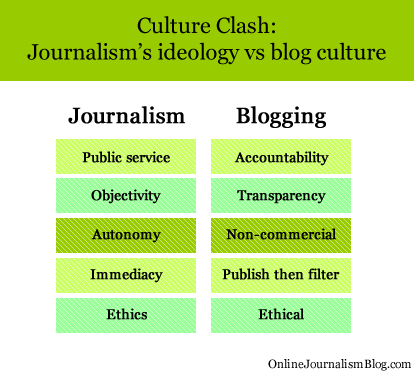
Culture Clash: Journalism’s ideology vs blog culture

CultureClash
If you read the literature on journalism’s professional ideology – or just follow any argument about journalists-versus-the-rest-of-the-world – you’ll notice particular themes recurring.

Like any profession, journalism separates itself from other fields of work through articulating how it is different. Reading Mark Deuze’s book Media Work recently I was struck by how a similar, parallel, ideology is increasingly articulated by bloggers. And I wanted to sketch that out. Continue reading

Guest post: Do we need moderation guidelines for dealing with mental health issues?

Last month the Press Complaints Commission made a judgement in a case involving discriminatory comments on a newspaper article. The case highlighted the issue of journalism on mental health and how it is treated by publishers alongside similar considerations such as sexuality, gender, religion and ethnicity. The complaint also led to a change in The Guardian’s moderation rules.

In a guest post for the Online Journalism Blog the person who brought that case, Beatrice Bray, writes about her experiences of comment abuse, and the role she feels publishers should take in dealing both with comments relating to mental health, as well as writers with mental health issues.

Last April I wrote a rallying cry for the Guardian for all who have endured taunts about mental ill health. In my reply article Cartoonists should be careful how they portray mental health (23/4/10) I reclaimed the word “psychotic”. Guardian cartoonist Martin Rowson had used the word to abuse Mrs Thatcher. I put him right.

I am a long-standing reader of the Guardian newspaper but I did not know the website audience. Being a proud campaigner I told Guardian readers that I had bipolar disorder and had experienced psychosis.

I expected a civil hearing. Newspaper readers did oblige but many online readers were foul.

The Guardian’s managing editor Chris Elliott did not warn me about the impending abuse. That was a mistake. I think Mr Elliott knew I would face hostility but I do not think he realised how badly I would be hurt.

Those insults made me physically sick. My head was sore for many weeks. This was all so pointless. If Mr Elliott had given me a chance to discuss the risks involved we both could have taken precautions. Instead there was a row.

Guardian staff gave me an apology but told me to grow a “thick skin”. That jibe spurned me into going to the Press Complaints Commission. It is free. It is also less adversarial and less costly than a disability tribunal.

I was not asking for anything unprecedented. The BBC has guidelines on working with vulnerable people. We need to extend this to new media.

Working with vulnerable people

For example when dealing with discussion sites moderators need to deal swiftly with abuse. They also must facilitate discussions so that they do not turn nasty.

Staff should appreciate the reasons for this action. This is not prima donna treatment. This action is necessary because the writer and many of the readers share a common disability. They all have mental health problems.

Section 2 of the PCC Editors’ code promised fairness to complainants. I thought it only fair to ask for warning of abuse but in my PCC ruling the Guardian and the PCC disagreed with me. The PCC did not say why.

However, I did score other points.

Before the PCC ruling the Guardian at my request did add the word “disability” to its moderation rules.

The PCC and the Guardian and did apologise with regard to the abuse.

Guardian online readers called me, amongst other things, a “nutter” and a “retard”. Unfortunately both the Guardian and PCC refused to accept that this was discrimination as defined by the terms of section 12 of the Editor’s code of the PCC.

This is not just semantics. To me the word “discrimination” is a word with power. It holds the abuser responsible but the PCC fights shy of doing that online.

I now know that you can only complain to the PCC if a staff member makes a discriminatory remark about you. Comments made by non-staff members do not fall within the PCC’s remit. My abusers were not Guardian staff.

It is a shame. By being discrimination deniers both the Guardian and the PCC cut themselves off from a store of knowledge on handling disability and mental health in particular.

Mobile journalism: Section 44 is dead – long live Section 43

One of the pictures the student was taking at the time he was stopped by plain-clothes officers

An image taken by the student when he was stopped by plain-clothes officers

Section 44 of the Terrorism Act 2000 was an ongoing problem for photographers and journalists using mobile phones who would find themselves stopped, searched, and sometimes arrested by police. After ongoing pressure and a judgement in the European Court of Human Rights, the section was finally suspended last July.

Now Amateur Photographer reports on the Metropolitan Police defending officers’ decision to stop and search a student for merely taking photographs near a school (the image above was being taken when he was approached by police). The search was done under Section 43, which “can only be enforced if a police officer ‘reasonably suspects’ a person to be a terrorist.”

Meanwhile, police are seeking new powers to replace those given under Section 44.

If you use mobile technology in your journalism, it’s worth keeping the stop and search bust card about you.

h/t Ewen Rankin

Is social capital dehumanising? (comment call)

Following on from my post about teaching community-based journalism, I had an interesting correspondence with James Brooks, who found terms like “social capital” dehumanising, refused to join Facebook and many other web platforms on ethical grounds (that they conflate the professional and private), and took issue with the idea that my assignment suggested that he “should become an active member” of certain “communities”.

I wanted to explore this further, because I think this is a complex area that deserves fleshing out. So, is social capital dehumanising? Should journalists refuse to join social networks on ethical grounds? And does a journalist have to engage with communities to do their job?

PS: James is happy for me to blog about it.