Category Archives: social media

Should you ‘brand’ a hashtag?

Faisal Islam: Sure that all the brilliant BBC reporters realise that #BBCBudget goes against the entire point of SOCIAL media. It will be abandoned.

Two experiments by news organisations with Twitter hashtags during today’s UK budget have raised an issue around ‘branding’ and how appropriate it is to social media.

The BBC, it seems, is encouraging users to adopt the #BBCBudget hashtag to flag their tweets as part of the ‘national conversation’. Channel 4’s Faisal Islam, above, feels it’s a waste of 3 characters.

But Channel 4 itself is trying something not too dissimilar: #C4cuts aims to crowdsource details of UK spending cuts. Ed Fraser, online editor for Channel 4 News, is quoted by Journalism.co.uk as saying the channel wants to “harness the power of social media and the wisdom of the crowd”. Continue reading

Does Twitter improve your site’s search engine results?

A Tweet's Effect On Rankings - An Unexpected Case Study

Yes. Or at least according to a couple of blog posts in the SEO blogosphere.

Back in December Search Engine Land’s Danny Sullivan asked what “social signals” Google and Bing count in their algorithms. Previously, the answer would have been none, as far as Twitter is concerned, because like most social media (including blog comments, forum posts and social networks) any links posted on Twitter carry a ‘nofollow’ tag, instructing search engines to ignore it.

But now that Twitter has signed deals with the big search engines, they now get the “firehose” of data from Twitter direct – without nofollow attributes. Bing tell Sullivan:

“We take into consideration how often a link has been tweeted or retweeted, as well as the authority of the Twitter users that shared the link.

Google tells him:

“We use the data only in limited situations, not for all of general websearch.”

The post contains more information about how both search engines use the “social authority” of a user (followers, followed, etc.) to further rank links.

A case study

Yesterday, the issue gained a fascinating case study from SEOmoz (image at top), when one of their articles suddenly appeared on the first page of Google search engine results for the term “Beginner’s Guide” following a tweet from Smashing Magazine and hundreds of retweets. Continue reading

No, blogging for free is not feudalism

Image by jimmiehomeschoolmom

Image by jimmiehomeschoolmom on Flickr

The sale of the Huffington Post has sparked another raft of posts about how we’re all suckers for building up the value of these companies through giving away our content for free.

The New York Times’s David Carr is typical, describing users as “A Nation of Serfs” and quoting Reuters’ Anthony De Rosa’s similar soundbite “a world of digital feudalism”.

Carr misses the point entirely: that this is not “people working free” (sic) but an exchange. A user exchanges demographic details and content for the functionality offered by Facebook. They put their photos on Flickr because they benefit from the network, access, and tools.

This is nothing new: we do not criticise telephone companies for being built on people ‘giving away their content’ in the form of the billions of conversations that take place across those networks. Or the demographic data we hand over when we sign up. Oh, and we pay them.

It’s a symptom of journalistic egocentrism that it should seem odd that other people hand over their content ‘for free’ (and of being a little threatened?).

Another symptom is to see the likes of Twitter and Facebook as content platforms, rather than communication networks.

Even the Huffington Post is a network as well as a content platform – the interesting problem for that site in selling to AOL is that while some people will have been happy to contribute for the network benefits (access to likeminded individuals), some will not.

But here’s where feudalism is no comparison to make. Serfs didn’t have a choice. Huffpo bloggers can leave – as indeed, many left similar operations before (Anthony De Rosa‘s analysis is sophisticated enough to recognise this). One of the questions occupying my mind at the moment is whether the current domination of Facebook will turn out to be a stepping stone to other forms of blogging, or if the social network will be enough for most people.

The fundamental point is that this is a marketplace, and if the exchange does not feel fair, users will move on – as they did with MySpace, and Friendster before that.

That doesn’t mean that there isn’t a wider problem around corporatisation of the public sphere, but don’t insult millions of people by calling them serfs.

The Independent’s Facebook innovation

The-Independent-Robert-Fisk

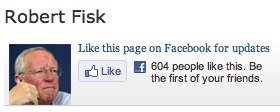
The Independent newspaper has introduced a fascinating new feature on the site that allows users to follow articles by individual writers and news about specific football teams via Facebook.

It’s one of those ideas so simple you wonder why no one else appears to have done it before*: instead of just ‘liking’ individual articles, or having to trudge off to Facebook to see if there’s a relevant page you can become a fan of, the Indie have applied the technology behind the ‘Like’ button to make the process of following specific news feeds more intuitive.

To that end, you can pick your favourite football team from this page or click on the ‘Like’ button at the head of any commentator’s homepage. The Independent’s Jack Riley says that the feature will be rolled out to columnists next, followed by public figures, places, political parties, and countries.

The move is likely to pour extra fuel on the overblown ‘RSS is dying‘ discussion that has been taking place recently. The Guardian’s hugely impressive hackable RSS feeds (with full content) are somewhat put in the shade by this move – but then the Guardian have generated enormous goodwill in the development community for that, and continue to innovate. Both strategies have benefits.

At the moment the Independent’s new Facebook feature is plugged at the end of each article by the relevant commentator or about a particular club. It’s not the best place to put given how many people read articles through to the end, nor the best designed to catch the eye, and it will be interesting to see whether the placement and design changes as the feature is rolled out.

It will also be interesting to see how quickly other news organisations copy the innovation.

*If I told you I said this deliberately in the hope someone would point me to a previous example – would you believe me? Martin Stabe in the comments points to The Sporting News as one organisation that got here first. And David Moynihan points out that NME have ‘Like’ buttons for each artist on their site.

More coverage at Read Write Web and Future of Media.

Leaving Delicious – which replacement service will you use? (Comment call)

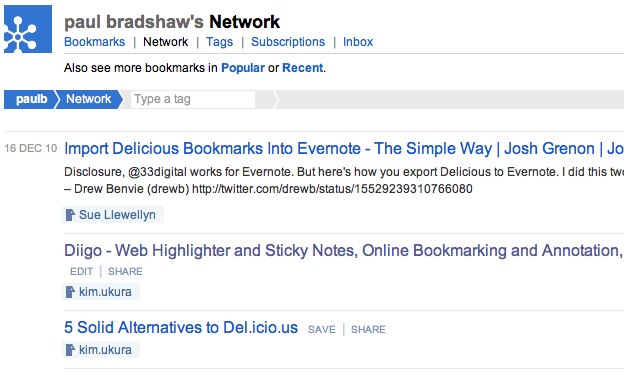
Leaving Delicious - other services already being bookmarked on my network

UPDATE: I’ve created a spreadsheet where you can add information about the various services and requirements. Please add what you can.

Delicious, it appears, is going to be closed down. I am hugely sad about this – Delicious is possibly the most useful tool I use as a journalist, academic and writer. Not just because of the way it makes it possible for me to share, store and retrieve information very easily – but because of the network of other users doing just the same whose overlapping fields of information I can share.

I follow over 100 people in my Delicious network, and my biggest requirement of any service that I might switch to is that as many of those people move there too.

So I’d like to ask: if Delicious does shut down, where will you move to? Publish2? Pinboard.in? Diigo? Google Reader (sorry, not functional enough for me)?  Or something else? (Here are some ideas) Please post your comments.

Case Study – Two political blog articles which went viral

One of the areas which interests me is how independent publishers can cut through to build an audience, or drive a story into the wider public arena. This is a cross-post from the Wardman Wire.

Two articles from the last month by the Heresiarch and Anna Raccoon form an interesting study in articles by political bloggers which gained widespread attention. Both of these pieces went viral via Twitter, rather than Facebook or any other social network.

Firstly, a piece, which caught the moment when the conviction of “Twitter Terrorist” Paul Chambers was confirmed. This piece achieved almost 1000 retweets.

This is the headline and abstract:

Heresy Corner: With the Conviction of Paul Chambers, it is now illegal to be English.

There is something deeply and shockingly offensive about the conviction of Paul Chambers for his Twitter joke, almost unbelievably reaffirmed today at the Crown Court in Doncaster. It goes beyond the normal anger anyone would feel at a blatant injustice, at a piece of prosecutorial and judicial overkill that sees the might of the state pitted against a harmless, unthreatening individual for no good reason.

Secondly, a piece from Anna Raccoon last week, about the case of Stephen Neary, who seems to have been caught up in a bureaucratic whirlpool through his autism:

The Orwellian Present – Never Mind the Future.

Steven Neary, Deprivation of Liberty Safeguards, Welfare Deputyships and The Court of Protection

These numbers of tweets are 50-100 times more than will be achieved by a reasonably well-received article. As a comparison the last 6 articles on the Heresy Corner homepage this morning are showing 3, 5, 4, 9, 40 and 2 retweets.

My observations:

1 – Both are non party-aligned writers embedded in the political blog niche, but also cover political questions from a position of non-political knowledge, with a degree of authority/respect which has come from their own work over two years or more.

2 – In these instances, both are amateur or professional subject specialists in the areas they cover here, and have an established readership who are able to give a boost to a piece in the social media nexus. As a comparison, in the world of Internet Consultancy much time (and money) is spent trying to build initial traction for articles and websites to give them a boost into wider internet prominence.

3 – The importance of “connectors”. Anna Raccoon’s piece received a significant boost from Charon QC, who provides an important hub-site in the legal niche – which of course is one place where a real difference can be made to Stephen Neary’s situation.

4 – The “edge of the political blogosphere” has become very important – both for specialist sites writing about political questions, and political blogs who “do more than politics”.

5 – These are two different types of article. The Heresy Corner summarised the online reaction to the “I’l blow you’re airport sky high” Twitter Joke Trial case at the right time to catch the Zeitgeist, while Anna Raccoon’s piece is a campaigning piece trying to direct attention to a particular case, in an area of society she has written about on perhaps a dozen occasions.

6 – Several legal commentators (eg Jack of Kent in addition to Charon) have pointed out (correctly) that for campaigning piece to convert attention into action, there needs to be more complete information about both sides of the story. A spotlight can be directed onto a perceived abuse, but there needs to be objective investigation afterwards.

That is a good distinction; but the rub is that officialdom can prevent both sides of the story being available to the public, and often only react to media spotlights – not to problems which they have not been embarrassed about.

7 – Neither of these bloggers are deeply embedded in the Facebook ecosystem, which is a distinct difference from some other mainly political sites, which report Facebook as a major source of traffic (example). I’ll write more on this another time, because I think it is important.

8 – During November, when the Paul Chambers piece was published, Heresy Corner jumped from 134 in the Wikio blog ranks to number 15 (illustrated). This was after changes which introduced a “Twitter” factor into the Wikio rankings. I’d suggest that this level of volatility may illustrate that they’ve overdone it.

Wrapping Up

The missing link for independent publishers is the ability to translate incisive observation or reporting into an effective influence.

I’ll return to that subject soon.

Can I ask a favour from brave souls who’ve reached the end of this article. I need a couple of dozen Facebook “Likes” for my own site’s new Facebook page to gain access to all features. You can “Like” me at the bottom of the rh sidebar here.

Cooks Source anger moves on to Dairy Goat Journal’s Dave Belanger

Cooks Source fake Facebook page discusses Dairy Goat Journal

UPDATE 2 – from Cathy in the comments (Nov 11): Dave Belanger has now paid the fee.

UPDATE – thanks to Vicki in the comments (Nov 11): Dave Belanger has responded to Suzanne, reinstating the image on their website with a credit and link, and offering to pay. However, he has refused to pay the amount requested by Suzanne, and Suzanne is now planning to take the magazine to court. Her reasoning is admirable, and it’s fair to say that contributions of commenters have helped her to make a well-informed stance:

“Countryside Publications is a five million dollar company. He accused me of being opportunistic by asking for an increased fee for the unauthorized and uncredited use.

“This is not about money. I may never see the $2100. If I do, it will be a long time from now. If I wanted to make a quick buck, I’d take the $500 [offered]. (I could use it.) But if I let him not only steal the photo but pay no penalty for it, there’s no reason for him to not steal again. After all, what did it cost him? He can steal photos all he wants and only pay for them (at a price he sets) if he’s caught. Just who is opportunistic? He published my photo without authorization or credit then says, here, take $500 or NOTHING.”

There’s also some detail about the possible impact on the publishers from Internet users:

“P.S. He mentioned receiving phone calls and emails from my readers and said he was not concerned about it. He admitted there had also been some subscription cancellations, but that people cancelled subscriptions and started subscriptions every day and that he had no reason to believe any subscription cancellations were related to his treatment of my work.”

The original post:

Oh dear. It appears another magazine editor is about to feel the force of a thousand emails following a blogger’s complaint of breach of copyright and – more importantly – said editor’s response to their request for fair payment and acknowledgement of authorship.

The editor in question is Dave Belanger who – apparently – hung up on Suzanne McMinn when she called to ask that her photo – used in Dairy Goat Journal – was properly credited.

With 80 comments already – many of them saying they have called and written to the magazine – and the case also being discussed on the fake Cooks Source Facebook page – you can only hope Dave looks at the Cooks Source and reacts quickly.

*All about this that I can find looks credible, but I’m extra cautious of this being an opportunistic hoax.

via Ulrike in the comments.

Facebook ‘mentions’ – a ‘talking point’ engine

Facebook mentions mockup

Mockup by Oliver Chiang - click to see original article

Oliver Chiang reports on a new feature being tested by Facebook that he dubs ‘mentions’. It tells you if more than one of your friends mentions the same thing – a celebrity, for example, or an event, or organisation.

I’ve often said that Facebook is the ultimate news publisher. ‘What my friends are doing’ was powerful enough, and they have since expanded their editorial proposition (with Pages) into ‘What companies and personalities I am interested in are doing’ too. The ‘mentions’ feature appears to extend that concept further, essentially identifying what is a ‘talking point’ in your social circle and circles of interest, and bringing that to your attention.

That is, of course, one of the things that journalists do.

Of additional interest are the obvious commercial applications of this technology. In fact, the focus at the moment on linking these ‘talking points’ to official ‘Pages’ drives that commercial application home rather forcefully. This overly-commercial application may in fact be a weakness – and it will be interesting to see if it is tweaked before being rolled out (Facebook’s history suggests they are more likely to tweak it than withdraw it).

In the meantime, publishers should be watching closely to see how advertisers respond to the potential of ‘mentions’ – and if there is any way they might adapt similar ideas for their own users and advertisers.