Category Archives: television

Sentencing data update: Manchester Evening News make another splash

Since I wrote about the need for more data journalism around sentencing in August, the Manchester Evening News have been beavering away keeping track of riot sentencing data on their own patch with stories on the first 60 looters to be sentenced and the role of poverty. Last week the newspaper finally made a splash on the figures.

The collected data led to this front page story: Looters jailed straight after Manchester riots given terms 30 per cent longer than those punished later.

While another article builds up a detailed profile of the rioters with plenty of visualisation, and links to the raw data.

The MEN’s Paul Gallagher had previously told me in an email correspondence that they were expecting at least 250-300 cases to be going through the courts in total, making “enough to make a very interesting and useful dataset but not so many as to make it too big a job.

“This spreadsheet is being completed using information provided by our journalists in court. The MEN is committed to staffing every court hearing so we should be able to fill this over time. This is a trial project limited only to the riots, and I don’t know if we will do anything with other court data in future.”

At the time Paul was trying to set up a system that would see court reporters add information when they covered a case, a system that could be used to publish court data in future.

“One of the biggest problems I have found is that we can produce graphics quite easily for online using Google Fusion Tables and other tools but it is difficult to turn these into graphics that will work in print without getting a graphic designer to recreate the image.”

A couple months on Paul remarks that the project has required significant editorial resources:

“Around ten MEN journalists have either sat in court to take down details of one or more riot cases in the last three months, or have been involved in the data analysis.”

He also says the exercise has raised some questions about the use, and sharing, of court data.

“Although the names and home addresses of adult defendants are published in court reports in the media, it does not seem appropriate to include them in shared spreadsheets, or to plot them on street level maps.

“For that reason, I decided to remove the names and personal details when we plotted home addresses of defendants on a map of Greater Manchester to visualise the correlation between rioters and high levels of poverty and deprivation.

The Manchester Evening News have not decided if they will continue their data work on other non-riot-related court data, which Paul feels “begs the question why court data is not publicly available from official sources.”
“At the moment there is no other way of getting this information than to have a person sat in court at every hearing, jotting down the details in their notebook and then copying them into a spreadsheet.”

The data and visualisation was also used in last night’s Panorama: Inside The Riots. Disappointingly, the Panorama website and solitary blog post include no links to the MEN coverage or data, and the official Twitter account not only failed to link – it has failed to tweet at all in almost two weeks.

VIDEO: Neal Mann on using Twitter as a journalist

Twi weeks ago I interviewed the journalist Neal Mann following a Q&A session with MA students at City University. Video of both the interview (3 clips of 1-2 minutes each) and the Q&A (around 25 minutes) are embedded below. These are also published under a Creative Commons licence so you can remix them if you wish (please let me know if you do).

Here they are:

20 recent hyperlocal developments (June-August 2011)

Ofcom’s Damian Radcliffe produces a regular round-up of developments in hyperlocal publishing. In this guest post he cross-publishes his latest presentation for this summer, as well as the background to the reports.

Ofcom’s 2009 report on Local and Regional Media in the UK identified the increasing role that online hyperlocal media is playing in the local and regional media ecology.

New research in the report identified that

“One in five consumers claimed to use community websites at least monthly, and a third of these said they had increased their use of such websites over the past two years.”

That was two years ago, and since then, this nascent sector has continued to evolve, with the web continuing to offer a space and platform for community expression, engagement and empowerment.

The diversity of these offerings is manifest in the Hyperlocal Voices series found on this website, as well as Talk About Local’s Ten Questions feature, both of which speak to hyperlocal practitioners about their work.

For a wider view of developments in this sector, you may want to look at the bi-monthly series of slides I publish on SlideShare every two months.

Each set of slides typically outlines 20 recent hyperlocal developments; usually 10 from the UK and 10 from the US.

Topics in the current edition include Local TV, hyperlocal coverage of the recent England riots, the rise of location based deals and marketing, as well as the FCC’s report on The Information Needs of Communities.

Feedback and suggestions for future editions – including omissions from current slides – are actively welcomed.

When will we stop saying “Pictures from Twitter” and “Video from YouTube”?

Image from YouTube

Image from YouTube

Over the weekend the BBC had to deal with the embarrassing ignorance of someone in their complaints department who appeared to believe that images shared on Twitter were “public domain” and “therefore … not subject to the same copyright laws” as material outside social networks.

A blog post, from online communities adviser Andy Mabbett, gathered thousands of pageviews in a matter of hours before the BBC’s Social Media Editor Chris Hamilton quickly responded:

“We make every effort to contact people, as copyright holders, who’ve taken photos we want to use in our coverage.

“In exceptional situations, ie a major news story, where there is a strong public interest in making a photo available to a wide audience, we may seek clearance after we’ve first used it.”

(Chris also published a blog post yesterday expanding on some of the issues, the comments on which are also worth reading)

The copyright issue – and the existence of a member of BBC staff who hadn’t read the Corporation’s own guidelines on the matter – was a distraction. What really rumbled through the 170+ comments – and indeed Andy’s original complaint – was the issue of attribution.

Continue reading

FAQ: How can broadcasters benefit from online communities?

Here’s another set of questions I’m answering in public in case anyone wants to ask the same:

How can broadcasters benefit from online communities?

Online communities contain many individuals who will be able to contribute different kinds of value to news production. Most obviously, expertise, opinion, and eyewitness testimony. In addition, they will be able to more effectively distribute parts of a story to ensure that it reaches the right experts, opinion-formers and eyewitnesses. The difference from an audience is that a community tends to be specialised, and connected to each other.

If you rephrase the question as ‘How can broadcasters benefit from people?’ it may be clearer.

How does a broadcaster begin to develop an engaged online community, any tips?

Over time. Rather than asking about how you develop an online community ask yourself instead: how do you begin to develop relationships? Waiting until a major news event happens is a bad strategy: it’s like waiting until someone has won the lottery to decide that you’re suddenly their friend.

Journalists who do this well do a little bit every so often – following people in their field, replying to questions on social networks, contributing to forums and commenting on blogs, and publishing blog posts which are helpful to members of that community rather than simply being about ‘the story’ (for instance, ‘Why’ and ‘How’ questions behind the news).

In case you are aware of networks in the middle east, do you think they are tapping into online communities and social media adequately?

I don’t know the networks well enough to comment – but I do think it’s hard for corporations to tap into communities; it works much better at an individual reporter level.

Can you mention any models whether it is news channels or entertainment television which have developed successful online communities, why do they work?

The most successful examples tend to be newspapers: I think Paul Lewis at The Guardian has done this extremely successfully, and I think Simon Rogers’ Data Blog has also developed a healthy community around data and visualisation. Both of these are probably due in part to the work of Meg Pickard there around community in general.

The BBC’s UGC unit is a good example from broadcasting – although that is less about developing a community as about providing platforms for others to contribute, and a way for journalists to quickly find expertise in those communities. More specifically, Robert Peston and Rory Cellan-Jones use their blogs and Twitter accounts well to connect with people in their fields.

Then of course there’s Andy Carvin at NPR, who is an exemplar of how to do it in radio. There’s so much written about what he does that I won’t repeat it here.

What are the reasons that certain broadcasters cannot connect successfully with online communities?

I expect a significant factor is regulation which requires objectivity from broadcasters but not from newspapers. If you can’t express an opinion then it is difficult to build relationships, and if you are more firmly regulated (which broadcasting is) then you take fewer risks.

Also, there are more intermediaries in broadcasting and fewer reporters who are public-facing, which for some journalists in broadcasting makes the prospect of speaking directly to the former audience that much more intimidating.

The ethics of using CCTV footage – A Very Dangerous Doctor

A Very Dangerous Doctor is a Channel 4 documentary about David Southall, the controversial doctor who was struck off after “abusing his position” in accusing a mother of killing her son.

The documentary includes CCTV footage of parents smothering their children, filmed covertly as part of Southall’s research into cot deaths. The footage is incredibly distressing – the Independent rightly describe it as “among the most shocking to be shown on TV”. Many tweeted that they were switching off the 100-minute broadcast – barely five minutes in – as a result.

The documentary is an excellent piece of work, and worth watching in full – but the CCTV footage raises an old ethical issue in a new context: is it justified?

There is a wealth of literature on the ethics of war reporting: whether distressing images should be shown, and the arguments for and against.

The spread of CCTV and mobile phone footage, its accessibility and its release by police authorities and availability on YouTube, raises similar questions – whether it is footage of a woman throwing her baby on the floor, race attacks, or the death of a protestor.

What are the questions to ask when you are given such footage? What are the ethical issues to balance? And what about this specific example (the footage begins around 04’25)? I’d love to know what you think.

All the news that’s fit to scrape

Channel 4/Scraperwiki collaboration

There have been quite a few scraping-related stories that I’ve been meaning to blog about – so many I’ve decided to write a round up instead. It demonstrates just the increasing role that scraping is playing in journalism – and the possibilities for those who don’t know them:

Scraping company information

Chris Taggart explains how he built a database of corporations which will be particularly useful to journalists and anyone looking at public spending:

“Let’s have a look at one we did earlier: the Isle of Man (there’s also one for Gibraltar, Ireland, and in the US, the District of Columbia) … In the space of a couple of hours not only have we liberated the data, but both the code and the data are there for anyone else to use too, as well as being imported in OpenCorporates.”

OpenCorporates are also offering a bounty for programmers who can scrape company information from other jurisdictions.

Scraperwiki on the front page of The Guardian…

The Scraperwiki blog gives the story behind a front page investigation by James Ball on lobbyist influence in the UK Parliament: Continue reading

Should you ‘brand’ a hashtag?

Faisal Islam: Sure that all the brilliant BBC reporters realise that #BBCBudget goes against the entire point of SOCIAL media. It will be abandoned.

Two experiments by news organisations with Twitter hashtags during today’s UK budget have raised an issue around ‘branding’ and how appropriate it is to social media.

The BBC, it seems, is encouraging users to adopt the #BBCBudget hashtag to flag their tweets as part of the ‘national conversation’. Channel 4’s Faisal Islam, above, feels it’s a waste of 3 characters.

But Channel 4 itself is trying something not too dissimilar: #C4cuts aims to crowdsource details of UK spending cuts. Ed Fraser, online editor for Channel 4 News, is quoted by Journalism.co.uk as saying the channel wants to “harness the power of social media and the wisdom of the crowd”. Continue reading

3 things that BBC Online has given to online journalism

It’s now 3 weeks since the BBC announced 360 online staff were to lose their jobs as part of a 25% cut to the online budget. It’s a sad but unsurprising part of a number of cuts which John Naughton summarises as: “It’s not television”, a sign that “The past has won” in the internal battle between those who saw consumers as passive vessels for TV content, and those who credited them with some creativity.

Dee Harvey likewise poses the question: “In the same way that openness is written into the design of the Internet, could it be that closedness is written into the very concept of the BBC?”

If it is, I don’t think it can remain that way for ever. Those who have been part of the BBC’s work online will feel rightly proud of what has been achieved since the corporation went online in 1997. Here are just 3 ways that the corporation has helped to define online journalism as we know it – please add others that spring to mind:

1. Web writing style

The BBC’s way of writing for the web has always been a template for good web writing, not least because of the BBC’s experience with having to meet similar challenges with Ceefax – the two shared a content management system and journalists writing for the website would see the first few pars of their content cross-published on Ceefax too.

Even now it is difficult to find an online publisher who writes better for the web.

2. Editors blogs

Thanks to the likes of Robin Hamman, Martin Belam, Jem Stone and Tom Coates – to name just a few – when the BBC did begin to adopt blogs (it was not an early adopter) it did so with a spirit that other news organisations lacked.

In particular, the Editors’ Blogs demonstrated a desire for transparency that many other news organisations have yet to repeat, while the likes of Robert Peston, Kevin Anderson and Rory Cellan-Jones have played a key role in showing skeptical journalists how engaging with the former audience on blogs can form a key part of the newsgathering process.

Unfortunately, many of those innovators later left the BBC, and the earlier experimentation was replaced with due process.

3. Backstage

While so many sing and dance about the APIs of The Guardian and The New York Times, Ian Forrester’s BBC Backstage project was well ahead of the game when it opened up the corporation’s API and started hosting hack days and meetups way back in 2005.

Backstage closed at the end of last year, just as the rest of the UK’s media were starting to catch up. You can read an e-book on its history here.

What else?

I’m sure you can add others – the iPlayer and their on-demand team; Special Reports; the UGC hub (the biggest in the world as far as I know); and even their continually evolving approach to linking (still not ideal, but at least they think about it) are just some that spring to mind. What parts of BBC Online have influenced or inspired you?

Twitter promoted tweets – the AdWords for live news?

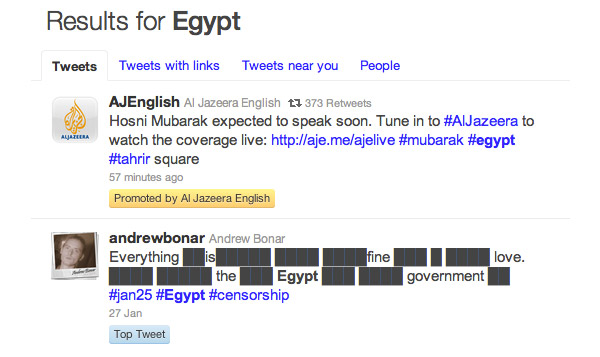
Al Jazeera sponsored Twitter tweet on Egypt
Remember all that fuss about newspapers bidding on Google Adwords to drive traffic to their site? Well here’s a Web 2.0 twist on the idea: Al Jazeera using sponsored tweets to raise awareness of their Egypt coverage.

Twitter itself has the background. Some notable differences to Adwords are that the promoted tweets can be replied to and retweeted just like any other Tweet.

Also, interestingly, “according to Riyaad Minty, head of social media at Al Jazeera English, the @AJEnglish team is operating their Promoted Tweets campaign just like a news desk.” That’s because the content is the advertising, rather than the advertising driving users to the content.

Some metrics to come out of this, according to Twitter (they’re linking to evidence here):

H/t Laura Oliver