Online journalism lesson #9: Audio slideshows, community and wikis

The penultimate session in my 10-class module in Online Journalism from last year covered a range of areas. There’s a little bit on audio slideshows, a lot on community, and related to that, I covered wikis too. I’ve split them into 3 presentations for ease of use. This year (the module starts again on Monday) I’ll probably take an axe to all of this…

Augmenting reality through journalism

It should come as no surprise that “augmented reality” – the technology that overlays virtual layers of data upon the real world – could be useful for journalism. If Yelp’s augmented reality application downloaded to your smartphone can generate a digital screen with ratings and reviews of a restaurant even as you enter it,  it’s not hard to envision a time in the future when your handheld could offer real-time news from your surroundings, almost as it unfolds.

Not surprisingly, news organizations are jumping on the bandwagon. In the past couple of months, Esquire magazine in the US and Wallpaper in Europe unveiled fancy “augmented reality” editions. Robert Downey Jr. came to life on the cover of Esquire, and videos and animation augmented text through the pages of Wallpaper. Last summer, Popular Science used a GE-powered augmented-reality feature with 3-dimensional wind turbines on its cover.

While all of this is “cool,” allowing publications to improve reader experience and perhaps, revenue, by providing interactivity and entertainment, none of them specifically utilized the potential of augmented reality to enhance delivery of serious content, as the Guardian’s Mercedes Bunz eloquently pointed out. While these publications have provided a good prelude to how the technology can be utilized, news organizations should segue into actually doing journalism with augmented reality instead of merely offering it as dessert.

Event reporting

One of the obvious uses of the technology would be in the reporting of live events. This has particular relevance in planned or staged events, which can range anywhere from international climate summits to polling booth stats to reporting from live games, and by extension, perhaps, award shows and concerts. Similar to the superimposed first-down line on NFL football fields, which has often been used to describe how augmented reality can overlay virtual information on real objects, stats about the distance of a quarterback’s pass, the speed of a tennis player’s serve, exit poll results on election days, or data released at international summits can be virtually generated so people can view them on their smartphones even as the event transpires.

Mixed media
Another way to utilize the technology more relevantly for journalism is a method employed by the company Moving Brands for its paper, Living Identity. Holding up the print edition of a story in front of a webcam in this case generates a live feed of the latest news and updates about the content in question. Such an integration of various forms of media might indeed be one of the biggest benefits of the technology – allowing users to engage and interact online through special tags and markers in the print product would enable news organizations to not necessarily charge for online content, but offer additional features accessible only through the print version. This might be an avenue to generate profit for an otherwise dying print product.

Localizing content
Augmented reality thrives on hyperlocal content, as seen by applications like Yelp’s Monocle and Mobilizy’s Wikitude, which can offer a user facts on a restaurant or site of interest, based on his location. Such applications utilize a smartphone’s GPS coordinates in conjunction with localized data garnered from the Web in order to provide information. If you can wave a smartphone in front of the Niagara Falls to get stats about the popular destination, why not point it in the general direction of a location of interest and generate a digital screen of the latest news from the region in question? It would be nice to see publications invest in providing local, breaking news through applications downloaded on smartphones, for instance. This would also allow national publications to “localize” themselves. Some radio stations already do this by providing news and traffic updates based on the location of a user’s handheld device.

User-generated content
Another important point to note is that many augmented reality apps are based on social sites, so much of the content for data points is user-generated; Wikitude even allows users to integrate to their Facebook and Twitter accounts, thus making the application socially aware. This concept brings up a whole host of possibilities for news organizations to not only provide more local information to readers, but also to seek user-contributed content. The New York Times, rightly taking a leaf out of the books of these companies, plans to implement augmented reality for its movie and restaurant reviews. While it’s at it, what the Times might also consider is reader input. It would be cool to whip out a mobile phone and see what Sam Sifton has to say about a restaurant, but in keeping with the ways of social media and technology, it would be somewhat wanting if users aren’t allowed to offer their own views and ratings.

Explaining concepts and background
Augmented reality also allows an interactive, engaging way for publications to explain background and concepts for issues they report on. Mainstream media entities like the Times and the BBC, and independent online startups like Flyp media have effectively used multimedia to elaborate on complex principles – from climate issues to African history.  Augmented reality could add a new dimension, quite literally, to this format of content delivery, without a reader having to navigate hyperlinks or popup windows.

In addition, it can enhance charts and graphical representations of information and localize them to make them more pertinent to a reader. Layar, the first-ever augmented reality browser, has developed an application that can help users track bailout money that was given to US banks by the Obama administration, for instance. News organizations would do well to augment their reporting in similar fashion; reading about a big bank miles away from where readers live can be informative, but knowing that a local company received federal money is often more relevant to people.

Apart from content, however, augmented reality’s more important potential might be in the area of revenue generation. Despite being a brainchild of technology, one essential factor in case of both the Esquire and Wallpaper augmented-reality issues is, of course, that readers need to have a print edition of the magazine to be able to experience the features. In addition, the features are interactive and engaging, and regardless of whether they offer exclusive information, they have the potential to keep readers riveted.

Advertising and revenue generation
Much has been said about the success of rich media ads in driving purchase intent; augmented reality can and is providing more effective strategies for advertising. In addition to making advertisements fun and engaging, publications could also use the technology to provide targeted advertising, which would be less rather than more disruptive for the user.  In a simple case, only users interested in purchasing that BMW would hold up the print ad in front of their computer screens to generate a virtual car that shows off all its features, for instance (though who in their right mind wouldn’t want a digitally-generated Z4 to zip in front of their very eyes?). The great potential of this technology for advertising is already being seen, as more and more brands jump on the augmented reality bandwagon. In fact, companies have perhaps implemented it most innovatively and effectively in order to help consumers get a real sense of the values and functions of their products.

With the growing number of paid smart phone apps, news organizations are beginning to understand that the audience is more likely to pay for technology than for content. Augmented reality (and mobile phones) have a long way to go before the technology can become mainstream, but it certainly has the potential to be one of several revenue streams that the media can begin to employ.

What augmented reality can do above and beyond everything else is make information relevant and tangible to a reader or viewer. For years, media puritans have worried about the Internet causing fragmented communities, and taking citizens away from their local communities. Smartphones enabled with augmented reality might be the answer to bridge that divide, as they provide a necessary interface between the real and virtual realms, offering as they do virtual information in a very real world. Geotags and location-aware digital maps not only unleash Web 2.0 information in front of the user, but also keep him or her firmly rooted to the ground he’s standing on.

What does John Terry’s case mean for superinjuntions?

The superinjunction obtained by England Captain John Terry was overturned on Friday – and the case raises some interesting issues (cross posted from John Terry: another nail in the superinjunction coffin):

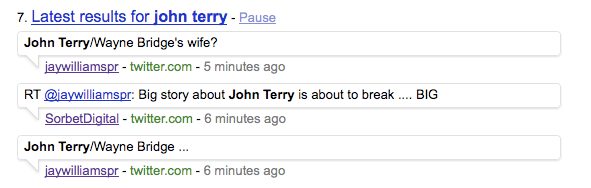
  • Ecen when the superinjunction was in force, you could find out about the story on Twitter and Google – both even promoted the fact of Terry’s affair – via the Twitter trends list and the real-time Google search box.
  • No one got the difference between an injunction and a superinjunction – the former banned reporting of Terry’s alleged affair, the latter banned revealing there was an injunction. They weren’t necessarily both overturned, but there was a widespread assumption you could say what you liked about Terry once the superinjunction was overturned. This wasn’t necessarily the case …
  • The Mail and Telegraph seemed to flout the superinjunction – as did the Press Gazette which decided if wasn’t bound as it hadn’t seen a copy. This seemed risky behaviour legally – which makes me wonder if the papers were looking for a weak case to try to discredit superinjunctions.
  • This superinjunction should never have been granted. What was the original judge thinking?

Google and Twitter ignored the superinjunction

Tweets from while the superinjunction was in force

Tweets from while the superinjunction was in force

The superinjunction was overturned at about 1pm or 2pm on Friday. Needless to say, the papers had a field day over the weekend. Continue reading

Come to the West Midlands Future of News Group February Meetup

The Future of News gathering first organised by Adam Westbrook has its first West Midlands meetup next week (organised by The Lichfield Blog‘s Philip John. I’ll be there, along with leading Portuguese blogger Alex Gamela, Brummie alpha blogger Jon Bounds, Andy Brightwell of Hashbrum and Grounds Birmingham; top journalism blogger Nigel Barlow and Pits n Pots‘ Mike Rawlins, among others.

It’s taking place from 6.45pm on Monday February 8 at Birmingham City University. Places are free but limited – book at http://www.meetup.com/The-West-Midlands-Future-of-News-Group/calendar/12461072/

How digital media changes are affecting local media

This article – an overview of the local media scene in the UK – appears in the latest issue of Government Gazette.

The local media are currently trying to ride through a perfect storm of change, from a decline in readers that long pre-dates the internet, to advertisers fleeing their pages in droves and a new medium that steadfastly refuses to give them the profits they enjoyed in print.

It’s a complicated picture, and anyone who pretends to blame one company, or one business model, for their demise, probably wants something. Continue reading

Another newspaper that ignores copyright law – and ethics

http://podcasting.ie/docs/mos.pdf

The Irish Mail on Sunday has finally responded to complaints about a story it published this week based on the words of a blogging female air traffic controller: “The male chauvinist pigs of air traffic control” (PDF)

“Melanie Schregardus,” the article says, “claims she was forced to endure a torrent of sexist abuse when she and a handful of colleagues first broke into [the] profession”, and the rest of the article continues in the same vein.

The publication of the article understandably caused Melanie some distress. She wrote:

“In the middle of an incredibly trying time for my colleagues, an article has appeared in a Sunday Newspaper that says I feel abused by the people I work with. It gives me opinions that I do not have, and uses words I have never said. It does so to attack my profession, impugn my employers, and portray me as a victim of my friends.

“I feel sick. Any future employer could fairly read what Luke Byrne has written about me and conclude that I am a disloyal, untrustworthy person. The people I work with today could, and probably have, read it and decided that I am not on their side, and that I think that they are sexist, nasty, bullies. None of this is true.

In fact, she deleted her blog, before realising that, without it, there would be no record of her actual words. So she then started a new blog, with the post quoted above. Apart from her complaints about misrepresentation, and that she was never contacted about the story, she also wonders how the newspaper was able to publish a photograph of her without permission (see comments for more on this aspect). And she has complained to the ombudsman. This is where the Irish Mail’s response comes in.

The Irish Mail responds: ‘She was asking for it, mate’

Now at this point The Irish Mail could have protected its brand and claimed this was just one rogue journalist without a sub editor to keep them in check.

Instead, they have decided to dig themselves in deeper, saying:

“The photograph of Mrs Schregardus which we published to accompany this article came from Page 36 of this online magazine http://issuu.com/connors-bevalot/docs/publication1_-destress

“Like Mrs Schregardus’s blog, it had been put into the public domain by Mrs Schregardus herself.”

Of course, being in the public domain has no relevance to copyright. A published newspaper is ‘in the public domain’, but that doesn’t mean anyone is free to copy images from it without paying or crediting the copyright holder. You’d think newspapers would know this.

As for not contacting Mrs Schregardus, they provide an insight into the rigorous journalism practised in their newsroom:

“On Thursday, January 21, Luke Byrne [the reporter] attempted to contact Mrs Schregardus by Twitter (the only contact details he had) and asked her for an interview. On Friday, January 22, Mrs Schregardus replied. She informed Mr Byrne that she had sought permission from her trade union to speak to us. He awaited further contact from her, but he did not hear from Mrs Schregardus again. Either she chose not to speak to him or her union refused her permission to do so.”

So here we have the relentless reporter who will leave no stone unturned in his search for… hold on. “Oh, she didn’t tweet back. Well, I guess I’ve done all I could then.”

Luke Byrne's tweets to Melanie Schregardus

And finally, the misrepresentation. Incredibly, the newspaper claims

“The Irish Mail on Sunday did not attribute to Mrs Schregardus the view that her colleagues were sexist”

So that line saying that she “claims she was forced to endure a torrent of sexist abuse”?

Or the one that reveals “She went on to say that the representation of women didn’t seem to have changed much”?

Or that “She revealed that she endured one of the most pervasive forms of workplace sexism”.

Silly words. They do have an awful habit of arranging themselves in the most unusual sentences.

Same old story, different context

Of course it’s nothing new for a Sunday newspaper to take quotes out of context. Normally that someone is a public figure, and the journalist can argue that it comes with the territory. In The Irish Mail on Sunday’s response you can detect the same theme: she “published on an internet blog that was open to millions of people around the world to read,” they say.

That’s true, and some will say Mrs Schregardus should have been more cautious. I think that’s expecting a level of cynicism that we wouldn’t like to see in the average air traffic controller, but that’s a conversation for another blog post. In the meantime, it’s worth pointing out (aside from the, you know, ruining-a-person’s-life-for-a-story aspect) the long-term effects of an event like this.

Firstly, there’s the effect on the newspaper brand and journalism as a whole. Schregardus outlines how her own opinion (and now, you would expect, those of her readers) has changed as a result:

“I’m sure this happens to other people all the time. Probably people who are far more famous than me. I’ve probably read and formed opinions of other people based on things that are just not true. I’ve probably talked about other people’s lives based on things I’ve read that were hurtful to them.”

Secondly, there’s the effect on workblogging more broadly. We’ve already seen the prize-winning writings of police blogger Nightjack deleted after he was unmasked by The Times, and it’s fair to say that it’s going to be more helpful to journalists to encourage workblogging than to shop their authors – or misrepresent them – to their employers.

Because when the workblogs have gone what will you do? Pick up the phone? Luke Byrne may struggle with that.

Police visit to Seismic Shock blogger after "harassment" complaint – the context

This is a cross-post from the Wardman Wire, looking at the various questions around the Sesmic Shock case, which Paul has mentioned previously. It’s an interesting and very important story, because it touches on politics, religion, law, and police use of that law.

A blogger who writes the Seismic Shock website has published articles critical of a Church of England Vicar, who has complained to the police over ‘harassment’ resulting in the blogger being paid a visit by the West Yorkshire constabulary, and his computer files at his University – who I believe is his emloyer – to be searched. The site linked above is the new one; the blogger deleted the old one “voluntarily” when the Constabulary had a “word”.

The Church of England Vicar is Rev Stephen Sizer, of the parish of Virginia Water. He is a known critic of the State of Israel, and of “Christian Zionism”, and a reasonably well-known controversialist on these questions.

We should also note that there are some statements being made around that would be on the edge of our defamation laws in the UK; see, for example, the introduction to this piece on the Z-Word blog of the American Jewish Committee.

This dispute doesn’t depend on the content of the story, though, and I’m not about to go fishing in the “Pro-Israel” or “Anti-Israel” or “Pro-” or “Anti-Palestinian” pool.

Sizer has also been doing his own bit of ‘harrassment’ in the comments on the blog of an Australian blogger, “Vee” of LivingJourney. She mentioned Sizer in a piece, and linked to the Seismic blog.

Sizer left her this comment:

Dear Vee,

You must take a little more care who you brand as anti-semitic otherwise you too will be receiving a caution from the police as the young former student of Leeds did recently. One more reference to me and you will be reported.

Blessings
Stephen

Harry’s Place has a guest post from Seesmic Shock setting out his point of view. There is also a report on the Index on Censorship blog.

Free Speech or Harassment

Paul Bradshaw has the key points summarised well at the Online Journalism Blog:

This is worrying on so many levels:

  1. A blogger links to evidence linking a reverend in the Anglican church with holocaust denial and antisemitism.
  2. The reverend complains to Surrey Police, who pass it on to Yorkshire Police, who pay the blogger a visit, during which the blogger agrees to delete one of his blogs.
  3. In addition, it appears that the police have also spoken to the university which the blogger attends, where the head of ICT “would like to remind me that I should not be using university property in order to associate individuals with terrorists and Holocaust deniers”.
  4. The blogger eventually chooses to speak up when the same reverend threatens another blogger with similar action (despite them being in Australia)

And he is asking exactly the right questions (updated slightly from Paul’s article):

  1. Why are police getting involved? West Yorks police say it was a claim of “harassment”. Is that all it takes?
  2. Why are they ‘paying a visit’?
  3. Why are they approaching an educational institution to gather information on that person?
  4. Why does that educational institution then get involved?

Harassment

For context, “harassment” is defined in English Law thus, under the 1997 Protection from Harassment Act:

““Harassment” of a person includes causing the person alarm or distress; and a course of conduct must involve conduct on at least two occasions.”

Where will this go?

This story is likely to run and run, and I think it is important to keep the principles of law at stake here separate from the arguments about Middle East politics and religion.

My View

I don’t think that a published author and controversialist will cover himself in glory by complaining to the police about hostile articles by somebody else. I hope that authors would pay more attention to the principle of freedom of expression. If material is defamatory, then the action should be for defamation. If it is a vigorous argument, then argue back. Note: I have not of course – since it has been deleted – seen all the original content of the Seismic blog.

I think we have a problem with a nebulous definition of harassment, which is being assessed too heavily on the basis of the statements of the victim; some reform is needed.

And, I’m reluctant to say it, but I think that there are so many petty interferences and use of laws to intimidate individuals by different varieties of policemen – the most topical example is photographers – that I think we need to make it almost a principle not to give in to “a quiet word from a Constable”; we need to make our police justify their actions at every point.

I think that it is important to keep the principles of law at stake here separate from the arguments about Middle East politics and religion.

Why news organisations should start thinking seriously about their data

I don’t often post a simple link-and-quote to another post these days, but Martin Belam’s article on the value of linked data to the news industry is worth blogging about. In it he makes the clearest argument I’ve yet seen for linked data. First, the commercial argument:

“Pages [on a non-news BBC project using linked data] are performing very well in SEO terms. They sometimes even outrank Wikipedia in Google when people make one word searches for animals, which is no mean feat … And the ongoing maintenance cost of organising this wealth of content is reduced.”

Second, the editorial one:

“Let us picture a scenario where each school has a unique canonical identifier, which is applied to all Government data relating to that school. Or – more likely perhaps – that we have mappings of all the different ways that one school might be uniquely identified, depending on the data source. Now picture that news organisations have also tagged any content about that school with the same unique or a similarly interoperable identifier.

“Suddenly, when a newsworthy event takes place, a researcher within a news organisation has at their fingertips a wealth of data – was the school failing, had the people involved been in any coverage of the school before, does the school have a ‘history’ of related incidents that might build up to a story. We have here a potential application of linked civic and news data that improves the tools in our newsrooms.

“And just because we share some common identifiers for data, it doesn’t necessarily mean producing homogeneous content. It is perfectly possible to imagine one news group producing an application that works out the greenest place to live if you want your child to be in the catchment area of a particular school, and another newspaper to use different sets of data to produce an application to tell you where you need to buy a house if you want to get your child into school x, and have the least chance of being burgled. And then news organisations repackaging these services and syndicating them to estate agent and property websites as part of their B2B activities.”

(With a commercial flourish there). It’s worth reading from start to finish.

More details on the Seismic Shock police visit. Still worrying.

Following yesterday’s post on the visit paid by two West Yorkshire police officers to an anonymous blogger, the BBC’s Rory Cellan-Jones has done some digging and spoken to the blogger in question, who explains:

“Someone had traced my IP address to Leeds University and the police had spoken to the university and retrieved some files of mine, none of which contained anything which I hadn’t made public. The police then relayed a message from the head of ICT department that I shouldn’t be using university property in such ways.”

Rory’s piece continues:

The officers asked him to take down his blog, which was at that time being written partly on a university computer, and he agreed to do so. “Why?” I asked him. “I did it because I felt intimidated,” he said. “I felt had to co-operate with the police.”

So why did the police or Leeds University get involved in this argument? The university offered no comment, except to say that the person who knew about this issue was away on holiday.

This is the most worrying piece of the puzzle for me.

  • Firstly, that – apparently on the basis of a complaint – the police should request computer files from a university.
  • And secondly, that the university should comply.

I’m waiting for a response from West Yorkshire Police and Leeds University for further details – particularly on how the police handle harassment complaints like this (and what the nature of the complaint was), and the university’s policy for handing over student data. This may well be a storm in a teacup, but there are valid questions here that need to be answered.

A roundup of other reports on the story can be found here.

UPDATE: I’ve now received a reply from West Yorkshire Police who appear to be merely repeating what they already told Index on Censorship: “As a result of a report of harassment, which was referred to us by Surrey Police, two officers from West Yorkshire Police visited the author of the blog concerned. The feelings of the complainant were relayed to the author who voluntarily removed the blog. No formal action was taken.”

I’ve repeated my questions about how they handle harassment complaints and requests for data more generally.