Twitter insights: Blaine Cooke @ teacamp

This is the video I shot (with hand-held Flash camera, someone tweeted about how I managed to keep my hand up for an hour) of one of Twitter’s creators, Blaine Cooke, visiting Teacamp, a gathering of Whitehall webbies and hangers on.

Cooke kindly spent a hour answering questions about Twitter – where it came from, is now and where it’s heading to. In other words, lots of insider knowledge

C&binet notes part 2: 10 things government can do to help local journalism

More notes from this morning’s train journey down to C&binet at the Department for Culture, Media & Sport.

The word holistic annoys me for some reason, but I can’t think of any other. Journalism’s problem is holistic; the solution is likely to be holistic as well. There is no magic bullet, so here are 10 ideas of things that government and other public bodies can do to help journalism.

  1. Journalism as volunteering – formally recognise journalism as a way to contribute to your local community: cleaning out the trash, so to speak, in a figurative sense. Provide the formal structures to support this: training, legal support, travel costs, connections. As a side-effect this can help address the Samantha Syndrome in the media: journalists increasingly coming from affluent backgrounds as they are the only ones who can afford to support themselves through internships, training etc. Make journalism a formal volunteering activity and you widen the pool of participants, while increasing media literacy.Arts funding for journalism – journalism is art. Journalism that engages particularly effectively with communities is, for me, worthy of arts funding. Let’s help that happen.
  2. Tax relief/support – on, for example, R&D. Local newspapers are sitting on a vast archive of local information that could be hugely useful if effectively digitised and an API created. Let’s help that happen.
  3. Open supply of information and data from public bodies – instead of spending the council PR budget on a local freesheet, spend part of it on streaming council meetings and providing public data that acts as a resource for professional journalists, citizen journalists, developers, startups and citizens generally.
  4. Outreach training & support – also from the council PR pot: if ‘celebrating the area’ is your objective spend money training local people and support them editorially to blog about the great and not so great things happening in their area.
  5. A Council News NetworkNick Booth’s suggestion of the BBC as a model for publicly owned news is a great one. Take editorial control over council news away from councils to a body that has independence. The BBC would be a good candidate for this.
  6. Postcode-based direct mail – If councils object to being required to advertise notices in their local paper on the ground that it doesn’t reach everyone, use direct mail through another agent. The Newspaper Club could do this very well: telling people about planning alerts, etc. based on their postcode, with the money used to subsidise other journalism.
  7. Wired cities – a perfect place for local information is the bus stop or train station – not just billboards but electronic systems that currently show bus times. Why not show other local information there? Invest in the infrastructure and improve local distribution networks for information. Put the supply of that information out to tender.
  8. VRM for power and people – Yoosk is a good model for vendor relationship management (VRM) between politicians and citizens: people post questions, politicians answer, and users vote on whether they felt the question was answered. Ultimately this is part of great journalism: interrogating power and holding power to account. The funding criteria need to avoid domination by powerful, so it might be based on, for example, the numbers of people looking at planning alerts, council meetings, engaging, voting etc.
  9. Providing efficiencies – supplying raw data is one efficiency; organisations like the BBC could provide training, platforms, kit and space, pubic organisations have distribution networks. All of these can be opened up for greater efficiency.
  10. Legal change – Libel is an enormous obstacle to true engagement with and challenging of power, particularly for news startups, and needs to be urgently addressed. Widening the Freedom of Information Act to apply to organisations who receive public money above a certain amount would be hugely useful. There are probably others you can add.

Those are the ideas I have, anyway. Anything to add?

UPDATE: FROM THE COMMENTS:

  1. Simon Clarke: “some kind of move against police harassment of journalists for spurious “security” reasons.”
  2. Paul Miller: “banning junk mail would have a pretty positive impact. It accounts for 11.5% of UK advertising spend and shifting that online and into newspapers would be a big boost to local revenues.”

Saving local journalism: some thoughts ahead of C&binet

I’m sat on a train on the way to the C&binet session at the Department for Culture, Media and Sport looking at the question of what the government should do – if anything – to save local journalism. Here are my notes:

The problem is not journalism

The vanity of journalists often leads to chest-beating deprecation of modern journalism. While there is some validity to that argument, it misses the point. Audiences have been steadily declining since well before the internet – that’s not what’s caused the current crisis.

The problem is not a journalism problem – it is an advertising problem, and a distribution problem.

The advertising problem is this: over recent years the market has been flooded with suppliers. This has driven the price down to a level that cannot sustain shareholder-owned print operations. In the last 12 months a sheer drop in demand has compounded the problem, and it’s widely accepted that some of that demand may never come back.

Advertising itself has changed too – from the traditional model of CPM (selling eyeballs) to CPC (selling clicks) to CPA (selling actions, e.g. purchases), and is likely to evolve further in the future towards VRM (vendor relationship management, i.e. managing the relationship between seller and buyer). I’ve seen little evidence of newspapers adapting their own advertising offerings in line to get a foothold when advertisers catch up – it’s still print-centric.

The distribution problem is that newspapers do not control distribution online – by and large their readers do, and newspapers have failed to acknowledge this, leaving themselves open to web startups that build user distribution into their design and operation. Of course the loss of control over distribution means losing the monopolies that allowed newspapers to keep advertising prices high enough to sustain the profit margins they were accustomed to. Now advertisers have choice, and the newspaper ad offering doesn’t look much of a bargain.

What does the future of local journalism look like?

I see 2 main paths of development, and both have one thing in common: the future is networked.

On the one side I see the national-grassroots-data path – I’ll call it the Networked Model for simplicity’s sake. As increasing numbers of local newspapers close or stunt their operations, hyperlocal blogs will spring up to address the gap. At the same time national news organisations enter the local market and partner with these and data-based operations. The most likely figures in this scenario are The Guardian, hyperlocal blogs and the likes of MySociety and OpenlyLocal. It’s a patchwork solution that is likely to leave gaps in coverage.

On the other side is the Local News Consortia proposed by Ofcom. Established operators like PA, ITN and regional newspaper publishers will partner up to gain access to a pot of public money and efficiencies that they cannot achieve without ending up in front of the Competition Commission. This will require some public service commitments such as covering councils and courts, and universal coverage – but fundamentally this will be Business As Usual.

More to follow in further posts

This year’s reading list – an OPML file

In addition to the usual reading list I give to students on the new MA Online Journalism, I also provide an OPML file of around 50 RSS feeds they should be subscribing to – broadly, 5 feeds each in 10 categories.

I thought I should make it available here, so: here it is.

The idea is that a) they get instant access to up-to-date news and analysis of a range of relevant areas; and b) it introduces them to the concept of RSS, if they don’t already know about it, and how to share OPML files.

It seems a no-brainer that we should be doing this on all courses.

Oh, and if you think there are better feeds, let me know.

Review: the Novatel Wireless Mobile Hotspot (MiFi to you and me)

MiFi

For the last month or so I’ve been playing around with a review copy of Novatel’s MiFi, a portable wifi hotspot that allows you to connect to the web with multiple devices.

It’s a cute bit of kit – slightly shorter than an iPhone, and ideal for journalists because it bridges the need for a wifi hotspot while addressing the limitations of a 3G smartphone.

The technology is pretty straightforward: inside the MiFi is a SIM card which pulls a 3G signal that is converted into that wifi hotspot.

Up to 5 devices can then connect to the web through that hotspot – there’s a password which is shown, intelligently, on the back of the battery cover.

Clearly you need a 3G signal for the MiFi to work – it’s great in urban areas but less successful where there’s poor mobile coverage. But even with a relatively low 3G signal the wifi hotspot is surprisingly strong. And even if you already have access to wifi – or a 3G dongle – the MiFi provides a second, often more reliable, connection for uploading material.

In fact, if you’re relying on 3G connections for mobile journalism I would recommend having a MiFi on one mobile operator, a pay as you go 3G dongle with another, and a smartphone on a third.

I managed to stream video very easily from my laptop, connected to the web on the iPod Touch, and had a group of MA Online Journalism students using it to access the web while we conducted a lesson. (aside from journalism it’s perfect for mobile education).

Sadly, I didn’t get to try out the Eye-Fi card alongside it, but now that it’s hit the UK I’m hoping to play with that too. The Eye-Fi sends images and video straight from an SD card to social media via a wifi hotspot, so you could use an SLR camera or mini camcorder with a MiFi to upload your footage as soon as you shoot it without having to mess with laptops or smartphones (or police officers).

The major weakness, however, is battery power: the specifications say that the MiFi should have 4 hours battery life after a charge (which is, to its credit, quick). But this is shorter if you have multiple devices, and after 4 weeks of using it (and yes, it will have been used by other reviewers), the battery no longer held its charge. Given that you have to sign up to a contract to get the MiFi*, this is rather worrying.

UPDATE: The company that sent me the unit tell me “Standard warranty for the Novatel Wireless Intelligent Mobile Hotspot 2352 is 24 months.”

That aside, this is a must-have piece of kit for me.

*Contract details:

T-Mobile:

  • Pay Monthly Contract (18 months)
  • Device is free at point of sale, then £20/mth (3GB data according to T-Mobile Fair Usage Policy)

Vodafone:

  • Pay Monthly Contract (24 months)
  • Option (1) Device purchase is £69.99, then GBP 15/mth with 3GB data
  • Option (2) Device is free, then £25/mth with 5GB data

Covert online campaigns: a primer

Following last week’s Question Time, the BBC’s Have Your Say forum was red hot with sympathy for old Nick.

This led to some soul searching in the media, and across the social sphere. To what extent can we say that this mass-protest; much of which condemned the ‘bullying’ of a panellist rather than openly endorsing his party’s policies, fairly reflects public opinion? Are we looking at an orchestrated online campaign?

Without access to HYS log data, it is very hard to say. And even with an extensive list of IP addresses, and a breakdown of traffic by source, the free availability of anonymous proxies and easy-to-set-up email and social network accounts will always leave breathing space for a well-regimented astroturfing campaign.

So how can we shed light on covert political campaigns online? Any group who have been infiltrated in the past will be ultra security-conscious – so events last week may be untraceable to outsiders. Other groups may not be as well organised – so here are some pointers.

 Language

Spreading an effective mass-campaign across a forum or social network requires speed. People who work quickly don’t have time to spell-check, or type accurately. But hunting out spelling errors won’t help you unearth a conspiracy here.

Typos are a different matter – if you spot regularly occurring mis-types, this could suggest a common origin.

Punctuation and the use of capital letters can also slow the process of rapid posting. Conversely, evidence of the sporadic and distinctive use of upper-case shouting (within ordinary text), can also be indicative of a single personality expressed across multiple accounts.

Phrase searching” excerpts from suspicious sentences can provide a simple way of tracking down duplicate content across the web. This can be useful where people are trolling across different forums (which might, in this case, include a perceived spike in support on the Sky News forums). But testing an adequate number of sentences can be time consuming.

Alternatively, there are a few freely available services out there intended to detect plagiarism, which can be used to track duplicate posting across parts of the web.

However, it is likely that well organised and long-term campaigns will already have organised participants into cells who are responsible for trolling particular domains, thus lending uniqueness and authenticity to their posting. Such decisions will most likely take place offline, or at least via encrypted communications – which some groups are known to use.

Getting back to the analysis of output, it is possible to mine large volumes of text (i.e. a large number of posts in one domain), via software such as Analysts Notebook. This could certainly help establish grammatical trends, and those phrases which are hard for the human eye to spot systematically. But this software is far too expensive for most media organisations.

Linking

In the unlikely event that a covert campaign to influence public opinion is discussed openly on the web, there are a number of places to check for mobilisation, and linking.

A search of Omgili (covering keywords, or URLs) will highlight any attempts on public discussion boards to mobilise on a given subject and/or target (though this is of little use for private boards).

Alternatively, Yahoo’s site explorer can be used to eke out all the inbound links to any page across the web. This source gives an insight into just how skewed political opinion on the web can be. If you search for Ron Paul’s Campaign for Liberty you will find it has over 600,000 inbound links, by comparison with the Republican National Committee which has just over 220,000. You might wonder which party’s representative came runner up at the last presidential election on this analysis.

For the social web, bit.ly’s search option allows you either to search for linking by keyword or by URL. When the results come back, check Info for a particular entry, then select View all from the Conversations option to track the development of conversation around the page in question, and tease out other associated links and trends.

Lost in hyperspace

Sometimes the most obvious indication that something’s going on is when that thing’s not going on somewhere you’d expect it to. The relative inactivity on Thursday night from those who publicise their affiliations (a bio: search in Tweepz will help here) is noteworthy.

On the eve of the greatest public exposure in the party’s history, some might question where were the pro- trending topics – there were no shortage of anti- topics that night. A cynic might suggest that mobilising on Twitter, where real identities often crowd out fakes, is not the ideal medium for pushing an unpopular agenda.

Dummy accounts represent a different challenge. Forum owners can easily keep track on accounts which spark unerringly to life when a particular issue comes along which fits with a particular agenda. But the surfer can replicate this too – IceRocket’s Twitter search tab allows you to browse vital statistics – including tweet count – which can be indicative of a dummy account (as can long periods of inactivity between non-specific tweeting, and proactive tweets).

A trawl through the names posted on forums may highlight a number of plausible but bogus identities (see 192.com for domestic names, or Infobel for international ones), which should arouse suspicion. The age-range option in 192 can be especially useful in analysing Facebook accounts. Where you see a profile picture of someone in their twenties, if everyone by that name on the electoral roll is over 40, something is surely up.

Likewise one or two people finders, such as 123people or Yasni, when used in conjunction with 192, can highlight anomalies between real and online identities.

When browsing through the real names posted on a forum, if you can’t find names who elsewhere publicly declare their affiliations, especially in relation to a contentious issue, then alarm bells may start ringing.

But then, where a campaign groups’ leadership encourage members to hide their true identity in public, it’s little wonder conspiracy abounds. Such advice accommodates a reactive approach to online campaigning, away from the direct expression of party support, and towards (for example) outrage at a perceived injustice. Yet the absence of significant online connections between a party and its activists would indicate that this type of strategy is working perhaps a little too well.

Linking and transparency in online politics

Groups who seek to hide their true colours online can come embarrassingly undone if they aren’t careful. The link can cut a swathe through façade – it can bring transparency to our politics, as well as to our journalism.

For this reason the Identify Firefox extension can bring insight. This plugin reads links on social network and blog profiles tagged rel=”me” (more information on the plugin can be found on Read Write Web). Use the keyword combination Ctr+i on any public profile to bring back other social networks and blogs which also link to these web sources.

Try it out on a couple of prominent public profiles – you may be surprised (or possibly appalled) at what you find.

Investigative journalism – accept no substitute

While conventional online research techniques offer options in terms of digging out evidence, there remains no substitute for good old fashioned investigative journalism.

With this in mind, a first port of call for guidance on approaching online groups for any investigator should be the internet research clinic.

2009 Technorati State of the Blogosphere Report – key findings.

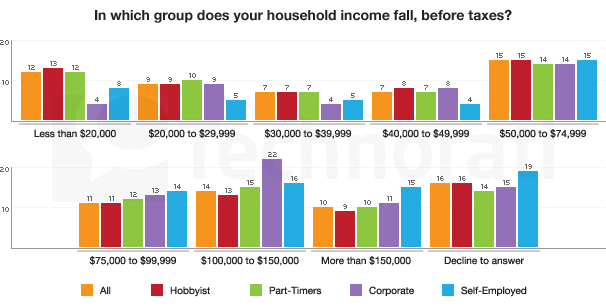
Bloggers are generally more affluent than the average person

Bloggers are generally more affluent than the average person

5 things journalists should know about the report:

  • The blogosphere continues to be dominated by male, affluent and educated bloggers
  • Bloggers use Twitter far more than the average person and microblogging is changing blogging habits
  • Blogging is becoming more mainstream and influential, but not replacing traditional media
  • More bloggers are making money, but most don’t make any
  • Most bloggers are “hobbyists” and are driven by personal fulfilment rather than financial gain.

Last week over five days, Technorati released the annual 2009 State of the Blogosphere Report with a strong theme of gaining strength. A record number of 2,828 bloggers submitted extensive surveys about their blogging activities from the past year from 50 countries, with half from the US (48%), 26% from the EU, 10% from the APAC (Asia Pacific) and 16% from elsewhere.
Results were combined with interviews with professional and well-known bloggers and statistics and findings from Lijit and Blogcritics. Bloggers were separated into four distinct groups; hobbyists, part-timers, self-employeds and professionals.

While blogging is gaining in popularity and credibility, the blogging demographic doesn’t appear to be widening. The average blogger continues to be male (two thirds), affluent (a majority have household incomes of an average of $75,000) and educated.

While most bloggers are blogging more regularly and have at least three blogs, the majority consider their output a hobby (72%).

The vast majority of bloggers seek to share their personal experience for emotional and personal fulfilment rather than monetary gain. Most bloggers feel their blog has acted positively on their personal and professional lives. Generally, respondents said they blog for one of three distinct reasons: speaking one’s mind; sharing expertise and experiences with family and friends (old and new); and making money or doing business.

70% of all respondents say that personal satisfaction is a way they measure the success of their blog, but for Pros, the leading measure of success is the number of unique visitors.

The survey found that contrary to popular belief, many bloggers have had professional media experience, with 35% of all respondents having worked in traditional media as a writer, reporter, producer, or on-air personality, and 27% continue to do so.

Interestingly, the report found that while bloggers read other blogs they do not consider them a substitute for other news sources and the majority do not consider online media more important than traditional media. However, 31% don’t think newspapers will survive the next ten years.

The report highlighted the instrumental role the blogosphere has played in recent global issues; namely the protests during the recent Iranian elections and debate surrounding last year’s US presidential elections. Even though only a relatively small number of bloggers commented on these events, bloggers believe their influence on global affairs is growing. 51% believe it will be a more effective tool to voice dissent in the future and 39% believe blogs made the Iranian protests earlier this year more effective.

Bloggers are getting savvier and more influential. Most bloggers know how their blog is created and use an average of five activities to draw an audience to their site. Bloggers with greater audiences and with Technorati authority ratings blog more regularly, posting more than 300 times more than lower ranked bloggers. One in five bloggers report updating on a daily basis, but the majority update their blog two to three times per week. The survey results and interviews with influential bloggers clearly show the number of page views depends on how prolific a blog is.

More bloggers are earning some revenue from their blog, but they are not in the majority and most income streams are indirect. For 83% of people that make money from their blog, it is not their primary income. Interviewees agreed the key to a successful blog is passion. In each case they describe how professional and lucrative blogging stemmed from their original passion and drive.

The growth of Twitter is having a big impact on the blogosphere. A large proportion of bloggers (73%) report using Twitter, largely for promotion and interaction with readers, compared with just 14% of the general population. Furthermore, according to Lijit, blogs with greater than 100 page views a day received on average 83% of their page views from Twitter referrals. Twitter was also by far the fastest growing content source to be included by bloggers.

Bloggers are avid Twitter users

Bloggers are avid Twitter users

The BNP on Question Time: the view from the User Generated Content hub

I put a few questions to Matthew Eltringham from the BBC’s UGC Hub on how the team dealt with comments from users during last night’s controversial Question Time debate featuring the BNP’s Nick Griffin. Here are his responses in full:

How did the volume of contributions to Have Your Say etc. compare with a typical Question Time?

Because of the way we structured the HYS round this QT the statistical comparisons can’t be exact.

This time we ran a programme based messageboard from first thing in the morning; usually it is launched much later in the afternoon. The number of responses to that debate — and the one we set up this morning on the impact of the QT has been extraordinary; an average programme-based QT HYS might get a couple of hundred comments; this one got more than 10,000.

And by 1130 this morning we have already received nearly 2,000 for a new messageboard about the impact — again a very, very big and fast response from the audience.

An interesting statistical comparison is the response to the awarding of the Nobel peace prize to President Obama, when over the same period of time we recieved about the same number of comments – though the audience was a more global audience in that case. And interestingly, we had a bigger response on HYS than any of the big US media organisations in their comment forums.

How did the hub prepare for that – did it do anything special for this broadcast?

We brought in extra staff to cope with the expected work load, especially in the evening around the programme transmission; we also discussed appropriate moderation as we were aware there would be some tricky issues.

How would you describe the balance of reaction that was coming in in terms of pro- and anti-BNP?

There were three clear strands of opinion — those who disagreed with the BBC’s decision to put Nick Griffin on QT; those who articulated their support for Nick Griffin and the BNP; and those who either didn’t offer any view on Griffin/ BNP or said they weren’t supporters but strongly argued that he should be allowed on the programme. This third strand was the largest.

A couple of people suggested that some comments were part of an “organised trolling campaign – the same typos keep recurring in several posts – ‘BMP'” – what is the policy on that? Do you look for repeated IP addresses, or copy & paste jobs?

We have very clear House rules against spamming and if – amongst the 10,000 comments that came in – we detect any organised campaign we would act on that by moderating the spam out. We don’t have any technology to help us with that.

We make it very clear that HYS is a manifestation of the balance of opinion recieved by us, reflecting the views of the members of the audience that wish to contribute. It’s not scientific, nor is it a balanced opinion.

In Defence of Principled Anonymous Blogging

(This article has been developed from a comment I left on Nick Baines’ blog, where there was a good debate about the rights and wrongs of anonymous blogging.)

Good Reasons for pseudonymous blogging

I think the right of bloggers to post anonymously/pseudonymously is important, for a number of reasons, but I like the term coined by Nick – “principled anonymous blogging”. Some bloggers have good reasons to conceal their identity, and that should be respected. Here are a few justifiable reasons for bloggers to use a pseudonym:

1 – Physical Danger

For many people, to deny them anonymity is to deny them a voice or put them in physical danger. Consider refugees or campaigners from abroad. What about victims of domestic violence – why should they not be able to speak in public without fear?

2 – Over-heavy restrictions imposed by employers

In this country, we see bloggers sacked If a blogger defames their employer or violates a reasonable contract, then I have no problem with sanctions being taken.

However, in the UK we do not have the balance right yet between freedom of expression, and the right of employers to restrict employees’ actions outside the workplace. This question is tied up with the need to create rational British (and particularly English) laws guaranteeing a right to express an opinion.

3 – Widening political participation

At a time when renewal/broadening of our political process to help individuals participate is perhaps the single most important challenge we face, we should not frighten people away from expressing their views publicly.

A good number of established bloggers have started out without revealing their identity, including me. In my case, I needed to distance my political commentary from a short-term contract in a workplace which required political neutrality. This was one of the coincidental reasons why I have ended up editing a non-partisan blog.

4 – Fear

There are many, many, examples of posts that would not have happened if not made anonymously. One example was the “Dave Walker reposts” here, which were part of a blog campaign starting in summer 2008. Much of the reporting of that saga – some by insiders whose jobs were at risk – would not have happened without anonymity; many people had been subjected to extended bullying at work, and were *frightened*.

Stick to one pseudonym

To me the key point about acceptable anonymous/pseudonymous blogging is that it be done with a consistent identity, so that debate is transparent.

There is an argument that different pseudonyms are acceptable in each niche or community where a person participates; I’m not commenting on the detail of that question here.

Pseudonyms in the wider media

If we are going to question blogging anyonymity, then we have to come up with a set of criteria which we also apply to pseudonyms used elsewhere and far before blogs even existed.

Newspaper diary columns, and writers in general, have used pen-names (or maiden names), for centuries. This is often ignored.

Online anonymity isn’t usually anonymous

In practice, most websites and online companies will divulge identities when faced with a demand from a Court of Law, as has been seen in recent Court Cases.

There are very few publishers in the UK who would conceal the identity of an abusive author. However, a whistleblower would be in a diifferent category.

Wrapping Up

My (obvious) conclusion is that it is not “anonymity” which is the problem, but rather “the abuse of anonymity”; the latter is where our laws should focus.

What does a mobile journalist need?

In my MA Online Journalism session this week I’ll be looking at mobile journalism. As part of that, below I’ve compiled 4 lists of things I think a mobile journalist needs: hardware, software, systems, and mindset. I’d welcome anything you can add to this.

In the spirit of mobile journalism, I will also be streamed the session live on Bambuser from 9am UK time on Thursday, for around 45 mins – if you can join us online and chip in, please do. I’ve embedded the player below (skip past it for the lists of things a mojo needs).

A note from the comments

Some comments rightfully point out that this list is potentially terrifying. I’m not suggesting you need all these things – my favourite response said that you needed a Posterous blog, a smartphone, and lots of batteries, and I’d go along with that. But here are a whole lot of potential things to explore when you get itchy…

Mobile journalism – hardware

  • Smartphone with camera, video, audio, unlimited data plan
  • Digital camcorder, e.g. Flip, Kodak Zi8
  • Digital dictaphone or Zoom (a Livescribe pen is also useful)
  • Portable mic
  • Portable mini tripod?
  • Batteries (including extra mobile phone battery)
  • Extension lead – and chargers
  • Portable chargers, e.g. solar
  • Bluetooth keyboard
  • Mifi and/or 3G dongle
  • Eyefi card
  • Wifi laptop or netbook with webcam

Mobile journalism – the software

  • Apps for your phone and services you can email or text to. Good ones include…
  • Shozu
  • Spinvox – blog via voice
  • iBlogger
  • Audioboo
  • Twitterfone
  • Twitvid
  • Twibble – GPS twitter updates
  • Zyb – synchronise contacts and calendar
  • Opera Mini; on iPhone use bookmarklets on Safari like ‘Read Later’, ‘Post with Tweetie’, ‘Save to Delicious’, ‘Share on Tumblr’
  • Qik, Bambuser, 12seconds – streaming video
  • Posterous – blog via email (shutting down April 2013)
  • ZoneTag – geotag images
  • JoikuSpot – create wifi hotspot from 3G phone
  • Google Maps

Mobile journalism – the systems

  • Email must be set up – more than one account as backup (Google Mail occasionally goes down)
  • Useful phone no.s, e.g. Twitter, Twitterfone
  • Useful emails, e.g. Twitpic, YouTube, Twittermail, Facebook, Posterous etc.
  • Map of wifi hotspots
  • Map of mobile and 3G coverage
  • Blog via email or text – Postie plugin/Posterous/app/etc.
  • Pulling RSS feeds from Twitter/Flickr/YouTube/Posterous/Tumblr/Google Docs
  • Embedded players for livestreaming/liveblogging
  • Geotagging information for mapping
  • Mashups
  • Preparation: web-based video/audio/image editors
  • Collaboration – preparing the users, hashtags, tweeting, feedback

Mobile journalism – the mindset

  • ‘Always-on’ approach – tweet on the go; share images; stream quick video. Think humour, art, quirky, as much as ‘news’. Prepare yourself and users for when you need it.
  • Play with new mobile tools – follow TechCrunch etc.
  • Try out mobile apps
  • Find the stories that are not online
  • Be part of a mobile community – follow people like @documentally @alisongow @ilicco @patphelan @moconews
  • Be creative with mobile, not formulaic: the rules aren’t written yet