Guardian the most bookmarked newspaper on delicious

The Guardian has more URLs bookmarked on Delicious than any other UK newspaper, as I first revealed here (with the original video here)

There are 10,914 Guardian URLs bookmarked, with the Times coming 2nd (3,944) and the Independent in 3rd place (3,196).

Newspaper
website
Bookmarks on Delicious
Guardian 10,914
Times Online 3,944
The Independent 3,196
Telegraph 2,258
The Sun 1,409
FT 1,303
Daily Mail 785
Mirror 624
Express 197

Quarkbase must be using the Delicious API but it doesn’t say where it gets the number. Click the papers’ name to see the Quarkbase figures (and more).

The Revenge of Lilliput: Former-SPCK Bookshop Campaign blog passes 150k visitors

20090824-spckssg-news-blog-past-150k-pageviews-screenshotThis morning the SPCK SSG News, Notes and Information campaign blog passed a total of 150,000 page views since it was established in June-July 2008.

This is a story which is an excellent example of both investigation by a network of people, and campaigning blogging. It shows how a coalition of individuals can make a significant difference. You can read a brief outline on the blog’s introductory page.

The blog is about the mismanagement and destruction of a chain of 25 Anglican bookshops, which have been around since the first half of the 20th Century, by two brothers based in the USA, J Mark – who is a lawyer – and Philip Brewer. They took over control of the Bookshops from the SPCK charity with the promise of maintaining and improving the business back in 2006. They used a charity called the “Society of Saint Stephen the Great” (SSG) as their vehicle.

Since then there has been a saga of “shenanigans”, including sackings by email, bullying of staff, “Cease and Desist” attempts to suppress straight reporting, creation of half-a-dozen business entities to confuse everyone, a fake attempt in the US at putting the core charity into bankruptcy (declaring only liabilities not assets) where the court has no jurisdiction anyway, and much much more, which I will be describing in some detail in a series of podcasts.

I (along with many others) helped promote the new campaign site in summer 2008 when Dave Walker the blogger doing the existing reporting (75 posts in about 18 months was one of several threatened legally by Mark Brewer; here is an example of the style of letter used – this one was published by Sam Norton. An instant archive of these deleted posts was of course established within days on the blog Open Debates not Libel Threats .

20080827-philip-brewer-of-spck-aircraft-for-sale-1-small1There have also been some lighter moments, such as the lawyer running a chain of religious bookshops being instructed by the Court to take remedial education in bankruptcy law and legal ethics, and the discovery that his brother possesses a private “hobby” aircraft painted in “Trotter Trading” yellow, which was maintained at charitable expense . However, the core objective is to make sure that the mismanagement of the chain is scrutinised, and the miscreants brought to book.
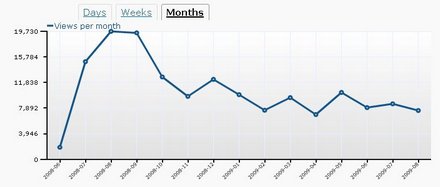
The campaign blog now has nearly 250 articles, and has received 2500 comments. Here are the visitor statistics from the WordPress stats module. You can see the initial surge, and how interest has been maintained at around 10k page views each month.

20090824-spckssg-news-blog-past-150k-pageviews

Though very respectable, this is not a huge amount of traffic, but a successful niche campaign does not need a huge amount of traffic – and it could even be a distraction to receive many more comments than we do already.

Continue reading

Wikipedia to require new biography edits to be approved first

The New York Times reports that edits by new users to biographical entries on Wikipedia will be held back from publication until a more experienced editor approves them.

This seems something of a no-brainer to me. When I talk to students about Wikipedia I always point out that the main risks come with biographies, because of the obvious personal element involved (I also point them to the discussion pages behind each entry, and the ability to look at the history of edits and who made them).

It’s more likely that someone will have a beef with a former editor of The Tennessean in Nashville than they will with the atmosphere of Jupiter.

Likewise, when someone dies, people know they can have fun with the media by inserting a little myth that they can guess will be repeated as fact by journalists under a deadline. (Recently Popbitch’s Camilla Wright, whose readers helped debunk inflated Michael Jackson sales figures, argued in a Press Gazette column that web journalists don’t seem to be as vulnerable to this as print journalists).

And it’s worth pointing out that the much-quoted study by Nature which compared Wikipedia’s accuracy with Britannica only looked at science articles.

So it’s a no-brainer on the accuracy front. But for Wikipedia it still raises that community issue: if a new contributor doesn’t see their edit go live immediately, how does that affect their involvement? How does creating a 2-tier system affect the community? Why not instead try adding a disclaimer to the top of all biographies urging caution because “this is about a person”?

It will be interesting to see what happens. In the meantime, I’m off to read about the atmosphere of Jupiter before someone hoaxes it.

Is poor SEO behind thelondonpaper’s failure?

thelondonpaper is closing – with a pre-tax loss of £12.9m last financial year on £14.1m turnover. Maybe if they’d sorted out their SEO strategy, they’d have got more website visitors and sold more adverts? (See this story in video form).

thelondonpaper's poor appearance in google's results

thelondonpaper's poor appearance in google's results

They have no meta descriptions on their pages. Although the meta description doesn’t influence your position in google‘s search results, it does affect users’ propensity to click on each result.

With no meta description, google has to guess what to show in its results – and the picture reveals what it shows for thelondonpaper’s home page.

Would this tempt YOU to click through?

UPDATE: from someone who worked with the website team at thelondonpaper: “The website relaunch included a number of changes to improve the search engine optimisation of the site. These had a pretty substantial positive impact. The issue you raise was a known one and would have been fixed in time. In general though, recent website performance had been good.”

Online video viewing has no ‘peak times’, says research

“Unlike television consumption, which mostly happens during hours of 8 pm to 11 pm, people across all demographics are watching online videos consistently throughout the day and night, with the exception of dinnertime… this fundamental shift in consumer behavior opens up opportunities… [to] leverage online video to reach target audiences more often than just once a week.”

Full post with statistics here.

How can the government save journalism?

I had an interesting meeting recently with an MP who wanted to get a handle on the state of the media right now and how good journalism could be supported. Rather than just hear my voice I thought it would be worth starting something wider that involves more voices, and point him to this.

To kick things off, here are some of the things I thought the government could do to create an environment that supports good journalism:

  • Release of public data (I’ve made this case before – it’s about helping create efficiencies for anyone reporting on public bodies). He seemed to feel that this argument has already been won.
  • Tax relief on donations to support investigative journalism: a number of philanthropists, foundations, public bodies and charities are starting to fund investigative journalism to fill the ‘market failure’ of commercial news production. In addition, an increasing amount of investigative journalism is being done by campaigning organisations rather than news organisations, and there is also the opportunity for new types of businesses – social enterprises and community interest companies – to fund journalism.
  • Encouraging innovation and enterprise: as regional publishers reduce their reporting staff and shut down their less profitable publications, gaps are appearing in local news coverage. Local people are launching news sites and blogs to fill those gaps – but not quickly enough, or with the resources, to match what was left behind. Funds to support these startups are much-needed and might also encourage journalists who have been made redundant to put their experience into an independent operation. There is no evidence to suggest that subsidising existing publishers will subsidise journalism; indeed, I would suggest it will stifle local innovation and economic growth.
  • Reskilling of redundant journalists: related to the last point, I would like to see funds made available to help put redundant journalists (more Chris Browns and Rick Waghorns) in a position to launch news startups. They have a wealth of experience, ability, knowledge and contacts that shouldn’t be left to waste – give them online and enterprise skills.
  • An effective local news consortia: The Digital Britain-mooted local news consortia is a vague idea in need of some meat, but clearly it could go some way to meeting the above 2 by supporting local independent media and providing training. Allowing the usual suspects to dominate any new operation will see business as usual, and innovative independent operators – including those who work on a non-commercial basis – will quickly become disillusioned. The idea of putting some or all of the commissioning process in the hands of the public, for instance, could be very interesting.
  • Address libel laws: one of the biggest obstacles to investigative reporting is the potential legal costs. Most newspapers now make a hard commercial decision on stories: if the story is worth enough money to make it worth fighting, it gets published; otherwise, it doesn’t. Public interest or importance is not the major factor other than in how it affects likely sales. Likewise, startup operations are likely to shy away from edgier reporting if they feel they can’t afford to fight for it in the courts. Stopping councils from suing for libel was an important step; keeping libel laws out of science should be the next one – and it shouldn’t stop there.

So those are the ideas that occurred to me. What would you suggest this MP, and government, do to help journalism?

An interview with tynt.com – in movie form

There was a recent post on OJB about the Daily Mail’s ‘feature’ that automatically adds a link and attribution to any text you copy – it turned out to be part of Tracer from Tynt.com, a service that lets you track how people are using content on your site.

I asked Derek from Tynt a few questions – and then I fed the whole lot into Xtranormal.com’s text to movie service. I would have tidied the interview up but I’ve left it verbatim underneath in case you can’t follow the video (which you can see in all its glory here – as this blog’s not quite wide enough to see the full picture!) …

ME: What have the most common use cases – and types of user – turned out to be in practice? Is it large publishers or small bloggers (or both?!?) And what are they using it for (to track, to get links etc)? Continue reading

What’s good for TwitPic may be bad for photojournalists

Yesterday Mashable ran an interesting story about how iPhone will soon become the top camera for images uploaded onto Flickr. Previously that spot belonged to the Canon EOS Digital Rebel XT, which is basically the DSL-R for beginners.

With each production cycle, mobile phone cameras are getting more sophisticated. Meanwhile it’s incredibly easy to upload a just-taken photo from your sophisticated camera phone onto the web. I recently upgraded my BlackBerry to the 8900, which has a 3.2MP auto-focus camera. Not a lot of megapixels, but the autofocus is what makes it a great camera phone. Taking a photo and uploading it to TwitPic takes less than a minute. The quality of the photos are pretty good, too.

The proliferation of iPhones, BlackBerrys and other camera phone brands has meant more people are photographing the things they do and putting them up on the web. For small and mid-size papers, getting art for a story could be as easy as doing a TwitPic search by keyword and see what pops up. If a user-taken photo of an event pops up, you could contact the author, ask for permission and post it. At worst, they’d ask for a small fee, which when paid would still be a money saver compared to sending a photojournalist to an event.

The same could be said for videos. If a video of an event is uploaded to YouTube or any of the other video hosting sites, a news organisation could contact the person who shot it and ask permission to use it.

As the line between reporter and reader becomes further blurred, technological advances and the will of the people may mean that photojournalists are primarily employed by news organisations who feel they can both print the photos and sell the originals for a nice profit.

If the public is providing printable photos either for free or at a fraction of the cost of employing a photojournalist, that won’t be a terribly difficult decision for any executive editor to make.

What happened when Sky News took images from Twitter

Holy crap police man shot at Southwark tube station! on Twitpic

When Sky News needed a picture to illustrate a shooting at Waterloo Station, they found what they needed on Twitter: a photo of the crime scene taken by Joe Neale and posted to Twitter using Twitpic (used above, with permission).

Just one problem: they didn’t bother to tell Joe. Continue reading

The Guardian kicks off the local data landgrab

Tonight I’ve been speaking at a Guardian-sponsored event in Birmingham: a special meetup of the Birmingham Social Media Cafe doubling as a sort-of-build-up-to-a-Hack Day.

And I think it’s a very significant event indeed.

For years I’ve lectured newspaper execs on the value of data and why they needed to get their APIs in order.

Now The Guardian is about to prove just why it is so important, and in the process take first-mover advantage in an area the regionals – and maybe even the BBC – assumed was theirs.

This shouldn’t be a surprise to anyone: The Guardian has long led the way in the UK on database journalism, particularly with its Data Blog and this year’s Open Platform. But this initial move into regional data journalism is a wise one indeed: data becomes more relevant the more personal it is, and local data just tends to be more personal.

Reaching out to those with access to that data, and the ability and knowledge to pick through it, makes perfect sense. But it also means treading on regional toes, and it will be interesting to see how (and indeed if) regional newspapers and broadcasters react.

Cobbling together some sort of regional API would be a welcome start – but is not going to be enough alone: The Guardian have spent years building a reputation in technology circles for their understanding of the web. As The Guardian’s Michael Brunton-Spall pointed out tonight, theirs is the only newspaper to offer ‘full fat’ RSS feeds that allow you to read full articles on an RSS reader – not to mention customisable URLs that allow you to build your own feeds based on combinations of tags, authors and categories. And Open Platform is one of the most, well – open news platforms in the world.

So if other news operations want to compete in this arena, they’ll need to make cultural efforts, not just technical ones.

There are few people in those organisations who truly understand why they should want to compete. They may see it in the context of the mutterings about a move by Guardian Media Group (GMG) into hyperlocal media, but that could be a different kettle of fish entirely (a red herring of sorts if you want to mix metaphors).

These early moves on the data side of things are about more than the prospect of launching competing web publications. It means the Guardian (rather than the GMG) is well positioned to provide a platform for a bottom-up network of hyperlocal sites, to become, in short, a Press Association for the 21st century, catering for a grassroots journalism movement filling ever-increasing holes in the regional news map: not just feeding national and international news to local and specialist websites, but pulling data the other way (although that doesn’t mean there isn’t scope to meet GMG hyperlocal plans in the middle). They have competition here from MSN Local and Reuters’ Open Calais, but I’ve not seen evidence of the same cultural efforts from that direction.

It’s very early days, but things move fast in this sphere. A cry is being taken up that all news organisations need to heed: “Raw data now!“.