Newspapers on Twitter – how the Guardian, FT and Times are winning

National newspapers have a total of 1,068,898 followers across their 120 official Twitter accounts – with the Guardian, Times and FT the only three papers in the top 10. That’s according to a massive count of newspaper’s twitter accounts I’ve done (there’s a table of all 120 at that link).

The Guardian’s the clear winner, as its place on the Twitter Suggested User List means that its @GuardianTech account has 831,935 followers – 78% of the total …

@GuardianNews is 2nd with 25,992 followers, @TimesFashion is 3rd with 24,762 and @FinancialTimes 4th with 19,923.

Screenshot of the data

Screenshot of the data

Other findings

  • Glorified RSS Out of 120 accounts, just 16 do something other than running as a glorified RSS feed. The other 114 do no retweeting, no replying to other tweets etc (you can see which are which on the full table).
  • No following. These newspaper accounts don’t do much following. Leaving GuardianTech out of it, there are 236,963 followers, but they follow just 59,797. They’re mostly pumping RSS feeds straight to Twitter, and  see no reason to engage with the community.
  • Rapid drop-off There are only 6 Twitter accounts with more than 10,000 followers. I suspect many of these accounts are invisible to most people as the newspapers aren’t engaging much – no RTing of other people’s tweets means those other people don’t have an obvious way to realise the newspaper accounts exist.
  • Sun and Mirror are laggards The Sun and Mirror have work to do – they don’t seem to have much talent at this so far and have few accounts with any followers. The Mail only seems to have one account but it is the 20th largest in terms of followers.

The full spreadsheet of data is here (and I’ll keep it up to date with any accounts the papers forgot to mention on their own sites)… It’s based on official Twitter accounts – not individual journalists’. I’ve rounded up some other Twitter statistics if you’re interested.

Best RSS feeds for information graphics – in one lovely OPML file

There’s a great list of RSS feeds for infographics news over at Nicholas Rapp’s blog, which I’ve belatedly discovered. It’s thoroughly recommended – but copying and pasting them all into your reader is a bit of a chore – so I’ve created an OPML file of them all which you can import in one graceful motion.

Here’s the OPML file

And here’s how you get those feeds into Google Reader (the process should be pretty similar in other RSS readers): Continue reading

Parliamentary website TheyWorkForYou launches redesign

MySociety, the non-profit organisation led by Tom Steinberg, has redesigned their TheyWorkforYou.com website with data about UK Parliamentary politics.

The site provides easily accessible records of the UK Parliamentary process, and now contains data going back to 1935.

The immediate benefit for journalists is that the records going back this far are now far more accessible than previously. Previously, the archive data only went as far back as 2001. Continue reading

More crowdsourcing from the Guardian and NYT – this time on Iran

They’re at it again. Following the very domestic issue of MPs’ expenses, The Guardian’s latest experiment with crowdsourcing goes international: Iran. Continue reading

BBC Free: Help us persuade the BBC to open their RSS feeds up

The internet blows my mind. Ryan Carson opened my eyes to the power of it a few months ago. We can sit down and create a blog or web application and have it instantly accessible to the world. That’s unique, and it’s exciting.

We’re asking the BBC to join us in this creativity. Today, we’re launching BBC Free – it’s a campaign to convince the BBC to offer full article RSS feeds.

Current short bbc feeds

Currently, their feeds are just a single line or two and this hurts your RSS experience, and it also hinders creativity in online news. RSS feeds are machine readable and a ton of great startups base their news products off that content. By making the feed “full article”, we can be far more creative with how we improve your online news experience.

We’re not asking the BBC to create an amazing news API like The Guardian. The BBC doesn’t run adverts, any users of RSS will appreciate this change, and people who don’t use RSS won’t know anything has changed.

We’re imploring you, internets, to help us with our campaign. Full details are at our site http://bbcfree.net – the twitter hash tag is #bbcfree and you can follow the campaign at @bbcfree.

— Peter Clark, CEO of Broadersheet.

Retweet this.

Newspapers: turn off your RSS feeds

Update, 2 days later: Paul lets me guest post here (ie I wrote this, not him). It was going fairly well until I wrote this post … You can read my climbdown here

The latest subscriber figures (see table below, and first published in my blog’s newspapers category) show that, apart from a couple of exceptions, it’s time for newspapers to turn off their RSS feeds – and hand over the server space, technical support and webpage real estate to an alternative, such as their Twitter accounts.

(You can read some of the defences of RSS here and here)

The table below shows that only 3 of the 9 national newspapers have an RSS feed with more than 10,000 subscribers in Google Reader.

And most newspaper RSS feeds have readerships in the 00s, if that.
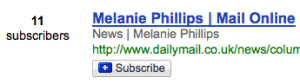
melanie-phillips-rssDaily Mail columnist Melanie Phillips has just 11 subscribers to her RSS feed (maybe there’s hope for the UK population yet …).

Despite having virtually no users, the Mail churns out 160 RSS feeds and the Mirror 280. All so a couple of thousand people can look at them in total.

The other papers are just as bad. And while the Guardian has a couple of RSS readers with decent numbers (partly because Google recommends it in its news bundle), it has more feeds than there are people in the UK … Continue reading

St Petersburg Times: cautiously embracing the web, assiduously reporting Scientology

Scientology has long been a tricky subject for journalists to cover; the corporate-structured religious movement has a reputation for litigation, against government agencies, news organisations and individuals.

Given this it is all the more interesting to consider the recent series of articles about Scientology in Florida’s St Petersburg Times, which focus on the behaviour of its leader David Miscavige and offer a counterpoint to the Church’s own line that “since the founding of the first Church of Scientology in 1954, Scientology has become the fastest-growing religion in the world.”

The Times presented the series as three large articles (totalling nearly 15,000 words, with the first article alone stacking up 6,618) published across print and web over three consecutive days, starting on Sunday 21st June. In addition the paper ran ancillary features which fleshed out elements of the main story, provided historical context, and also laid out some of the raw material which helped to underpin the series. Continue reading

Daily express website relaunching

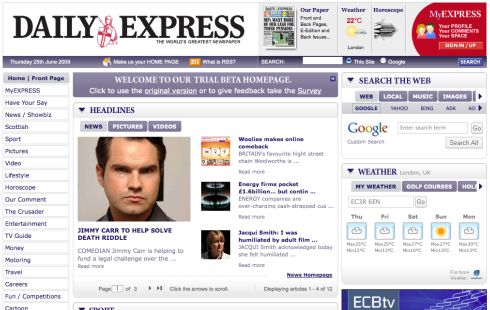
Express.co.uk is about to undergo a redesign (and there’s a good review of the new look, still currently in beta, at econsultancy).

To me, the new site isn’t that impressive (screenshot below, or you can compare the old front page or new front page) – it looks like a poor mashup of the BBC and Yahoo in the existing colour scheme.

Even worse, it’s not very accessible as there is literally no content on the new home page with javascript turned off.

The agency behind it is Netro42 who say here about the old version that “Netro42 working in partnership with Northern and Shell quickly established that the key to success was in wholly utilising the digital space.”

Personally, I like to partially use the analogue space when working on websites, but I may be old fashioned.

New Express homepage

New Express homepage

I wonder if the new design means they’ll update their site on a sunday? Or get some better suggested search terms?

Even “heavy newspaper readers” spend a quarter of their media time online

Some research from The Media Audit makes a pretty strong point about how quickly media consumers’ behaviour is changing:

“The Internet now represents 32.5% of the typical “media day” for all U.S. adults when compared to daily exposure to newspaper, radio, TV and outdoor advertising.

“Even those who are considered heavy newspaper readers spend about as much time online today as the typical U.S. adult. According to the report, heavy newspaper readers, those who spend more than an hour per day reading, currently spend 3.7 hours per day online. In 2006 the Internet represented only 18.4% of a heavy newspaper reader’s “media day,” but today it represents 28.4%.”

But there’s good news for some US newspapers who have made the most of their online presence to achieve an impressive reach “of 80% or more when the past 30-day website visitor figure is combined with the past month print readership figure.”

It will be interesting to see how paywall experiments might result in quite different reach stats for other newspapers in the coming months.

More at MediaPost.