Seven psychological complaints of bloggers and social media addicts

In my capacity as amateur psychotherapist to the blogerati, I have discovered a new raft of complaints as social media addicts adapt to the demands of new technologies and fluctuating social structures. The syndromes identified include:

Comment Guilt

Patients complain of an overwhelming regret that they are not commenting more on other people’s blogs, and ‘engaging with the online community’. Feelings of worthlessness and frustration. Continue reading

Something for the weekend #6: Mashups with Yahoo! Pipes

Pipes tutorialImage by Sid05 via Flickr

This weekend’s tool-to-play-with is Yahoo! Pipes. Chances are you’ve heard of Yahoo! Pipes (it’s been around for over a year and I’ve blogged about it before) but if you’ve not played with it yet, now is the time to have a go.

Pipes is essentially a mashup tool, particularly useful for doing things with RSS feeds. And at its basic levels it doesn’t require any knowledge of programming language. Continue reading

Recommending news

In his first post for the OJB Wilbert Baan looks at sorting news by systems

The website as we know it is breaking apart. Widgets, API’s and feeds take information to other places outside the domain. In a network culture we like to take our information with us. Your mobile phone, desktop, widgets, websites, digital television, everywhere. For the EN project I am thinking about how we can interact with news as an object. How can we take the article everywhere or use it to make new collections.

The article as a social object

For example on Flickr the picture is the social object. It connects you to your friends. You have a personal contact page where you see the pictures that are relevant to you. All of these photos are probably public information, but it is the selection based on your personal network that makes this page interesting for you. Continue reading

Online magazine Monkey goes social

Dennis’s online-only (and hugely successful) magazine Monkey is set to launch another website next Wednesday (at MonkeyMag.co.uk) with a focus on the social. It’s “for readers”, you see.

A press release says the website

“will be centred around the same type of great video found in Monkey, while also encouraging readers to interact with the site by posting their own ratings and exchanging comments on the clips. The website will also offer daily content not found in the mag, competitions and exclusive chances to vote for what you want to see featured in upcoming issues.” Continue reading

…and I was going to be on a panel with Chris “Long Tail” Anderson…

I was due to take part in the 9th Journalism Leaders Forum next Tuesday, but sadly have had to pull out. I’m especially gutted because Chris Anderson, editor of Wired magazine and author of “The Long Tail“, will be there via video link. Another time perhaps… Continue reading

Two places I’ll be in May and June

On the evening of Thursday May 29th I’ll be at ‘Power Your Business with Web 2.0’, on a discussion panel. That’s at the Technology Innovation Centre in Birmingham B4 7XG from 6pm till 10pm. Email creative.networks@tic.ac.uk or register online at www.creativenetworksonline.com

On Friday June 13th I’ll be in London at the Investigative Journalism Goes Global conference at Westminster University. The day will include the official launch of the second edition of the book Investigative Journalism, for which I’ve written a chapter on ‘Investigative Journalism and Blogs‘. I’ll be on a panel discussing “What is the point of investigative journalism in the online media world?”

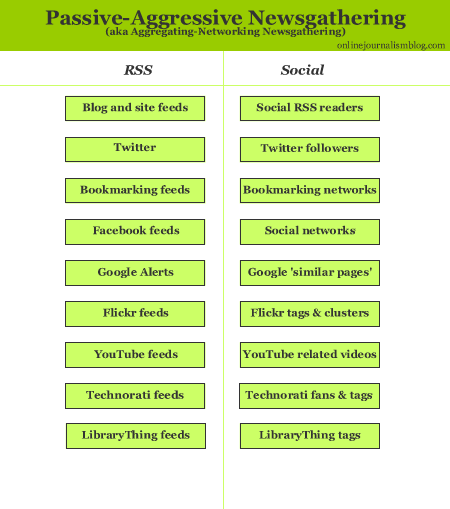
RSS + social media = “Passive-Aggressive Newsgathering” (A model for the 21st century newsroom part 2 addendum)

Passive aggressive newsgathering

Just when I thought I’d put the 21st century newsroom to bed, along comes a further brainwave about conceptualising newsgathering in an online environment (the area I covered in part 2: Distributed Journalism). It seems to me that the first stage for any journalist or budding journalist lies along two paths: subscribing to a reliable collection of RSS feeds (and email alerts); and exploring a collection of networks. The first part is passive; the latter, more active. So I’ve called it, tongue-in-cheek, “Passive-Aggressive Newsgathering”. But if that sounds too Woody Allen for you, you could call it “Aggregating-Networking Newsgathering”.

Not quite as catchy, though, is it? Continue reading