Tag Archives: economist

Words as data: how data journalists tell stories about documents and text

Documents and other collections of text can be goldmines for data journalism — if you know how to approach them as data. Here are some techniques and inspiration for your next data project.

From stories about political speech and song lyrics, to street names and social media chatter, data journalists now have a wide range of examples of text-as-data to draw inspiration and guidance from, while tools such as Pinpoint and NotebookLM are making text analysis easier than ever.

I compiled a list of over 200 pieces of data journalism where text or documents were used as sources. Quantification techniques ranged from counting the frequency of a single word and using Google’s ngram viewer, to machine learning and topic modelling.

Looking at those articles it’s clear that, once quantified, journalists tell the same stories about text as any other piece of data: using the seven most common angles.

But how those angles are used — and how often — is where it gets interesting…
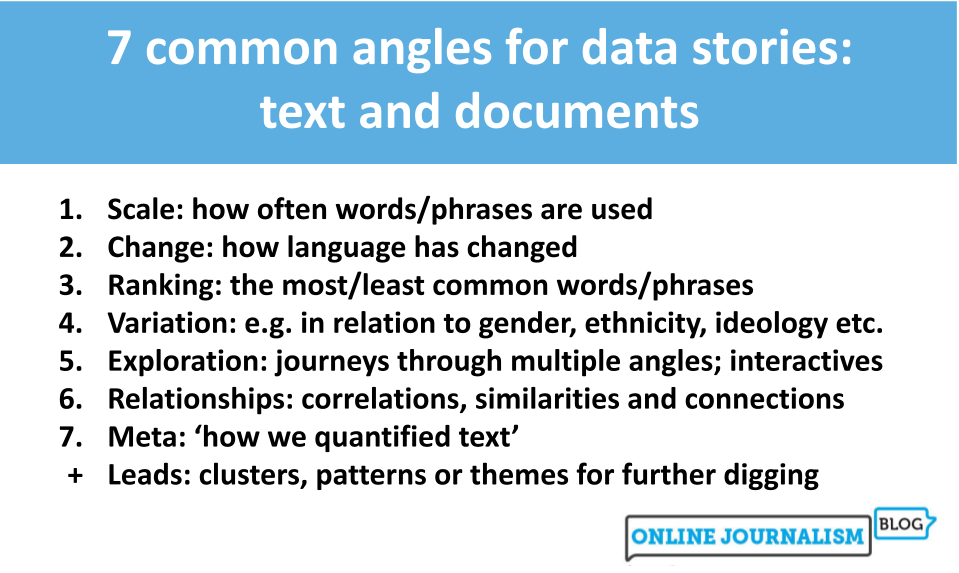
7 common angles for data stories: text and documents 
Scale: how often words/phrases are used
Change: how language has changed
Ranking: the most/least common words/phrases
Variation: e.g. in relation to gender, ethnicity, ideology etc.
Exploration: journeys through multiple angles; interactives
Relationships: correlations, similarities and connections
Meta: ‘how we quantified text’
Leads: clusters, patterns or themes for further digging
Continue reading

The visual challenges of big data: how The Economist turned Spotify data into a story about language

Early Visualisation from Off the Charts

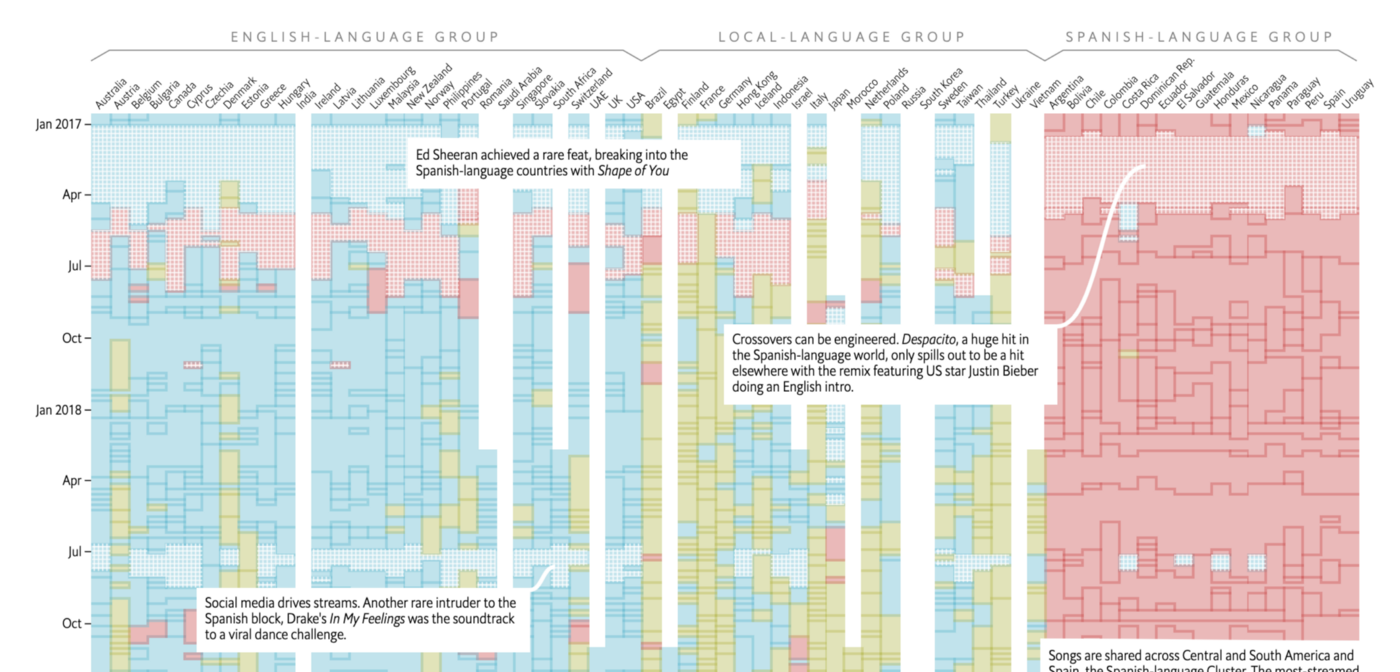
In an interview with Kirstin Bunce for OJB, interactive journalist Olivia Vane explains the production process behind ‘Singing in tongues. What Spotify data show about the decline of English.

Earlier this year The Economist team published an interactive analysis delving into 5 years of Spotify’s data in 70 countries. It was a large data project that started with a scraper — by data journalist Dolly Setton, who was interested in the role of language on the platform — but getting the data was just the beginning.

“I thought it was an interesting experience at the beginning, exploring and figuring out together what was the heart of the piece,” says Olivia. “We didn’t realise what the story was going to be until sort of midway through.”

Continue reading

17 takeaways on mobile publishing from Monetising Media 2015

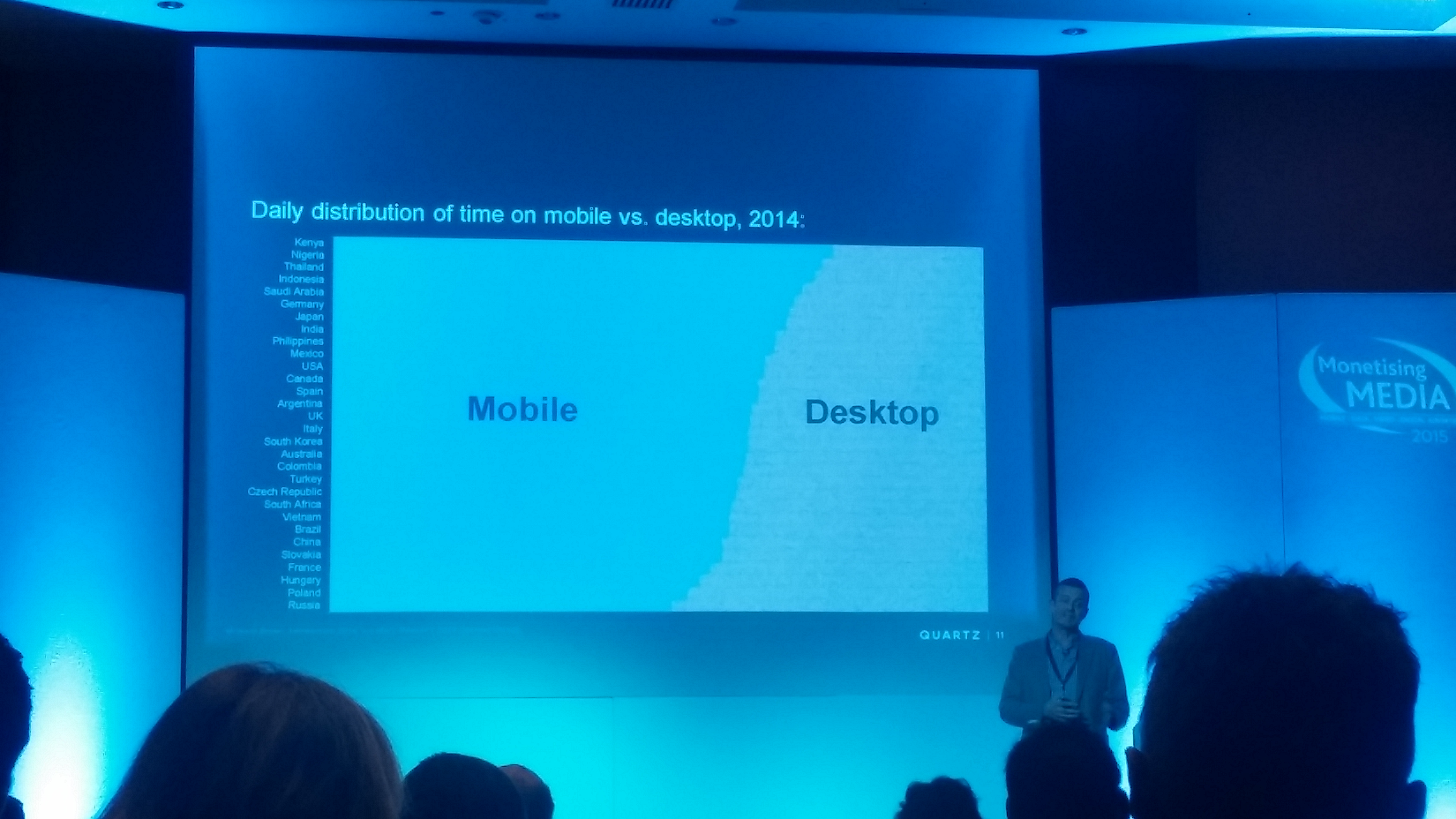
mobile desktop timeHow do you reach an audience which is consuming more content on mobile than desktop – and at different schedules to the traditional print model? At Monetising Media last week industry leaders shared their concerns and strategies for succeeding on mobile without losing quality and content. Maria Crosas Batista sums up some of the key takeaways:

Product rather than platform: Lee Wilkinson, Hearst Magazines International

Lee Wilkinson bets on product rather than platform:

“If your audience is the core of a product strategy you are more likely to engage and reach them when your content is out there.”

Continue reading

Charging for journalism – crowdfunder SA Mathieson’s experience

SA Mathieson Beacon page

If you assumed that the future of journalism would only be free (or at least advertiser-funded), says SA Mathieson, you’re wrong. In a guest post for OJB Mathieson – who recently successfully crowdfunded his own project to report on the Scottish referendum – explains why the web turns out to be capable of charging for access too.

The Columbia Review of Journalism recently reported that the Financial Times now has nearly twice as many digital subscribers as print ones, having added 99,000 online customers in 2013.

They pay significant amounts for access: the cheapest online subscription to the FT is £5.19 a week. A free registration process does allow access to 8 articles a month – but try to access a ninth and you have to pay.

The FT was earlier than most to charge online, but many publishers have followed suit. Only a few – such as The Times – lock up everything, but titles including the Telegraph, New York Times and Economist all use metering, allowing non-paying readers access to a limited number of articles before a subscription is required. They have been joined by increasing numbers of trade and local publications.

This isn’t just an option for established titles: as a freelance journalist I write for Beacon, a start-up used by more than 100 journalists in more than 30 countries to publish their reporting. It has “more than several thousand” subscribers after five months’ operation, co-founder Adrian Sanders told the New York Times recently.

Continue reading

UK General Election 2010 – Interactive Maps and Swingometers

Tony Hirst takes a look at how different news websites are using interactivity to present different possibilities in the UK election. This post is cross-posted from the OUseful.Info blog:

So it seems like the General Election has been a Good Thing for the news media’s interactive developer teams… Here’s a quick round up of some of the interactives I’ve found… Continue reading