The crowdsourcing site Bellingcat – whose posts were previously only visible to donors – is now completely open. Continue reading

The crowdsourcing site Bellingcat – whose posts were previously only visible to donors – is now completely open. Continue reading
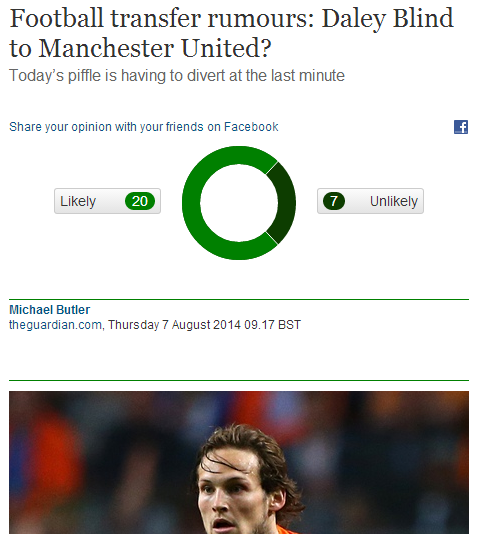
Nice work by The Guardian (above) in their online reporting on transfer rumours: readers of each report are presented with a vote on whether they think the rumour is likely to be true before they get to read the full article.
It’s a good example of putting interactivity – and distribution – front and centre when the headline has already done most of the editorial work. Continue reading

You could be forgiven for not having heard of John Henry Skillern. The 41 year old is facing charges of possession and promotion of child pornography after Google detected images of child abuse on his Gmail account.
Because of his case we now know that Google “proactively scours hundreds of millions of email accounts” for certain images. The technology has raised some privacy concerns which have been largely brushed aside because, well, it’s child pornography.
Sky’s technology correspondent Tom Cheshire, for example, doesn’t think it is an invasion of our privacy for “technical and moral reasons”. But should journalists be worried about the wider applications of the technology, and the precedent being set?

Not all hyperlocal sites cover everything that’s happening in the patch, some focus on specific subject areas. The latest in our series of Hyperlocal Voices sees Damian Radcliffe look at Coventry Culture. As the site celebrates its first anniversary this month, founder and editor Matthew Duffy tells him about his journey over the past 12 months. Continue reading
My post on threat models for journalists is quite lengthy, so I thought I’d put the sample threat models from that in their own, separate post. Here they are – note that these are very simple, sketchy threat models and you would want to expand on these. But hopefully they provide a starting point. I’d also recommend checking out this resource from Privacy for Journalists.
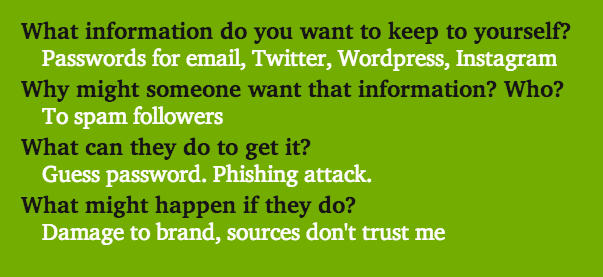
A basic threat model for anyone with access to a key social media account – or colleagues who do.
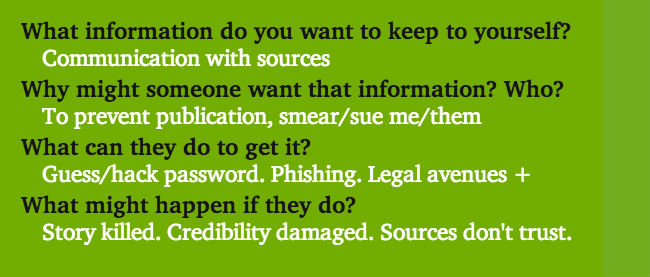
This is an example of a threat model for anyone who deals with protestors, complainants, or others who might be targets of others
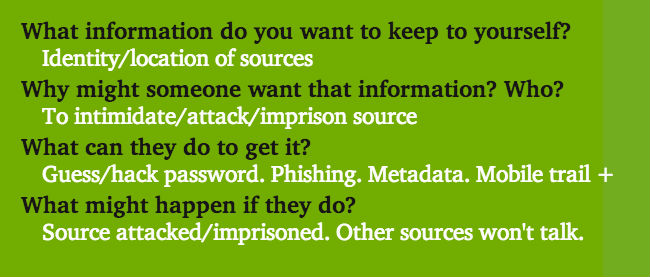
When dealing with whistleblowers, leaks, or sources in oppressive regimes, you need to protect identity and location. Here’s a sample threat model for that.
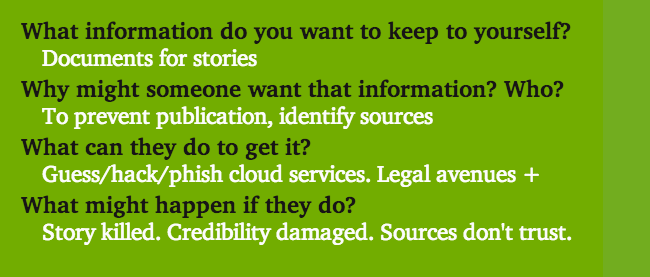
When working with documents, you may need to prevent others getting access to them. Here’s a sample threat model for that.
If you’re a journalist in the 21st century you have two choices: you can choose to be paranoid, or you can choose to be delusional.
The paranoid journalist assumes that someone is out to get them. The delusional journalist assumes that no one is.
In this post I will explain why and how every journalist – whether you’re a music reporter or a political correspondent – can take a serious and informed look at their security and arrive at a reasonable evaluation of risks and safeguards.
Don’t panic. I promise that by the end of this piece you will be less anxious about security, and no longer paranoid. I also promise to use lots of lolcats. Continue reading

Searches for ‘content marketing’ according to Google Trends. Since February the term has been at the peak of its popularity [Tweet this image]
As online marketing and search engine optimisation (SEO) practices have evolved, journalists have become increasingly sought-after by the agencies that compete to improve their clients’ rankings.
“For a long time there was a very poor practice in online marketing,” says Joe Sharp, Head of SEO at Hearst Magazines. “Generic advertorials were duplicated across multiple sites with strategic links engineered to increase SEO value. Continue reading
 Last week the number of people who have bought my ebook Scraping for Journalists passed the 1,000 mark. That is, to me, incredible. A thousand journalists interested enough in scraping to buy a book? What happened?
When I first began writing the book I imagined there might be perhaps 100 people in the world who would be interested in buying it. It was such a niche subject I didn’t even consider pitching it to my normal publishers.
Now it’s so mainstream that the 1000th ‘book’ was actually 12: purchased by a university which wanted multiple copies for its students to borrow – one of a number of such institutions to approach me to do so. Continue reading
SA Mathieson, who has previously written for OJB about crowdfunding journalism, was one of three speakers at an NUJ Oxford event on how to make digital journalism pay. In a guest post for OJB he sums up the key points.
It is perfectly realistic for journalists to make money out of digital journalism, but the problem comes from making a decent living.

Speaking first, Tim Dawson, vice-president of the National Union of Journalists and a long-time writer and editor for The Sunday Times, has literally written the book on this area: Help Yourself – new ways to make money from writing
He outlined some of the methods for raising money, which can be divided into three types: advertising-funded, marketing for other business and reader-funded. (More on his New Model Journalism site here.)
Yesterday Staffordshire County Council controversially published details of “The cost of “Freedom of Information” to local people“. The titling of that page gives some clue to its intent: FOI is a ‘cost’, and it’s you, local people, who pay.
But I think the list – despite its obvious agenda and related weaknesses – is actually rather brilliant.
Why? Because it shows just how flexible a tool FOI is, how widely it is used, and perhaps raises questions to be answered about why it has to be used in the first place.
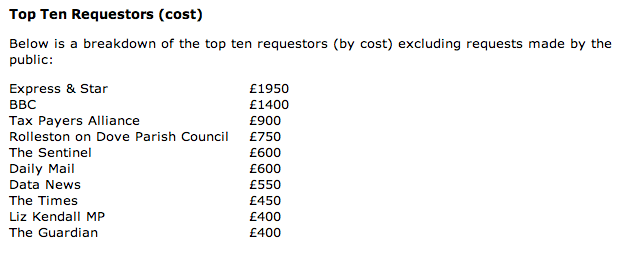
Staffordshire’s top 10 list of FOI requesters includes a parish council, elected MP and local and national media
The top ten requesters, for example, throws up not just news organisations but a politician, a parish council, and the right wing campaign group TaxPayers’ Alliance. Continue reading
 Online Journalism Blog