Finding Common Terms around a Twitter Hashtag

@aendrew sent me a link to a StackExchange question he’s just raised, in a tweet asking: “Anyone know how to find what terms surround a Twitter trend/hashtag?”

I’ve dabbled in this area before, though not addressing this question exactly, using Yahoo Pipes to find what hashtags are being used around a particular search term (Searching for Twitter Hashtags and Finding Hashtag Communities) or by members of a particular list (What’s Happening Now: Hashtags on Twitter Lists; that post also links to a pipe that identifies names of people tweeting around a particular search term.).

So what would we need a pipe to do that finds terms surrounding a twitter hashtag?

Firstly, we need to search on the tag to pull back a list of tweets containing that tag. Then we need to split the tweets into atomic elements (i.e. separate words). At this point, it might be useful to count how many times each one occurs, and display the most popular. We might also need to generate a “stop list” containing common words we aren’t really interested in (for example, the or and.

So here’s a quick hack at a pipe that does just that (Popular words round a hashtag).

For a start, I’m going to construct a string tokeniser that just searches for 100 tweets containing a particular search term, and then splits each tweet up in separate words, where words are things that are separated by white space. The pipe output is just a list of all the words from all the tweets that the search returned:

Twitter string tokeniser

You might notice the pipe also allows us to choose which page of results we want…

We can now use the helper pipe in another pipe. Firstly, let’s grab the words from a search that returns 200 tweets on the same search term. The helper pipe is called twice, once for the first page of results, once for the second page of results. The wordlists from each search query are then merged by the union block. The Rename block relabels the .content attribute as the .title attribute of each feed item.

Grab 200 tweets and check we have set the title element

The next thing we’re going to do is identify and count the unique words in the combined wordlist using the Unique block, and then sort the list accord to the number of times each word occurs.

Preliminary parsing of a wordlist

The above pipe fragment also filters the wordlist so that only words containing alphabetic characters are allowed through, as well as words with four or more characters. (The regular expression .{4,} reads: allow any string of four or more ({4,}) characters of any type (.). An expression .{5,7} would say – allow words through with length 5 to 7 characters.)

I’ve also added a short routine that implements a stop list. The regular expression pattern (?i)b(word1|word2|word3)b says: ignoring case ((?i)),try to match any of the words word1, word2, word3. (b denotes word boundary.) Note that in the filter below, some of the words in my stop list are redundant (the ones with three or fewer characters. Remember, we have already filtered the word list to show only words of length four or more characters.)

Stop list

I also added a user input that allows additional stop terms to be added (they should be pipe (|) separated, with no spaces between them). You can find the pipe here.

Strategies vs tools redux

Yesterday I chaired a panel on ‘UGC and Social Media’ at Birmingham’s Hello Culture event. Determined that it did not descend into the all-too-common obsession with tools that often characterises such discussions, I framed it from the start with the questions “Why should we care? Why should users care?”

The panellists were grateful – and the tactic seemed to work. We talked about the tension between creating content and building relationships; between the urge to ‘get people on our platform’ and going to their platforms instead. We discussed how the experience of designing physical spaces might inform how we approach designing digital ones; and about revisiting strategic priorities as a whole instead of simply trying to ‘find time’ to ‘do the online stuff’.

In other words we talked about people rather than technology, and strategies rather than tools.

So this morning it was good to be brought back down to earth and reminded just how embedded the technology-driven mindset is by Richard Millington.

Richard writes about a ‘State of Branded Online Communities’ report that uses Bravo TV as an example of a “successful” online community. The problem is that by any sensible measure, it isn’t. And I think Richard’s quotes on just how flawed the example is are worth reproducing here at length:

“If simply posting a standardized thread each week and leaving people to their own endeavours is seen as good community management practice, what exactly is bad community management? This is community management by autopilot.

“… You judge a community’s success by it’s stage in the life cycle, the number of interactions it generates, it’s members sense of community and the ROI it offers the organization. ComBlu defines success by what features the platform offers. By that assessment, nearly all of the most successful communities would be considered failures. [They struggle to get more than 10 members participating in a community at any one time.]

“ComBlu credits Bravo with an array of successes which have no impact on the community’s success. Only one suggestion is offered:

“[..] On our Bravo wish list? A better gamification or reputation management system.”

“There are a variety of things the community needs, a better gamification system certainly isn’t one of them.

“How about hiring a community manager to take responsibility for stimulating discussions […]?

“… Content sites branded as communities are still content sites.”

Ah, gamification: I’ll tip that to be next year’s QR code/Facebook page. How about an iPhone app? Everyone else is doing it so why shouldn’t we? Remember when everyone had to have a space in Second Life?

It’s a point I’ve made before in Technology is not a strategy: it’s a tool (and its follow-up), and which is explored at length in my Online Journalism book. Too often in an organisation or in a student project someone decides that they must launch a Facebook page or ‘be on Twitter’.

I recently compared this to someone approaching a TV producer, saying they wanted to make a documentary, and explaining that their strategy would be to “use a camera”.

No producer would accept that, and we need an equally critical attitude to the use of new technology. Otherwise we’re just hammers walking around seeing nails.

A case study in crowdsourcing investigative journalism part 7: Conclusions

In the final part of the research underpinning a new Help Me Investigate project I explore the qualities that successful crowdsourcing investigations shared. Previous parts are linked below:

Conclusions

Looking at the reasons that users of the site as a whole gave for not contributing to an investigation, the majority attributed this to ‘not having enough time’. Although at least one interviewee, in contrast, highlighted the simplicity and ease of contributing, it needs to be as easy and simple as possible for users to contribute (or appear to be) in order to lower the perception of effort and time needed.

Notably, the second biggest reason for not contributing was a ‘lack of personal connection with an investigation’, demonstrating the importance of the individual and social dimension of crowdsourcing. Likewise, a ‘personal interest in the issue’ was the single largest factor in someone contributing. A ‘Why should I contribute?’ feature on crowdsourcing projects may be worth considering.

Others mentioned the social dimension of crowdsourcing – the “sense of being involved in something together” – what Jenkins (2006, p244) would refer to as “consumption as a networked practice”, a motivation also identified by Yochai Benkler in his work on networks (2006). Looking at non-financial motivations behind people contributing their time to online projects, he refers to “socio-psychological reward”. He also identifies the importance of “hedonic personal gratification”. In other words, fun.

Although positive feedback formed part of the design of the site, no consideration was paid to negative feedback: users being made aware of when they were not succeeding. This element also appears to be absent from game mechanics in other crowdsourcing experiments such as The Guardian’s MPs’ expenses app.

While it is easy to talk about “Failure for free”, more could be done to identify and support failing investigations. A monthly update feature that would remind users of recent activity and – more importantly – the lack of activity might help here. The investigators in a group might be asked whether they wish to terminate the investigation in those cases, emphasising their responsibility for its progress and helping ‘clean up’ the investigations listed on the first page of the site.

However, there is also a danger in interfering too much in reducing failure. This is a natural instinct, and the establishment of a reasonable ‘success rate’ at the outset – based on the literature around crowdsourcing – helps to counter this. That was part of the design of Help Me Investigate: it was the 1-5% of questions that gained traction that would be the focus of the site. One analogy is a news conference where members throw out ideas – only a few are chosen for investment of time and energy, the rest ‘fail’.

It is the management of that tension between interfering to ensure everything succeeds (and so removing the incentive for users to be self-motivated) and not interfering at all (leaving users feeling unsupported and unmotivated) that is likely to be the key to a successful crowdsourcing project. More than a year into the project, this tension was still being negotiated.

In summing up the research into Help Me Investigate it is possible to identify five qualities which successful investigations shared: ‘Alpha users’ (highly active, who drove investigations forward); modularity (the ability to break down a large investigation into smaller discrete elements); public-ness (the ability for others to find out about an investigation); feedback (game mechanics and the pleasure of using the site); and diversity of users.

Relating these findings to other research into crowdsourcing more generally it is possible to make broader generalisations regarding how future projects might be best organised. Leadbeater (2008, p68), for example, identifies five key principles of successful collaborative projects, summed up as ‘Core’ (directly comparable to the need for alpha users identified in this research); ‘Contribute’ (large numbers, comparable to public-ness); ‘Connect’ (diversity); ‘Collaborate’ (self governance – relating indirectly to modularity); and ‘Create’ (creative pleasure – relating indirectly to feedback). Similar qualities are also identified by US investigative reporter and Knight fellow Wendy Norris in her experiments with crowdsourcing (Lavrusik, 2010).

The most notable connections here are the indirect ones. While the technology of Help Me Investigate allowed for modularity, for example, the community structure was rather flat. Leadbeater’s research (2008) and that of Lih (2009) into the development of Wikipedia and Tsui (2010, PDF) into Global Voices indicate that ‘modularity’ may be part of a wider need for ‘structure’. Conversely ‘feedback’ provides a specific, practical way for crowdsourcing projects to address users’ need for creative pleasure.

As Help Me Investigate reached its 18th month a number of changes were made to test these ideas: the code was released as open source, effectively crowdsourcing the technology itself, and a strategy was adopted to recruit niche community managers who could build expertise in particular fields, along with an advisory board that was similarly diverse. The Help Me Investigate design was replicated in a plugin which would allow anyone running a self-hosted WordPress blog to manage their own version of the site.

This separation of technology from community was a key learning outcome of the project. While the site had solved some of the technical challenges of crowdsourcing and identified the qualities of successful crowdsourced investigation, it was clear that the biggest challenge lay in connecting the increasingly networked communities that wanted to investigate public interest issues – and in a way that was both sustainable and scalable beyond the level of individual investigations.


References

  1. Arthur, Charles. Forecasting is a notoriously imprecise science – ask any meteorologist, January 29 2010, The Guardian, http://www.guardian.co.uk/technology/2010/jan/29/apple-ipad-crowdsource accessed 14/3/2011
  2. Beckett, Charlie (2008) SuperMedia, Oxford: Blackwell
  3. Belam, Martin. Whatever Paul Waugh thinks, The Guardian’s MPs Expenses crowd-sourcing experiment was no “total failure”, Currybetdotnet, March 10 2010 http://www.currybet.net/cbet_blog/2010/03/whatever-paul-waugh-thinks-the.php accessed 14/3/2011
  4. Belam, Martin. Abort? Retry? Fail? – Judging the success of the Guardian’s MP’s expenses app, Currybetdotnet, March 7 2011, http://www.currybet.net/cbet_blog/2011/03/guardian-mps-expenses-success.php accessed 14/3/2011
  5. Belam, Martin. The Guardian’s Paul Lewis on crowd-sourcing investigative journalism with Twitter, Currybetdotnet, March 10 2011, http://www.currybet.net/cbet_blog/2011/03/paul-lewis-investigative-journalism-twitter.php accessed 14/3/2011
  6. Benkler, Yochai (2006) The Wealth of Networks, New Haven: Yale University Press
  7. Bonomolo, Alessandra. Repubblica.it’s experiment with “Investigative reporting on demand”, Online Journalism Blog, March 21 2011, https://onlinejournalismblog.com/2011/03/21/repubblica-its-experiment-with-investigative-reporting-on-demand/ accessed 23/3/2011
  8. Bradshaw, Paul. Wiki Journalism: Are wikis the new blogs? Paper presented to The Future of Journalism conference, Cardiff University, September 2007, https://onlinejournalismblog.com/wp-content/uploads/2007/09/wiki_journalism.pdf
  9. Bradshaw, Paul. The Guardian’s tool to crowdsource MPs’ expenses data: time to play, Online Journalism Blog, June 19 2009 https://onlinejournalismblog.com/2009/06/19/the-guardian-build-a-platform-to-crowdsource-mps-expenses-data/ accessed 14/3/2011
  10. Brogan, C., & Smith, J. (2009). Trust Agents: Using the Web to Build Influence, Improve
  11. Reputation, and Earn Trust (1 ed.), New Jersey: Wiley
  12. Bruns, Axel (2005) Gatewatching, New York: Peter Lang
  13. Bruns, Axel (2008) Blogs, Wikipedia, Second Life and Beyond, New York: Peter Lang
  14. De Burgh, Hugo (2008) Investigative Journalism, London: Routledge
  15. Dondlinger, Mary Jo. Educational Video Game Design: A Review of the Literature, Journal of Applied Educational Technology Volume 4, Number 1, Spring/Summer 2007, http://www.eduquery.com/jaet/JAET4-1_Dondlinger.pdf
  16. Ellis, Justin. A perpetual motion machine for investigative reporting: CPI and PRI partner on state corruption project, Nieman Journalism Lab, March 8 2011 http://www.niemanlab.org/2011/03/a-perpetual-motion-machine-for-investigative-reporting-cpi-and-pri-partner-on-state-corruption-project/ accessed 21/3/2011
  17. Graham, John. Feedback in Game Design, Wolfire Blog, April 21 2010 http://blog.wolfire.com/2010/04/Feedback-In-Game-Design accessed 14/3/2011
  18. Grey, Stephen (2006) Ghost Plane, London: C Hurst & Co
  19. Hickman, Jon. Help Me Investigate: the social practices of investigative journalism, Paper presented to the Media Production Analysis Working Group, IAMCR, Braga, 2010, http://theplan.co.uk/help-me-investigate-the-social-practices-of-i
  20. Howe, Jeff. Gannett to Crowdsource News, Wired, November 3 2006, http://www.wired.com/software/webservices/news/2006/11/72067 accessed 14/3/2011
  21. Jenkins, Henry (2006) Convergence Culture, New York: New York University Press
  22. Lavrusik, Vadim. How Investigative Journalism Is Prospering in the Age of Social Media, Mashable, November 24 2010, http://mashable.com/2010/11/24/investigative-journalism-social-web/ accessed 14/3/2011
  23. Leadbeater (2008) We-Think, London: Profile Books
  24. Leigh, David. Help us solve the mystery of Blair’s money, The Guardian, December 1 2009, http://www.guardian.co.uk/politics/2009/dec/01/help-us-solve-blair-mystery accessed 14/3/2011
  25. Lih, Andrew (2009) The Wikipedia Revolution, London: Aurum Press
  26. Marshall, Sarah. Snow map developer creates ‘Cutsmap’ for Channel 4’s budget coverage, Journalism.co.uk, 22 March 2011, http://www.journalism.co.uk/news/snow-map-developer-creates-cutsmap-for-channel-4-s-budget-coverage/s2/a543335/ accessed 22/3/2011
  27. Morozov, Evgeny (2011) The Net Delusion, London: Allen Lane
  28. Nielsen, Jakob. Participation Inequality: Encouraging More Users to Contribute, Jakob Nielsen’s Alertbox, October 9, 2006, http://www.useit.com/alertbox/participation_inequality.html accessed 14/3/2011
  29. Paterson and Domingo (2008) Making Online News: The Ethnography of New Media Production, New York: Peter Lang
  30. Porter, Joshua (2008) Designing for the Social Web, Berkeley: New Riders
  31. Raymond, Eric S. (1999) The Cathedral and the Bazaar, New York: O’Reilly
  32. Scotney, Tom. Help Me Investigate: How working collaboratively can benefit journalists, Journalism.co.uk, August 14 2009, http://www.journalism.co.uk/news-features/help-me-investigate-how-working-collaboratively-can-benefit-journalists/s5/a535469/ accessed 21/3/2011
  33. Shirky, Clay (2008) Here Comes Everybody, London: Allen Lane
  34. Snyder, Chris. Spot.Us Launches Crowd-Funded Journalism Project, Wired, November 10, 2008, http://www.wired.com/epicenter/2008/11/spotus-launches/ accessed 21/3/2011
  35. Surowiecki, James (2005) The Wisdom of Crowds, London: Abacus
  36. Tapscott, Don & Williams, Anthony (2006) Wikinomics, London: Atlantic Books
  37. Tsui, Lokman. A Journalism of Hospitality, unpublished thesis, Presented to the Faculties of the University of Pennsylvania, 2010 http://dl.dropbox.com/u/22048/Tsui-Dissertation-Deposit-Final.pdf accessed 14/3/2011
  38. Weinberger, David (2002) Small Pieces, Loosely Joined, New York: Basic Books

What made the crowdsourcing successful? A case study in crowdsourcing investigative journalism part 6

In the penultimate part of the serialisation of research underpinning a new Help Me Investigate project I explore the qualities that successful crowdsourcing investigations shared. Previous parts are linked below:

What made the crowdsourcing successful?

Clearly, a distinction should be made between what made the investigation successful as a series of outcomes, and what made crowdsourcing successful as a method for investigative reporting. This section concerns itself with the latter.

What made the community gather, and continue to return? One hypothesis was that the nature of the investigation provided a natural cue to interested parties – The London Weekly was published on Fridays and Saturdays and there was a build up of expectation to see if a new issue would indeed appear.

The data, however, did not support this hypothesis. There was indeed a rhythm but it did not correlate to the date of publication. Wednesdays were the most popular day for people contributing to the investigation.

Upon further investigation a possible explanation was found: one of the investigation’s ‘alpha’ contributors – James Ball – had set himself a task to blog about the investigation every week. His blog posts appeared on a Wednesday.

That this turned out to be a significant factor in driving activity suggests one important lesson: talking publicly and regularly about the investigation’s progress is key to its activity and success.

This data was backed up from the interviews. One respondent mentioned the “weekly cue” explicitly. And Jon Hickman’s research also identified that investigation activity related to “events and interventions. Leadership, especially by staffers, and tasking appeared to be the main drivers of activity within the investigation.” (2010, p10)

He breaks down activity on the site into three ‘acts’, although their relationship to the success of the investigation is not explored further:

  • ‘Brainstorm’ (an initial flurry of activity, much of which is focused on scoping the investigation and recruiting)
  • ‘Consolidation’ (activity is driven by new information)
  • ‘Long tail’ (intermittent caretaker activity, such as supportive comments or occasional updates)

Networked utility

Hickman describes the site as a “centralised sub-network that suits a specific activity” (2010, p12). Importantly, this sub-network forms part of a larger ‘network of networks’ which involves spaces such as users’ blogs, Twitter, Facebook, email and other platforms and channels.

“And yet Help Me Investigate still provided a useful space for them to work within; investigators and staffers feel that the website facilitates investigation in a way that their other social media tools could not:

““It adds the structure and the knowledge base; the challenges, integration with ‘what do they know’ ability to pose questions allows groups to structure an investigation logically and facilitates collaboration.” (Interview with investigator)” (Hickman, 2010, p12)

In the London Weekly investigation the site also helped keep track of a number of discussions taking place around the web. Having been born from a discussion on Twitter, further conversations on Twitter resulted in further people signing up, along with comments threads and other online discussion. This fit the way the site was designed culturally – to be part of a network rather than asking people to do everything on-site.

The presence of ‘alpha’ users like James and Judith was crucial in driving activity on the site – a pattern observed in other successful investigations. They picked up the threads contributed by others and not only wove them together into a coherent narrative that allowed others to enter more easily, but also set the new challenges that provided ways for people to contribute. The fact that they brought with them a strong social network presence is probably also a factor – but one that needs further research.

The site had been designed to emphasise the role of the user in driving investigations. The agenda is not owned by a central publisher, but by the person posing the question – and therefore the responsibility is theirs as well. This cultural hurdle – towards acknowledging personal power and responsibility – may be the biggest one that the site has to address, and the offer of “failure for free” (Shirky, 2008), allowing users to learn what works and what doesn’t, may support that.

The fact that crowdsourcing worked well for the investigation is worth noting, as it could be broken down into separate parts and paths – most of which could be completed online: “Where does this claim come from?” “Can you find out about this person?” “What can you discover about this company?”. One person, for example, used Google Streetview to establish that the registered address of the company was a postbox. Other investigations that are less easily broken down may be less suitable for crowdsourcing – or require more effort to ensure success.

Momentum and direction

A regular supply of updates provided the investigation with momentum. The accumulation of discoveries provided valuable feedback to users, who then returned for more. In his book on Wikipedia, Andrew Lih (2009 p82) notes a similar pattern – ‘stigmergy’ – that is observed in the natural world: “The situation in which the product of previous work, rather than direct communication [induces and directs] additional labour”. An investigation without these ‘small pieces, loosely joined’ (Weinberger, 2002) might not suit crowdsourcing so well.

Hickman’s interviews with participants in the Birmingham council website investigation found a feeling of the investigation being communally owned and led:

“Certain members were good at driving the investigation forward, helping decide on what to do next, but it did not feel like anyone was in charge as such.”

“I’d say HMI had pivital role in keeping us together and focused but it felt owned by everyone.” (Hickman 2010, p10)

One problem, however, was that the number of diverging paths led to a range of potential avenues of enquiry. In the end, although the core questions were answered (was the publication a hoax and what were the bases for their claims) the investigation raised many more questions. These remained largely unanswered once the majority of users felt that their questions had been answered. As in a traditional investigation, there came a point at which those involved had to make a judgement whether they wished to invest any more time in it.

Finally, the investigation benefited from a diverse group of contributors who contributed specialist knowledge or access. Some physically visited stations where the newspaper was claiming distribution to see how many copies were being handed out. Others used advanced search techniques to track down details on the people involved and the claims being made, or to make contact with people who had had previous experiences with those behind the newspaper. The visibility of the investigation online also led to more than one ‘whistleblower’ approach providing inside information, which was not published on the site but resulted in new challenges being set.

The final part of this series outlines some conclusions to be taken from the project, and where it plans to go next.

Sentencing data update: Manchester Evening News make another splash

Since I wrote about the need for more data journalism around sentencing in August, the Manchester Evening News have been beavering away keeping track of riot sentencing data on their own patch with stories on the first 60 looters to be sentenced and the role of poverty. Last week the newspaper finally made a splash on the figures.

The collected data led to this front page story: Looters jailed straight after Manchester riots given terms 30 per cent longer than those punished later.

While another article builds up a detailed profile of the rioters with plenty of visualisation, and links to the raw data.

The MEN’s Paul Gallagher had previously told me in an email correspondence that they were expecting at least 250-300 cases to be going through the courts in total, making “enough to make a very interesting and useful dataset but not so many as to make it too big a job.

“This spreadsheet is being completed using information provided by our journalists in court. The MEN is committed to staffing every court hearing so we should be able to fill this over time. This is a trial project limited only to the riots, and I don’t know if we will do anything with other court data in future.”

At the time Paul was trying to set up a system that would see court reporters add information when they covered a case, a system that could be used to publish court data in future.

“One of the biggest problems I have found is that we can produce graphics quite easily for online using Google Fusion Tables and other tools but it is difficult to turn these into graphics that will work in print without getting a graphic designer to recreate the image.”

A couple months on Paul remarks that the project has required significant editorial resources:

“Around ten MEN journalists have either sat in court to take down details of one or more riot cases in the last three months, or have been involved in the data analysis.”

He also says the exercise has raised some questions about the use, and sharing, of court data.

“Although the names and home addresses of adult defendants are published in court reports in the media, it does not seem appropriate to include them in shared spreadsheets, or to plot them on street level maps.

“For that reason, I decided to remove the names and personal details when we plotted home addresses of defendants on a map of Greater Manchester to visualise the correlation between rioters and high levels of poverty and deprivation.

The Manchester Evening News have not decided if they will continue their data work on other non-riot-related court data, which Paul feels “begs the question why court data is not publicly available from official sources.”
“At the moment there is no other way of getting this information than to have a person sat in court at every hearing, jotting down the details in their notebook and then copying them into a spreadsheet.”

The data and visualisation was also used in last night’s Panorama: Inside The Riots. Disappointingly, the Panorama website and solitary blog post include no links to the MEN coverage or data, and the official Twitter account not only failed to link – it has failed to tweet at all in almost two weeks.

What are the characteristics of a crowdsourced investigation? A case study in crowdsourcing investigative journalism part 5

Continuing the serialisation of the research underpinning a new Help Me Investigate project, in this fifth part I explore the characteristics of crowdsourcing outlined in the literature. Previous parts are linked below:

What are the characteristics of a crowdsourced investigation?

Tapscott and Williams (2006, p269) explore a range of new models of collaboration facilitated by online networks across a range of industries. These include:

  • Peer producers creating “products made of bits – from operating systems to encyclopedias”
  • “Ideagoras … a global marketplace of ideas, innovations and uniquely qualified minds”
  • Prosumer – ‘professional consumer’ – communities which can produce value if given the right tools by companies
  • Collaborative science (“The New Alexandrians”)
  • Platforms for participation
  • “Global plant floors” – physical production lines split across countries
  • Wiki workplaces which cut across organisational hierarchies

Most of these innovations have not touched the news industry, and some – such as platforms for participation – are used in publishing, but rarely in news production itself (an exception here can be made for a few magazine communities, such as Reed Business Information’s Farmer’s Weekly).

Examples of explicitly crowdsourced journalism can be broadly classified into two types. The first – closest to the ‘Global plant floors’ described above – can be described as the ‘Mechanical Turk’ model (after the Amazon-owned web service that allows you to offer piecemeal payment for repetitive work). This approach tends to involve large numbers of individuals performing small, similar tasks. Examples from journalism would include The Guardian’s experiment with inviting users to classify MPs’ expenses in order to find possible stories, or the pet food bloggers inviting users to add details of affected pets to their database.

The second type – closest to the ‘peer producers’ model – can be described as the ‘Wisdom of Crowds’ approach (after James Surowiecki’s 2005 book of the same name). This approach tends to involve smaller numbers of users performing discrete tasks that rely on a particular expertise. It follows the creed of open source software development, often referred to as Linus’ Law, which states that: “Given enough eyeballs, all bugs are shallow” (Raymond, 1999). The Florida News Press example given above fits into this category, relying as it did on users with specific knowledge (such as engineering or accounting) or access. Another example – based explicitly on examples in Surowiecki’s book – is that of an experiment by The Guardian’s Charles Arthur to predict the specifications of Apple’s rumoured tablet (Arthur, 2010). Over 10,000 users voted on 13 questions, correctly predicting its name, screen size, colour, network and other specifications – but getting other specifications, such as its price, wrong.

Help Me Investigate fits into the ‘Wisdom of Crowds’ category: rather than requiring users to complete identical tasks, the technology splits investigations into different ‘challenges’. Users are invited to tag themselves so that it is easier to locate users with particular expertise (tagged ‘FOI’ or ‘lawyer’ for example) or in a particular location, and many investigations include a challenge to ‘invite an expert’ from a particular area that is not represented in the group of users.

Some elements of Tapscott and Williams’s list can also be related to Help Me Investigate’s processes: for example, the site itself was a ‘platform for participation’ which allowed users from different professions to collaborate without any organisational hierarchy. There was an ‘ideagora’ for suggesting ways of investigating, and the resulting stories were examples of peer production.

One of the first things the research analysed was whether the investigation data matched up to patterns observed elsewhere in crowdsourcing and online activity. An analysis of the number of actions by each user, for example, showed a clear ‘power law’ distribution, where a minority of users accounted for the majority of activity.

This power law, however, did not translate into a breakdown approaching the 90-9-1 ‘law of participation inequality’ observed by Jakob Nielsen (2006). Instead, the balance between those who made a couple of contributions (normally the 9% of the 90-9-1 split) and those who made none (the 90%) was roughly equal. This may have been because the design of the site meant it was not possible to ‘lurk’ without being a member of the site already, or being invited and signing up. Adding in data on those looking at the investigation page who were not members may shed further light on this.

In Jon Hickman’s ethnography of a different investigation (into the project to deliver a new website for Birmingham City Council) he found a similar pattern: of the 32 ‘investigators’, thirteen did nothing more than join the investigation. Others provided “occasional or one-off contributions”, and a few were “prolific” (Hickman, 2010, p10). Rather than being an indication of absence, however, Hickman notes the literature on lurking that suggests it provides an opportunity for informal learning. He identifies support for this in his interviews with lurkers on the site:

“One lurker was a key technical member of the BCC DIY collective: the narrative within Help Me Investigate suggested a low level of engagement with the process and yet this investigator was actually quite prominent in terms of their activism; the lurker was producing pragmatic outcomes and responses to the investigation, although he produced no research for the project. On a similar note, several of the BCC DIY activists were neither active nor lurking within Help Me Investigate. For example, one activist’s account of BCC DIY shows awareness of, and engagement with, the connection between the activist activity and the investigation, even though he is not an active member of the investigation within Help Me Investigate.” (Hickman, 2010, p17)

In the next part I explore what qualities made for successful crowdsourcing in the specific instance of Help Me Investigate.

Following the money: making networks visible with HTML5

Network analysis – the ability to map connections between people and organisations – is one branch of data journalism which has enormous potential. But it is also an area which has not yet been particularly well explored, partly because of the lack of simple tools with which to do it.

One recent example – AngelsOfTheRight.net – is particularly interesting, because of the way that it is experimenting with HTML5.

The site is attempting to map “relationships among institutions due to the exchange of large quantities of money between them as reported to IRS in a decade of Form 990 tax filings.”

But it’s also attempting to “push the limits” of using HTML5 to create network maps. As this blog post explains:

“This project was built using the NodeViz project […] which wraps up a bunch of the functionality needed to squeeze network ties out of a database, through Graphviz, and into a browser with features like zooming, panning, and full DOM and JavaScript interaction with the rest of the page content. This means that we can do fun things like have a tour to mode a viewer through the map, and have list views of related data alongside the map that will open and focus on related nodes when clicked. It is also supposed to degrade gracefully to just display a clickable image on non-SVG browsers like Internet Explorer 7 and 8.”

HTML5 offers some other interesting possibilities, such as improved search engine optimisation compared to a static image or Flash interactive, although I have no idea how much this project explores that (comments invited).

Also interesting is the discussion section of AngelsOfTheRight.net, which outlines some of the holes in the data, methodological flaws, and ways that the project could be improved:

“In this sort of survey, it is always hard to tell if organizations are missing because they really didn’t make contributions, or just because nobody had time to record the data from their financial statements into the database. Several sources mention the Adolph Coors Foundation as an important funder of the conservative agenda, yet they do not appear in this database. Why not?”

via Pete Warden

A case study in crowdsourcing investigative journalism (part 4): The London Weekly

Continuing the serialisation of the research underpinning a new Help Me Investigate project, in this fourth part I describe how one particular investigation took shape. Previous parts are linked below:

Case study: the London Weekly investigation

In early 2010 Andy Brightwell and I conducted some research into one particular successful investigation on the site. The objective was to identify what had made the investigation successful – and how (or if) those conditions might be replicated for other investigations both on the site and elsewhere online.

The investigation chosen for the case study was ‘What do you know about The London Weekly?’ – an investigation into a free newspaper that was, the owners claimed (part of the investigation was to establish if the claim was a hoax), about to launch in London.

The people behind The London Weekly had made a number of claims about planned circulation, staffing and investment which went unchallenged in specialist media. Journalists Martin Stabe, James Ball and Judith Townend, however, wanted to dig deeper. So, after an exchange on Twitter, Judith logged onto Help Me Investigate and started an investigation.

A month later members of the investigation (most of whom were non-journalists) had unearthed a wealth of detail about the people behind The London Weekly and the facts behind their claims. Some of the information was reported in MediaWeek and The Guardian podcast Media Talk; some formed the basis for posts on James Ball’s blog, Journalism.co.uk and the Online Journalism Blog. Some has, for legal reasons, remained unpublished.

Methodology

Andrew Brightwell conducted a number of semi-structured interviews with contributors to the investigation. The sample was randomly selected but representative of the mix of contributors, who were categorised as either ‘alpha’ contributors (over 6 contributions), ‘active’ (2-6 contributions) and ‘lurkers’ (whose only contribution was to join the investigation). These interviews formed the qualitative basis for the research.

Complementing this data was quantitative information about users of the site as a whole. This was taken from two user surveys – one conducted when the site was three months’ old and another at 12 months – and analysis of analytics taken from the investigation (such as numbers and types of actions, frequency, etc.)

In the next part I explore some of the characteristics of a crowdsourced investigation and how these relate to the wider literature around crowdsourcing in general.

Crowdsourcing investigative journalism: a case study (part 3)

Continuing the serialisation of the research underpinning a new Help Me Investigate project, in this third part I describe how the focus of the site was shaped by the interests of its users and staff, and how site functionality was changed to react to user needs. I also identify some areas where the site could have been further developed and improved. (Part 1 is available here; Part 2 is here)

Reflections on the proof of concept phase

By the end of the 12 week proof of concept phase the site had also completed a number of investigations that were not ‘headline-makers’ but fulfilled the objective of informing users: in particular ‘Why is a new bus company allowed on an existing route with same number, but higher prices?’; ‘What is the tracking process for petitions handed in to Birmingham City Council?’ and ‘The DVLA and misrepresented number plates’

The site had also unearthed some promising information that could provide the basis for more stories, such as Birmingham City Council receiving over £160,000 in payments for vehicle removals; and ‘Which councils in the UK (that use Civil Enforcement) make the most from parking tickets?’ (as a byproduct, this also unearthed how well different councils responded to Freedom of Information requests#)

A number of news organisations expressed an interest in working with the site, but practical contributions to the site took place largely at an individual rather than organisational level. Journalist Tom Scotney, who was involved in one of the investigations, commented: “Get it right and you’re becoming part of an investigative team that’s bigger, more diverse and more skilled than any newsroom could ever be” (Scotney, 2009, n.p.) – but it was becoming clear that most journalists were not culturally prepared – or had the time – to engage with the site unless there was a story ‘ready made’ for them to use. Once there were stories to be had, however, they contributed a valuable role in writing those stories up, obtaining official reactions, and spreading visibility.

After 12 weeks the site had around 275 users (whose backgrounds ranged from journalism and web development to locally active citizens) and 71 investigations, exceeding project targets. It is difficult to measure ‘success’ or ‘failure’ but at least eight investigations had resulted in coherent stories, representing a success rate of at least 11%: the target figure before launch had been 1-5%. That figure rose to around 21% if other promising investigations were included, and the sample included recently initiated investigations which were yet to get off the ground.

‘Success’ was an interesting metric which deserves further elaboration. In his reflection on The Guardian’s crowdsourcing experiment, for example, developer Martin Belam (2011a, n.p.) noted a tendency to evaluate success “not purely editorially, but with a technology mindset in terms of the ‘100% – Achievement unlocked!’ games mechanic.”. In other words, success might be measured in terms of degrees of ‘completion’ rather than results.

In contrast, the newspaper’s journalist Paul Lewis saw success in terms of something other than pure percentages: getting 27,000 people to look at expense claims was, he felt, a successful outcome, regardless of the percentage of claims that those represented. And BBC Special Reports Editor Bella Hurrell – who oversaw a similar but less ambitious crowdsourcing project on the same subject on the broadcaster’s website, felt that they had also succeeded in genuine ‘public service journalism’ in the process (personal interview).

A third measure of success is noted by Belam – that of implementation and iteration (being able to improve the service based on how it is used):

“It demonstrated that as a team our tech guys could, in the space of around a week, get an application deployed into the cloud but appear integrated into our site, using a technology stack that was not our regular infrastructure.

“Secondly, it showed that as a business we could bring people together from editorial, design, technology and QA to deliver a rapid turnaround project in a multi-disciplinary way, based on a topical news story.

“And thirdly, we learned from and improved upon it.“ (Belam, 2010, n.p.)

A percentage ‘success’ rate of Help Me Investigate, then, represents a similar, ‘game-oriented’ perspective on the site, and it is important to draw on other frameworks to measure its success.

For example, it was clear that the site did very well in producing raw material for ‘journalism’, but it was less successful in generating more general civic information such as how to find out who owned a piece of land. Returning to the ideas of Actor-Network Theory outlined above, the behaviour of two principal actors – and one investigation – had a particular influence on this, and how the site more generally developed over time. Site user Neil Houston was an early adopter of the site and one of its heaviest contributors. His interest in interrogating data helped shape the path of many of the site’s most active investigations, which in turn set the editorial ‘tone’ of the site. This attracted users with similar interests to Neil, but may have discouraged others who did not – further research would be needed to establish this.

Likewise, while Birmingham City Council staff contributed to the site in its earliest days, when the council became the subject of an investigation staff’s involvement was actively discouraged (personal interview with contributor). This left the site short of particular expertise in answering civic questions.

At least one user commented that the site was very ‘FOI [Freedom Of Information request]-heavy’ and risked excluding users interested in different types of investigations, or who saw Freedom of Information requests as too difficult for them. This could be traced directly to the appointment of Heather Brooke as the site’s support journalist. Heather is a leading Freedom of Information activist and user of FOI requests: this was an enormous strength in supporting relevant investigations but it should also be recognised how that served to set the editorial tone of the site.

This narrowing of tone was addressed by bringing in a second support journalist with a consumer background: Colin Meek. There was also a strategic shift in community management which involved actively involving users with other investigations. As more users came onto the site these broadened into consumer, property and legal areas.

However, a further ‘actor’ then came into play: the legal and insurance systems. Due to the end of proof of concept funding and the associated legal insurance the team had to close investigations unrelated to the public sector as they left the site most vulnerable legally.

A final example of Actor-Network Theory in action was a difference between the intentions of the site designers and its users. The founders wanted Help Me Investigate to be a place for consensus, not discussion, but it was quickly apparent users did not want to have to go elsewhere to have their discussions. Users needed to – and did – have conversations around the updates that they posted.

The initial challenge-and-result model (breaking investigations down into challenges with entry fields for the subsequent results, which were required to include a link to the source of their information) was therefore changed very early on to challenge-and-update: people could now update without a link, simply to make a point about a previous result, or to explain their efforts in failing to obtain a result.

One of the challenges least likely to be accepted by users was to ‘Write the story up’. It seemed that those who knew the investigation had no need to write it up: the story existed in their heads. Instead it was either site staff or professional journalists who would normally write up the results. Similarly, when an investigation was complete, it required site staff to update the investigation description to include a link to any write-up. There was no evidence of a desire from users to ‘be a journalist’. Indeed, the overriding objective appeared rather to ‘be a citizen’.

In contrast, a challenge to write ‘the story so far’ seemed more appealing in investigations that had gathered data but no resolution as yet. The site founders underestimated the need for narrative in designing a site that allowed users to join investigations while they were in progress.

As was to be expected with a ‘proof of concept’ site (one testing whether an idea could work), there were a number of areas of frustration in the limitations of the site – and identification of areas of opportunity. When looking to crowdfund small amounts for an investigation, for example, there were no third party tools available that would allow this without going through a nonprofit organisation. And when an investigation involved a large crowdsourcing operation the connection to activity conducted on other platforms needed to be stronger so users could more easily see what needed doing (e.g. a live feed of changes to a Google spreadsheet, or documents bookmarked using Delicious).

Finally investigations often evolved into new questions but had to stay with an old title or risk losing the team and resources that had been built up. The option to ‘export’ an investigation team and resources into a fresh question/investigation was one possible future solution.

‘Failure for free’ was part of the design of the site in order to allow investigations to succeed on the efforts of its members rather than as a result of any top-down editorial agenda – although naturally journalist users would concentrate their efforts on the most newsworthy investigations. In practice it was hard to ‘let failure happen’, especially when almost all investigations had some public interest value.

Although the failure itself was not an issue (and indeed the failure rate lower than expected), a ‘safety net’ was needed that would more proactively suggest ways investigators could make their investigation a success, including features such as investigation ‘mentors’ who could pass on their experience; ‘expiry dates’ on challenges with reminders; improved ability to find other investigators with relevant skills or experience; a ‘sandbox’ investigation for new users to find their feet; and developing a metric to identify successful and failing investigations.

Communication was central to successful investigations and two areas required more attention: staff time in pursuing communication with users; and technical infrastructure to automate and facilitate communication (such as alerts to new updates or the ability to mail all investigation members)

The much-feared legal issues threatened by the site did not particularly materialise. Out of over 70 investigations in the first 12 weeks, only four needed rephrasing to avoid being potentially libellous. Two involved minor tweaks; the other two were more significant, partly because of a related need for clarity in the question.

Individual updates within investigations, which were post-moderated, presented even less of a legal problem. Only two updates were referred for legal advice, and only one of those rephrased. One was flagged and removed because it was ‘flamey’ and did not contribute to the investigation.

There was a lack of involvement by users across investigations. Users tended to stick to their own investigation and the idea of ‘helping another so they help you’ did not take root. Further research is needed to see if there was a power law distribution at work here – often seen on the internet – of a few people being involved in lots of investigations, most being involved in one, and a steep upward curve between.

In the next part I look at one particular investigation in an attempt to identify the qualities that made it successful.

If you want to get involved in the latest Help Me Investigate project, get in touch on paul@helpmeinvestigate.com

Getting Started With Twitter Analysis in R

Earlier today, I saw a post vis the aggregating R-Bloggers service a post on Using Text Mining to Find Out What @RDataMining Tweets are About. The post provides a walktrhough of how to grab tweets into an R session using the twitteR library, and then do some text mining on it.

I’ve been meaning to have a look at pulling Twitter bits into R for some time, so I couldn’t but have a quick play…

Starting from @RDataMiner’s lead, here’s what I did… (Notes: I use R in an R-Studio context. If you follow through the example and a library appears to be missing, from the Packages tab search for the missing library and import it, then try to reload the library in the script. The # denotes a commented out line.)

require(twitteR)
#The original example used the twitteR library to pull in a user stream
#rdmTweets <- userTimeline("psychemedia", n=100)
#Instead, I'm going to pull in a search around a hashtag.
rdmTweets <- searchTwitter('#mozfest', n=500)
# Note that the Twitter search API only goes back 1500 tweets (I think?)

#Create a dataframe based around the results
df <- do.call("rbind", lapply(rdmTweets, as.data.frame))
#Here are the columns
names(df)
#And some example content
head(df,3)

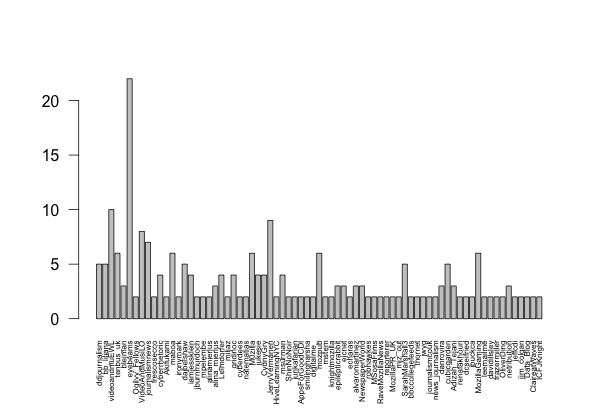
So what can we do out of the can? One thing is look to see who was tweeting most in the sample we collected:

counts=table(df$screenName)
barplot(counts)

# Let's do something hacky:
# Limit the data set to show only folk who tweeted twice or more in the sample
cc=subset(counts,counts>1)
barplot(cc,las=2,cex.names =0.3)

Now let’s have a go at parsing some tweets, pulling out the names of folk who have been retweeted or who have had a tweet sent to them:

#Whilst tinkering, I came across some errors that seemed
# to be caused by unusual character sets
#Here's a hacky defence that seemed to work...
df$text=sapply(df$text,function(row) iconv(row,to='UTF-8'))

#A helper function to remove @ symbols from user names...
trim <- function (x) sub('@','',x)

#A couple of tweet parsing functions that add columns to the dataframe
#We'll be needing this, I think?
library(stringr)
#Pull out who a message is to
df$to=sapply(df$text,function(tweet) str_extract(tweet,"^(@[[:alnum:]_]*)"))
df$to=sapply(df$to,function(name) trim(name))

#And here's a way of grabbing who's been RT'd
df$rt=sapply(df$text,function(tweet) trim(str_match(tweet,"^RT (@[[:alnum:]_]*)")[2]))

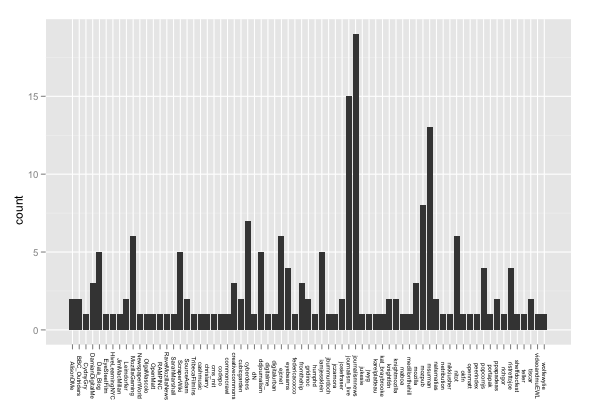
So for example, now we can plot a chart showing how often a particular person was RT’d in our sample. Let’s use ggplot2 this time…

require(ggplot2)
ggplot()+geom_bar(aes(x=na.omit(df$rt)))+opts(axis.text.x=theme_text(angle=-90,size=6))+xlab(NULL)

Okay – enough for now… if you’re tempted to have a play yourself, please post any other avenues you explored with in a comment, or in your own post with a link in my comments;-)