Tag Archives: facebook

BASIC principles of online journalism: A is for Adaptability

In the second part of this five-part series, I explore how adaptability has not only become a key quality for the journalist – but for the information they deal with on a daily basis too. This will form part of a forthcoming book on online journalism – comments very much invited.

The adaptable journalist

A key skill for any journalist in the new media age, whatever medium they’re working in, is adaptability. The age of the journalist who only writes text, or who only records video, or audio, is passing. Today, the newspaper and magazine, the television and the radio programme all have an accompanying website. And that website is, increasingly, filled with a whole range of media, which could include any of the following:

  • (Hyper)Text
  • Audio
  • Video
  • Still images
  • Audio slideshows
  • Animation
  • Flash interactivity
  • Database-driven elements
  • Blogs
  • Microblogging/Text/email alerts (Twitter)
  • Community elements – forums, wikis, social networking, polls, surveys
  • Live chats
  • Mapping
  • Mashups

This does not mean that the online journalist has to be an expert in all of these fields, but they should have media literacy in as many of these fields as possible: in other words, a good online journalist should be able to see a story and think:

  • ‘That story would have real impact on video’;
  • or: ‘A Flash interactive could explain this better than anything else’;
  • or ‘This story would benefit from me linking to the original reports and some blog commentary’;
  • or ‘Involving the community in this story would really engage, and hopefully bring out some great leads’. Continue reading

Introducing journalists to Twitter – what I’d do differently

On Friday I wrote about my frustrations with teaching student journalists to Twitter – which generated some very helpful debate. Having dwelt on my experiences I’ve come up with the following idea for integrating Twitter into newsrooms:

Make it an internal tool first.

What I mean is: employ Twitter as a way of keeping journalists in touch with other members of their team, and their editors, via their mobile phones.

Here’s how it would work: Continue reading

Five W’s and a H that should come *after* every story (A model for the 21st century newsroom: pt3)

So far this model has looked at sourcing stories in the new media age, and reporting a news story in the new media age. In this third part I look at what should happen after a news story has been reported, using a familiar framework: the 5 Ws and a H – who, what, where, why, when and how.

Five W’s and a H that should come *after* every story

A web page – unlike a newspaper, magazine or broadcast – is never finished – or at least, can always be updated. Its permanence is central to its power, and relates directly to its connectivity (and therefore visibility).

Once out there it can be linked to, commented on, discussed, dissected, tagged, bookmarked and sent to a friend. That can take place on the original news site, but it probably doesn’t. The story is no longer yours. So once the news site has added comments, a message board, ’email to a friend’ boxes and ‘bookmark this’ buttons, what more can it do? Continue reading

Washington Post Facebook app – the sequel

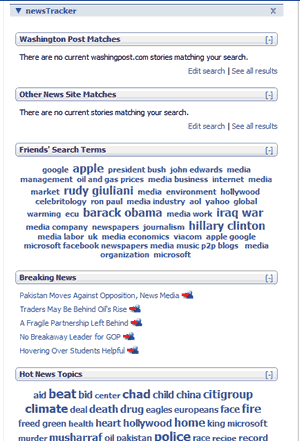
Washington Post Facebook appThe Washington Post have followed up their playful Facebook app Compass with the more functional newsTracker – and it’s very good indeed.

Not only can you specify which topics you want ‘fed’ to your page – but you can also include custom searches (which is why mine has no current matches – they’re very specific).

The ‘Hot News’ tag cloud is nice – but the ‘Friends’ Search Terms’ really takes advantage of the social element of Facebook technology – although it does raise possible privacy issues (Blog Friends does a similar thing very well).

Add the application here.

Read Rob Curley’s blog entry on the tool here.

A model for the 21st century newsroom pt2: Distributed Journalism

In the first part of my model for the 21st century newsroom I looked at how a story might move through a number of stages from initial alert through to customisation. In part two I want to look at sourcing stories, and the role of journalism in a new media world.

The last century has seen three important changes for the news industry. It has moved… Continue reading

How to be a journalism student

A colleague of mine once wrote a hugely entertaining blog post entitled ‘How to go to uni‘. As the new term begins, here’s my supplement: How to be a journalism student. (Note: there is now a wiki if you want to add extra tips/corrections/clarifications). 


  1. Read the news. Amazingly, some journalism students don’t read newspapers. I don’t know why they want to write news, but chances are they won’t if they don’t read it. And yes, that means newspapers, in print or online. For the most part newspapers dictate the news agenda that broadcast news and magazines then follow. But yes, watch television news and listen to radio news as well, and read magazines. And do all of this often, and do it critically. Continue reading

A Brazilian online journalism student writes… (Q&A)

Brazilian online journalism student Gabriela Zago has emailed me a number of questions about wikis and OJ. Here are my responses (the links are mine):

Q. How did you came up with the idea of writing an article about wiki journalism in a wiki format? Has the text received any more changes and contributions after the version presented at the Future of Newspapers Conference [PDF]?

A: Last year Shane Richmond wrote a post on his blog in reaction to another post by Bambi Francisco. I wrote a post asking ‘are wikis the new blogs’ which was then written up into an article for Press Gazette. When the conference called for papers I thought it would be an interesting issue to explore further. I suppose this is an example of iterative journalism in action. Posting it as a wiki was an obvious way to experiment with the format (I also created a Wikipedia entry for ‘wiki journalism’). Neither have had any changes since the conference. Continue reading

Heathrow protests see more mobile/social media reporting

Press Gazette reports on a Sky reporter using “mobile and social media tools” to cover the Heathrow protest:

“In an experiment in applying consumer-level social media tools to newsgathering, Teddler used his Blackberry to send 140-character text-message updates to the microblogging site Twitter and emailed pictures taken using the phone’s camera to the photo-sharing site Flickr.”

The experiment seems to be part of a growing trend among news organisations away from relying on in-house systems, and using freely available tools like Twitter (Guardian, etc.), Google Maps (BBC Berkshire), Facebook (Mail & Guardian, Sky), YouTube (The Mirror, BBC’s Ben Hammersley, etc.) and even WordPress (various local paper blogs). As Julian March,Sky.com’s editor, says: “The attraction is that a reporter can update his story or his page directly from his mobile phone without having to go through the CMS or someone who has access to the CMS back at base.”

It’s also part of the new “iterative” journalism – a journalism that is always “work in progress”, that conversation-not-lecture that Dan Gillmor identified. Seems those ideas are finally taking shape.

Facebook journalism: experiment #2: setting the agenda

Many thanks to those who contributed to the first Facebook journalism experiment, which has proved pretty successful in providing a range of useful sources for online journalism news (both for myself and members of the group). The discussion forum is still open for ongoing contributions.

Now I want to do something which news organisations resist more than anything: turn over the agenda of this blog to you. What areas of online journalism are you most interested in? And are there any particular stories you want more coverage/analysis of? Post your responses here.

I will then try to respond to the results in my coverage…

Note: I could have set up a poll for this, which Facebook charges 25 cents per response for (you can set a maximum number of responses), although this would have been to all Facebook members, I’m guessing. Maybe another time.

Note 2: Or there’s the “Surveys, Petitions, Votes, Polls & Questionnaires” Facebook application to create and respond to surveys, votes & petitions on Facebook…  http://apps.facebook.com/questionnaires/