I’m currently in the middle of a 3-week break from computers – in the meantime, here’s an article I wrote for Press Gazette the week before last, about the past year’s raft of newspaper website relaunches:
The last Luddite has left the building. With almost every national newspaper having revamped its website in the past twelve months, Richard Desmond has finally joined the club and relaunched Express.co.uk – and the Daily Star site is set to follow later in the year.
In an industry of technophobes, Desmond was the Piltdown Man of news. Before last week Express Newspapers’ only attempt to tackle the threat of the internet was to offer an ‘e-Edition’ of the Express and Star which amounted to little more than a PDF with animated pages.
But as his competitors launched MySpace-inspired sections and video-heavy offerings – and even resorted to lime green in their attempts to appear up-to-date – something had to give.
Still, it’s something of a watershed moment that sees Express journalists moving to a 24-hour reporting cycle, plans being made for online video and podcasts, and even web 2.0 elements such as blogging and social networking.
In reality, the new site looks like it was created by someone who has had a website described to him, but never actually seen one. The ‘blogs’ are actually opinion columns with nary a link to be seen, video is being outsourced, and online journalists will work separately from print hacks.
But it’s the move into social networking with ‘MYExpress’ that represents a quantum leap for this most reluctant of online newspapers. The service, which allows readers to create a personalised homepage, blog, and communicate with other users, has the potential to create a community of Disgusteds from Tunbridge Wells that may well represent the group’s cash cow.
So how did Richard Desmond – the man who sold the Express websites for £1 in November 2000 – come to join the rush online? And why the recent rush by national newspapers generally to give their sites a makeover?
Desmond can blame his rival Rupert Murdoch. It was he who, in 2005, warned the American Society of Newspaper Editors that unless his industry woke up to the changes brought about by new media they would be “relegated to the status of also-rans.”
Murdoch had sneezed, and the whole news industry began to catch a web fever.
The Times and Telegraph websites, which weren’t even in the top ten online news destinations, have since been overhauled and are making significant ground on leader The Guardian. Tabloids began to see that there was more to the web than monetising page 3 girls. And the middle market just worried about internet chatrooms.
Murdoch wasted no time in buying up promising web properties including, most spectacularly, MySpace, a property which was then cloned on The Sun’s ‘MYSun’ feature.
The Sun’s transformation has been most surprising of all – the reactionary paper has proved technologically progressive as the paper embraced video and virals, slideshows and podcasts, created blogs that actually understood the medium, and built a ‘Lite’ version of the paper for time-starved visitors. Perhaps most tellingly, the paper realised the web presented a window into the regional classifieds market. Oh, and we mustn’t forget the legendary video version of Dear Deirdre.
The Mirror, once again, has been left playing catch up. Its February redesign was ripped apart by many observers for a range of misjudged decisions ranging from buying in video content from the US (coverage of American Idol, anyone?) to the use of capital letters on the home page. The site has five sections – news, sport, showbiz, blogs, and… ‘more’ – a vagueness which perhaps gives some indication of a lack of direction behind the scenes.
Video has been a recurring theme throughout all newspaper website relaunches as ad sales departments realised they could tap into the television advertising market. The Mail has been no exception with its ‘showbiz video’ section, while a number of newspapers have bought in content from the likes of ITN and Reuters. And the ability to encroach on broadcasters’ territory without that pesky Ofcom to worry about has proved particularly useful for tabloid exclusives such as The Sun’s ‘friendly fire’ video and a range of NOTW stings.
The three major broadsheet websites have led the way in the use of blogs and podcasts, video and galleries. The Telegraph’s relaunch focused on the systems behind the site, building a multimedia ‘hub’ and training journalists to work across print and online, video and audio. But The Times’ makeover resulted in an all-singing site that belied its staid reputation and currently looks the most modern of national newspaper sites. The Independent plans a low-key revamp this year but for the most part has sat and watched from the sidelines like a kid waiting to be asked to join in the football game.
So where do the sites go from here? Last year The Guardian’s commentisfree raised the bar for newspaper blogs, while its Flash interactives remain a unique demonstration of the possibilities of new media. But a wholesale revamp is likely to be part of editor Alan Rusbridger’s planned £15m investment, while the move into television production with Guardian Films demonstrates that the group have ambitions beyond getting reporters to read out the day’s headlines: it has already brought dividends with a series of slots on prime time ITV News.
The Sun continues to innovate in the tabloid market, and the launch of a mobile edition suggests they understand the next big challenge for newspapers: if Desmond thought his work was done with new media, he’d better think again: the battleground is moving on.

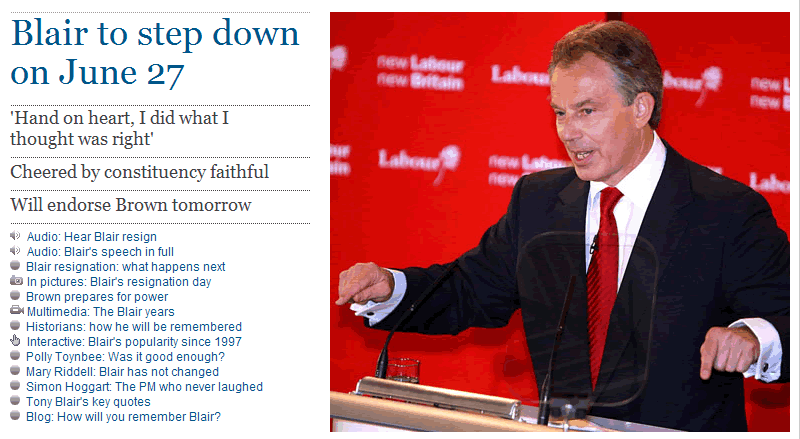 The Guardian’s new site has gotten off to a great start, with impressive coverage of the Blair resignation. Alongside the main story is lengthy promotion of audio, galleries, video, interactive and analysis. The depth of treatment backs up Mark Porter’s point that the new design “allows us to respond dynamically to events, by varying the layout as the news agenda develops.”
 The Telegraph’s treatment is much smaller, giving the impression of less depth…
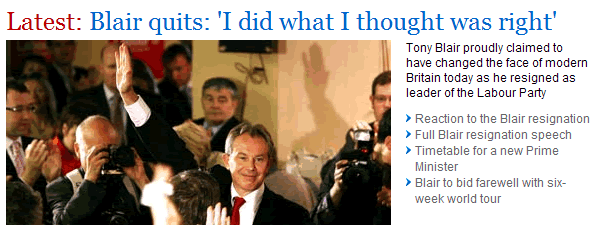 …and The Times is pretty similar. The tabloids’ treatment is even smaller, although their editorial agenda is obviously different.
 Sky is worth a look, though- their new design gives the capability to add a story to the main navigation – so ‘The Blair Years’ becomes an option alongside ‘Sport’. This is a screengrab of the Blair Years page, not the homepage.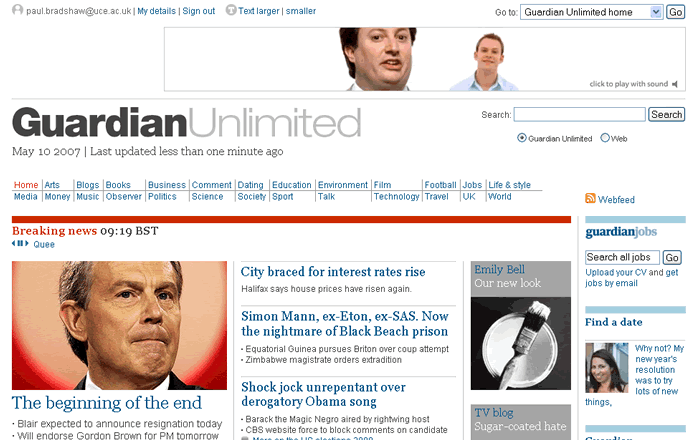
 Online Journalism Blog