Tag Archives: online video

Speech to Trinity Mirror Midlands

I’ve been at it again. Last night I presented a speech to editors and ad directors at Trinity Mirror Midlands (Birmingham Mail and Post, Coventry Telegraph, Sunday Mercury and various weeklies throughout the region). Given that they’d been exploring digital ideas all day I tried to keep it light to begin with – so the linked Powerpoint below begins with a mock awards, with the more hard hitting stuff coming after.

The hard-hitting stuff consists of lots of pithy phrases – the headlines were:

  • It’s no longer about content, it’s about services
  • It’s no longer about publishing, it’s about communication

I talked about how the news industry is having to shift from a 19th century production-based system to a 21st century service-based industry, and how online advertising alone is not going to plug the gap left by dropping print revenues (a number of new business models are covered that may provide other sources of revenue).

And I tackled this common phrase that the newspaper is now ‘one of many channels’. I think that’s still a ‘broadcaster’ mindset, and that instead we should think of print as ‘one way of helping people communicate’.

And I revisited some of the elements from my Vienna speech about the strengths that journalism needs to play to: investigative journalism, database-driven journalism, interactive journalism, and multimedia journalism; and reader-driven forms such as wikis and crowdsourcing.

Here’s the PowerPoint. Comments welcome.
Speech to Trinity Mirror Midlands

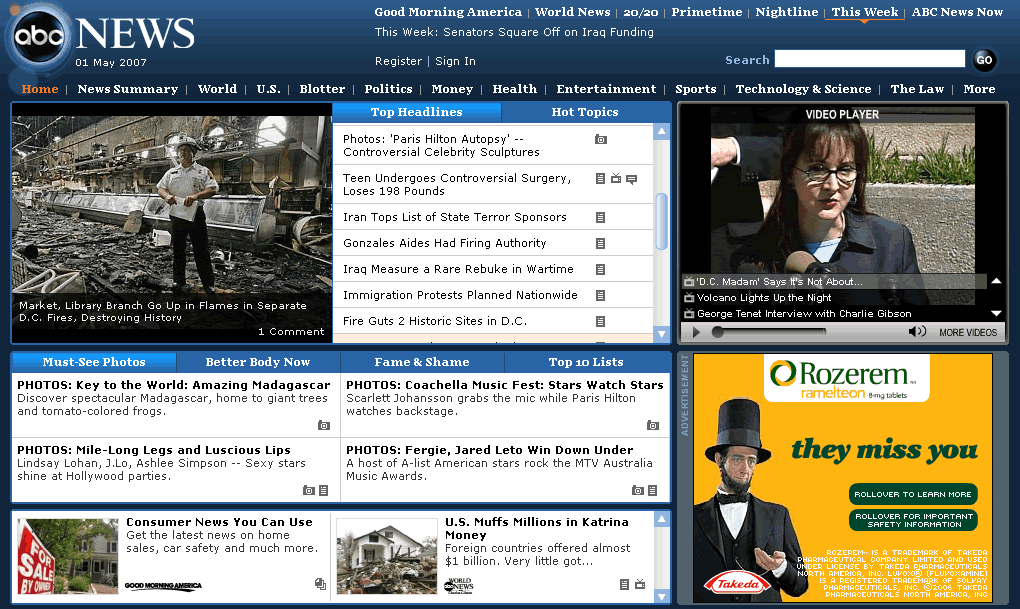
ABCNews.com relaunches with citizen journalism

ABC News May 1 07Another day, another relaunch. Micro Persuasion reports on the ABCNews.com relaunch:

According to Michael Clemente, Senior Executive Producer, the new site, which it launched last night, is designed to harness the power of what they call “citizen reporters.” Viewers and readers can now help ABC help report the news by feeding in news and leaving comments. The new site also supports video uploads from cell phones and video cameras, some of which will make it on to air.”

It’s pretty snazzy looking, if a little overloaded with navigation. The option to click on a story or photos or video or even ‘full coverage’ is a nice touch, but it’s a missed opportunity for the most part when compared to other relaunches.

The video journalist’s next purchase

Flip VideoThe New York Post reports on a clever (and relatively inexpensive) device which allows videographers to film, edit and upload material without spending large amounts of time on a computer:

“The little spy-corder device, named Flip Video, is being billed as the first camcorder to upload directly to sites such as YouTube and Grouper – eliminating the step of putting video on a computer to edit before uploading.”

At $119 and $149 it’s clearly aimed at the consumer market, but the instant publishing element makes it an appealing buy for journalists, although it seems you still need to go onto a computer to ‘instantly’ upload to the web.

Here’s the press release.

Video tips from award-winning videographers

The joys of pingback have led me to the News Videographer blog – and just in time for my lesson this afternoon in Flash video galleries: Video tips from award-winning videographers, summarised from NewsLab. My favourite tip:

Don’t stop the action for the interview. “Go with the flow,” Tim says. “Try to ‘interview’ your subject while they’re doing what makes them comfortable, or doing what your story is really about.””

Marie Claire podcast raises product placement ethics

Women’s Wear Daily (not my usual breakfast reading matter) has raised the issue of magazine podcasting ethics separating advertising and editorial after Marie Claire’s Unilever-sponsored “The Masthead With Marie Claire” podcast featured repeated mentions of the company’s products.

“sponsored by Unilever with occasional chipping in by Diesel as “patron.” … Nearly every one of the eight segments so far has prominently featured Unilever beauty products in scenes with the magazine’s editors, and the most recent one included footage of the Diesel New York show, with Marie Claire fashion director Tracy Taylor explaining in the podcast, “What I love about Diesel….”

The article goes on to quote American Society of Magazine Editors board member Jacob Weisberg as saying “[Advertising] can’t include the editors and shouldn’t be produced by the editors.”

Of course fashion and women’s magazines have never been renowned for their editorial integrity or independence. And Marie Claire seem to think they can avoid the issue by claiming “ASME guidelines do not extend to podcasts and Webisodes.”

“‘The Masthead With Marie Claire’ is a podcast that is designed as a television show produced for the Web. From reality shows such as ‘The Apprentice’ to scripted shows like ‘The Office,’ brand integration is the norm.”

Nice try.

Marlene Kahan, executive director of ASME, disagrees. “The general codes do apply” to digital productions by members, she says.

“All online pages should clearly distinguish between editorial and advertising or sponsored content,” the ASME guidelines read. “A magazine’s name or logo should not be used in a way that suggests editorial endorsement of an advertiser. The site’s sponsorship policies should be clearly noted, either in text accompanying the article or on a disclosure page, to clarify that the sponsor had no input regarding the content.”

Seems pretty clear to me.

Video: how to be an online journalist

A great way to start the week: my students are back from their Easter break, and one has not only posted a story about police being unable to keep up with 999 calls, but also created a witty video of ‘how to be an online journalist’, with royalty-free music to boot (note: Corbis is mentioned in the video – students are allowed to use image banks as long as they cost it up for a professional operation).

New contender for worst newspaper video

And I thought the Bolton News was bad. The bar has just been lowered by Reading Evening Post’s Sports Editor David Wright’s video bulletin, a painful lesson in how not to do online video:

Rule #1: if you’re aiming to imitate broadcast television, make sure you’ve watched it since the ’80s.

Rule #2: if you use a cloth for a background, make sure you iron it.

Rule #3: tempted to use those fancy transition effects on your video editing software? Sleep on it. Please.

Rule #4: if you’re going to do ‘green screen’ make sure the green covers the whole background.

Rule #5: don’t start talking to your mate while the camera is still filming.

Rule #6: speak clearly, slow down.

Rule #7: film at a time or place when people are not coming in and out of a door and mumbling to each other out-of-shot

Rule #8: do more than one take.

It’s not David Wright’s fault that he has to learn his trade in public. I doubt Surrey and Berkshire Newspapers have invested in any training for him, and it’s clear they’ve not invested in facilities. Perhaps material like this may persuade them otherwise.

UPDATE: I hope David’s hits have shot up – they’re watching him in Australia and Hungary.

Sky News website crashes on relaunch day

Sky website April 19 2007 1.05pmIt had to happen. Relaunching on the day news organisations around the world reported on the Virginia Tech gunman’s video statements, Sky News’ video-heavy website couldn’t cope when workers hit their site in huge numbers at lunchtime.

The site was inaccessible for at least an hour before a stripped-down version of the homepage went live around 1pm. Even then, response times were snail-like.

Of course, crashes like this are not new: on September 11 news websites around the world crashed under the demand, and a number of blogs sprang up to distribute the information around the net, but Sky seems to be the only site to have struggled today.

Sky News’ serendipitous website relaunch

Sky News has relaunched its website on what may prove the biggest day for online video this year.

It’s no surprise to see the Virginia Tech gunman’s self-filmed video dominating the homepage, which has a strong focus on video generally, as well as adopting what are becoming conventional features in news websites: the ‘most read’ stories list; podcasts; and blogs.

The most interesting feature – and it’s not clear whether this will be repeated for other major stories – is that ‘Campus Shooting’ is actually one of the main navigation options, alongside more conventional categories ‘world news’, ‘UK news’, ‘business’ etc.

Journalism.co.uk has more on the relaunch, including some notable organisational changes:

“”In the past few months alone, a number of senior journalists have joined Sky News Online from Sky News,” a statement read. “Phil Wardman, Sky News’ head of home news, has been seconded for nine months to sky.com/news to head up online intake, and executive producer Julian March and news editor John Gripton are also bringing their experience to Sky News Online.

“Simon Bucks has been appointed associated editor to put Sky News Online at the forefront of audience participation, encouraging online users to collaborate further in areas such as voting, commenting charing views and contributing to stories. He will continue to solidify the integration of Sky News’ TV and online news services.

“BSkyB is currently trialling a user-generated content portal, SkyCast, with the aim of taking videos from viewers of Sky News and other channels for use on air.”

You can see what Sky News’ website looked like in 2005 at the Web Archive.

UPDATE: as of 12.35 the Sky News website is down, presumably from too many visitors during the UK lunchtime surge. If your glass is half empty, perhaps it wasn’t the best day to relaunch; if it’s half full, well, they got the best day to test the site they could have asked for.