Tag Archives: verification

The Charlie Sheen Twitter intern hoax – how it could be avoided

Hoax email Charlie Sheen

image from JonnyCampbell

Various parts of the media were hoaxed this week by Belfast student Jonny Campbell’s claim to have won a Twitter internship with Charlie Sheen. The hoax was well planned, and to be fair to the journalists, they did chase up documentation to confirm it. Where they made mistakes provides a good lesson in online verification.

This post is a duplicate version – see the original in full here.

The Charlie Sheen Twitter intern hoax – how it could be avoided

Jonny Campbell's Charlie Sheen internship hoax

Image from jonnycampbell.com

Various parts of the media were hoaxed this week by Belfast student Jonny Campbell’s claim to have won a Twitter internship with Charlie Sheen. The hoax was well planned, and to be fair to the journalists, they did chase up documentation to confirm it. Where they made mistakes provides a good lesson in online verification.

Where did the journalist go wrong? They asked for the emails confirming the internship, but accepted a screengrab. This turned out to be photoshopped.

They then asked for further emails from earlier in the process, and he sent those (which were genuine) on.

They should have asked the source to forward the original email.

Of course, he could have faked that pretty easily as well (I’m not going to say how here), so you would need to check the IP address of the email against that of the company it was supposed to be from.

An IP address is basically the location of a computer (server). This may be owned by the ISP you are using, or the company which employs you and provides your computer and internet access.

This post explains how to find IP addresses in an email using email clients including Gmail, Yahoo! Mail and Outlook – and then how to track the IP address to a particular location.

This website will find out the IP address for a particular website – the IP address for Internships.com is 204.74.99.100, for example. So you’re looking for a match (assuming the same server is used for mail). You could also check other emails from that company to other people, or ideally to yourself (Watch out for fake websites as well, of course).

And of course, finally, it’s always worth looking at the content the hoaxer has provided and clues that they may have left in it – as Jonny did (see image, left).

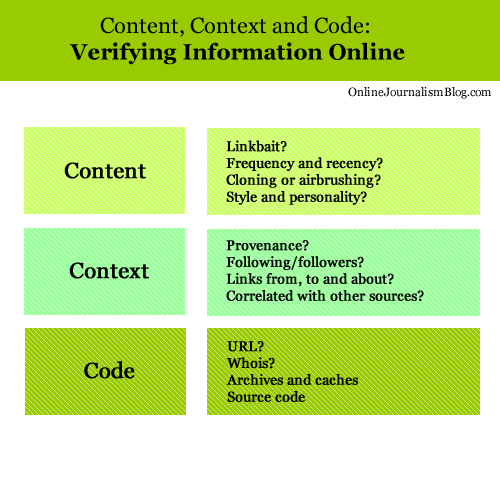
For more on verifying online information see Content, context and code: verifying information online, which I’ll continue to update with examples.

Content, context and code: verifying information online

ContentContextCode_VerifyingInfo

When the telephone first entered the newsroom journalists were sceptical. “How can we be sure that the person at the other end is who they say they are?” The question seems odd now, because we have become so used to phone technology that we barely think of it as technology at all – and there are a range of techniques we use, almost unconsciously, to verify what the person on the other end of the phone is saying, from their tone of voice, to the number they are ringing from, and the information they are providing.

Dealing with online sources is no different. How do you know the source is telling the truth? You’re a journalist, for god’s sake: it’s your job to find out.

In many ways the internet gives us extra tools to verify information – certainly more than the phone ever did. The apparent ‘facelessness’ of the medium is misleading: every piece of information, and every person, leaves a trail of data that you can use to build a picture of its reliability.

The following is a three-level approach to verification: starting with the content itself, moving on to the context surrounding it; and finishing with the technical information underlying it. Most of the techniques outlined take very little time at all but the key thing is to look for warning signs and follow those up. Continue reading

Content, context and code: verifying information online

The full version of this post can be found here (this is a duplicate).

When the telephone first entered the newsroom journalists were sceptical. “How can we be sure that the person at the other end is who they say they are?” The question seems odd now, because we have become so used to phone technology that we barely think of it as technology at all – and there are a range of techniques we use, almost unconsciously, to verify what the person on the other end of the phone is saying, from their tone of voice, to the number they are ringing from, and the information they are providing.

Dealing with online sources is no different. How do you know the source is telling the truth? You’re a journalist, for god’s sake: it’s your job to find out.

In many ways the internet gives us extra tools to verify information – certainly more than the phone ever did. The apparent ‘facelessness’ of the medium is misleading: every piece of information, and every person, leaves a trail of data that you can use to build a picture of its reliability. Continue reading

Summary of "Magazines and their websites" – Columbia Journalism Review study by Victor Navasky and Evan Lerner

The first study (PDF) of magazines and their various approaches to websites, undertaken by Columbia Journalism Review, found publishers are still trying to work out how best to utilise the online medium.

There is no general standard or guidelines for magazine websites and little discussion between industry leaders as to how they should most effectively be approached.

Following the responses to the multiple choice questionnaire and the following open-ended questions –

  • What do you consider to be the mission of your website, does this differ from the mission of your print magazine?
  • What do you consider to be the best feature of aspect of your website?
  • What feature of your website do you think most needs improvement or is not living up to its potential?

– the researchers called for a collective, informed and contemporary approach to magazine websites with professional body support.

The findings were separated into the following 6 categories: Continue reading

Internet news as a market for news lemons

This article frames the problem of news dissemination as a problem of market lemons, analogous to the issue raised by George Akerlof in 1970. Framing news as a mechanism of vetting common knowledge as opposed to entertainment allows one to see that instant common knowledge in the byzantine and uncertain way in which humans communicate and live in is unattainable. Given this frame of the problem a potential solution is posited which allows traditional newspaper companies to serve and focus on the role of validating news rather than simply creating or capturing it. The most value added service that traditional news organizations can provide is validation of truth and quality assurance.

“It is hard to get the news from poems, but everyday, men die miserably for lack of what can be found there.” (William C. Williams)

Introduction

Gauging quality of entertainment is fairly simple and self-evident. Consumers know instantly whether a product is entertaining and consumers continue to pay attention if they find the material to be entertaining.

News providers tend to serve both an individual’s desire for entertainment and information in one product bundle. Although it is very easy for consumers to test the quality of the entertainment component of news it is much more difficult to gauge the information quality of news.

Consumers face the intangible dilemma of assessing whether news is accurate or true, which poses a problem of asymmetric information for consumers. Continue reading

How to spot a hoax Twitter account – a case study

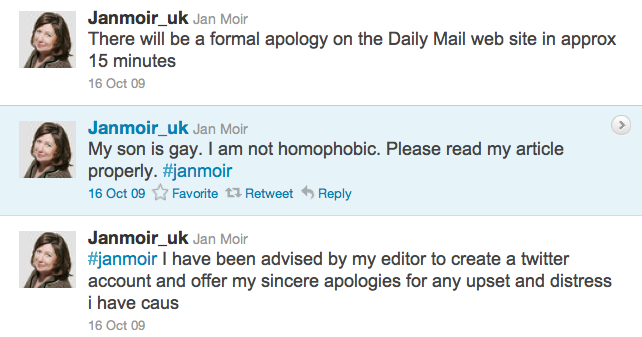
Fake Jan Moir tweets on Twitter

The fake Jan Moir lays some too-good-to-be-true bait on Twitter

If you were following the Jan Moir-Stephen Gateley story that was all over Twitter today you may have come across a Twitter account claiming to be Jan Moir herself – @janmoir_uk. It wasn’t her – but it was a convincing attempt, and I thought it might be worth picking out how I and other Twitter users tried to work out the account’s legitimacy.

The too-good-to-be-true test

The first test in these cases is the too-good-to-be-true test, and this works on a number of levels. Jan Moir tweeting in itself was a great story – but not completely unbelievable. Her second tweet said “I have been advised by my editor to create a twitter account and offer my sincere apologies for any upset and distress i have caus” [sic] – a superficially plausible story. Would you buy it?

But there were some other too-good-to-be-true claims in her tweets. One said “My son is gay. I am not homophobic. Please read my article properly.” Does Jan Moir have a son? Is he gay? Would she announce it on Twitter? Continue reading

Blogging journalists pt 7: Discussion and conclusion: “The writing on the wall”

The final part of the results of my survey of blogging journalists relates some of the findings to wider research into blogging and journalism, and also looks at some of the differences between sectors and industries.

Blogging has grown and developed considerably in the years since the studies of journalism blogs by Robinson (2006) and Singer (2005) – indeed, three-quarters of respondents had only started blogging since that research was published (in that time the BBC, for instance, expanded from its first blog in December 2005 to 43 in less than a year (Hermida 2008 [PDF]))

Respondents frequently spoke of a rapid transformation by their employers from resistance to blogs to wholesale adoption, in which commercial considerations have played an important role. These ranged from search engine optimisation (blogs help improve the rankings of news websites on search engines such as Google), to “bringing readers back more often”; “a cheap way of getting lots of content online and … resulting ad impressions” (Respondent 113, UK, freelance), to a perceived opportunity to make money, and a way of protecting against the threat from citizen media and the declining state of the news industry itself: Continue reading

YouTube and the first casualty of war

“This is the dramatic moment a TV reporter was shot by a sniper as she reported live from war-torn Georgia,” according to the Daily Mail, MSNBC’s Clicked, USA Today, the Herald Sun in Australia and a whole host of others.

The problem? None of those media outlets address the possibility of the video being a fake, despite dozens of comments like this: Continue reading