
A month ago, I used the Online Journalism Facebook Group to ask readers to suggest what areas they wanted covering, in an experiment with bottom-up editing (the forum for suggestions is still open by the way). Megan T suggested “Rethinking the production of newspapers”.
After researching, conceptualising and scribbling, I’ve come up with a number of models around the news process, newsgathering, interactivity and business models.
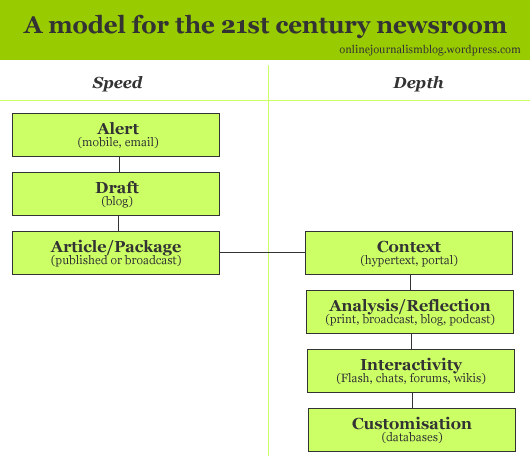
The following, then, is the first in a series of proposals for a ‘model for the 21st century newsroom’ (part two is now here). This is a converged newsroom which may produce material for print or broadcast or both, but definitely includes an online element. Here’s the diagram. The model is explained further below it
Building on the strengths of the medium
The strengths of the online medium are essentially twofold, and contradictory: speed, and depth.
New media technologies are able to publish news faster than the previous kings of speed: TV and radio. Think mobile and email updates. Think moblogs. Think Twitter.
At the same time, the unlimited space and time of the web, and its hypertextual and ‘pull’ properties, make it potentially deeper and broader than the previous kings of context and analysis: newspapers and magazines. Think Wikipedia’s coverage of Hurricane Katrina. Think the Daily Kos. Think hyperlocal websites. Think Chicagocrime.org.
The process model above proposes how a large news story might pass through a converged newsroom, from speed to depth, in the following steps:
- Alert: as soon as the journalist or editor is aware that a story is breaking, an alert is sent out. This might be from their mobile phone, Blackberry, or wifi laptop. Subscribers to text or email updates, a Twitter or Facebook feed, would be notified instantly. This shows you ‘own’ the story; it reinforces your reputation for being first with the big stories; and for the smaller stories, it can provide an opportunity to add personality to your coverage (the ‘what I’m doing now’ approach of Twitter). And it drives readers to your website, newspaper or broadcast.
- Draft: too rough for print or broadcast, but perfect for blogs. Backing up the alert, the draft report – like a wire report – gives initial names, places and details – and sources. It is updated as fresh details come in. The draft performs the important role of keeping the ‘Alert’ readers on your site, but it also serves to spread word through the blogosphere, bringing in more readers and helping your search engine ranking. Ideally it will also attract commenters and pingbacks which can add or correct details, or even provide new leads. Frequent updates – for instance linking to other coverage – help to prevent it getting knocked off the top of Google News (which looks for the most recently updated, not the first posted).
- Article/Package: in between the two extremes of speed and depth where online excels, traditional print and broadcast media have these strengths: their documentary nature, and the very limitations of their time and space. Their ability to document a ‘snapshot’ – an interim definitive account: the 300-word article or 3-minute package – is key to traditional news media’s appeal. The editorial decision that this story was worth a spot is important when compared to the internet’s infinity. At this stage, the draft turns into a package with higher production values, and which could be online, in print, broadcast, or all of those. The timing may be dictated by print or broadcast processes.
- Context: back online, that infinite space has an important role to play in providing instant and extensive context: how many times has this happened? Where can I access previous reports? What does that concept mean? How does this scientific principle work? Where can I find more information about this person or organisation? Where can I go to for support or help? Hypertext is central here – the ability to link to a range of documents, organisations, and explanations – both from your own archive and from external providers – in a portal that provides an essential resource. The print or broadcast report may also draw on some of this context, but it should refer to the online resource for more.
- Analysis/Reflection: after the report, comes the analysis. For online this may mean gathering the almost instant reaction taking place in the blogosphere in general, on your own blogs and forums, and proactively from the informed and the affected. The person covering the story may reflect on the whole experience on their blog, while podcasts are great for staging discussion and debate. At some point print and broadcast will take one or more snapshots for their production cycles.
- Interactivity: interactivity requires investment and preparation, but can engage and inform the user in a way other media cannot, as well as providing a ‘long tail’ resource that generates repeat visits over a long timescale: a Flash interactive may take days to produce but can provide a compelling combination of hypertext, video, audio, animation and databases (they can also be dynamically updated); a forum can provide a place for people to gather and post experiences and information; a wiki can do the same but more effectively. Live chats can allow users direct access to newsmakers, journalists and experts.
- Customisation: the final stage should be automatic: the ability for users to customise information to their own needs. At its most basic this might be to subscribe to email, text or RSS updates of that particular story. More advanced services might include social recommendation (‘Other people who read this story also read…‘) or database-driven journalism that allows users to drill down into the information: ‘What happened to that street?’; ‘How many cases were there in my postcode?’; ‘What does this tax mean for someone on my wage?’. This means production processes that integrate things like metatagging, and interfaces that can run off a database, and last but not least, a culture that thinks in terms of these possibilities.
That news process in action
Let’s take a typical mid-range news story: ‘public figure makes controversial statement’ to illustrate the process specifically:
- Alert: ‘Lord Smith: “stop ‘Mickey Mouse’ degrees”‘ – link to…
- Draft: gives more detail, and is open to comments and discussion, linking to other blogs. One commenter points out that Lord Smith studied English Literature. Journalist seeks ‘official’ comment to put in the…
- Article: two blog post comments incorporated into a version that goes in the printed newspaper.
- Context: best links taken from blog post comments, as well as full transcript of speech, audio and some mobile phone video taken by one attendee. Tags (‘LordSmith’) used to link to ongoing coverage and provide an instant ‘portal’.
- Analysis: one particularly well informed blogger who linked to the Draft post is paid to write a longer piece for the paper. A commenter – an academic – is invited to a podcast discussion with Lord Smith.
- Interactivity: website visitors are invited to ‘attempt an essay question’ from a ‘Mickey Mouse’ degree, giving a real first-hand understanding of what is involved in the subject.
- Customisation: an RSS feed or email alert is available for any stories tagged ‘LordSmith’
The news diamond
This model can also be represented as an alternative to the inverted pyramid: a ‘news diamond’, if you like.
Just as the inverted pyramid was partly a result of the increasing role of the telegraph in the news industry, and dominant cultural ideas of empiricism and science, this news diamond attempts to illustrate the change from a 19th century product (the article) to a 21st century process: the iterative journalism of new media; the story that is forever ‘unfinished’. More than anything, it’s designed to challenge the dominance of the inverted pyramid, to illustrate its origins in the industrial era, and its shortcomings. And in the spirit of the ‘unfinished’, none of these models are final: please post a comment with your own contributions.

UPDATE: Part two of the model for the 21st century newsroom is now live.



Pingback: Notes from a Teacher: Mark on Media » Monday squibs
Pingback: Created in Birmingham » Paul Bradshaw's posts on how journalism can adapt to the online world
Pingback: Magnetbox - links for 2007-09-18
Man, this is great stuff.
The news diamond in particular is a really useful starting point for discussions around the flow of news. I’m hearing a lot, still, about resistance to web first publishing. I think a lot of that is down to people not seeing all the options for the type of content you could get on line without ‘busting’ a story.
Speaking of pyramids. I did a bit of thinking a while back on how the structure of newsroom, geared towards a mono-media approach, could impact pressure points in the newsroom.
I see a lot of newsrooms where subs are still responsible for uploading – even editing video – as well as putting the paper to bed. A recipe for stress if ever there was one.
Great work Paul.
Pingback: contentious.com - links for 2007-09-18
Pingback: Models for 21st Century Newsrooms by andydickinson.net
Pingback: Vario Creative Blog - Marketing, design, web tech and small farm animals
Pingback: Podnosh Blog : High Fibre Podcasting » Archive » The Peril of Perfectionism explained by the News Diamond.
Pingback: cowbite.org
Pingback: links for 2007-09-18 by andydickinson.net
Pingback: Greg Palmer » Blog Archive » links for 2007-09-19
This is seriously good stuff and I will be starting a discussion on this model with my staff immediately. Great stuff.
Paul,
Outstanding post! Knowingly or not, this is exactly where our newsroom is heading. There are bits and pieces we have not figured out yet (leveraging external platforms for alerts, for example…though we are experimenting with Twitter)
The only place I’m not sure I agree is in the mutual exclusivity of these categories of content. Newsgathering is and always has been an iterative process. It’s the nature of print that made it seem more cyclical.
The web, though, changes the math. Now, all of this can be done in parallel. No reason when a breaking news story hits that the research department couldn’t be working on an external Wikipedia-esque “topics” page filled with related content, source documents and outside links. With the new RAD tools available now (Ruby on Rails, Django, etc.), there’s no reason the CAR team, graphics and web developers couldn’t be developing on the interactive side just as quickly.
I guess I see it as less a pyramid than a series of parallel tracks. The web allows us to be more than a good read. We can be a good resource as well.
Pingback: O FIM DA PIRÂMIDE INVERTIDA? : André Deak
Its a good propose,
I just want to say to you about other idea by João Canavilhas. He thinks in another alternative for the inverted pyramid: “Tumbled pyramid”, wich one has 4 levels. If you are interested about it, you can take a look to know more: http://www.idmaa.org/idmaaNovember2006/schedule.htm or
http://www.labcom.ubi.pt/livroslabcom/fichas/ficha_barbosa_jornalismo_online.html
Suzana B.
Aron: agreed. The stages are not meant to be necessarily progressive – perhaps I could re-design as a critical path diagram, but then it wouldn’t look so clean.
Suzana: sounds very interesting. Can you summarise it?
Pingback: Infotendencias.com :: blog colectivo sobre convergencia periodística
Pingback: O rascunho da revolução informativa tomou forma | Tech Letters
Pingback: Two reminders « Online Journalism Blog
Pingback: Mais um modelo derivado da pirâmide invertida « : : Atelier de Novas Mídias : :
Pingback: Nova adaptação da Pirâmide invertida « Jornalismo Digital
If only I could read Spanish…
Pingback: Jornalismo: entre rapidez e profundidade « Jornalismo e Comunicação
Very very interesting post … much food for thought here, but … I nearly posted this eysterday, but events this morning have proved my point.
I think the assertion:
“New media technologies are able to publish news faster than the previous kings of speed: TV and radio.” is open to question. Radio is still the quickest medium, where news can be broadcast within seconds of it occurring. This morning The Today programme on BBC Radio 4 broke the news that Avram Grant would be the new Chelsea manager within seconds of the journalist being told, even twitter and sms would never be quicker than that.
Fair point – depends how quick you can text 😉
If someone has arranged an event like a news conference and the news organisation has been able to set up to broadcast live – or if the news is important enough to break into normal programming for a newsflash, or if timing is just fortunate, then broadcast does have an advantage. For the rest of the time, mobile phones and wifi have an advantage. An ‘alert’ stage might be ‘news conference at Chelsea FC @9am’, for instance.
Pingback: A new view — are you looking? « The Producer Page
Pingback: the news diamond « Online Journalism Blog « wxj’s basic blog
Pingback: Darcy - » ¿Un “adiós” a la Pirámide Invertida?
I interst to Journalism
Pingback: Darcy - » El nuevo periodista ¿un súper periodista?
Pingback: Journalism Daily - Today’s Top Blog Posts on Journalism - Powered by SocialRank
Hoi Paul, as we discussed last thursday @ Picnic ’07, I don’t think this model is generally applicable in the online newsroom. The model is really good for big news occasions. In those cases you send an instant news sms, yes. And you make graphics, videos, write articles etc etc.
My experience in the newsroom of de Volkskrant newspaper though is that the influx of articles/content is just too huge. We have to think about how to deal with that: do we select stricter? Or do we develop a robot that does the selecting for us, so we can devote our precious time to producing content ourselves? And how can we produce such content? Those are more important questions in the online newsroom, though the diamond model is very good as a guide during big news events.
Thanks Bas – as I say in the piece, this is a model for large news stories, so yes, there is a degree of editorial judgement in how many steps you incorporate. There is another factor too in sending too many alerts to a reader – although I think there’s a case for specialist alert channels (technology; sport; music; politics; etc.) to get around that problem.
As you say, technologies and robots can really help here – for instance a robot or CMS that takes your intro and makes it an alert with a link; or a CMS that gives you the option to ‘Publish Draft’ to a blog, then ‘Publish Article’ to the website when you’re ready to do that.
As for information filtering – the next part of my news model deals with this to some extent.
Pingback: A model for the 21st century newsroom pt2: Distributed Journalism « Online Journalism Blog
Pingback: BA Newspaper Journalism » Blog Archive » Is the future Online?
Pingback: Novinarstvo 2.0 - Ili, šta je DANAS potrebno znati kao novinar na Internetu? | Dragan Varagic Weblog
Pingback: Rosa J.C. » Blog Archive » Un diamante en la redacción
Pingback: Paul Bradshaw and the 21st Century News Diamond | AEJMC Membership Forum
Pingback: Redacciones siglo XXI: Nuevos modelos « [EL MIRADOR]
OJB Virtual Intern Gabriela Zago has helpfully translated the Portuguese language reactions to English. Many thanks to her – here they are:
TechLetters calls the model “one of the first drafts for the new theory of communication”.
GJol and Mediascopio pointed out the similarities to the “tumbled pyramid”, proposed by João Canavilhas.
André Hollanda points out that the “exploration level”, from the “tumbled pyramid”, is missing in the “news diamond”.
Ponto Media says that it is “indispensable”.
All the blog reactions for the “news diamond” in Portuguese:
[I’ve checked both the trackbacks and the Technorati reactions for the post ( http://www.technorati.com/search/http%3A//onlinejournalismblog.wordpress.com/2007/09/17/a-model-for-the-21st-century-newsroom-pt1-the-news-diamond/?page=1) ]
http://ciberjornalismo.com/pontomedia
The first post in Portuguese was made by Antonio Granado, a science journalist and journalism lecturer at Universidade Nova de Lisboa in Portugal. He just posted the link, the picture and said “indispensable”.
http://www.andredeak.com.br/2007/09/19/o-fim-da-piramide-invertida/
Then, after seeing what Granado has said, André Deak, from Brazil (journalist of the Brazilian Agency of News), posted a summary of the post, explaining with his own words what would be the alert, the draft, the article, and so on. Somehow, everyone else that talked about it followed what he had said about the model.
http://gjol.blogspot.com/2007/09/o-fim-da-pirmide-invertida-em-redaes.html
http://gjol.blogspot.com/2007/09/mais-sobre-superao-da-pirmide-invertida.html
At GJol (blog from an online journalism research group from Brazil, from Universidade Federal da Bahia), they first posted a brief summary of what André Deak has said about the pyramid, and then, in a new post, they compared the idea to other two models for online news. One of them was mentioned in a comment in OJB. The other one was created by one of the researchers from the research group in her thesis. They mentioned that the ‘Tumbled pyramid’ (proposed by João Canavilhas, from Portugal, in a 2005 paper) is a model very close to the idea of the news diamond.
[maybe I could read the article about tumbled pyramid and then summarize it for you]
http://techletters.net/2007/09/19/o-rascunho-da-revolucao-informativa-tomou-forma/
This blogs reproduces what André Deak has said. And they call the news diamond model “one of the first drafts for the new theory of communication”.
When explaining the news diamond, they mention that the structure is very similar to the “tumbled pyramid”, and say that, comparing one to the another, in the “news diamond” is missing the “exploration level”. Finally, he adds that, for him, interactivity and customisation should be implied in all the structure, so there wouldn’t be a reason to mention them in the lower part of the diamond.
http://jornalismodigital.wordpress.com/2007/09/19/nova-adaptacao-da-piramide-invertida/
The exact same post from above. Both were posted by the same online journalism professor.
Blog from a research group from Portugal (Universidade do Minho). They just mention that all specialists and people interessed in online journalism are commenting the model, and that that would be interesting for the blog readers to try to follow up these comments.
This post is from Alex Gamela. He posted both in English and Portuguese.
My posts >>
http://gabrielaz.blogspot.com/2007/09/notcia-online.html
I’ve talked about the news diamond in my blog, not adding anything new.
http://observatorio.ultimosegundo.ig.com.br/artigos.asp?cod=452ENO001
Outside blogs… I’ve mentioned your model in a text on microblogging journalism (mostly about Twitter) for the Media Observatory in Brazil, explaining the ‘Alert” part of the news diamond. Two blogs copied and pasted my text with the original link to OJB:
http://afalaire.blogspot.com/2007/10/microblogs.html
http://preparacaodovlau.blogspot.com/2007/10/jornalismo-em-microblogs.html
Pingback: From the inverted pyramid to the tumbled pyramid (João Canavilhas) « Online Journalism Blog
I must have skipped over the reference to me the first time, cause I just re-read this and was like “omg!” I’m working on reorganizing the workflow at my paper, and your miodels have been extremely helpful. Thank you!
OJB Virtual Intern Lola Mola has translated the Spanish language reactions to English. Many thanks to her – here they are:
Infotendencias (www.infotendencias.com) was the first to comment (comment 17), showing the picture, describing the model, adding nothing, just saying the proposal is interesting. However, this blog is a popular blog about convergence (financially supported by the Spanish government), written for several important Spanish researchers. I usually read it.
Comment 28, is Darcy, a Chilean. She also describes and translates your explanations. Some days later, she links again to link your theory with a conference that she attended by professor Javier Díaz-Noci (http://www.ehu.es/diaz-noci/first.htm) . Its seems this researcher was talking about a Spanish experience: “Goiena”. Goiena is a small cooperative group of local media in the north of Spain, at the Basque country. Its seems that some time ago some local media of this small region decided to became a cooperative, to reorganize the way of working. They are a website, http://www.goeina.net, a newspaper, a radio station and a local radio.
It seems they have a kind of central editor, who decides where to publish what information and in what way, (radio, print, tv, web…), working all in only one newsroom.
Comment 37 thanks the post in Infotendencias. This journalist just pastes the news diamond graphic.
Comment 39: http://fernandarubio.com.ar (Argentina) She just explains and pastes the news diamond picture.
Pingback: hbznuxen
Pingback: Algumas constatações sobre o futuro do jornalismo | Porque todo dia a gente aprende uma coisa nova
Pingback: iPM: have they been reading my model for a 21st century newsroom? « Online Journalism Blog
Pingback: Another source of inspiration for journalism (Bas Timmers) « Online Journalism Blog
Paul,
Excellent stuff. It looks scarily complex but it serves as a great model that you can then play other factors through: staffing, technological innovations, even revenue models.
Pingback: www.bastimmers.nl » Blog Archive » Diginews 07: Een extra inspiratiebron vooor journalistiek (2)
Pingback: Sarmale si mici » Blog Archive » Jurnalismul secolului 21 - I’M BACK
Pingback: Music Downloads Mp3 Files » Blog Archive » Deak Diamond-Alles Wird Gut
Pingback: the ride up to nahr el bared « unpegged
Pingback: Rohdiamant
Great starting point, Paul. The only big gap I see is that this doesn’t give much role to conversation and community — especially to how the news org and journos can & should participate publicly in that conversation. It still seems mainly premised on the publishing model — although it’s more flexible than traditional publishing, of course.
Also, it still seems mainly focused on activities that would occur only on the new org’s site — when in fact it helps to connect what happens on your site to social media services, other sites and blogs, etc.
Thoughts?
– Amy Gahran
Ah, I disagree. The alert stage is premised on getting readers involved before anything is officially published; while the draft stage is about inviting comments and engaging with the blogosphere.
The second part of this model – distributed journalism says more about the importance of community and conversation before the story is written.
Pingback: MiSeasons.com - Blogs - Blogs Home Page » Social networking: knowing what you want to know without you knowing it
Pingback: links for 2008-02-21 « Object neo = neo Object
Pingback: DNA2008 - Day2: Multi platform by andydickinson.net
Pingback: “The first and the last word on a story”? Clarifying the 21st century newsroom « Online Journalism Blog
Pingback: Redesign av Sydsvenskan.se » Blog Archive » 24 timmars-tidningen
My name is Nasiruddin Dareez an Afghan young journalist. I interest with journalism occupation, and I say thankful from your personnel and appreciate them. I would like to be a member of your. I hope you send me the new themes about journalism in the world and I would like to find a job in an international organization by your help. Best regards.
Hi Paul, these graphs are an excellent description of what the newsroom in the 21st century looks like. Thank you for your permission to re-print them in the annual report of the World Editors Forum, Trends in Newsrooms (www.trends-in-newsrooms.org).
Pingback: British entries shortlisted for Knight journalism grants | Fleet Street 2.0 | Press Gazette
Pingback: NME.com “do” the News Diamond « Online Journalism Blog
Pingback: My graph is going to be published! « Joanna Geary
Pingback: Liverpool Post break tax news on live blog « Journalism Technology Watch
Pingback: What is original about Charlie Beckett’s ‘conceptual model of networked journalism’? « Online Journalism Blog
Pingback: links for 2008-05-26 | Daily EM
Pingback: Seeing is believing « Content Ninja’s Weblog
Pingback: Networked journalism and climate change | alexlockwood.net
Pingback: Talking about Independent Journalism in Northern Lebanon « eSahafa
Pingback: News as a process and what it means for journalists « Reportr.net
Pingback: Nachrichtenfluss » Blog Archive » 1000 Dinge die ich über das Bloggen gelernt habe
Pingback: A handy list to read to myself on the bus each morning at Sean Yeomans Consulting
Pingback: How to Blog « Welcome to Jack’s Blog
Pingback: 99 conclusiones acerca de los blogs y la blogosfera
Pingback: 1000 things I’ve learned about blogging | Online Journalism Blog
Pingback: Post more = rank higher. We knew it already, but here’s the evidence. | Online Journalism Blog
Pingback: Are you teaching (or being taught) the News Diamond? | Online Journalism Blog
Twitter is already dead as are several other suggestions in this book.
Pingback: A model for the 21 St century Newsroom : Scribed Notes
Pingback: Experience from the Volkskrant that I agree on : Scribed Notes
Pingback: BBC Future of Journalism day 1: some reflections | Online Journalism Blog
Pingback: Foules électroniques » Blog Archive » Les blogs, les Anglais et le diamant
Pingback: Model for the 21st century newsroom pt.6: new journalists for new information flows | Online Journalism Blog
Pingback: Jornalismo do século XXI : Ponto Media
Pingback: Cours Leon Elie-Troclet » Blog Archive » Cours du 3 décembre
Pingback: Beyond the inverted pyramid: The news diamond « All the News: The Companion Blog
Pingback: Twitter Power « O Lago | The Lake
Pingback: La radio annonce, la télé illustre, le journal met en perspective… et le web ? « 4×21
Pingback: How do you financially support journalism online? « Qwerty2009’s Blog
Pingback: Poynter Sommerskole » Blogarkiv » Poynter Summer School 2009: Cross Media Storytelling
Pingback: Speaking in Norway this week (say Hi) | Online Journalism Blog
Pingback: McGuire on Media » McGuire’s new syllabus for Business and Future of Journalism
Pingback: Top5 : Most annoying discussions | Discussões mais irritantes « O Lago | The Lake
That is a very interesting insight as to how press releases work.
Pingback: Starting a blog? 12 ideas for blog posts | Online Journalism Blog
Hey Mr. Bradshaw,
I have to write a paper on this question “Traditional newsrooms and news organs are failing, shrinking and floundering all over North America discuss alternative models for the newsrooms of the future” and I have to get people who are in the media or have an opinion about the media to answer it, if you find the time do you mind adding to the question, I am a journalist student as well and really like your ideas. Thanks for your time!
Raquel
Pingback: Terra Computerata » Ο κύκλος της ψηφιακής ενημέρωσης
Pingback: Making money from journalism: new media business models (A model for the 21st century newsroom pt5) | Online Journalism Blog
Pingback: СМИ в интернете → СМИ 21-го века. Часть 1. Алмаз новостей «
Have you seen that YouTube has now established a channel providing short ‘How To’ films on citizen journalism. A presentation of your diamond would be good for that channel. It appears that this emerged, in part, because of all the citizen journalism that took place during the Iranian election and protests (ongoing).
Have you seen that YouTube has now established a channel providing short ‘How To’ films on citizen journalism. A presentation of your diamond would be good for that channel
Pingback: Journalism 2.0: the Future of Journalism Syllabus « Compassion in Politics: Christian Social Entrepreneurship, Education Innovation, & Base of the Pyramid/BOP Solutions
Pingback: McGuire on Media » McGuire’s 2009 Business and Future of Journalism syllabus
Pingback: El diamante de noticias (Modelo para la redacción del siglo XX1 – 1ra parte) « tejiendo redes
Pingback: Estrutura da notícia hipertextual « Jornalismo Digital
Pingback: Consulting, Part II: Analyzing news models « The Future of Journalism
Pingback: Saving Journalism « Bill Bowman
Pingback: First Blog « KatherineLR
Pingback: The Future of Journalism, Part Deux « brandon fried
Pingback: Future models for news…part 2 « Samantha
Pingback: The Future of Newspapers « News Blog
Pingback: Textos da nova era do jornalismo que resistiram à prova do tempo « Jornalismo e Comunicação
Pingback: Ganando plata con el periodismo: modelos de negocio de los nuevos medios (Modelo para la redacción del siglo XXI – 5ta parte) « tejiendo redes
Thanks a lot for nice article. But I had difficulty navigating through your website because I kept getting 502 bad gateway error. Just thought to let you know.
Pingback: FAQ: questions from Maite Fernandez | Online Journalism Blog
Pingback: Behind the scenes of a travel feature – pt 1: transparency and the trouble with top tens « Tourist Vs Traveller
Pingback: Snow and Diamonds « WHITE WEDDING
Pingback: News Story Diamond examples « Athens
This is seriously good stuff and I will be starting a discussion on this model with my staff immediately. Great stuff.
Pingback: O Twitter e o jornalismo | Notícias Digitais
Pingback: Choice 4: Convergence « New Communication Technologies
Pingback: Interesting ideas about blogging | Ismail Mechbal Portfolio
Pingback: Novinarstvo 2.0 – Ili, šta je DANAS potrebno znati kao novinar na Internetu? | Dragan Varagic
Pingback: News diamond « dveras em rede
Pingback: El nou cicle de vida de les notícies | Reflexions sobre periodisme, comunicació i cultura
This is seriously good stuff and I will be starting a discussion on this model with my staff immediately. Great stuff.
My name is Nasiruddin Dareez an Afghan young journalist. I interest with journalism occupation, and I say thankful from your personnel and appreciate them. I would like to be a member of your. I hope you send me the new themes about journalism in the world and I would like to find a job in an international organization by your help. Best regards.
Have you seen that YouTube has now established a channel providing short ‘How To’ films on citizen journalism. A presentation of your diamond would be good for that channel. It appears that this emerged, in part, because of all the citizen journalism that took place during the Iranian election and protests (ongoing).
Pingback: A model for the 21st century newsroom: pt1 – the news diamond « Online Journalism Blog
Pingback: Manage a System for Multimedia News « PRNDG.org
Pingback: Paul Bradshaw's News Diamond « PRNDG.org
Pingback: Ivory tower dispatch: It’s all about the process | andydickinson.net
this is useful and new for me,and it’s true.The journalism indeed becomes multiple and diverse. I enjoyed reading the articles here,which motivate me much more.
Pingback: Meanland: Abandoning print « Overland literary journal
Pingback: Journalism 3.0 Thesis Parts 2&3
Pingback: The News Diamond reinterpreted: “Let the crowd have the middle” | Online Journalism Blog
Pingback: The news diamond | Bill Doskoch: Media, BPS*, Film, Minutiae
Pingback: Du nouveau sur la pyramide inversée « Le contenu web
Pingback: Catch the star » 12 ideas for blog posts
nice job guys,i like your simple themes
But I had difficulty navigating through your website because I kept getting 502 bad gateway error.
Pingback: My web 2.0 » Blog Archive » The digital news lifecycle
Pingback: Rascunho e palimpsesto at Qualidade da Informação e produsage
Pingback: A model for the 21st century newsroom: pt1 – the news diamond | Online Journalism Blog « Glen Mulcahy's -VJ Mentor Blog
Pingback: Mubarak ‘dood’ in Nederland | herwinthole.nl
Vureo has the highest quality flash games as well as selection. click to go to vureo.com
Pingback: #ISMB11: Obligatorisk læsestof til kurset I samspil med brugerne « Ny Journalistik
Pingback: Is Ice Cream Strawberry? Part 2: Cars, roads and picnics | Online Journalism Blog
Pingback: Review of a blog : onlinejournalism.com « Samosa24's Blog
Pingback: With freedom, comes irresponsibility? | Hurriyat News
Pingback: links for 2011-07-11 : The ChipCast || by Chip Mahaney
Pingback: Daily bookmarks & places archive | Chipcinnati
Pingback: With freedom, comes irresponsibility? at Ahmed Tamjid Aijazi
Years old, just was alert to your website via Bing, and located that it is genuinely educational. I will be cautious about the city. We’ll delight in for those who continue on that later on. Lots of other individuals might be reaped the benefit out of your producing. Thanks!
thanks for sharing I have had suggestions that I should by grouping the online tools (e.g. subscriptions, comments) by colour, but I have tried and this seems to confuse the graph
thanks for an excellent post. bookmarked and will come back for sure.
Pingback: A model for the 21st century newsroom (Thai Translation) | Online Journalism Blog
Awesome blog you have here, I like the structure very much. If I may ask, what WP theme did you use?
Pingback: » اينترنت تلويزيون راديو رسانهها روزنامهنگاري روزنامهنگاري آنلاين فرهنگ مهارتهاي نوشتن نوشتن براي وب وبسايت » معرفی سبک الما
Oh my goodness! an amazing article dude. Thank you However I’m experiencing concern with ur rss . Don’t know why Unable to subscribe to it. Is there anyone getting an identical rss drawback? Anybody who knows kindly respond. Thnkx
Yet another excellent article to help me understand the structure of a newsroom. But this is more about transmission of news on the internet, right? What about an actual, physical newsroom?
Pingback: Model for the 21st Century Newsroom Redux: part 1 on BBC College of Journalism blog | Online Journalism Blog
Pingback: The changing nature of news consumption and the importance of reading at work | TheMediaBriefing « Newsplexer
Pingback: Death of Journalism – and how to resurrect yourself in the digital age « chanellerodger
Pingback: Augmented Reality as a tool for journalism at Sarah Hartley
Pingback: Model for a 21st Century Newsroom – the sequel (free ebook) | Online Journalism Blog
Pingback: A Brand News Approach to Content Marketing | jhWebWorks | Columbus Ohio Web Design, Development, SEO, Social Media
Pingback: A Brand News Approach to Content Marketing | Mitch Wakem
Pingback: A Brand News Approach to Content Marketing - Canadian SEO Blog – Canada SEO Professional Ltd.
Wow, wonderful blog layout! How long have you been blogging for?
you make blogging look easy. The overall look of your web site is fantastic, let alone the content!
Pingback: The media in the Boston blasts |
Pingback: Three new skills for a digital press officer | All users
constantly i used to read smaller articles or reviews that also
clear their motive, and that is also happening with this article which I am reading at this place.
Great post.
Hello colleagues, nice piece of writing and fastidious arguments commented here, I am in fact enjoying by these.
Baking soda and hydrogen peroxide are some of the best teeth whitening ingredients.
There’s no need for further explanation on how smoking can negatively affect your health. Some people do all the wrong things such as smoking, drinking red wine, and drinking lots of tea and coffee every day, and wonder why their teeth do not stay white for very long.
Aw, this was an exceptionally good post. Spending some time
and actual effort to produce a superb article… but what can I say… I procrastinate
a whole lot and never seem to get anything done.
That is very interesting, You’re a very skilled blogger. I have joined your rss feed and look forward to searching for more of your excellent post. Additionally, I have shared your website in my social networks
Quality articles or reviews is the important to attract the users to pay a quick visit the web page,
that’s what this site is providing.
What’s up, I would like to subscribe for this webpage to take newest updates, so where can i do it please assist.
Hi there, I enjoy reading all of your article.
I wanted to write a little comment to support you.
Hi there! I simply wish to offer you a big thumbs up for your excellent information you have got here on this post.
I’ll be returning to your site for more soon.
I’m extremely impressed with your writing skills as well as with the layout on your blog. Is this a paid theme or did you customize it yourself? Anyway keep up the nice quality writing, it’s rare to
see a nice blog like this one today.
magnificent put up, very informative. I wonder why the opposite experts of this sector do not realize this.
You should proceed your writing. I’m confident, you’ve a huge readers’ base already!
So when the coming lafayette auto care 19444 shortage takes hold, a Frugal Yankee will
have someone on whom they can rely on and will treat them right.
Attractive part of content. I just stumbled upon your web site and in accession capital to assert that I get
actually enjoyed account your blog posts. Anyway I’ll be subscribing to your feeds and even I fulfillment you get entry to consistently fast.
super acest lucru este minunat am gasit ceva la fel
aici la WZY.RO 🙂 imi place
Pingback: Magazines and YouTube, Story and Image
I like the helpful info you supply on your articles.
I’ll bookmark your blog and check once more right here regularly. I am quite certain I’ll learn many new stuff right right here!
Best of luck for the following!
There are several factors that may establish the charges you will pay
for vehicle insurance. The truth is, looking for the web address of every car insurance provider when searching for free car insurance
quotes and doing this step time and again for every website that you visit can also
take a lot of time. In the instance where you are not necessarily at
fault and the other driver does not have liability car insurance, you are protected
by uninsured, or under-insured, motorist coverage.
Notre générateur de kamas est enfin terminée et disponible gratuitement en
téléchargement.
Depêchez-vous il n’est disponible qu’en petite
quantité limitée. Notre générateur de kamas vous garantie de non-bannissement
avec beaucoups d’options intégrée vous garantissant une sécurité parfaite.
Il est nécéssaire de comprendre que notre logiciel n’est
pas compliquée d’accès et vous permet une utilisation sereine
en toutes circonstances
En plus vous allez pouvoir générer des kamas très facilement mais en plus vous
êtes sur
d’être en toutes sécurité grâce à notre façon de programmation unique utilisant des techniques
utilisés par les plus grands du moment.
Decide wwho you will select as your trustee to manage the life
insurance trust fund. At first glance this coverage
may seem absolutely necessary, or absolutely unnecessary depending upon the assumptions you make about car insurance and rental car companies.
You can then compare and select the car insurance quote that provides
the right cover for your budget.
Started in 2002 along with improvements to the Florida building
code, these wind mitigation discounts were an important step in
the process to deliver lower Florida home insurance
rates to those with homes less likely to sustain serious damage
in a Florida hurricane. A real estate agent or a home seller usually offers this type
of homeowners insurance when you are buying a house. Wind damage can
greatly deviate in its definition from tornado damage.
Everything within the remewal notice is dependable and true.
It is quite evident tjat with so many companies providing
motor insurance online, yyou can get a little confused. In
Connecticut, however allowance companies accept too
acquaint their action holders if they use their acclaim history ass allotment of the appraisement belief for auto
and homeowners insurance.
Your full coverage policy will extend to protect your assets while driving the rental car.
You can also browse the internet to seeek car insurance
quotes. Yes, the car insurance companies check your credit score, aand if it’s
not a good one, they will charge you more.
No inxividual in the UK is allowed to drive on public highways without any
type of insuraance hence, not having a sufficient
income too buy one iss not an excuse. Consider whether youu will be taking out
the minimum liability cover or comprehensive and collision.
Driving is easily the ffirst major responsibility American teenzgers are given when
they are of the right legal age.
Pingback: Middle east news politics heath nutrition
Pingback: Data journalism in 2014: unicorns, racehorses – and a mule cameo | Online Journalism Blog
Pingback: Model for the 21st Century Newsroom Redux: part 1 on BBC College of Journalism blog | Online Journalism Blog
Pingback: A model for the 21st century newsroom (Thai Translation) | Online Journalism Blog
Pingback: The News Diamond reinterpreted: “Let the crowd have the middle” | Online Journalism Blog
Pingback: The News Diamond reimagined as ‘The Digital News Lifecycle’ | Online Journalism Blog
Pingback: Model for the 21st century newsroom pt.6: new journalists for new information flows | Online Journalism Blog
Pingback: lynnenelson
Diagrams are always better to visualize content, did you use office to create these graphics or was it a tool like creately ?
I used Fireworks.
Pingback: ¿Sabes escribir para Internet? - UX Lumen
Pingback: Características De La Noticia En La Web | Romina Jorge
Pingback: News Cycle: Lessons for Content Marketers | Digital Uncovered
Pingback: Fifth meeting: Practices of journalism, part 1. – Journalism as a Profession