Author Archives: Paul Bradshaw

Interview: Ton Zijlstra on open data in the EU (audio)

A couple weeks ago I spoke at the PICNIC festival in Amsterdam. While I was there I grabbed an interview with Ton Zijlstra, who has been following open data developments across EU governments very closely. You can find the interview embedded below:

[audio:http://audioboo.fm/boos/186944-ton-zijlstra-on-open-data-in-the-eu.mp3%5D

Something I wrote for the Guardian Datablog (and caveats)

I’ve written a piece on ‘How to be a data journalist’ for The Guardian’s Datablog. It seems to have proven very popular, but I thought I should blog briefly about it if you haven’t seen one of those tweets.

The post is necessarily superficial – it was difficult enough to cover the subject area for a 12,000-word book chapter, so summarising further into a 1,000 word article was almost impossible.

In the process I had to leave a huge amount out, compensating slightly by linking to webpages which expanded further.

Visualising and mashing, as the more advanced parts of data journalism, suffered most, because it seemed to me that locating and understanding data necessarily took precedence.

Heather Billings, for example, blogged about my “very British footnote [which was the] only nod to visual presentation”. If you do want to know more about visualisation tips, I wrote 1,000 words on that alone here. There’s also this great post by Kaiser Fung – and the diagram below, of which Fung says: “All outstanding charts have all three elements in harmony. Typically, a problematic chart gets only two of the three pieces right.”:

Trifecta checkup

On Monday I blogged the advice on where aspiring data journalists should start in full. There’s also the selection of passages from the book chapter linked above. And my Delicious bookmarks on data journalism, visualisation and mashups. Each has an RSS feed.

I hope that helps. If you do some data journalism as a result, it would be great if you could let me know about it – and what else you picked up.

Hyperlocal voices: Adirondack Almanack / John Warren

hyperlocal voices - Adirondack Almanack, John Warren

Following a nomination via the Online Journalism Blog Facebook group, this Hyperlocal Voices looks at a US blog: the Adirondack Almanack, which covers the rural Adirondack region of upstate New York.

Launched in 2005 out of frustration with the lack of coverage from the mainstream media, the site now boasts 20 contributors, “mostly veteran local writers, journalists, and editors and includes media professionals from local radio, magazines, and newspapers,” says founder John Warren. Here’s the full interview with John:

What made you decide to set up the blog?

The Adirondacks is home to the largest park and the largest state-level protected area in the contiguous United States (it’s also the largest National Historic Landmark). The park is over 6 million acres in size (that makes it bigger than Vermont, or Yellowstone, Yosemite, Grand Canyon, Glacier, and Great Smoky Mountains National Parks combined).

However, about half the land is publicly owned and the rest privately owned, including several villages. That mix of public and private land makes the Park a unique area and fodder for some heated discussions over sustainable development, wilderness, environmental and outdoor recreation issues. I felt strongly that local news media was not fully representing the variety of perspectives on these important issues – many of which are important in other parts of the country as well. Continue reading

Hyperlocal voices: Jon Clarke (Beckenhamtown.us)

hyperlocal site Beckenhamtown.us

Jon Clarke launched the UK hyperlocal site Beckenhamtown.us 2 years ago using the social network builder Ning. He sees the site as differing from traditional publishers in offering everyone a free voice, as well as providing a space to play out local debates around issues such as academy schools and parking zones. Here’s the interview in full:

Who were the people behind the blog, and what were their backgrounds before setting it up?

Me, and no one else, I’ve been in digital media at various ad agencies for over 10 years and therefore am au fait with lots of the ways to create and promote a website.

What made you decide to set up the blog?

The main reason was that I thought Beckenham was not well served with a ‘live’ and ‘community’ based website, there just weren’t any for what is quite a neighbourly area for neighbours to talk and share local things.

When did you set up the blog and how did you go about it?

The site was set up in August 2008. I’m not a programmer or web designer so I used the Ning.com community website platform that allows one to cut and paste and move various features around to make a good community site. I then used my knowledge to bring in lots of dynamic content, widgets and RSS feeds to pad out the site and bring it alive.

I wanted to use a co.uk address but it was gone so I plumped instead for a .US address. I thought it best represented who the website was for and about – all of US in Beckenham Town. Continue reading

A brilliant Donald Duck mashup – Right Wing Radio Duck

Jonathan McIntosh of Rebellious Pixels has just published a mashup of Donald Duck cartoons matched to a mashed-up Glenn Beck (of Fox News) voice track, called “Right Wing Radio Duck”.

[youtube:http://www.youtube.com/watch?v=HfuwNU0jsk0%5D

Jonathan has taken dozens of segments from the cartoon archives, and dozens of voice clips from Glenn Back, to create a new jigsaw from existing pieces, satirising the North American Right.

This is work of studio quality. Alternatively, it can be produced by an individual in their bedroom, and can potentially in this case be a career-creating “splash”.

Either way, it demonstrates how high the bar can be raised. It also illustates the advantages of having a liberal set of copyright laws. How difficult would it be to make this in the UK?

Here’s the Youtube blurb:

“This is a re-imagined Donald Duck cartoon remix constructed using dozens of classic Walt Disney cartoons from the 1930s to 1960s. Donald’s life is turned upside-down by the current economic crisis and he finds himself unemployed and falling behind on his house payments. As his frustration turns into despair Donald discovers a seemingly sympathetic voice coming from his radio named Glenn Beck.

“This transformative remix work constitutes a fair-use of any copyrighted material as provided for in section 107 of the US copyright law. “Right Wing Radio Duck” by Jonathan McIntosh is licensed under a Creative Commons BY-NC-SA 3.0 License – permitting non-commercial sharing with attribution.”

As a contrast, this below is an agitprop video produced by Lib Dem campaigners within a few hours of Gordon Brown’s decision to back away from holding an Election in Autumn 2007. This one was made so quickly, that they used a US version of “The Grand Old Duke of York”.

[youtube:http://www.youtube.com/watch?v=l22kHO5jdRU%5D

This video did not circulate outside the political/media community.

Open data meets FOI via some nifty automation

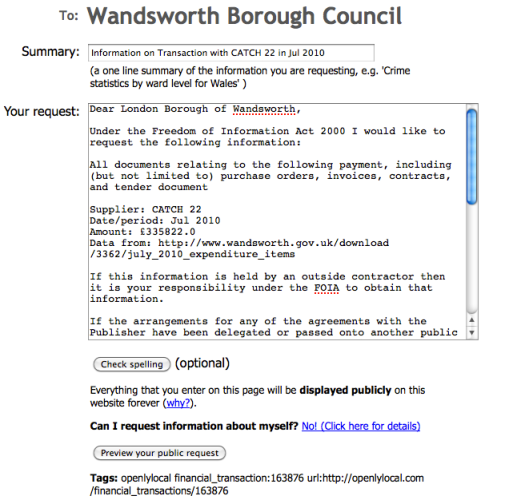
OpenlyLocal generated FOI request

Now this is an example of what’s possible with open data and some very clever thinking. Chris Taggart blogs about a new tool on his OpenlyLocal platform that allows you to send a Freedom of Information (FOI) request based on a particular item of spending. “This further lowers the barriers to armchair auditors wanting to understand where the money goes, and the request even includes all the usual ‘boilerplate’ to help avoid specious refusals.”

It takes around a minute to generate an FOI request.

The function is limited to items of spending above £10,000. Cleverly, it’s also all linked so you can see if an FOI request has already been generated and answered.

Although the tool sits on OpenlyLocalFrancis Irving at WhatDoTheyKnow gets enormous credit for making their side of the operation work with it.

Once again you have to ask why a media organisation isn’t creating these sorts of tools to help generate journalism beyond the walls of its newsroom.

Where should an aspiring data journalist start?

In writing last week’s Guardian Data Blog piece on How to be a data journalist I asked various people involved in data journalism where they would recommend starting. The answers are so useful that I thought I’d publish them in full here.

The Telegraph’s Conrad Quilty-Harper:

Start reading:

http://www.google.com/reader/bundle/user%2F06076274130681848419%2Fbundle%2Fdatavizfeeds

Keep adding to your knowledge and follow other data journalists/people who work with data on Twitter.

Look for sources of data:

ONS stats release calendar is a good start http://www.statistics.gov.uk/hub/release-calendar/index.html Look at the Government data stores (Data.gov, Data.gov.uk, Data.london.gov.uk etc).

Check out What do they know, Freebase, Wikileaks, Manyeyes, Google Fusion charts. Continue reading

Time to talk about legal

As a lone blogger how much legal protection do you have? No more than anyone else, when it comes to libel, contempt of court law and so on, except that people are more likely to pay attention to large media organisations.

But there are many instances where bloggers have lost a lot of time and money over legal disputes. Last week, for example, journalist and blogger Dave Osler finally saw an end to a legal battle that consumed three years of his life, after he was sued for libel by the political activist Johanna Kaschke. Despite being refused the right to appeal the strike-out of the Osler case, she is still planning to appeal another High Court decision that ended her libel claim against Alex Hilton and John Gray.

If all individual bloggers worried about getting into trouble too much, we’d write much less than we do. Even big scary cases aren’t a deterrent: Dave Osler is still blogging. I was personally surprised by the results of my survey of 71 small online publishers this summer. Not that only 27 per cent had been involved in legal disputes (that was about what I expected) but that over half were satisfied with the number of legal resources available.

Personally, the grey areas of law trouble me and I don’t think there could be enough support: I’d like to see more organised structures for legal help, a sort of Citizens Advice Bureau for bloggers, if you like. Informal advice is already spreading via social networks, as lawyers increasingly use Twitter and blogs to join the conversation.

As I reported on my site Meeja Law, one hyperlocal blogger who was accused of breach of copyright asked for legal advice via Twitter: “Two separate media lawyers confirmed (for free) that I’d done nothing wrong. I also contacted [hyperlocal organisation] Talk About Local for advice, and they told me the same.”

Talk About Local has published several media law guides online (eg. this one on defamation) and the organisation’s founder William Perrin offers some frank legal advice ahead of a legal session at last weekend’s London Local Neighbourhoods Online Unconference:

…just about the best legal advice, which very few follow is to set up a 
limited company and keep the website inside that. Then you don’t lose 
your house to a nutter under defamation law….

Another concern of mine is the lack of transparency of courts data, something I’ve discussed at length here. I think bloggers should be able to access more information about cases; at the very least, the Ministry of Justice needs to consider its outmoded contempt of court law that is ill-equipped to deal with the online age.

In the coming months, I’d like to build up the conversation in this area and think about how we might approach some of these issues. If you’d like to be part of this informal online ‘working group’ please consider joining the Help Me Investigate challenge at this link (request membership here), or discussing via the OJB Facebook group.

UPDATE [Paul Bradshaw]: I’ve created a LinkedIn group as a place for people to more openly discuss how to take this forward.

Judith Townend (@jtownend on Twitter) is a PhD research student at City University London and freelance journalist.

Hyperlocal Voices: Julia Larden (Acocks Green Focus Group)

Hyperlocal voices - Acocks Green Focus Group blog

Today’s Hyperlocal Voices interview is with Julia Larden, chair of the Acocks Green Focus Group blog, which campaigns to make Acocks Green a “better place to live, work and shop”. The group was established in 2004 and the blog followed in 2007. “We are less likely to get confused or get our facts slightly muddled” than professional journalists, says Julia. Here’s the full interview:

Who were the people behind the blog, and what were their backgrounds before setting it up?

That’s a bit complicated. Originally the blog was set up, more as a straight website, by a member who has long since left the area. It was not working very well at that time, and the ex-member was also asking for quite a lot of money to carry it on. I don’t think the member had any particular background in IT – he was in education, although he has set up a few small websites of his own. I had done some work for it, written some materials and supplied some photographs. My son, who runs a small software company, agreed to take the whole thing into his care for a bit.

Things lay dormant and then, when my son had time he simply picked the content up and plonked the whole thing into a WordPress blog – one of the slightly posher ones that you have to pay a bit for, but he has some sort of contract and can get quite a few of these blogs, so the group just pays him a very nominal sum each year.

It then sat there for a bit longer with not very much happening except the occasional comment, and then several members pointed out that it was a valuable resource which we were not using properly.

One of the members had web experience (running her own online teaching company) and started to make it into a far more interesting blog, asking for more materials, creating new pages and adding in bits and pieces and an opinion survey of the area – as a launch gimmick. (We have kept that – it still gets a lot of interest – more since I shifted it to another page, for some reason.) Continue reading

"The mass market was a hack": Data and the future of journalism

The following is an unedited version of an article written for the International Press Institute report ‘Brave News Worlds (PDF)

For the past two centuries journalists have dealt in the currency of information: we transmuted base metals into narrative gold. But information is changing.

At first, the base metals were eye witness accounts, and interviews. Later we learned to melt down official reports, research papers, and balance sheets. And most recently our alloys have been diluted by statements and press releases.

But now journalists are having to get to grips with a new type of information: data. And this is a very rich seam indeed.

Data: what, how and why

Data is a broad term so I should define it here: I am not talking here about statistics or numbers in general, because those are nothing new to journalists. When I talk about data I mean information that can be processed by computers.

This is a crucial distinction: it is one thing for a journalist to look at a balance sheet on paper; it is quite another to be able to dig through those figures on a spreadsheet, or to write a programming script to analyse that data, and match it to other sources of information. We can also more easily analyse new types of data, such as live data, large amounts of text, user behaviour patterns, and network connections.

And that, for me, is hugely important. Indeed, it is potentially transformational. Adding computer processing power to our journalistic arsenal allows us to do more, faster, more accurately, and with others. All of which opens up new opportunities – and new dangers. Things are going to change. Continue reading