Author Archives: Paul Bradshaw

Unknown's avatar

About Paul Bradshaw

Paul teaches data journalism at Birmingham City University and is the author of a number of books and book chapters about online journalism and the internet, including the Online Journalism Handbook, Mobile-First Journalism, Finding Stories in Spreadsheets, Data Journalism Heist and Scraping for Journalists. From 2010-2015 he was a Visiting Professor in Online Journalism at City University London and from 2009-2014 he ran Help Me Investigate, an award-winning platform for collaborative investigative journalism. Since 2015 he has worked with the BBC England and BBC Shared Data Units based in Birmingham, UK. He also advises and delivers training to a number of media organisations.

How CORRECTIV launched a live sanctions tracker in under a week

German investigative non-profit CORRECTIV launched its sanctions tracker less than a week after the invasion of Ukraine. In an interview with OJB, Olaya Argüeso Perez talks about the background to the project, how it’s been used — and what they’ve learned since.

“It was my co-editor-in-chief Justus von Daniels who had the idea”

“We were discussing how to address the Russian invasion of Ukraine as a non-daily investigative outlet,” Olaya says. “And very soon we realized that the sanctions were going to play key role as the main and maybe only Western tool against Russia and its allies.”

Continue reading

VIDEO: Computational thinking in data journalism

I’ve written previously about the importance of computational thinking as a technique in data journalism, as well as some examples of that.

In this video — first made for students on the MA in Data Journalism at Birmingham City University and shared as part of a series of video posts — I explain what computational thinking is and how it can improve your ability to work with data as a journalist, with some exercises and examples that help you exercise your own computational thinking.

Links mentioned in the video include Adrian Holovaty’s post A fundamental way newspaper sites need to change; Politifact; and How BuzzFeed News Used Betting Data To Investigate Match-Fixing In Tennis;

Computational thinking challenges can be found here.

Continue reading

Video plays 4 roles online — here’s a video all about that

When making video for the web there are four broad roles that it is likely to play: it might illustrate a story; add to it; distil the story; or tell it.

In the video below, made for students on the MA in Multiplatform and Mobile Journalism at Birmingham City University, I talk through examples of each type of video, as well as some tips on considering variety of shots, and sequence. You can find links to the examples below.

Videos mentioned:

Continue reading

VIDEO: Mapping for data journalists

If you’re using maps as a data journalist it’s important to be aware of the editorial choices you are making — and how they can skew your reporting.

In this video — first made for students on the MA in Data Journalism at Birmingham City University and shared as part of a series of video posts — I introduce critical cartography, the different types of maps you might choose to use to tell a story, and the different types of stories that they can tell.

I also give some examples of geography-based stories that might be better told with other charts, and list some tools and tips that can be used to tell geographical stories.

Links mentioned in the video include Theo Kindynis’s research on critical cartography; and Stories Behind A Line. And there are two related videos I refer to which are embedded below. First, a West Wing clip on mapping (more on that here):

Continue reading

VIDEO: The 3 chords of data journalism

With just a few basic data journalism techniques you can tell a lot of data journalism stories. I call these the “three chords of data journalism” — a nod to Simon Rogers’s talk on data journalists as the new punks. Those chords are: sorting; filtering; and calculating percentages.

In this third video first made for students on the MA in Data Journalism at Birmingham City University and shared as part of a series of video posts, I walk through how to use those techniques in practice, using gender pay gap data to demonstrate how those techniques can be used to find outliers and potential interviewees; to drill down to a particular category or area in a dataset; and to put figures into context.

VIDEO: Where data journalists get data from

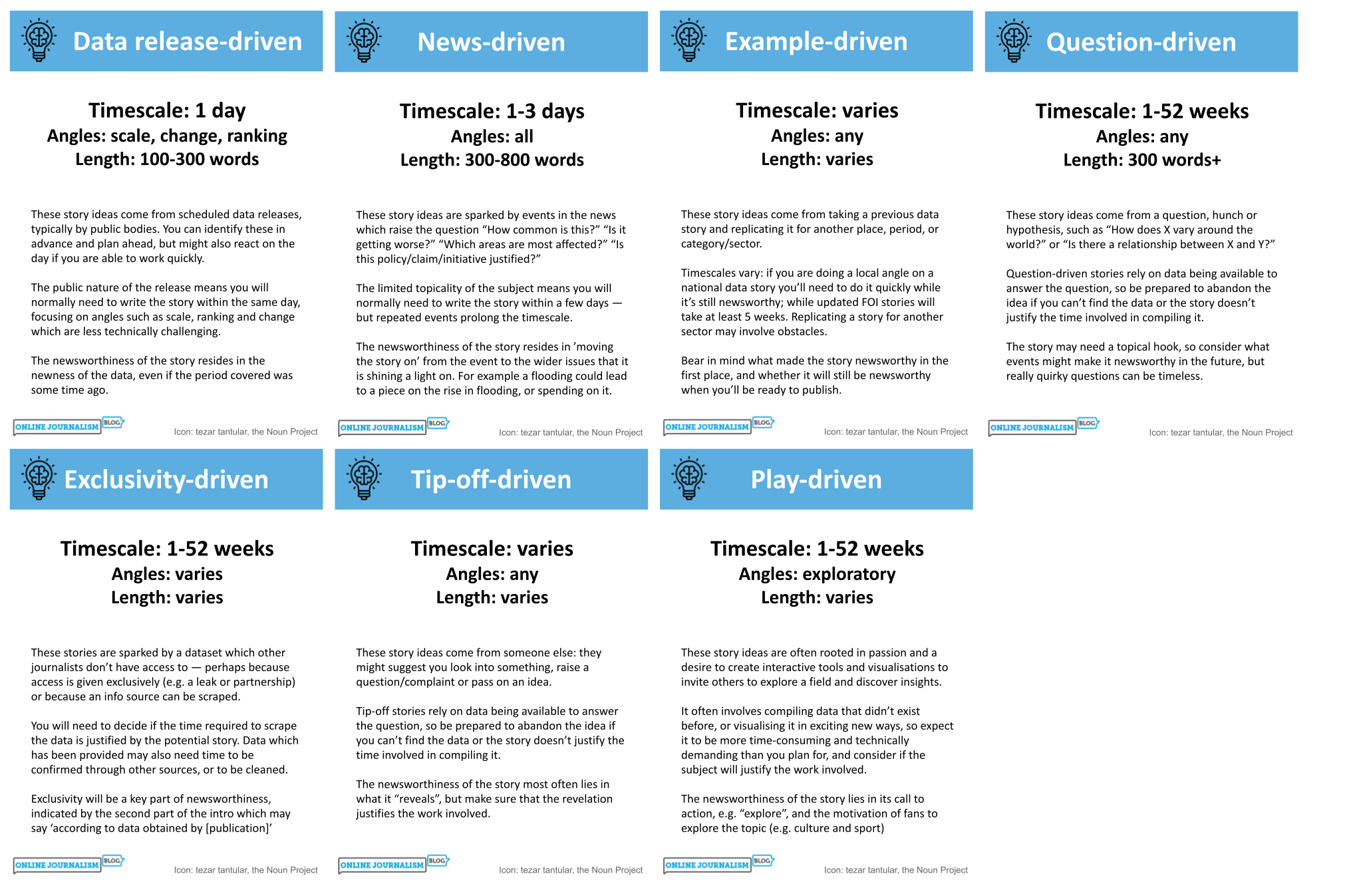
Journalists get hold of data using four broad approaches: it might be newly published or issued; it might be leaked; they might request it; or they might seek it out based on an idea or in reaction to a news event.

In this second short video first made for students on the MA in Data Journalism at Birmingham City University and shared as part of a series of video posts, I go through the different ways that journalists obtain data and the different types of story that those sources can lead to.

VIDEO: What is data journalism — and why is it growing so much?

Data journalism isn’t just about spreadsheets and interactives: in this video from my MA Data Journalism classes at Birmingham City University I look at why the news industry has expanded its focus on data journalism over the past decade, and how thinking about definitions of data journalism can help reporters think more broadly about potential stories and subjects beyond official statistics.

I also look at related terms such as computational journalism, robot journalism and augmented journalism — and what we can learn from those definitions as practitioners.

This is part of a series of videos recorded during the coronavirus pandemic.

VIDEO: How to write for the web (BASIC principles)

The best online journalism has a range of qualities: it tends to be succinct, easy to scan, and it considers how a user might interact with it — whether through links or embedded elements, or more conversational elements like comments and social media hashtags.

One way to remember those qualities is the mnemonic BASIC: Brevity; Adaptability; Scannability; Interactivity; and Community/Conversation. In the video below I talk through those five qualities, and how to put them into practice when writing for the web.

This video was first made for students on the MA in Multiplatform and Mobile Journalism and the MA in Data Journalism at Birmingham City University and is shared as part of a series of video posts. A shorter version can also be found here.

VIDEO: What makes a good email newsletter

Email newsletters are an excellent way for journalism students to build a profile in a field while also improving their specialist knowledge and editorial skills. I’ve put together a short video guide on some of the key techniques to use when starting an email newsletter — and why it’s a great way to stand out in the jobs market.

The video outlines three typical purposes of newsletters, the importance of visuals and links, and other key qualities of the genre. Watch it below.

This video was first made for journalism students on Birmingham City University’s MA in Multiplatform and Mobile Journalism. It also includes some advice on referencing reading and evidence in an evaluation of students’ work.

Here’s a story about a celebrity fashion charity which provides some useful tips and tricks for journalists using company accounts

If you follow me on Twitter you’ll know every so often I highlight a story which uses company accounts. This latest one has celebrity and fashion, and involves a charity that’s raising money through star-studded events — what more can you ask for?

It’s a great excuse to find out about a range of techniques for finding stories and background in company accounts. Follow the thread from the tweet embedded below, or read it on Threadreader here.