Category Archives: newspapers

Guest post: Do we need moderation guidelines for dealing with mental health issues?

Last month the Press Complaints Commission made a judgement in a case involving discriminatory comments on a newspaper article. The case highlighted the issue of journalism on mental health and how it is treated by publishers alongside similar considerations such as sexuality, gender, religion and ethnicity. The complaint also led to a change in The Guardian’s moderation rules.

In a guest post for the Online Journalism Blog the person who brought that case, Beatrice Bray, writes about her experiences of comment abuse, and the role she feels publishers should take in dealing both with comments relating to mental health, as well as writers with mental health issues.

Last April I wrote a rallying cry for the Guardian for all who have endured taunts about mental ill health. In my reply article Cartoonists should be careful how they portray mental health (23/4/10) I reclaimed the word “psychotic”. Guardian cartoonist Martin Rowson had used the word to abuse Mrs Thatcher. I put him right.

I am a long-standing reader of the Guardian newspaper but I did not know the website audience. Being a proud campaigner I told Guardian readers that I had bipolar disorder and had experienced psychosis.

I expected a civil hearing. Newspaper readers did oblige but many online readers were foul.

The Guardian’s managing editor Chris Elliott did not warn me about the impending abuse. That was a mistake. I think Mr Elliott knew I would face hostility but I do not think he realised how badly I would be hurt.

Those insults made me physically sick. My head was sore for many weeks. This was all so pointless. If Mr Elliott had given me a chance to discuss the risks involved we both could have taken precautions. Instead there was a row.

Guardian staff gave me an apology but told me to grow a “thick skin”. That jibe spurned me into going to the Press Complaints Commission. It is free. It is also less adversarial and less costly than a disability tribunal.

I was not asking for anything unprecedented. The BBC has guidelines on working with vulnerable people. We need to extend this to new media.

Working with vulnerable people

For example when dealing with discussion sites moderators need to deal swiftly with abuse. They also must facilitate discussions so that they do not turn nasty.

Staff should appreciate the reasons for this action. This is not prima donna treatment. This action is necessary because the writer and many of the readers share a common disability. They all have mental health problems.

Section 2 of the PCC Editors’ code promised fairness to complainants. I thought it only fair to ask for warning of abuse but in my PCC ruling the Guardian and the PCC disagreed with me. The PCC did not say why.

However, I did score other points.

Before the PCC ruling the Guardian at my request did add the word “disability” to its moderation rules.

The PCC and the Guardian and did apologise with regard to the abuse.

Guardian online readers called me, amongst other things, a “nutter” and a “retard”. Unfortunately both the Guardian and PCC refused to accept that this was discrimination as defined by the terms of section 12 of the Editor’s code of the PCC.

This is not just semantics. To me the word “discrimination” is a word with power. It holds the abuser responsible but the PCC fights shy of doing that online.

I now know that you can only complain to the PCC if a staff member makes a discriminatory remark about you. Comments made by non-staff members do not fall within the PCC’s remit. My abusers were not Guardian staff.

It is a shame. By being discrimination deniers both the Guardian and the PCC cut themselves off from a store of knowledge on handling disability and mental health in particular.
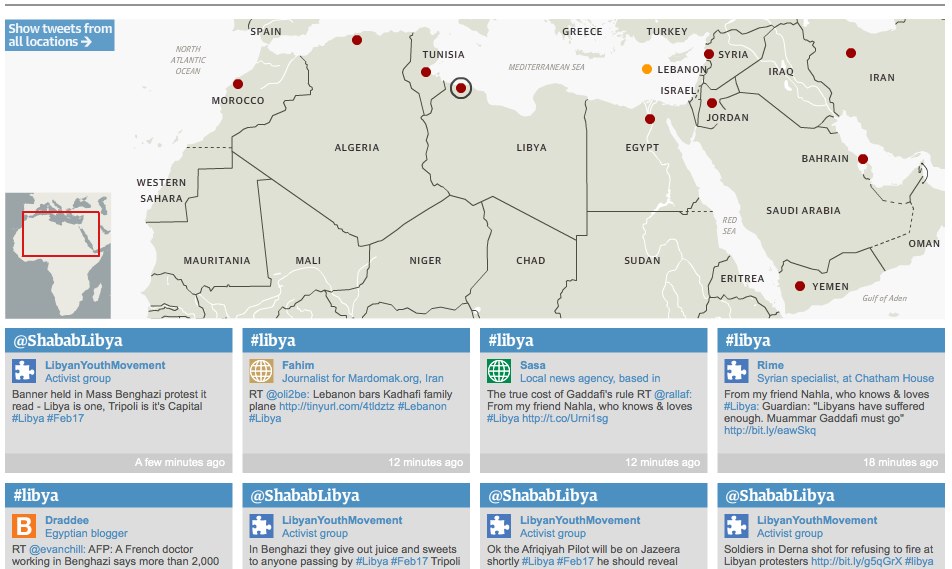
Matt Wells on The Guardian’s interactive protests Twitter map

Twitter network of Arab protests - interactive map | guardian.co.uk

Twitter network of Arab protests – interactive map | guardian.co.uk

The Guardian have published an impressive map displaying Twitter coverage of protests around the Arab world and the Middle East. I asked Matt Wells, who oversaw the project, to explain how it came about.

The initial idea, which I should credit to deputy editor Ian Katz, was to build something that showcased the tweets of our correspondents, along a broader network of vetted tweeters in different countries. We wanted to connect all of these on a map, so you could click on a country and see relevant live-updating tweets.

I was asked to oversee it. The main thing was to check out the best English-language tweeters in each country – preferably people who appeared reliable, who were involved in first-hand reporting themselves, and who did a lot of retweeting of others.

I started by asking our correspondents who they followed, then broadened it out from there. We asked everyone if they minded being included – we had one refusal from a Tweeter in a particularly authoritartian country who was worried about the exposure. Everyone else thought it was a great idea.

Meanwhile one of our developers, Garry Blight, overseen by Alastair Dant, set about building it. As with anything of this kind, it took a bit longer than orginally anticipated, but we had it ready on the day that Mubarak fell. And brilliantly, it has worked for every country since then.

It’s powered by a Google spreadsheet – so it’s really easy to add new people and to attach them to particular countries or search terms.

And it should be very easily adaptable for other news events around the world.

Serene Branson: The Sun changes its story – but not the URL

Serene Branson Grammys Stroke story 3am

It appears last week’s guidance from the PCC on correcting URLs as well as the contents of stories has not reached The Sun. Serene Branson’s on-air slurring was initially mocked by the tabloid with the headline “Grammy’s reporter goes gaga”. When it emerged that the presenter may have* suffered from a stroke the article was rewritten – but not the URL:

sun_SereneBranson_URL

The Daily Record, meanwhile, have changed their URL as well as the headline (or their content management system has done it for them). 3am haven’t changed anything (see image at top).

A further issue occurs here too: comments posted on the original Sun story remain, but now – under a now more sober report – these appear insensitive.

More recent commenters can be seen criticising these older comments, and without any notice on the article that it has been updated, those commenting under their real names could argue that their reputations are being damaged as a result.

Certainly there’s an ethical issue here: if you change a story so substantially that original comments now no longer apply, should you remove them?

Via Dave Lee, whose post ‘Serene Branson: The disturbing viral that shames us all‘ should also be read.

*UPDATE: The station website says she was examined by paramedics but not hospitalized. “Her vital signs were normal” and “she says that she is feeling fine this morning”.

Sources fight back: fabrication, complaints, and the Daily Mail

Juliet Shaw writes in a guest post on No Sleep ‘Til Brooklands about her experience of fighting The Daily Mail through the courts after they published an apparently fabricated article (her dissection of the article and its fictions is both painstaking and painful).

There is no happy ending, but there are almost 100 comments. And once again you are struck by the power of sources to tell their side of the story. For Juliet Shaw you could just as well read Melanie Schregardus, or the Dunblane Facebook Group.

Among the comments is Mail reader Elaine, who says

“I have always taken their stance and opinions with a large doze of salt. It will be even larger now. Thank goodness for the internet – as a balance to the Mail I can access the Guardian and the Independent to see their take on a particular world/UK event.”

But also in the comments are others who say they have suffered from being the subject of fabricated articles in the Mail – first Catherine Hughes:

“The article was so damaging to my freelance career that editors I was working with now no longer answer my emails. ‘Heartbroken, devastated and gutted’ doesn’t even come close to how I feel. It happened in September and I am still distraught.”

Then Pomona:

“[I have] been a victim of the Daily Fail’s “journalism” on two occasions: once when my first marriage broke up and they printed a lurid and utterly innaccurate story about me (I’m no celeb, just Jo Public), and more recently when one of their journalists lifted and printed a Facebook reply to their request for information (leaving out the bit where I told them I did not permit them to use or reprint any part of my post)”

And Anonymous:

“The Daily Mail said they were looking for a real life example of a similar case of teachers exploiting trust to complement a news story. They promised to protect my anonymity, use only a very small picture and as one of a number of case studies. A week later a double page spread – taken up mostly with a picture of me – bore the headline ‘Dear Sir, I think I Love you’. The quotes bore no resemblance to what I said and made it sound like I liked the teacher?! Instead of what really happened – a drunken shuffle in the back of a car and a feeling of abuse of trust and sadness the next day.”

Jon Morgan:

“When the article was published, my role as welfare officer was never mentioned, the average overdraft had become *my* overdraft, and I was apparently on the verge of jacking in my studies in despair.”

Anonymous:

“I applied as a case study, the photoshoot, the invasive questions. Took months to get my expenses after dozens of ignored emails. Thankfully the article never went to print. At the time I was annoyed but now I am thankful. I also work in PR and would feel extremely uncomfortable offering anyone as a case study for a client. No matter how large the exposure.”

Dirtypj:

“I complained to the editor. He insisted that all journalists identify themselves as such every time. And that his employee had done no wrong. In short, he was calling ME a liar. And as all interviews are recorded he could prove it. I said, Okay, listen to the recording then! He replied, No, I don’t need to. I stand by my writers.”

Other comments mention similar experiences, some with other newspapers. It’s a small point, driven home over and over again: power has shifted.

The Independent’s Facebook innovation

The-Independent-Robert-Fisk

The Independent newspaper has introduced a fascinating new feature on the site that allows users to follow articles by individual writers and news about specific football teams via Facebook.

It’s one of those ideas so simple you wonder why no one else appears to have done it before*: instead of just ‘liking’ individual articles, or having to trudge off to Facebook to see if there’s a relevant page you can become a fan of, the Indie have applied the technology behind the ‘Like’ button to make the process of following specific news feeds more intuitive.

To that end, you can pick your favourite football team from this page or click on the ‘Like’ button at the head of any commentator’s homepage. The Independent’s Jack Riley says that the feature will be rolled out to columnists next, followed by public figures, places, political parties, and countries.

The move is likely to pour extra fuel on the overblown ‘RSS is dying‘ discussion that has been taking place recently. The Guardian’s hugely impressive hackable RSS feeds (with full content) are somewhat put in the shade by this move – but then the Guardian have generated enormous goodwill in the development community for that, and continue to innovate. Both strategies have benefits.

At the moment the Independent’s new Facebook feature is plugged at the end of each article by the relevant commentator or about a particular club. It’s not the best place to put given how many people read articles through to the end, nor the best designed to catch the eye, and it will be interesting to see whether the placement and design changes as the feature is rolled out.

It will also be interesting to see how quickly other news organisations copy the innovation.

*If I told you I said this deliberately in the hope someone would point me to a previous example – would you believe me? Martin Stabe in the comments points to The Sporting News as one organisation that got here first. And David Moynihan points out that NME have ‘Like’ buttons for each artist on their site.

More coverage at Read Write Web and Future of Media.

Plagiarists should at least be *competent* plagiarists – Media Ooops 002

This is a shorter version of an article appearing on the Wardman Wire.

Plagiarism is an interesting game.

You can either rewrite the piece, find a bit more information, leave other bits out, and – if you’re the Daily Mail – reduce the reading age by a year or three.

Or you can acknowledge that the story came from somewhere else, and give a hat-tip for a nugget, or a small fee for an article.

Or you can try and ride both horses and end up sitting on your backside in the middle.

So, we have Exhibit A, from Dizzy Thinks:

The Department for Culture, Media and Sport has a dedicated civil servant working on the Queen’s Diamond Jubilee celebrations in 2012? Not particular shocking really, but there is an oddity.

According to an FoI release, one of the roles of this civil servant is the development of equalities impact assessment for the Queen’s celebratory bash. Why does a celebration for one person need an equalities impact assessment?

Mind you, as an eagle-eyed reader put to to me. Perhaps it’s because she’s (a) a woman, (b) a pensioner, (c) dependent on state benefits, and (d) married to an immigrant?

and Exhibit B, from the Daily Mail:

The Department for Culture, Media and Sport has a dedicated civil servant working on the Queen’s Diamond Jubilee celebrations in 2012. One of the roles of the civil servant is the development of an ‘equalities impact assessment’. Why does a ­celebration for one person need an equalities impact assessment? Is it because she’s a woman, a pensioner, relies on the state for handouts — and is married to a foreigner?

The two are nearly the same, and it’s only an item in a Diary column, for heaven’s sake. A tip would cost about twenty pounds or a gift voucher, and an acknowledgement would cost nothing.

(Hat-tip: Dizzy).
[Update: re-edited]

FAQ: Data journalism, laziness, information overload & localism

I seem to have lost the habit of publishing interview responses here under the FAQ category for the past year, but the following questions from a journalist, and my answers, were worth publishing in case anyone has the same questions:

Simon Rogers, Editor of the Datablog, said that he thinks in the future simply publishing the raw data will become acceptable journalism. Do you not think that an approach like this to raw data is lazy journalism? And equally, do you think that would be a type of journalism that the public will really be able to engage with?

It’s not lazy at all, and to think otherwise is pure journalistic egoism. We have a tendency to undervalue things because we haven’t invested our own effort into it, but the value lies in its usefulness, not in the effort. Increasingly I think being a journalist will be as much about making journalism possible for other people as it will be about creating that journalism yourself. You have to ask yourself: do I just want to write pretty stories, or allow people to hold power to account?

In a world where we can access information directly I think it’s a central function of journalists to make important information findable. The first level of that is to publish raw data.

It’s interesting to see that this seems to be a key principle for hyperlocal bloggers – making civic information findable.

The second level – if you have the time and resources – is then to analyse that raw data and pull stories out of it. But ultimately there will always be other ‘stories’ in the information that people want to find for themselves, which may be too specific to be of interest to the journalist or publisher.

The third level – which really requires a lot of investment – is to create tools that make it easier for the user to find what they want, to make it easier to understand (e.g. through visualisation), and to share it with others.

Do you think that alot of the information can be quite overwhelming and sometimes not go anywhere?

Of course, but that isn’t a reason for not publishing the information. It’s natural that when the information is released some of it will attract more attention than other parts – but also, if other questions come up in future there is a dataset that people can go back and interrogate even if they didn’t at the time.

At the moment we have a lot of data but very few tools to interrogate that. That’s going to change – just in the last 6 months we’ve seen some fantastic new tools for filtering data, and the momentum is building in this area. It’s notable how many of the bids for the Knight News Challenge were data-related.

Additionally, do you tihnk The Guardian continue to pursue stories from the masses of data as consistently as they have done in previous years?

Yes, I think the Guardian has now built a reputation in this field and will want to maintain that, not to mention the fact that its reputation means it will attract more and more data-related stories, and benefit from the work of people outside the organisation who are interrogating data. They’ll also get better and better as they learn from experience.

And why do you think that smaller news resources struggle to use this sort of information as a source for news?

Partly because data has historically been more national than local. Even now I get frustrated when I find a dataset but then discover it’s only broken down into England, Wales, Scotland and Northern Ireland. But we are now finally getting more and more local data.

Also, at a local level journalists tend to be less specialised. On a national you might have a health or environment or financial reporter who is more used to dealing with figures and data. On a local newspaper that’s less likely – and there’s a high turnover of staff because of the low wages.

CCTV spending by councils/how many police officers would that pay? – statistics in context

News organisations across the country will today be running stories based on a report by Big Brother Watch into the amount spent on CCTV surveillance by local authorities (PDF). The treatment of this report is a lesson in how journalists approach figures, and why context is more important than raw figures.

BBC Radio WM, for example, led this morning on the fact that Birmingham topped the table of spending on CCTV. But Birmingham is the biggest local authority in the UK by some distance, so this fact alone is not particularly newsworthy – unless, of course, you omit this fact or allow anyone from the council to point it out (ahem).

Much more interesting was the fact that the second biggest spender was Sandwell – also in the Radio WM region. Sandwell spent half as much as Birmingham – but its population is less than a third the size of its neighbour. Put another way, Sandwell spent 80% more per head of population than Birmingham on CCTV (£18 compared to Birmingham’s £10 per head).

Being on a deadline wasn’t an issue here: that information took me only a few minutes to find and work out.

The Press Association’s release on the story focused on the Birmingham angle too – taking the Big Brother Watch statements and fleshing them out with old quotes from those involved in the last big Birmingham surveillance story – the Project Champion scheme – before ending with a top ten list of CCTV spenders.

The Daily Mail, which followed a similar line, at least managed to mention that some smaller authorities (Woking and Breckland) had spent rather a lot of money considering their small populations.

There’s a spreadsheet of populations by local authority here.

How many police officers would that pay for?

A few outlets also repeated the assertions on how many nurses or police officers the money spent on surveillance would have paid for.

The Daily Mail quoted the report as saying that “The price of providing street CCTV since 2007 would have paid for more than 13,500 police constables on starting salaries of just over £23,000”. The Birmingham Mail, among others, noted that it would have paid the salaries of more than 15,000 nurses.

And here we hit a second problem.

The £314m spent on CCTV since 2007 would indeed pay for 13,500 police officers on £23,000 – but only for one year. On an ongoing basis, it would have paid the wages of 4,500 police officers (it should also be pointed out that the £314m figure only covered 336 local authorities – the CCTV spend of those who failed to respond would increase this number).

Secondly, wages are not the only cost of employment, just as installation is not the only cost of CCTV. The FOI request submitted by Big Brother Watch is a good example of this: not only do they ask for installation costs, but operation and maintenance costs, and staffing costs – including pension liabilities and benefits.

There’s a great ‘Employee True Cost Calculator‘ on the IT Centa website which illustrates this neatly: you have to factor in national insurance, pension contributions, overheads and other costs to get a truer picture.

Don’t blame Big Brother Watch

Big Brother Watch’s report is a much more illuminating, and statistically aware, read than the media coverage. Indeed, there’s a lot more information about Sandwell Council’s history in this area which would have made for a better lead story on Radio WM, juiced up the Birmingham Mail report, or just made for a decent story in the Express and Star (which instead simply ran the PA release UPDATE: they led the print edition with a more in-depth story, which was then published online later – see comments).

There’s also more about spending per head, comparisons between councils of different sizes, and between spending on other things*, and spending on maintenance, staffing (where Sandwell comes top) and new cameras – but it seems most reporters didn’t look beyond the first page, and the first name on the leaderboard.

It’s frustrating to see news organisations pass over important stories such as that in Sandwell for the sake of filling column inches and broadcast time with the easiest possible story to write. The result is a homogenous and superficial product: a perfect example of commodified news.

I bet the people at Big Brother Watch are banging their heads on their desks to see their digging reported with so little depth. And I think they could learn something from Wikileaks on why that might be: they gave it to all the media at the same time.

Wikileaks learned a year ago that this free-to-all approach reduced the value of the story, and consequently the depth with which it was reported. But by partnering with one news organisation in each country Wikileaks not only had stories treated more seriously, but other news organisations chasing new angles jealously.

*While we’re at it, the report also points out that the UK spends more on CCTV per head than 38 countries do on defence, and 5 times more in total than Uganda spends on health. “UK spends more on CCTV than Bangladesh does on defence” has a nice ring to me. That said, those defence spending figures turn out to be from 2004 and earlier, and so are not exactly ideal (Wolfram Alpha is a good place to get quick stats like this – and suggests a much higher per capita spend)

Manchester Police tweets and the MEN – local data journalism part 2

Manchester Evening News visualisation of Police incident tweets

A week ago I blogged about how the Manchester Evening News were using data visualisation to provide a deeper analysis of the local police force’s experiment in tweeting incidents for 24 hours. In that post Head of Online Content Paul Gallagher said he thought the real benefit would “come afterwards when we can also plot the data over time”.

Now that data has been plotted, and you can see the results here.

In addition, you can filter the results by area, type (crime or ‘social work’) and category (specific sort of crime or social issue). To give the technical background: Carl Johnstone put the data into a mysql database, wrote some code in Perl for the filters and used a Flash applet for the graphs. Continue reading