Category Archives: newspapers

FAQ: How can news organisations compete at a hyperlocal level? (and other questions from AOP)

These questions were submitted to me in advance of the next AOP meeting, on ‘Microlocal Media’, and have been published on the AOP site. As usual, I’m republishing here as part of my FAQ series.

Q. How can publishers compete with zero-cost base community developed and run sites?

They can’t – and they shouldn’t. When it comes to the web, the value lies in the network, not in the content. Look at the biggest web success story: Google. Google’s value – contrary to the opinion of AP or Rupert Murdoch or the PCC – is not in its content. It is in its connections; its links; its network. You don’t go to Google to read; you go there to find. The same is true of so many things on the internet. One of the problems for publishers is that people use the web as a communications channel first, as a tool second, and as a destination after that. The successful operations understand the other two uses and work on those by forging partnerships, and linking, linking, linking. Continue reading

FAQ: How would paywalls affect advertisers? (and other questions)

More questions from a student that I’m publishing as part of the FAQ section:

1. If News Corp starts charging for news stories, do you think readers would pay or they would just go to different newspapers?

Both, but mostly the latter. Previous experiments with paywalls saw audiences drop between 60 and 97%. And you also have to figure in that a paywall will likely make content invisible to search engines (either directly or indirectly, because no one will link to them which will drop their ranking). Search engines are responsible for a significant proportion of visits (even the Wall Street Journal receives a quarter of its traffic from Google). Still, some people will always pay – the question is: how many? Continue reading

What if a newspaper was designed using principles of user experience design?

What if a newspaper was designed using principles of web user experience design*? That’s the question that design agency Information Architects asked themselves when they put together a pitch for Swiss newspaper Tages-Anzeiger. They lost the pitch, but the blog post about their ideas is fascinating reading for anyone interested in usability and reinventing the print package for a multiplatform world.

front page

Their innovations included making the text scannable with blue text for key words (see above), high contrast, and being limited to two fonts. They cleaned up the logo (optimising it, essentially), and printed comments next to the articles they commented on. The blog post contains lots more images. In addition, they’ve put the original PDFs of their pitch online too – linked below:

Garcia Media has more context including why Garcia felt they failed.

H/t: Adrian Short. *I should have said user experience design not web design, which was the original headline.

Sun misjudges readers’ mood over Gordon Brown letter

The Sun is running a despicable campaign against Gordon Brown. But I’ve analysed the comments on its website – and readers disagree with its stance by a ratio of more than 3 to 2 (on top of which, there are now accusations that the Sun is censoring pro-Brown comments).

The paper has exploited the grief of Jacqui Janes over her son Jamie’s death in Afghanistan to attack the PM – because his handwritten letter of condolence was supposedly disrespectful due to sloppy writing and (disputed) spelling errors.

It’s loathsome journalism that ignores the effect of his disability (the PM is blind in one eye).

And it seems Sun readers are mostly on the Prime Minister’s side.

Of the 100+ comments on the story (don’t worry, I’ve nofollowed those links) when I checked, 111 expressed a view for or against Jacqui Janes or Gordon Brown (the rest commented on other issues or corrected people’s spelling errors). Of these:

  • 42 were anti Gordon or pro the Sun’s stance.
  • 69 were pro Gordon or anti the Sun’s stance.

So that’s more than 60% who don’t agree with the Sun, and less than 40% who do.

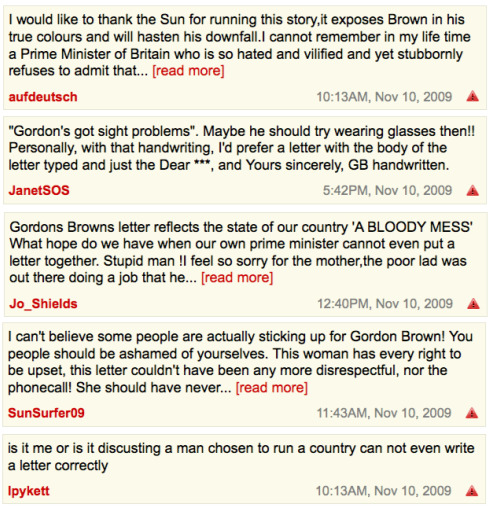
Sample comments from those who agree with the Sun’s stanceanti-gordon-brown

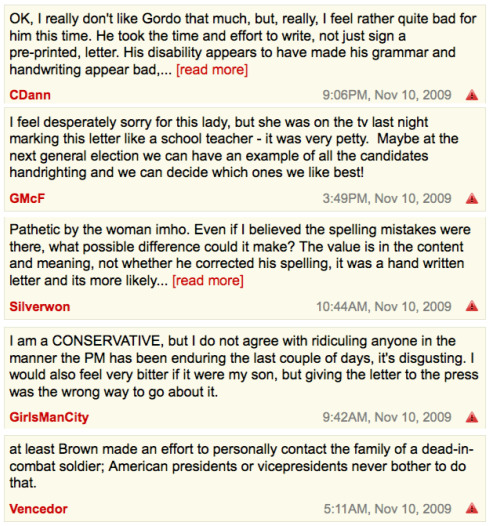
Some comments from those opposing itpro-gordon-brown

Conclusion

The Sun is channeling this woman’s grief into a personal attack on the Prime Minister.

It’s refusing to make allowances for his disability (maybe we could next attack the war wounded for being workshy benefit scroungers?).

And it’s facilitating her breaking data protection laws by releasing a recording of a private phone call.

The whole thing is sickening – let’s hope that observing its readers’ reactions will lead to an end to this (not that this happened in the Jan Moir case) – and preferably prosecution of the Sun over the data protection offence. What’s more, Daily Mail readers are pro Brown, too. The Sun has got this badly wrong.

Twit-Fit of the Week: It’s Monday, so let’s Wibble about Twitter…

Articles in newspapers complaining about bloggers and twitter users seem to come along like bills from the taxman – at a rate of about 5 a week.

We have had the remarkable exhibit of Janet Street-Porter (or “Janet Self-Publicist”) complaining about “publicity seeking bloggers“, and more recently Rachel Sylvester starting a pop-psychology consultancy practice for sad and lonely individuals possessed by the Twitter demon.

Last Monday, Nicholas Lezard, the usually literate writer for the Guardian and the Independent, had what I would call a “Twit-Fit”, wibbling furiously for an entire 700 words against Twitter – here.

This is my commentary cum translation. A little light relief for a Sunday, and I hope that Paul Bradshaw doesn’t give me an ASBO.

So you’re eating lunch? Fascinating

(I only read boring Twitter accounts)

Stephen Fry … Twitter

(faux introductory wibble … let’s set up the target)

I have nothing against Stephen Fry

(lots of my friends use Twitter, so I am not prejudiced … I have the right to quibble wibble)

but I CERTAINLY have something against Twitter

(pop-polemical wibble)

The name tells us straightaway

(pop-etymological wibble)

it’s inconsequential, background noise, a waste of time and space

(unintentionally self-revelatory wibble)

Actually, the name does a disservice to the sounds birds make, which are, for the birds, significant, and, for the humans, soothing and, if you’re Messiaen, inspirational

(arty-farty-Primrose-Hill-party wibble)

But Twitter? Inspirational?

(well, it isn’t when you can’t hear for your own ranting)

The online phenonemon is about humanity disappearing up it’s own fundament, or the air leaking out of the whole Enlightenment project

(I just managed to look over Nigel Molesworth‘s shoulder, and I cribbed a bit from his 2nd year philosophy test, Hem-Hem)

It makes blogging look like literature

(I have a whole quiverful of cookie-cutter stereotypes, and boy am I going to use them)

It’s anti-literature, the new opium of the masses

(Clickety-click! I taught Blue Peter how to prepare things earlier, and this one is from 1843)

It’s unreflective instantaneousness encourages neurotic behaviour in both the Tweeter and the Twatters

(Dear Damien Hirst, can I be your Press Officer ? )

Seriously, the Americans have proposed that “twatted” should be the past participle of “tweet”

(Obviously there are 300 million identical cardboard-cut-out idiots across the pond. Perhaps “stereotroped” should be the past participle of “stereotype”)

It encourages us in the delusion that our random thoughts, our banal experiences, are significant

(I want to be Alain de Botton when I grow up, Blankety-Blank)

It is masturbatory and infantile, and the amazing thing is that people can’t get enough of it – possibly because it IS masturbatory and infantile

(or ############, Yankety-Yank)

(redacted to avoid being sued by a certain award-winning journalist)

Oh God, that it should have come to this. Centuries of human thought and experience drowned out in a maelstrom of inconsequential rubbish.

(Does Andrew Keen or David Aaronovitch need a ghost-writer for when they are on holiday? )

Don’t tell me about Trafigura – one good deed is not enough

( don’t tell me about the hundreds of other achievements either; the last thing I need is facts – or reality – interfering with my opinions)

(My Rachel Sylvester piece includes a list of about 10 examples of how Twitter can be used positively that I compiled last March).

and an ordinary online campaign would have done the trick just as well

(bollocks …. no other online forum has anything like the permeability or reaction speed of Twitter)

It is like some horrible science-fiction prediction come to pass: it is not just that Twitter signals the end of nuanced, reflective, authoritative thought – it’s that no one seems to mind

(pleeeeeeeease … SOMEBODY … I’ll even write leaders for the Daily Mail)

And I suspect that it’s psychologically dangerous

( Was it Twitter that did for Gordon Brown?)

We have evolved over millions of years to learn not to bore other people with constant updates about what we’re doing,

(I didn’t consult my partner before writing this column)

and we’re throwing it all away

(which is what would have happened if I had consulted my partner)

Twitter encourages monstrous egomania, and the very fact that Fry used Twitter to announce that he was leaving Twitter shows his dependence on it.

(Unlike being an opinionated columnist, of course, Hem Hem)

He was never going to give it up. He’s addicted to it.

(And – finally – did I tell you that I am a self-qualified Doctor able to diagnose from afar)

(Hem-Hem)

Wrapping Up

I really have trouble understanding why some people just do not seem to appreciate the positive side of Twitter, although many of them seem to be general commentators inside the London media bubble.

I suspect that it could be that the main benefits of Twitter (and blogging) have made to make politics and media more permeable, and have made it possible for a far wider group of people to engage in the political debate without going through the media filter.

The point is that if you are inside the bubble and already get politicians reply to your emails in person because you work for an organisation they have heard of, then all of these seem to be unwelcome threats, rather than benefits or opportunities.

Bye-bye media bubble, I hope.

Five factors that foster innovation in the online newsroom

I recently heard a newspaper chief editor say something quite shocking. I attended a meeting arranged by the Norwegian consortium New Media Network where the chief editor of the second biggest national tabloid in Norway, Dagbladet, was to give a speech. And believe it or not, chief editor of Dagbladet, Anne Aasheim, said: “I have been a media executive for 20 years now and I must say; it’s more fun today than ever before!”

More fun today than ever before?  Everybody at the meeting knew that Dagbladet has suffered massive losses in recent years – much more than their competitor VG, which is the flagship of Schibsted, one of Europe’s most successful and innovative newspaper publishers, according to The New York Times. Dagbladet is probably the newspaper that has suffered the most in the Norwegian newspaper market in recent years. What could possibly be fun about that? Was Anne Aasheim joking?

Anne Aasheim wasn’t joking. She soon explained what she meant: “When the crisis becomes big enough you no longer just mend things. Your tear everything apart and then you re-construct it. We are now searching for the power to do disruptive innovation. It’s going to be a cut-throat competition to have the greatest power of innovation.”

Then she smiled before exclaiming: “And we are gonna win that competition!”

I thought this was an interesting argument – especially since I have conducted much research in the Dagbladet newsroom during the last four years. Dagbladet is one of those newspapers that always wants to be the first mover. When new technology comes around Dagbladet jumps on it. Dagbladet was the first Norwegian newspaper to launch an online edition, it implemented bloging as the first online newspaper in Scandinavia, etc, etc. Dagbladet’s position in the shadow of the bigger and more successful newspaper VG has forced it to push for innovative initiatives.

The key question for Dagbladet and any other firm that push for successful innovations, is of course: How do you know if a innovative initiative will be a success? I shall not claim that I have the answer to that question (if I did, I would probably be very rich man). However, I have done some research in order to pinpoint the factors that influence processes of innovation in newsrooms. In an article in the current issue of the journal Journalism Studies I argue that there are five factors that affect whether an innovation is diffused successfully or not in an online newsroom:

  1. Newsroom autonomy: are innovative projects initiated and implemented within an autonomous newsroom and with relative autonomy within the online newsroom? (If not, the project is less likely to succeed)
  2. Newsroom work culture: does the online newsroom reproduce editorial gatekeeping or are alternative work cultures explored? (reproduction of “old media” work cultures is likely to prevent innovative initiatives from being successful)
  3. The role of management: is newsroom management able to secure stable routines for innovation?
  4. The relevance of new technology: is new technology perceived as relevant, i.e. efficient and useful? (New technology can be costly and time consuming to utilize)
  5. Innovative individuals: is innovation implemented and understood as part of the practice of journalism?

These factors derive from an ethnographic case study of a process of innovation in dagbladet.no – the online edition of Dagbladet. The findings of this case study are compared to all other research on innovations (or lack of innovations) in online newspapers. This body of research consist of – among many other studies – the research done by Pablo Boczkowsi in his book Digitizing the News: Innovation in Online Newspapers; David Domingo’ Ph.D-thesis Inventing online journalism: Development of the Internet as a news medium in four Catalan newsrooms (which can be downloaded here); Lucy Küng’s When Innovation Fails to Disrupt. A Multi-lens Investigation of Succesfull Incumbment Respons to Technological Disconuity: The Launch of BBC News Online; and Jody Brannon’s quite old, but still very interesting Ph.D.-thesis Maximizing the medium: assessing impediments to performing multimedia journalism at three news web sites (parts of it available on here website).

One last point: Innovation and crisis tend to go hand in hand. Businesses, organisations and nation states alike have always pushed for innovations in times of crisis. There are two reasons for this assumed causal link between recession and innovation, according to an article by Geroski and Walters published in The Economic Journal. First, in times of recession the value of existing rents usually falls, thus making it more attractive for firms to implement new products and processes that hopefully will yield higher returns. Second, to invest in innovations requires a firm to divert resources from activity/production to product development. Such a diversion of resources is more likely to be feasible when the current production is less profitable, e.g. in times of recession.

No wonder why the chief editor of Dagbladet, Anne Aasheim, was so enthusiastic about the opportunities for disruptive innovation…

Guardian makes its comments accessible, SEO friendly and mobile friendly all in one go!

The Guardian has changed its user-generated comment system – moving from a client-side system to a server-side one. (This story was first published here, where you can read a bit more of the background.)

With the old system, once you loaded a story, some javascript would go off and look up readers’ comments and display them. This wasn’t terribly accessibleif you couldn’t or didn’t run javascript, you couldn’t see the comments.

It was also bad for SEO, as search engines couldn’t run the javascript (so couldn’t see the comments). And if your mobile didn’t run javascript (like mine), you couldn’t read the comments either.

With the new system, the comments are just part of the web page, like all the rest of the text.

This is a great change by the Guardian, and not before time. Google has already started to index the text of comments, as this search for some text I left as a comment once shows.

If you notice any problems, they’ve asked you to point them out.

Growth of Newspaper Twitter accounts running out of steam

English national newspaper Twitter accounts continue to grow – but at an ever slower rate, according to the latest figures for the 130 accounts I’m tracking:

The detail

These 130 accounts had 1,801,811 followers on November 2nd, up by 137,568 from 1,664,243 on October 1. Of that increase, 95,007 (or 69%) was for the @guardiantech account (which benefits from being on Twitter’s suggested user list).

(NB the Telegraph has renamed its @TelegraphScienc account, so this month I’ve restated October’s figures to be for 130 accounts – I thought it had deleted it when I downloaded the latest figures.).

The biggest mover was @MirrorFootball, up 11 places to 81st (from 455 to 809 followers), suggesting the Mirror is finally making some use of Twitter (most of its other accounts are near the bottom – and only appear to have moved up a place due to the demise of the Telegraph’s Science account).

The full spreadsheet is here or you can see the iframe below.