Category Archives: newspapers

How “organised” was the Jan Moir campaign?

Was the campaign against Jan Moir that crashed the PCC website “heavily orchestrated”? Jan Moir herself thinks so. Was it “organised”? The deputy editor of the Telegraph said it was.

If this was the case, who was organising this? “The big gay who runs the internet“? Stephen Fry?

And what do they mean by organised?

Let’s start with 3 definitions:

  1. Functioning within a formal structure, as in the coordination and direction of activities.
  2. Affiliated in an organization, especially a union.
  3. Efficient and methodical.

Of the 3 descriptions, the only one that might apply in this case is the third, and here’s the rub. Imagine the Jan Moir fuss in a world without Twitter: here’s how it unfolded:

  1. Some people read the Jan Moir article and are offended; they forward it to their friends to express disgust.
  2. People complain to the PCC. They also complain to advertisers.
  3. After a while the expressions of disgust reach a celebrity, and a columnist.
  4. The celebrity mentions the article during a public appearance; the columnist writes a column about it. The columnist mentions the parts of the Press Complaints Commission code that the article breaks. Politicians pick it up too.
  5. More people complain. They also complain to advertisers.
  6. The ‘offence’ over the article now becomes a story in itself; the celebrity angle is key to selling the story.
  7. More people complain. They also complain to advertisers.

In a world without Twitter the above might unfold over a series of days. The difference in a world with Twitter is that the above process is accelerated beyond the ability of many people to see, and they think Step 4 is where it begins.

But why does it matter if it’s organised?

But of course this isn’t about definitions, but about the discourse of what ‘organised’ means in this context. It means ‘not spontaneous’; it means ‘not genuine’; it means ‘not valid’.

Although different people may have different (oppositional, negotiated) readings I would argue this is the dominant one, where the discourse of ‘organised’ is being used to marginalise the protests. I will make a bet here that the PCC use that discourse in how they deal with the record numbers of complaints.

Stef Lewandowski hit the nail on the head when he said that it sounded “like the argument from design applied to social media”.

Help me investigate this

But what would be really interesting here is to test the hypotheses against some evidence: I want to see just how organised the ‘campaign’ was. How important were the celebrities and the formal organisations?

I’m using Help Me Investigate to see if we can work out what level of organisation there was in the campaign. So far, thanks to Kevin Sablan we have a key part of the evidence: all the #janmoir tweets since October 14. And some suggestions on how to analyse that from Ethan Zuckerman (who’s been here before): “grab all #janmoir tweets, do word freq. analysis esp on RTs, look to see if it’s grassroots or one instigator, amplified…”

If you need an invite, let me know.

And if you have any ideas how you can measure the organisation of a campaign like this, I’d welcome them.
Notes on #janmoir – don’t ‘blame’ Fry

I’ve seen a few media reports now on yesterday’s unprecedented new media revolt against the Daily Mail.

Of all of them the Huffington Post’s takes the biscuit for ‘worst take’. They reckon it’s about a fight between the Daily Mail and The Guardian. Seriously. I suspect a showbizzy intern selected their quote heavy, googled contribution.

A meme in practically all the reports is the role of Stephen Fry. This has now culminated in a Telegraph piece titled ‘Don’t laugh – Stephen Fry is giving the orders now.’

Those, like Fry, who are “deeply dippy about all things digital”, argue that the internet is the ultimate tool of democracy. But it could just be that historians – if they are so permitted – might look back on this period as the moment when the techno-savvy few seized control of the minds of the many.

The blogger Guido Fawkes seems effectively to run British politics. Ashton Kutcher – actor and tweeter with over three million followers: “life isn’t tied with a bow, but it’s still a gift” – is our spiritual leader. And Fry? Well, he’s bigger than both of them.

Where to start? Iain Dale has a lot more blog traffic than Guido. Not sure what Kutcher’s in there for save to keep the ‘celeb’s rule’ idea going (and his Twitter following like that of other Hollywood celebs doesn’t seem to translate to followers automatically watching their shows). And as for Fry?

I was actually dipping in-and-out of the #janmoir Twitter stream yesterday and very, very few of the tweets were Fry Retweets. Sure, his numbers are huge but the ‘Twitosphere’ is far, far, far huger. Presumably far too huge for most journalist’s to get their minds around.

By 2010, 26 Million (1 in 7) U.S. Adults Will Use Twitter Monthly.

Edited to add: Thanks to to commentator Ian Hopkinson for pointing to some evidence.

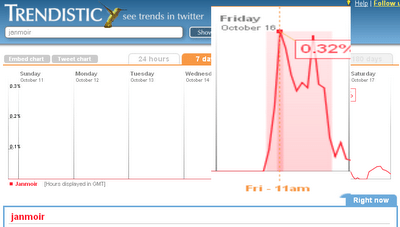
Here’s the trendastic tracking of #janmoir

Showing it peaking at 11am – @stephenfry first tweet on #janmoir was at 12:27pm.

What the ubiquitous Fry mentions in their reports are about is a journalistic laziness and the ever-present need for a celeb mention. A real piece of good work would be to actually track #janmoir all the way from where the first rock was thrown out to the furthest reach of the ripples.

Such as the excellent American analyst Evgeny Morozov‘s tweet:

notes on the new public sphere: Twitter has shrunk the Atlantic and purely local UK scandals are now global news

That’s why HuffPost bothered putting Gately on the front page – #janmoir was number one or two trending topic when they woke up, and it had that celeb angle they love. 

It’s notable that they’ve ignored what it by far the most game-changing event on Twitter this week, #trafigura – something which Gill Hornby in the Telegraph thinks is also down to Mr Fry.

From his palm-top device .. he struck a major blow for press freedom – when the Dutch company Trafigura won an order preventing the press from discussing the impact of its pollutants on the African coast, Fry tweeted the details to his vast audience and the gag was lifted.

Sigh.

Pluck out your eyes: the anatomy of a super injunction

Super injunctions – those that don’t just order a newspaper not to report something, but forbid it from reporting the existence of the reporting restrictions – are on the rise.

The Guardian has been served with at least 12 notices of injunctions that could not be reported so far this year, compared with six in the whole of 2006 and five the year before.

And Carter Ruck continue their kafkaesque moves to stop reporting about Trafigura and the Minton report (their latest attempt is to write to Parliament saying it can’t discuss the matter, at the same time as saying they’re not trying to forbid anyone reporting what Parliament discusses. That’s because there wouldn’t be anything to discuss).

So what does a super injunction look like? I’ve got hold of one – I obviously can’t say which and I’ve had to leave out the juicy bits. But here’s what it says. Continue reading

Mugging the lawyers

If the famous media gaggers, the libel law firm Carter-Ruck, scourge of Private Eye, thought they’d scored another famous victory suppressing news (these guys are big on bragging) they hadn’t reckoned with social media.

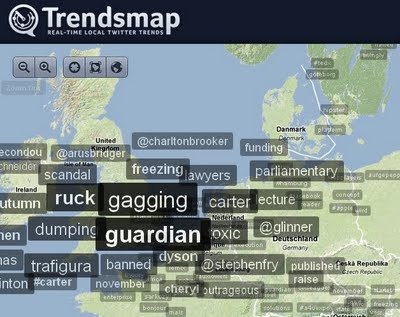
#trafigura is as I type the #1 trending topic on Twitter (that’s in the whole world). The Spectator has already broken the wall between what the blogs will say and what the print media thinks it can get away with … and many, many more people are now aware of the very story a very rich set of people running a polluting company is paying them – presumably – many millions to kill.

In a few hours American bloggers will start picking up on the story enmasse. What’s Carter-Ruck going to do then? As @ElrikMerlin just pointed out to me ‘this is Streisand Effect in action’ – something which I have blogged about before.

When Uzbek billionaire Alisher Usmanov tried the same trick, and created the same effect, it generated this quote from Boris Johnson (one of those inadvertently whacked by Usmanov’s ‘take-down’ action):

We live in a world where internet communication is increasingly vital, and this is a serious erosion of free speech.

This is what Carter-Ruck did: Continue reading

@Guardiantech accounts for 78% of the growth in national newspaper Twitter accounts

National UK newspapers had 1,665,202 followers of their Twitter accounts at the start of October – an increase of 193,266 on September 1st (when they had 1,471,936).

The rate of growth has slowed, however. This is a monthly increase of 13.1%, compared with 17% from August 1 to September 1, and also from July 1 to August 1.

What’s more, 151,555 of the increase (or 78% of the total) is down to just one account – that of @guardiantech (which owes its popularity to its place on the Twitter Suggested User List). Indeed, of the 131 accounts I’m tracking, 51 have fewer followers than me (@malcolmcoles)!

You can see the full table here, or below (although the iframe isn’t behaving properly, so you’re better off clicking here).
Continue reading

The shaping of an online feature journalist

What happens when an online newspaper decides to implement web-only feature journalism? Will the role of the online feature journalist be different from that of a print feature journalist?

These questions form the topic of a recently published article in a special issue of the academic journal Journalism focusing on the changing conditions of work and labour in the global news industry (the introduction to this special issue can be downloaded here). In the article, I argue that academic research into online journalism has been biased towards exploring online journalism as breaking news journalism, thereby to some extent neglecting the magnitude of new styles and genres that emerges in online news sites (see David Domingo’s excelent Phd dissertation (pdf) for a thorough overview of the academic research into online journalism). An increasing number of online newspapers across the world
now for instance include sections like “special reports” (e.g this section on the St. Petersburg Times online edition), “multimedia features” (like The New York Times online multimedia/photo section), ‘travel’ (e.g The Guardian online’s travel section), etc., where breaking news and immediacy in reporting are not core activities.

Such sections signal a coming together of two apparently widely different practices of journalism: feature journalism and online journalism. Feature journalism is often associated with glossy magazines and newspaper weekend sections where readers are invited to spend time, relax and take pleasure in their reading. The dominant discourses of feature journalism therefore seem to contrast with the discourse of online communication as it so far has been portrayed in research on the practice of online journalism and the evolving role of the online journalist. (For a more thorough discussion of what feature journalism is, see the paper What is feature journalism? that I recently presented at the 19th Nordic Conference for Media and Communication Research in Karlstad, Sweden)

In the article in the special issue of Journalism I investigate how the implementation of feature journalism in an online newsroom influences the role of online journalists and how the role of an online feature journalist is thus shaped. The article is based on a longitudinal, ethnographic case study of the production of feature journalism in the Norwegian online newspaper dagbladet.no (which, as the first Scandinavian online newspaper, launched a section entirely devoted to feature stories in 2002). What is interesting with this online feature section is that most of the production is web exclusive – it is produced by especially assigned online feature journalists. Feature stories that emerge online elsewhere (e.g Soundslides- and Flash-productions) tend to be spin-off products of already published newspaper productions. The dagbladet.no-case therefore represents a unique opportunity to explore how (or if) an online newsroom establish a new, online-based understanding of what feature journalism is or should be when they are left to explore the genre without influence from old media editors and journalists.

The empirical material gathered from the case study (six weeks of observation in the newsroom of dagbladet.no in four different periods from 2005 to 2007), 28 interviews with newsroom staffers, and document analysis) reveals that – in this particular case – the online feature journalists became heavily influenced by the productions routines and role performance of their online colleagues. Hence immediacy became a virtue for them – they developed a production routine where frequent publishing of new stories became important. However, the online newsroom at large was influenced by what the feature journalists brought to the table: The other online journalists felt that the feature section ernhanced their status and gave them a competitive advantage over other Norwegian online newspapers.

The findings can further be summed up in these points:

  • In order to provide their role with status, the online feature journalists in dagbladet.no felt a need to distance them selves from how feature journalism is understood and practiced in conventional media in general and in the Dagbladet (print) feature journalism supplement “Magasinet” in particular. This lead to, amongst other things, a dismissal of the reportage as genre. The online feature journalists felt the readers provided the same kind of ‘human touch’ to their stories as the method of field reporting and face-to-face interviewing did for their print counterparts, as the readers were allowed to comment on and attach personal stories to the feature pieces. An interesting examples of this strategy can be found in this story on the troubles of gay people in rural areas in Norway, where the comments at the end of the article are dominated by personal experiences on the topic from gay readers (the story is in Norwegian).
  • Even though they became heavily influenced by the work routine of their online colleagues, the feature journalists of dagbladet.no felt a need to distance them selves from the standards of online journalism in general which they perceived to be too inaccurate and shallow. They therefore became intensely occupied with for instance backing up there stories with a sufficient amount of sources and hyperlinks. They perceived their role as being pioneers in the process of increasing the standards of online journalism. This was appreciated by the other online journalists in dagbladet.no as they felt the feature journalists enhanced the overall status of online journalism.
  • The online feature journalists of dagbladet.no developed a strategy implying that close relations with readers became more important than close relations with sources – the latter being a more common virtue in conventional feature journalism, where close encounters with people and milieus are common elements in the discourse. Even though they based their stories on many sources, the majority of the sources where second or third hand and largely assembled from other websites (reflecting a copy/paste practice common in online journalism at large). In stead of searching for first hand sources, the feature journalists devoted their attention to the audience. Readers were perceived as content providers both in the sense that the discussions the stories generated were regarded as valuable content and because the journalists ‘outsourced’ the human touch reporting to the audience. Thus, the readers to some extent became the sources.

The article concludes that the web exclusive feature journalism of dagbladet.no is a “multi-skilled practice of feature journalism entailing a devaluation of reportage as genre and emphasizing audience participation. This marks a shift from source-driven to audience-driven feature journalism, where debate and sharing of information and knowledge replace intimacy and adventure as dominant discourses.” (p. 715).

The case study is framed by an understanding of labour in general and media work in particular as undergoing substantial change and entailing a more individualized and random style of work. This development can be traced both in a historical axis of factors that have shaped the role of journalists throughout history, and a contemporary axis of the particulars of labour in modern society at large. Thus, the case study of how the role of an online feature journalist was negotiated within the online newsroom of dagbladet.no, serve as an example of these more general trends in media work.

Help correct the damage from the media’s irresponsible coverage of the cervical cancer vaccine

I’ve pointed out that parents using Google to research the cervical cancer jab (in the tragic wake of a schoolgirl’s death) see a mass of negative and inaccurate information linking her death to the vaccine.

She died of an unrelated tumour. But Google’s results will give parents second thoughts about letting their daughters be vaccinated, even though the injection will save hundreds of lives a year. You can help however.

YOU can help do something about this.

If you publish web pages …

Google’s results are influenced by two things –  links to a page, and the text that’s used to link.

So, please, if you can publish a web page (a blog, say), then link to these URLs:

Ideally, use text like cervical cancer jab or cervical cancer vaccine to link to those pages, like this: cervical cancer jab and cervical cancer vaccine and cervical cancer vaccine Q&A.

The more of us who link, the better in Google’s results these pages will do, counteracting the ill-informed scaremongering.

If you can tweet, or you have a friend with a blog

Why not publicize this plan? Tweet it or ask friends with blogs to add a link to the relevant NHS pages.

If you’ve already blogged about this

Already published something about this online? Why not go back to that post and add links to the NHS pages. If you’ve linked to a misleading news story in your outrage, add rel = “nofollow” to your link. That stops Google counting your link as a ‘vote’ for the page.

Look in the HTML view and change something like this:

<a href=”http://tabloid.com/misleadingstory”>cervical cancer jab</a>

to this:

<a href=”http://tabloid.com/misleadingstory&#8221; rel=”nofollow”>cervical cancer jab</a>.

At the moment, many angry bloggers link to the scaremongering tabloid stories, giving them a boost in google’s results. Adding nofollow like this will avoid this problem.

If you need any help

Leave a comment if you want some advice on the best way to help deal with this. You can see all my posts charting the history of this media scaremongering here.

Cervical cancer jab: how the newspapers have learned nothing from MMR

The UK media have learned nothing from the debacle over the MMR vaccine – where they relentlessly covered stories doubting the safety of MMR, putting the lives of children at risk (this is cross-posted from my blog).

They are continuing their habit of undermining public-health initiatives with their latest scare story about the safety of the cervical cancer jab, after the tragic death of a schoolgirl who had the vaccine the same day.

I’ve given each of the mainstream media an irresponsibility rating below – the Mail and Express are the worst scaremongers, followed by the Mirror and Times.

It’s calculated as follows:

  • A headline suggesting a causal link between the vaccine and the girl’s death – there is no evidence of this so far, the two events just occurred on the same day: 20 points
  • The use of a photo or words in the headline casting doubt on the safety of the vaccine itself (as opposed to, say, this being a one-off allergic reaction): 20 points
  • Calls for the vaccine to be banned: 20 points
  • No mention of how many lives the vaccine will save: 20 points.
  • Separate comment piece doubting the safety of the vaccine, or emphasis of other stories about vaccine problems: 10 points
  • Ill-informed user comments adding to the suggestion of unsafety. 10 points

Daily Mail: 90% irresponsible

Headline: First picture of girl, 14, who died after being injected with cervical cancer jab from ‘rogue batch’

  • The headline suggests a causal link. It makes claims of a ‘rogue batch’ in quotes where the only use of those words in the story are the journalist’s own.
  • It’s running a poll: “Should the cervical cancer vaccination be suspended”.
  • There are a lot of figures about side effects – no mention of actual lives saved.
  • The best rated comment is currently “Chemical experiments on our children.” The worst rated is “Many more deaths may occur without the vaccine to guard against HPV.” The comments section is appalling, frankly – full of ill-informed anti-vaccine scaremongering.

Express: 80% irresponsible

Headline: Girl, 14, dies after taking cervical cancer vaccine Continue reading

What thelondonpaper’s death means for freesheets on the web

On 18 September 2009, beloved London evening freesheet thelondonpaper folded. In its wake, London Lite remains.

While the closure is part of a larger effort by owners News International to trim the fat from their portfolio and erect paywalls around profitable titles, it also speaks to the future of freesheets on the web.

Back in April, thelondonpaper re-launched their web site. What was interesting about that was that London Lite had effectively no web site. It still doesn’t — just a ‘e-edition’. Its content is “incorporated” with morning freesheet Metro.co.uk. Looking back, one has to wonder what would have happened if the money hadn’t been sank into the web presence. Would thelondonpaper still be around?

In a comment on a Guardian article about the closure, a now-former londonpaper web developer had the following to say about the redesign: Continue reading

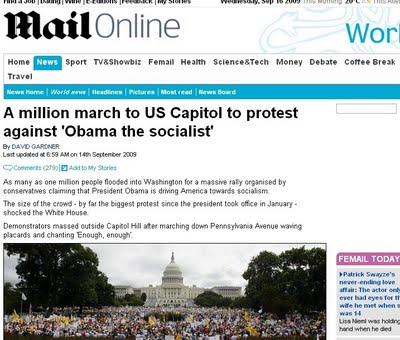
Daily Mail has joined the American lunatic fringe

It’s Wednesday and the Daily Mail is still carrying a factually inaccurate story published the previous Sunday morning.

And it’s not like they haven’t been told it’s inaccurate, comment after comment in the 279 thus far point out exactly why they are wrong.

What’s interesting is exactly how come they are wrong. Continue reading