Category Archives: online journalism

Do Daily Express search suggestions reveal editorial agenda?

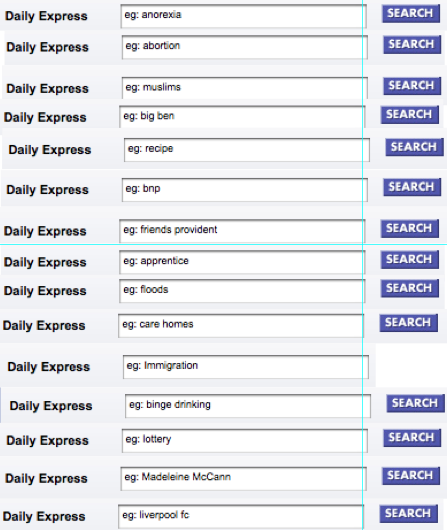
Which comes first? A newspaper’s agenda or its readers’ interest in those subjects? The search suggestions at Express.co.uk give a revealing insight into either what its readers are searching for or what the Express wants them to be interested in.

The screenshot below, first published on this blog, is a photomontage of the search box on the Express site. Every time you reload the Express search page, a different ‘example search’ is shown. The list seems to suggest a certain editorial agenda …

Daily Express search suggestions

Daily Express search suggestions

Continue reading

#CollegeJourn comes to Europe

The widely respected #CollegeJourn is coming to Europe. #CollegeJourn was established as the real-time online discussion for members of the college journalism community in the US. But it runs in the early hours of Monday mornings, which often stops people from this side of the Atlantic attending.

So Sunderland journalism student Josh Halliday, editor for www.injournalism.co.uk, is launching a chat for Europe at a more amenable hour. #CollegeJourn Europe will launch this Sunday 22nd March at 8pm GMT.

Josh said: “It’s  a great chance for those in journalism education who are either worried or excited about the state of journalism today to come along and see what others think.”

If you want to share some ideas for the discussion in advance, you can send any topic suggestions towards the #collegejourn hashtag on Twitter, to Josh directly or the deceptively named @florida_mike. To read more about plans and topics that might come up then take a read over at Josh’s blog.

The mission of #CollegeJourn is to provide a meaningful and resourceful forum of conversation for college journalists. University journalists, journalism professors, and journalism professionals, are all welcome. Josh is hoping to attract some big names in j-education to the opening debate. The chat takes place in Meebo. Put it in your diary now, and spread the word.

External links: the 8 stages of linking out denial

Do you have a link problem? You can handle linking. It’s just one post/article/page without a link. You can link whenever you want to. Or can you?

Where are you on this scale …? (Originally posted here.)

1 Don’t link to anyone

Link to other sites? But people will leave my site. They won’t click on my ads. They won’t read other pages. I’ll leak page rank. No way.

2 Add URLs but don’t make them hyperlinks

OK, that’s a bit ridiculous. If I’m talking about other organisations, I can’t pretend they don’t have a website. I know, I’ll put web addresses in. But i won’t make them hyperlinks. Brilliant, yes?

3 Add an ‘external links’ box

Even I’m finding that no hyperlink thing annoying when I go back to an old page and have to copy and paste the damn things.

I suppose I should have some links on my page. I’ll put them in a box. Over there (down a bit …). I’m going to use some sort of internal redirect or annoying javascript, though, to make sure I don’t pass any page rank. Mwah, hah hah.

4 Put some links in the copy

I don’t seem to be getting many inbound links. I guess I’m not playing fair. I know, I’ll sort out my workflow so that it’s possible to add links easily inside the actual copy. But I’m still not passing any pagerank. I’m going to put “rel=nofollow” on every link.

5 Give my users some google juice

Commenters seem thin on the ground. Maybe I’ll let them link to their own sites. I’ll use some annoying javascript to hide the links from google though. Most of my commenters are probably spammers, and I can’t trust them to police their own community, after all.

6 Link when I have to. And remove nofollow and any other annoying tricks

That seemed to make everyone happier. There are a few proper links on my pages. And people seem to want to link to me now that I’m playing fair with my links.

7 Acknowledge my sources

Oops. Spoke to soon. Been outed as pinching someone else’s idea and not attributing it. From now on, I’m going to make sure I always link to everyone I should.

8 Enlightenment: Make linking part & parcel of what I do

Internet. Inter as in inter-connected. Net as in network.

I get it now. I’m going to become a trusted source for information and advice, AND of what else people should read elsewhere on the internet. Blimey, more and more people are visiting my site and linking to it. Continue reading

Why don’t newspaper websites embed ads in cartoons?

Image by Matt Buck for http://www.computing.co.uk

Image by Matt Buck for http://www.computing.co.uk

Yesterday I had the pleasure of taking part in the Professional Cartoonists’ Organisation‘s biannual meeting. Like most content creators, cartoonists are struggling to adapt to how the web is changing their livelihoods – while also finding themselves increasingly marginalised by publishers focused on what they see as their core product: news.

As I’ve written previously, I think cartoons are massively overlooked in online news production. They have potential international appeal, are unique and – importantly – unlike text, when people redistribute it you can keep the advertising with it.

So why don’t newspapers embed advertising in cartoons?

They do with video and audio, after all – and video advertising is proving to be particularly successful for many newspapers.

Of course, there are obvious editorial and branding issues. I can’t imagine an advert for high-class perfume next to an over-corpulent caricature of Gordon Brown. But that doesn’t mean there aren’t possibilities.

As one of the cartoonists pointed out, imagine the advertising potential next to golf cartoons.

Now, imagine you positively encourage users to share that cartoon; help them embed it elsewhere, or personalise it.

Isn’t that a market advertisers would want?

Image by Matt Buck for http://www.computing.co.uk

Use a crowd, gain an expert

Karthika Muthukumaraswamy on how crowdsourcing experiments in journalism need to learn from their commercial counterparts – and how the end results could bring financial rewards for everyone.

The crowd has done a great deal for journalism: it has counted the number of SUVs on the streets of New York City, determined Bill Clinton’s financial impact on Hillary Clinton’s campaign, and offered valuable suggestions to transform an impoverished Ugandan village.

Ever since journalism jumped on the crowdsourcing bandwagon following innovative business models in T-shirt designing and problem solving, it has been baffled by the intensity of crowd response. Consequently, the media’s implementation of it has lacked the selection process that is essential to use crowdsourcing to its fullest potential.

There are only so many T-shirts that Threadless can make and sell; there are only so many solutions to Innocentive’s complex problems; and there are only so many photographs that iStockphoto consumers will purchase. Continue reading

If you’re still thinking about charging for online news in 2009, you’re dead already (a primer)

This afternoon I will once again be working with a group of editors as we look at business models for online news. To their credit, the micropayments/paywall issue rarely comes up – and then only as a ‘devil’s advocate’ question. But it seems others have been asleep for the past 10 years. To those and the unfortunate souls having to field these questions, I offer you the following primer culled from recent coverage of this pointless debate: Continue reading

Are you a journalist using Yahoo! Pipes?

How widely is Yahoo! Pipes used in newsrooms? Could it be better used? Is there a way us Piping Journos could exchange best practice, ideas, and support?

I’d like to bring journalists using Yahoo! Pipes together, so I’ve created a little Twitter group. Hope you can join, and we can find some ways to help each other out.

If you’re not using Pipes or would still like a primer, here’s one I prepared earlier.