The OJB guide to open news APIs – part 1: Guardian, NYT and Daylife

In the first of a series, Peter Clark, founder of Broadersheet, takes a look at three of the leading APIs for people looking to build news-based web projects and mashups.

About six months ago, a friend of mine released a new search engine called Duckduckgo. Duckduckgo was based on the much hyped (free) Yahoo BOSS search engine platform, it was well received and now serves hundreds of thousands of searches a day.

Yahoo recently announced BOSS was going to be a paid-for service – surprising a lot of developers. When you’ve built a popular (albeit non-profitable) service on a free platform, and that platform suddenly becomes rather expensive – that eats into your ramen budget.

So when various news agencies announced content delivery developer platforms, I was particularly interested in where they were headed.

There are various services – some free, some paid-for – that developers can use to extract content and valuable information from news agencies. My friend was developing a web application that took content from The Guardian, and automatically printed a bespoke newspaper each day about your favourite topics. He expressed displeasure about The Guardian restricting developers from doing this:

“You will not: Use Open Guardian Platform Content in any printed format”

We’re entering a new age of restrictions and jumping through hoops and loopholes to make awesome content platforms for users.

There are three top platforms for news content which I explore below. I’ll discuss what you can and can’t do technically. Continue reading

A Model for a 21st Century Newsroom – in Russian

Russian translation of the Push-Pull-Pass distribution model

Maxim Salomatin has translated the entire Model for a 21st Century Newsroom series into Russian – no small feat as the whole comes to around 10,000 words. 

You can find the translated posts below:

Part 1: The News Diamond – http://habrahabr.ru/blogs/mass_media/54706/
Part 2: Distributed Journalism – http://habrahabr.ru/blogs/mass_media/54808/
Part 3: 5 Ws and a H that should come after every story – http://habrahabr.ru/blogs/mass_media/54958/
Part 4: News distribution in a new media age – http://habrahabr.ru/blogs/mass_media/55035/
Part 5: Making money from journalism online: new media business models –http://habrahabr.ru/blogs/mass_media/56516/
Part 6: New journalists for new information – http://habrahabr.ru/blogs/mass_media/56353/

Is free news really killing newspapers?

Those newspaper executives who seem to be casting around for someone to blame for the downfall of their empires may want to look at the lessons learned by the music industry. Of particular interest is this from today’s Guardian:

“The Norwegian study looked at almost 2,000 online music users, all over the age of 15. Researchers found that those who downloaded “free” music – whether from lawful or seedy sources – were also 10 times more likely to pay for music. This would make music pirates the industry’s largest audience for digital sales.”

Then, take a look at this from the 2008 Pew study:

“Newspapers would have suffered even greater losses without their online versions. Most of the loss in readership since 2006 has come among those who read the print newspaper; just 27% say they read only the print version of a daily newspaper yesterday, down from 34% in 2006.”

So what is really killing newspapers?

News as a game: the view from Slashdot

Last week the OJB published a roundup piece on how games were being used in journalism. The discussion around the post at Slashdot concerning journalism in general is so good it’s worth highlighting in its own right. I would republish the best ones here, but that would be a disservice to the range of discussion taking place. Take a look here* 

*if you’re not familiar with Slashdot, comments get rated so you’ll only see the most ‘interesting’ ones expanded at first – another lesson for news organisations. 

Newspaper websites need to improve their readability

Most newspaper websites are doing a bad design job in making their stories readable. Too many are using:

  • small fonts,
  • long off-putting paragraphs,
  • no subheadings,
  • no in-content boxes or pictures, and
  • no in-content links.

To explain more, I’ve written a companion post on online readability (design, not writing – and this post was first published here). And here’s an example each of their news stories so you can see the issue: Daily Mail, Express, FT, Guardian, Independent, Mirror, Sun, Telegraph, Times.

Main readability design mistakes

This table summarises the main ways they are going wrong.

Tiny fonts

They are all using font sizes that are too small for comfortable reading on copy-heavy pages. Only the Guardian, Independent, Mirror and Telegraph offer obvious controls for resizing text.

But most of the sites use 12 or 13px fonts for body copy. I think this is too small to be the default – 16px is a much more readable size. Only the Guardian comes anywhere near this. Continue reading

What should we talk about at JEEcamp?

It’s 2 weeks until JEEcamp – the unconference for journalism experimenters and entrepreneurs – and I think it’s probably time to whittle down what we’ll be talking about.

Whether you’re attending or not, what do you think are the biggest issues you’d want to discuss with others in the news, social media and technology industries?

Games and journalism: Now that journalism is in trouble, why not play with it?

Karthika Muthukumaraswamy looks at how games have been used in online journalism.

BlackBerrys, iPods and Kindles are not enough anymore. Let’s add a joystick to the expanding repertoire of tools available to news consumers.

Gaming is often overlooked as a tool for disseminating news. Online games are attempting to explain the economy through the politics of oil, educate users on disaster readiness in the context of Hurricane Katrina and, perhaps more in line with traditional video games, some are exploring the various military operations implemented in the Iraq war. In a strange likeness to fantasy sports, one game allowed people to draft their own cabinet picks for Obama’s then-new administration.

Nick Diakopoulos, a researcher at the Georgia Tech Journalism and Games Project, gives one compelling reason for the media to turn to online games: they offer a format that would wean away from the current emphasis on unusual and inopportune events, focusing instead on more process-oriented journalism. How many times do you hear about a specific incident or event that killed troops or civilians in Iraq, without any knowledge whatsoever of the military operation that caused it? Continue reading

Why it’s dangerous to compare print figures to website stats

Dan Thornton, Community Marketing Manager at Bauer Media, reposting from his blog, TheWayoftheWeb.

Although hardly newspaper/print apologists, both John Duncan and Martin Langeveld have posted interesting articles trying to compare the print/online split in newspaper readership in number terms. Duncan comes in with online having 17% of page impressions on Inksniffer using the Guardian as a case study, while Langeveld posts that only 3% of newspaper reading happens online.

While I totally agree that it’s easy to overestimate the online figures in comparison to print products, and both articles are good reality checks, I have to say that I think comparing print and online readerships directly in this way is equivalent to comparing the number of people who drive cars with the number of people with vowels in their name.

And touting the eventual figures is very dangerous. Continue reading

Google’s Fusionchart

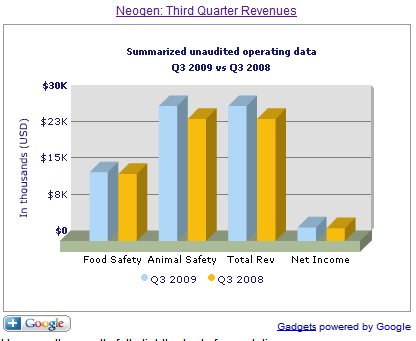
I discovered Google’s Fusionchart by accident.

One of our scientists, who left the company to form his own agrochemical patent-tracking subscription news using Blogspot, used this free javascript-based software to illustrate this rather turgid subject matter. I borrowed his idea and used Fusionchart to illustrate a life science story on Neogen, a diagnostics company.

Life science reporting, like technology reporting, employs unnecessary amount of jargons and uninspiring polysyllabic words, often in passive sentences. This is largely down to bad subbing, bad editing (alas, not many can retell the story of science as well as former Nature editor Pete Wrobel) – and bad story-telling skills.

So often, it is down to the web editors to make the content more palatable to the laymen, although we know more about technology than science. Continue reading

How news organisations can use ‘open innovation’ – interview with InnoCentive CEO Dwayne Spradlin

Dwayne Spradlin is CEO of InnoCentive, a company which has been building and managing crowdsourcing platforms since 2001. I asked him what news organisations could learn from InnoCentive’s experiences:

News organizations are at a turning point right now. The problem is that publishers have yet to find an online advertising model that can compensate for the shift from paid to free subscriptions. And when you think about what it means to compensate for this shift, online advertising needs to both fund online content and subsidize traditional print content if both vehicles are to survive.

Publishers have not found this magic formula, which is why you see so many abandoning their print publications. Today, they must innovate and reinvent their businesses for the online world.

We have had the opportunity to observe how established industries (R&D, for example) have been forced to change and adjust to a new reality. News organizations are no different from other industries in that to grow and compete in an increasingly Internet-driven world they need to operate within a fundamentally different model – an interactive model. Continue reading