If the economy of the web forces us all to cut our cloth accordingly, the list of job requirements will go further than that…

By Rick Waghorn: (My thanks to Paul for this opportunity to ‘cross-post’; this is from OutWithABang yesterday… http://outwithabang.rickwaghorn.co.uk/?p=153 – I have to say being granted access to someone else’s blog is very weird; it’s like tip-toeing through someone else’s bedroom… Anyway, we digress.)

Much has already been made of the Daily Express’ decision to slash away at its cost base by asking its reporters to place their stories on the pages themselves – in an instant wiping out the sub-editors’ craft.

Self-written, self-subbed pages – that’s the future, say the suits. Before introducing the nice man from Sweden whose new, multi-platform CMS system can make it all happen…

Clearly what’s good enough for Richard Desmond is good enough for the Epping Forest Gazette – and, indeed, reportedly the Welwyn & Hatfield Times as Archant mirrors Newsquest’s thinking in multi-skilling and multi-tasking their local news reporters for this new digital world.

What’s interesting is the job descriptions that follow in technology’s wake; there are 300 journalists across the Midlands already applying for a job with the word ‘multi’ well to the fore… many, many more will be asked to follow suit as the suits upstairs desperately seek to match revenue to editorial process. Continue reading


Don’t make them disappear

Bas Timmers on the problems with updating on the web.

Imagine this: you read an exclusive breaking news article on a website that says Gordon Brown is about to resign voluntarily. An hour later you come back to that same site, same article, but it now tells you David Miliband is about to step down after an argument with Brown. What to believe now? Continue reading

Define blogging without mentioning technology

What is blogging? Time was you could simply say: “writing a blog”, but now? I wonder whether the genre has outgrown the platform, with the likes of Seesmic, Twitter, Facebook, Flickr and Delicious providing new spaces for ‘things we used to blog’ (any more you can think of?).

As I write a book and ask myself this question I wonder: can you define blogging without mentioning technology? Personal? Open? Linked? I’d love to know your thoughts.

It’s time to relieve the stress of RSS. Newspapers, make your own readers!

(This entry was originally posted by Dave Lee on jBlog)

A few days ago on this blog, Paul Bradshaw wrote what he called one of the most important posts he’s ever made. Here it is.

In it he describes how the era of the awkward, socially backward geek is nearly behind us. They’re not geeks, he says, they’re early adopters. And you’d better listen to them if you want to stay a step ahead of the game. Continue reading

5 stages of a blogger’s life

Hope you enjoy this. Concept by Paul Bradshaw, drawings by the wonderful Alex Hughes:

1st stage of blogging: play

1st stage of blogging: play

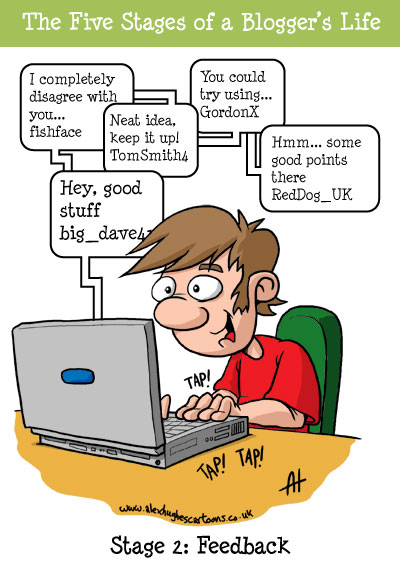
2nd stage of blogging: feedback

2nd stage of blogging: feedback

3rd stage of blogging: community

3rd stage of blogging: community

4th stage of blogging: fame

4th stage of blogging: fame

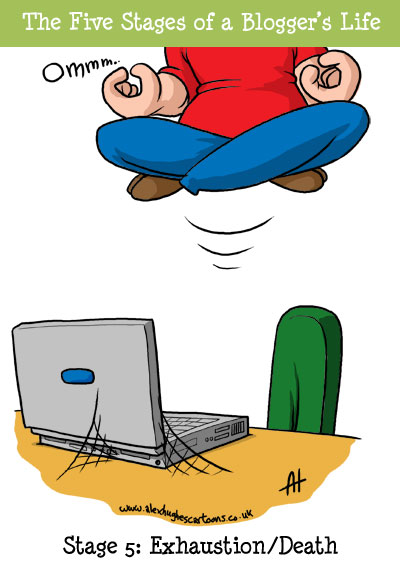
5th stage of blogging: exhaustion/death

5th stage of blogging: exhaustion/death

Here are some Twitter avatar-size versions too:

.

Post more = rank higher. We knew it already, but here’s the evidence.

The second part of Technorati’s State of the Blogosphere report is out, with more obvious headlines: the more you post, the better your blog does. Here’s the detail from TechCrunch:

“Blogging is a volume game. The more you post, the more chances there are that someone else will link to one of your posts. (Technorati rank is based on the number of recent links to your blog). The majority of the Top 100 blogs tracked by Technorati post five or more times per day, and a full 43 percent post more than 10 times per day. Meanwhile, 64 percent of the 5,000 blogs ranked lower than 600 post two to four times a day, which is still a serious commitment.”

For ‘Technorati’, you can also read ‘Google’, as it also ranks pages based on how many incoming links they have (among other things).

This really only confirms what own experience – and those of millions of others – suggests. But I would add a caveat.

While regular posting definitely increases blog traffic, a well considered, high quality post can be just as effective. Posts like the 21st Century Newsroom series generate a constant stream of visits to this blog, for instance. Another point is that frequent posting can result in good posts being buried beneath other ones when people check their RSS readers.

The best strategy, it seems, is a balance of frequency with quality.

Writer’s Residence et al: just how stupid do you think journalism students are?

Writer’s Residence is a web service which thinks journalism students are stupid.

“Student journalists worldwide can register for a free, one-year membership to an online writing portfolio Web site that they can use to show off their writing and demonstrate their web savvy to potential employers.”

After that? “Membership costs only $8.29 US Dollars per month.” Continue reading

Maps, mashups and multimedia: online journalism students tackle interactivity

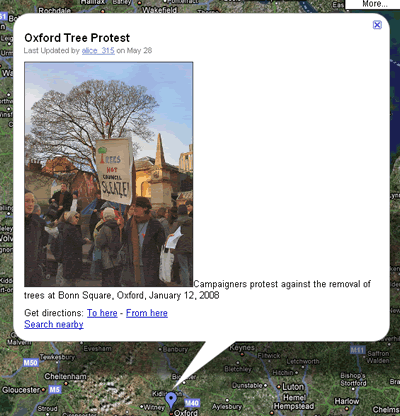
Alice Fanning's map of UK eco stories

Alice Fanning's map of UK eco stories

As a new semester begins it seems a good time to finally post about how my second year journalism degree students approached the ‘interactive’ element of their portfolio way back in May (yes, everything they do is interactive, but bear with me).

For the first time I gave them an open brief in terms of what they did interactively (in previous years I asked them to produce Flash interactives). Having been taught how to create everything from audio slideshows and image maps to multimedia interactives, Google Maps and Yahoo! Pipes mashups, I was curious to see what they would pick. Would they all plump for the same option? Continue reading